Grid-Tie Solar Inverter: How It Works, Types, Cost & Buying Guide 2026
If you are planning to install an on-grid solar system, one of the most important components you need is a grid-tie solar inverter. This device converts the electricity generated by your solar panels into usable power for your home while keeping your system connected to the utility grid.
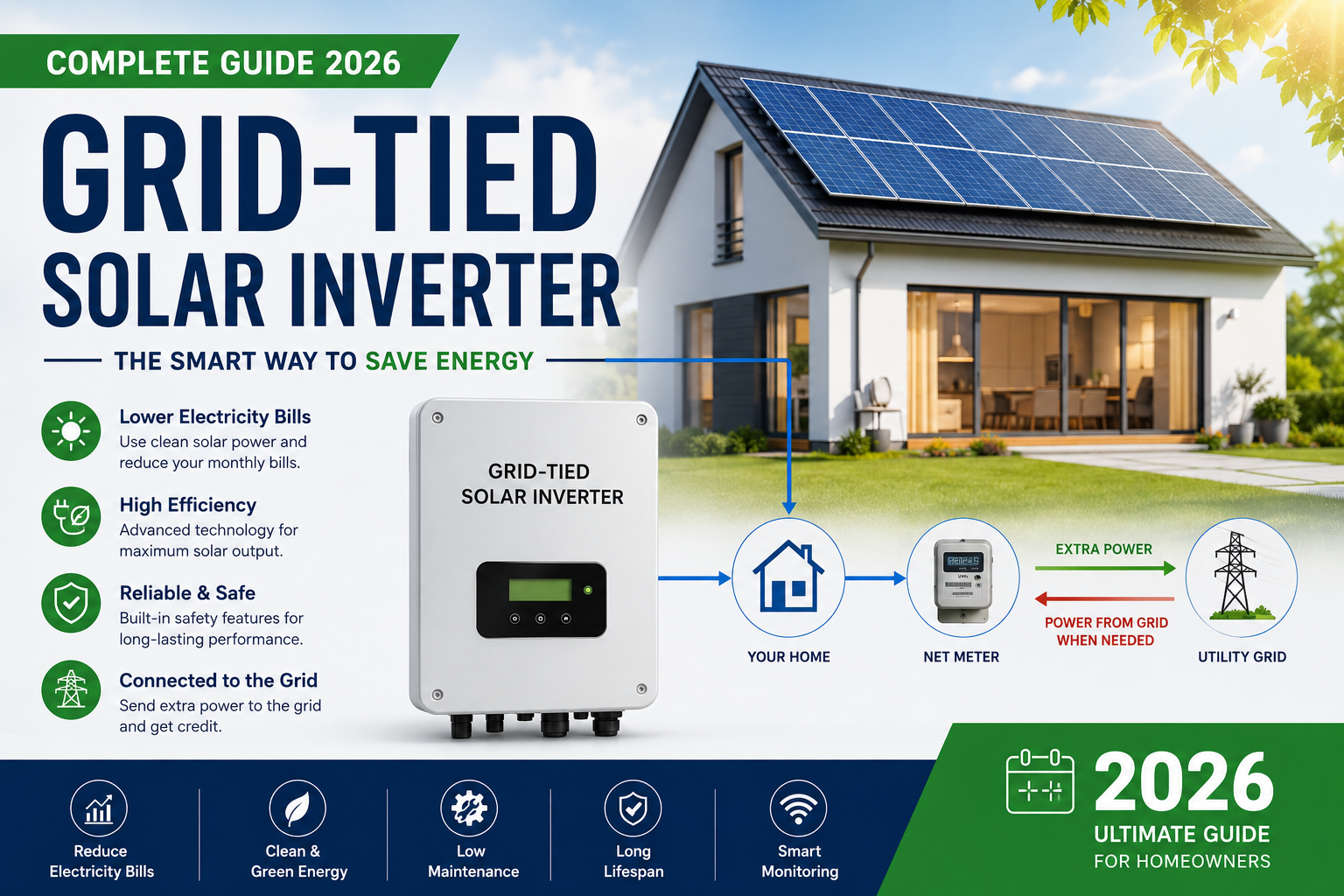
A grid-tied solar inverter connects your solar panel system to the utility grid and converts the DC electricity produced by solar panels into AC electricity for your home or business. Unlike a typical off-grid system, it usually works without batteries, but it normally shuts down when the utility grid goes down.
A grid-tie solar inverter is the most common type of solar inverter used in homes and businesses that have access to the electricity grid. It helps reduce electricity bills, improves energy efficiency, and allows extra solar power to be sent back to the grid where net metering is available.
In this guide, you will learn what a grid-tie solar inverter is, how it works, its main components, benefits, disadvantages, and whether it is the right choice for your home.
Table of Contents
- What Is a Grid-Tie Solar Inverter?
- Main Components
- Why Is a Grid-Tie Solar Inverter Important?
- How Does a Grid-Tie Solar Inverter Work?
- Does a Grid-Tie Inverter Work Without a Battery?
- A standard grid-tie inverter is not normally a backup inverter.
- What Is Anti-Islanding Protection?
- Advantages of a Grid-Tie Solar Inverter
- Disadvantages of a Grid-Tie Solar Inverter
- Where Is a Grid-Tie Solar Inverter Commonly Used?
- Grid-Tie vs Off-Grid Inverter
- Grid-Tie vs Off-Grid vs Hybrid Inverter
- Types of Grid-Tie Solar Inverters
- What Is MPPT in a Grid-Tied Solar Inverter?
- Why MPPT Matters When Buying a Grid-Tied Inverter
- What Is the Difference Between an MPPT and a String?
- How Many MPPTs Do You Need?
- Latest Grid-Tie Inverter Technology in 2026
- Grid-Following vs Grid-Forming Inverters
- How to Choose the Right Grid-Tie Solar Inverter
- Grid-Tied Inverter Sizing: DC-to-AC Ratio, Clipping, and Panel Voltage
- Grid-Tie Solar Inverter Price in Pakistan 2026
- Important Pakistan 2026 Update: Net Metering Has Changed
- What Happened to Existing Net-Metering Consumers in Pakistan?
- Pakistan Prosumer Regulations 2026: Important Points
- Is a Grid-Tie Solar Inverter Still Worth It in Pakistan in 2026?
- How to Maximize the Value of Grid-Tie Solar in 2026
- Grid-Tie Inverter Efficiency: What Really Matters?
- Grid-Tie Solar Inverter for Bifacial Solar Panels
- Grid-Tie Inverter for Hot and Dusty Climates
- Grid-Tie Inverter Warranty: What Should You Check?
- Grid-Tie Solar Inverter Installation: Important Components
- Grid-Tie Solar Inverter Maintenance
- Common Mistakes When Buying a Grid-Tie Inverter
- How Much Does a Grid-Tie Solar Inverter Cost?
- Expert Tips Before Buying
- Quick Buy Checklist for a Grid-Tied Inverter
- Quick Summary
- FAQs
- Final Thoughts
What Is a Grid-Tie Solar Inverter?
A grid-tie solar inverter, also called an on-grid solar inverter, is an electronic device that converts DC (Direct Current) electricity from solar panels into AC (Alternating Current) electricity used by household appliances.
Unlike an off-grid inverter, a grid-tie inverter does not usually require batteries. Instead, it works together with the utility grid. During sunny hours, your home uses electricity produced by the solar panels. If your system generates more electricity than your home needs, the extra power can be exported to the utility grid through net metering, where available.
When solar production is low, such as at night or on cloudy days, your home automatically receives electricity from the grid.
This makes grid-tie solar inverters an excellent choice for homeowners who want to reduce electricity bills without investing in expensive battery storage.
A grid-tie solar inverter is a key component of an on-grid solar system. If you want to understand how on-grid and off-grid systems differ, read our detailed guide on On-Grid vs Off-Grid Solar System.
Main Components of a Grid-Tie Solar Inverter System
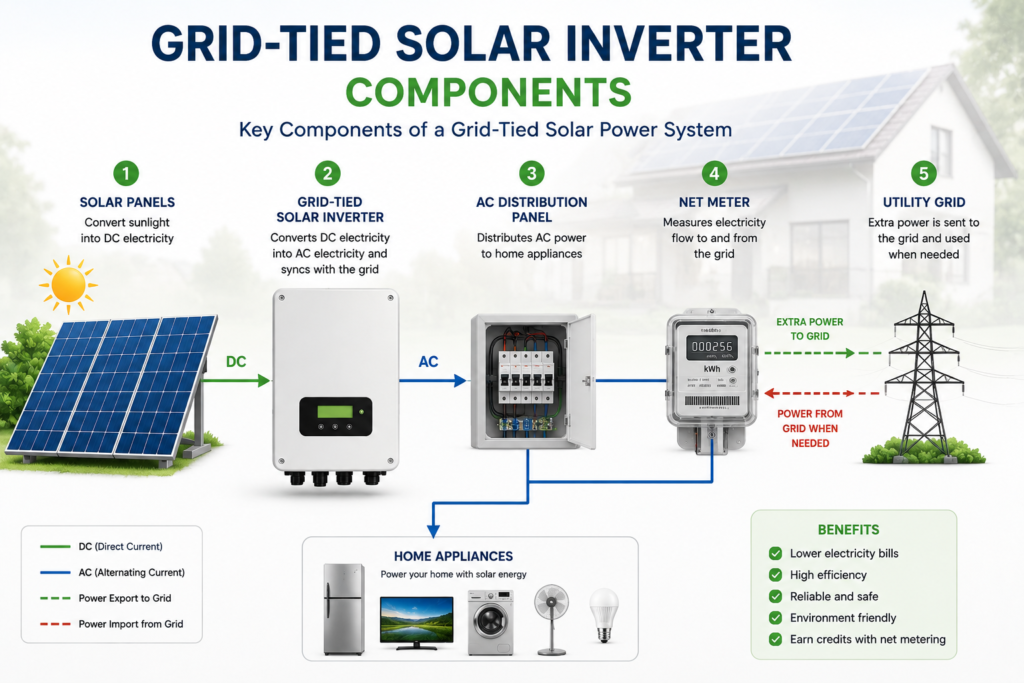
A typical grid-tie solar system includes the following components:
1. Solar Panels
Solar panels capture sunlight and produce DC electricity.
2. Grid-Tie Solar Inverter
The inverter converts DC electricity into AC electricity that your home can use safely.
3. Net Meter
The net meter records both the electricity you consume from the grid and the extra electricity your solar system sends back.
4. Utility Grid
The electricity grid provides power whenever your solar panels are not producing enough energy.
5. Home Appliances
The AC electricity produced by the inverter powers lights, fans, televisions, refrigerators, air conditioners, and other household appliances.
Why Is a Grid-Tie Solar Inverter Important?
A grid-tie inverter is the heart of an on-grid solar system. Without it, the electricity generated by solar panels cannot be used by most household appliances.
It also helps:
- Monitor system performance in many modern models.
- Convert solar energy into usable electricity.
- Synchronize your solar system with the utility grid.
- Improve system efficiency.
- Support net metering where available.
How Does a Grid-Tie Solar Inverter Work?
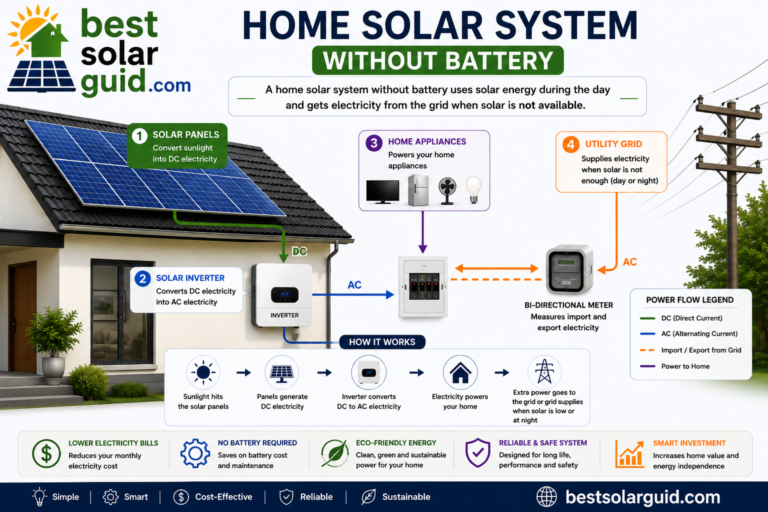
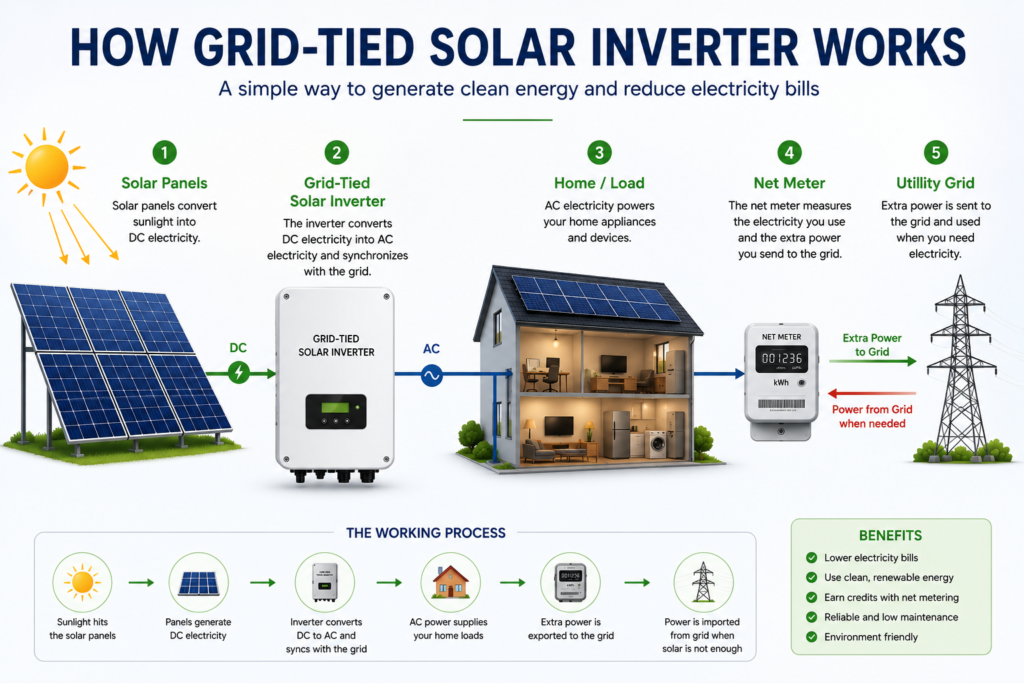
A grid-tie solar inverter works by converting the electricity generated by solar panels into safe and usable electricity for your home. It also keeps your solar system synchronized with the utility grid.
Let’s understand the process step by step.
Step 1: Solar Panels Generate DC Electricity
When sunlight falls on the solar panels, they produce Direct Current (DC) electricity.
However, most household appliances cannot use DC power directly.
Step 2: The Grid-Tie Inverter Converts DC into AC
The DC electricity from the solar panels is sent to the grid-tie solar inverter.
The inverter converts it into Alternating Current (AC) electricity, which is used by lights, fans, TVs, refrigerators, washing machines, and other home appliances.
Step 3: Your Home Uses Solar Electricity First
The converted AC electricity is supplied to your home.
During the day, your home uses solar power before taking electricity from the utility grid.
This helps reduce your monthly electricity bill.
Step 4: Extra Electricity Is Sent to the Utility Grid
If your solar panels produce more electricity than your home needs, the extra electricity flows through the net meter and is sent to the utility grid (where net metering is available).
This allows you to make better use of the electricity your system generates.
Step 5: The Utility Grid Supplies Power When Needed
At night or on cloudy days, when solar panels are not producing enough electricity, your home automatically receives electricity from the utility grid.
This process is seamless, so you usually do not notice any interruption in power.
Simple Working Flow
You can summarize the process like this:
Sunlight → Solar Panels → DC Electricity → Grid-Tie Inverter → AC Electricity → Home → Net Meter → Utility Grid (Extra Power)
This simple flow helps beginners understand the complete working process in just a few seconds.
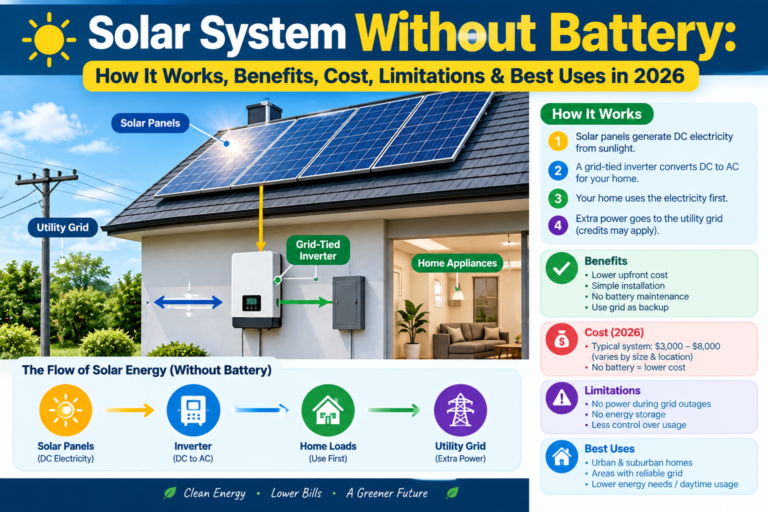
Does a Grid-Tie Inverter Work Without a Battery?
Yes.
A conventional grid-tied solar system can operate without battery storage.
This is one of the main advantages of grid-tie solar.
A typical system can work like this:
During sunny hours:
Solar → Home Loads → Excess Solar → Grid
At night:
Grid → Home Loads
During cloudy weather:
Solar + Grid → Home Loads
However, there is an important limitation.
A standard grid-tie inverter is not normally a backup inverter.
When the utility grid goes down, a conventional grid-following inverter normally disconnects from the grid.
This is because of anti-islanding protection, which is an important safety requirement for grid-connected generation.
Therefore:
Grid-tie inverter + no battery = lower system complexity and cost, but normally no solar backup during a grid outage.
If backup power is required, a properly designed hybrid inverter and battery system, or another approved backup architecture, is generally more suitable.
What Is Anti-Islanding Protection?
Anti-islanding protection is a critical safety feature of grid-connected solar inverters.
Suppose the utility grid loses power because of a fault, maintenance, equipment failure, or another event. The solar inverter should not simply continue energizing an isolated section of the utility network.
An unintended condition in which a distributed energy system continues supplying an isolated portion of the grid is known as islanding.
A properly designed grid-connected inverter detects relevant grid conditions and disconnects according to applicable interconnection requirements.
Anti-islanding protection helps protect utility workers, electrical equipment, and the stability of the electrical network.
This is one of the main reasons a conventional grid-tie inverter should not be treated as a backup power source during a blackout.
Advantages of a Grid-Tie Solar Inverter
A grid-tie solar inverter offers several benefits for homeowners and businesses.
1. Lower Electricity Bills
By using solar energy during the day, you can significantly reduce your monthly electricity costs.
2. No Battery Required
Most grid-tie systems do not need batteries, making them more affordable than off-grid systems.
3. High Efficiency
Modern grid-tie inverters are highly efficient and convert most of the solar energy into usable electricity.
4. Easy Maintenance
Since there are fewer components and usually no battery bank, maintenance is simple and less expensive.
5. Environment Friendly
Using clean solar energy helps reduce carbon emissions and supports a greener future.
Where Is a Grid-Tie Solar Inverter Commonly Used?
Grid-tie solar inverters are commonly installed in:
- Residential homes
- Office buildings
- Schools
- Hospitals
- Shopping centers
- Small businesses
- Factories with a reliable utility grid
Since most grid-tie solar systems operate without batteries, you may also like our complete guide on Solar System Without Battery to learn how these systems work.
Disadvantages of a Grid-Tie Solar Inverter
Although a grid-tie solar inverter is an excellent choice for many homes, it also has a few limitations. Understanding these disadvantages will help you make a better decision.
1. Does Not Work During a Power Outage
Most grid-tie solar inverters automatically shut down when the utility grid goes offline. This safety feature protects utility workers who may be repairing power lines.
If you need electricity during blackouts, you will need a hybrid solar system or a battery backup.
2. Depends on the Utility Grid
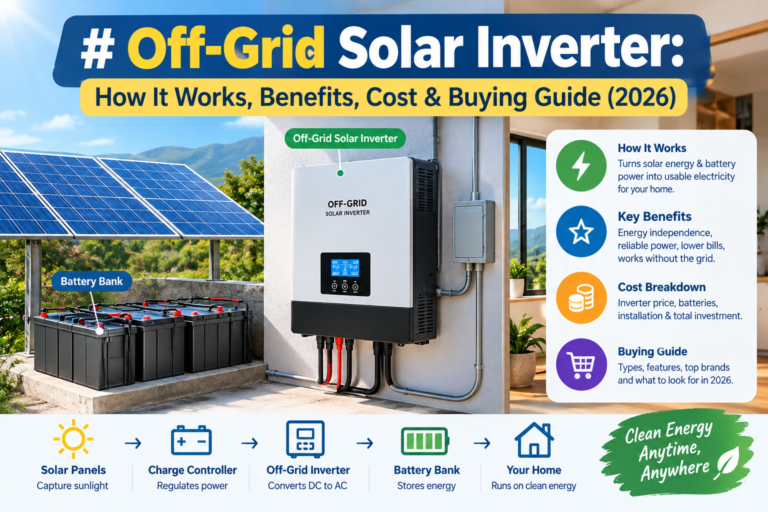
A grid-tie inverter cannot operate without a grid connection. If there is no utility grid in your area, an off-grid solar inverter is a better option.
3. No Energy Storage
Since there are usually no batteries, you cannot store extra solar energy for use at night.
Grid-Tie Solar Inverter vs Off-Grid Solar Inverter
Both types of solar inverters convert DC electricity into AC electricity, but they are designed for different purposes.
| Feature | Grid-Tie Solar Inverter | Off-Grid Solar Inverter |
| Grid Connection | Yes | No |
| Battery Required | Usually No | Yes |
| Works During Power Outage | No | Yes |
| Installation Cost | Lower | Higher |
| Maintenance | Low | Moderate |
| Best For | Homes with a reliable utility grid | Remote areas without grid access |
Grid-Tie vs Off-Grid vs Hybrid Inverter
| Feature | Grid-Tie Inverter | Off-Grid Inverter | Hybrid Inverter |
|---|---|---|---|
| Utility grid | Required for normal operation | Not required | Supported |
| Battery | Usually not required | Usually required | Supported |
| Export to grid | Possible if approved | Usually no | Possible depending on configuration |
| Normal operation during grid outage | Normally shuts down | Can continue | Can continue with suitable backup setup |
| Main purpose | Grid-connected solar | Independent solar power | Solar + battery + grid |
| System complexity | Lower | Higher | Higher |
| Best for | Reliable-grid locations | Remote/off-grid locations | Homes needing backup and flexibility |
The right inverter depends on the property’s electricity needs, grid reliability, budget, and backup requirements.
Grid-Tie Inverter vs Hybrid Inverter
A conventional grid-tie inverter mainly manages:
Solar → AC Loads/Grid
A hybrid inverter can manage:
Solar + Battery + Grid → Loads
This makes hybrid systems more suitable for homes where electricity backup is important.
However, hybrid systems are generally more complex and may have higher upfront costs because of battery storage and additional energy-management equipment.
If power outages are frequent in your area, a hybrid system may be worth considering even if a simple grid-tie system has a lower initial cost.
Types of Grid-Tie Solar Inverters
1. String Grid-Tie Inverter
A string inverter connects multiple solar panels in series to form one or more PV strings.
The strings are then connected to the inverter’s MPPT inputs.
Advantages of String Inverters
- Simple system architecture
- Generally cost-effective
- Easier maintenance
- Suitable for many residential installations
- Good option for roofs with similar orientation and shading conditions
Limitations
String inverter performance can be affected by differences between panels and roof sections.
If a roof has multiple orientations or significant shading, proper string design and multiple MPPT inputs become more important.
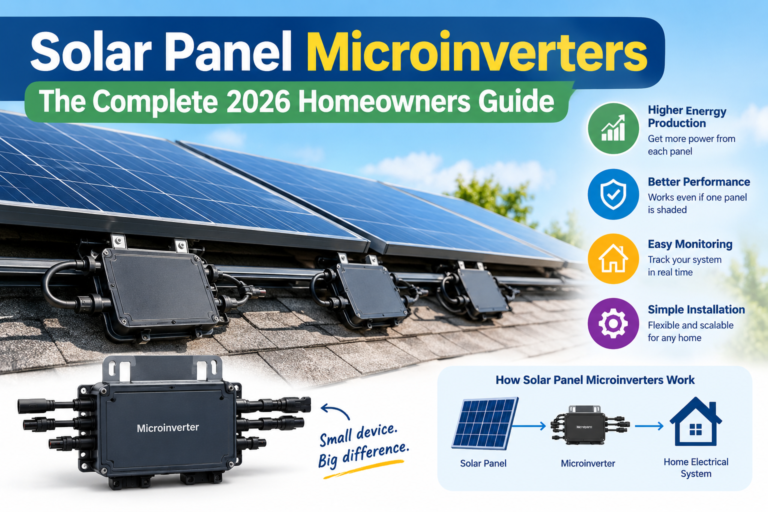
2. Microinverter System
A microinverter is installed at or near an individual solar panel.
Instead of sending DC electricity from several panels to one central inverter, each panel can have its own inverter.
Advantages
- Panel-level power conversion
- Useful for roofs with multiple orientations
- Can reduce the effect of shading on other panels
- Panel-level monitoring may be available
- Flexible system design
Disadvantages
- More electronics are installed around the solar panels
- Upfront equipment cost can be higher
- Maintenance and replacement are different from a central string-inverter system
For more information, see our guide to solar panel microinverters.
3. Single-Phase Grid-Tie Inverter
Single-phase grid-tie inverters are commonly used in smaller residential solar installations where the property has a single-phase electrical connection.
The inverter must be compatible with the property’s electrical service and the applicable utility requirements.
4. Three-Phase Grid-Tie Inverter
Three-phase grid-tie inverters are commonly used in:
- Larger homes
- Commercial buildings
- Offices
- Shops
- Agricultural facilities
- Industrial applications
They are particularly suitable where the property already has a three-phase electrical service.
5. Smart Grid-Tie Inverter
Modern grid-tie inverters are becoming increasingly intelligent.
Depending on the model and applicable grid requirements, smart inverter functions may include:
- Remote monitoring
- Voltage regulation
- Frequency response
- Volt-VAr control
- Frequency-Watt control
- Voltage ride-through
- Frequency ride-through
- Export limitation
- Load monitoring
- Communication with energy-management systems
These functions allow modern inverters to play a more active role in supporting grid stability.
What Is MPPT in a Grid-Tied Solar Inverter?
MPPT, or Maximum Power Point Tracking, is a technology used by solar inverters to get the maximum possible power from solar panels under changing sunlight conditions. Solar panels do not always produce the same amount of electricity because sunlight intensity, temperature, shading, and other conditions change throughout the day. An inverter with MPPT continuously adjusts the operating point of the solar panels to help extract as much available power as possible.
Why MPPT Matters When Buying a Grid-Tied Inverter
The number and quality of MPPT trackers can affect how well a solar system performs, especially when panels are installed on different roof orientations or experience partial shading. Multiple MPPT inputs allow different groups of solar panels to operate more independently. When choosing a grid-tied inverter, consider the number of MPPTs, the number of panels that can be connected to each tracker, and the inverter’s MPPT voltage range.
What Is the Difference Between an MPPT and a String?
A string is a group of solar panels connected together in series. MPPT is the electronic tracking system inside the inverter that helps a connected group of panels operate near its maximum power point. One MPPT can sometimes manage one or more strings, depending on the inverter design. Therefore, a string refers to how panels are electrically connected, while an MPPT refers to how the inverter manages the power produced by those panels.
How Many MPPTs Do You Need?
The number of MPPTs you need depends on the design of your solar array. A simple system with all panels facing the same direction and receiving similar sunlight may work well with fewer MPPTs. Multiple roof orientations, different panel groups, or partial shading can make additional MPPTs more useful. Always check the inverter manufacturer’s specifications and make sure the panel voltage and current remain within the permitted operating range.
Latest Grid-Tie Inverter Technology in 2026
Grid-tie inverter technology has changed significantly in recent years.
If you are buying an inverter in 2026, it is worth looking beyond the basic wattage rating.
1. Higher PV Input Current
Modern solar panels often have higher current ratings than older panels.
As a result, newer grid-tie inverters increasingly support higher string currents.
This is particularly important when installing:
- High-power solar panels
- N-type solar panels
- TOPCon panels
- Bifacial solar panels
- Large-format PV modules
When selecting an inverter, check:
- Maximum input current
- Maximum short-circuit current
- MPPT voltage range
- Maximum DC voltage
- Number of MPPTs
Do not select an inverter based only on its AC output rating.
2. Multiple MPPT Inputs
Multiple MPPT channels allow the inverter to manage different PV strings more independently.
This can be particularly useful when a roof has:
- East-facing panels
- West-facing panels
- South-facing panels
- Different roof slopes
- Different string lengths
- Partial shading
For a simple roof with uniform conditions, fewer MPPTs may be sufficient.
For a complex roof, multiple MPPT inputs can provide greater design flexibility.
3. AFCI Protection
AFCI stands for Arc-Fault Circuit Interrupter.
AFCI technology is designed to detect certain dangerous electrical arcing conditions and respond according to the inverter’s protection design.
It has become an important safety feature in many modern solar inverter systems.
When comparing models, check whether AFCI is included and whether it meets the requirements applicable to your location and installation.
4. Export Power Control
Export control is becoming increasingly important in modern grid-connected solar systems.
Some grid-tie inverters can limit the amount of electricity exported to the grid.
This can be useful where:
- The utility has an export limit
- Zero-export operation is required
- The property owner wants to maximize self-consumption
- The interconnection agreement restricts export
Export control may require additional metering or communication equipment depending on the inverter and system design.
5. Smart Monitoring
Modern inverters can provide detailed information about the solar system.
Depending on the model, monitoring may include:
- Solar generation
- Grid import
- Grid export
- Household consumption
- Daily energy production
- Monthly energy production
- Historical performance
- System faults
- Inverter status
Remote monitoring is particularly useful because it allows homeowners and installers to identify abnormal system behavior more quickly.
6. Better Environmental Protection
Solar inverters installed outdoors can be exposed to:
- High temperatures
- Dust
- Humidity
- Rain
- UV exposure
- Electrical surges
- Harsh weather
For hot and dusty climates, check the inverter’s operating-temperature range and enclosure protection rating.
However, a high IP rating does not mean the inverter can be installed anywhere.
Proper ventilation, clearance, shade where appropriate, and installation according to the manufacturer’s instructions are still important.
Grid-Following vs Grid-Forming Inverters
This is an increasingly important topic in modern solar and battery systems.
Grid-Following Inverter
A conventional grid-tie inverter is generally grid-following.
It relies on an existing grid voltage and frequency reference and synchronizes its output with that grid.
This is the architecture used by most conventional residential grid-tied solar systems.
Grid-Forming Inverter
A grid-forming inverter is designed to establish and regulate voltage and frequency under suitable operating conditions.
Grid-forming technology is becoming increasingly important for:
- Battery energy storage
- Microgrids
- Weak-grid environments
- Grid resilience
- High-renewable electricity systems
Grid-forming capability should not be assumed simply because an inverter is marketed as a “smart inverter.” Always check the actual specifications and supported operating modes.
How to Choose the Right Grid-Tie Solar Inverter
Choosing a grid-tie inverter only by price or wattage is a mistake.
Consider the following factors.
1. Solar Array Size
First calculate the total PV capacity.
For example:
10 × 550W panels = 5,500W = 5.5 kW
However, this does not automatically mean you need an exactly 5.5 kW inverter.
The inverter’s permitted DC input power and DC/AC ratio should be checked.
2. Maximum DC Voltage
Maximum DC voltage is one of the most important inverter specifications.
The open-circuit voltage of a PV string can increase under certain conditions, especially at low temperatures.
The designed string voltage must remain within the inverter’s maximum DC voltage limit under expected operating conditions.
3. MPPT Voltage Range
Check the inverter’s:
- Startup voltage
- MPPT operating voltage range
- Maximum DC voltage
- Full-load MPPT range
The solar string configuration must be compatible with these limits.
4. Maximum Input Current
This is particularly important with modern high-power solar panels.
Compare the panel’s:
- Maximum power current (Imp)
- Short-circuit current (Isc)
with the inverter’s:
- Maximum input current
- Maximum short-circuit current
Never assume that an inverter is compatible with a panel simply because both have similar wattage ratings.
5. Number of MPPTs
Multiple MPPTs can be useful for roofs with different orientations or shading conditions.
For example, if half of the panels face east and half face west, separate MPPT inputs may provide a better design than placing all panels on one MPPT.
6. Efficiency
Look at both maximum efficiency and the inverter’s performance across different operating loads.
Also consider:
- MPPT efficiency
- Thermal performance
- Cooling system
- Monitoring
- Warranty
- Service support
A slightly higher maximum efficiency does not automatically make an inverter the best choice.
7. Warranty and After-Sales Support
A good inverter should have:
- A clear warranty
- Reliable local support
- Genuine replacement parts
- Accessible technical service
- A practical warranty-claim process
A reliable local service network can be just as important as the inverter’s specifications.
The best inverter is the one that matches the complete solar system and your long-term needs. A slightly more expensive inverter may offer better value if it provides stronger warranty coverage, reliable monitoring, better compatibility, and accessible technical support.
Grid-Tied Inverter Sizing: DC-to-AC Ratio, Clipping, and Panel Voltage
Correct sizing is important because the inverter must work safely and efficiently with the solar array. The inverter should be matched to the total panel capacity, expected electricity production, operating voltage, and local environmental conditions.
Grid-Tie Inverter Sizing Example
Suppose a homeowner installs:
12 × 585W solar panels
Total PV capacity:
12 × 585W = 7,020W
The solar array is therefore approximately 7.02 kW DC.
A suitable inverter might be in the 6–7 kW range depending on the manufacturer’s specifications and system design.
However, the final inverter selection should consider:
- Maximum permitted DC input power
- DC/AC ratio
- Maximum DC voltage
- MPPT voltage range
- Maximum input current
- Short-circuit current limit
- Local grid requirements
- Expected operating conditions
A somewhat smaller AC inverter can sometimes be paired with a larger DC solar array if the manufacturer permits the required DC oversizing.
The correct ratio should always come from the inverter manufacturer’s specifications rather than a generic online rule.
What Is the DC-to-AC Ratio?
The DC-to-AC ratio compares the total rated power of the solar panels with the AC power rating of the inverter. For example, a 6 kW solar array connected to a 5 kW inverter has a DC-to-AC ratio of 1.2. A carefully designed ratio can help the inverter operate closer to its useful capacity for more hours of the day, but the exact ratio should follow the manufacturer’s specifications and system design requirements.
What Is Inverter Clipping?
Inverter clipping happens when the solar panels can produce more DC power than the inverter can convert into AC power at a particular moment. For example, if a solar array produces more power than the inverter’s maximum AC output, the inverter limits its output to stay within its rated capacity. Some clipping can occur in properly designed systems, particularly around periods of strong sunlight, but excessive clipping can reduce the amount of solar energy that is converted into usable AC electricity.
Why Solar Panel Voltage Matters
Solar panel voltage must stay within the inverter’s permitted operating range. When panels are connected in series, their voltage adds together, so the total string voltage must be checked carefully. The inverter should be able to operate within the panel string’s expected voltage range under both normal and extreme conditions. Incorrect voltage calculations can reduce performance or create safety and equipment risks.
Why Cold Weather Matters When Calculating Maximum Voltage
Solar panel voltage generally increases as temperatures fall. This means a string that appears to be within the inverter’s voltage limit during normal conditions could produce a higher voltage on a very cold day. When designing a solar system, installers should calculate the expected maximum string voltage at the lowest relevant temperature and compare it with the inverter’s maximum DC input voltage.
Why Hot Weather Matters Too
High temperatures can reduce solar panel voltage and affect overall system performance. Inverters installed in hot environments can also experience thermal stress if ventilation is poor or the equipment is exposed to excessive heat. For this reason, system designers should consider both panel temperature and inverter operating temperature when selecting and installing a grid-tied inverter.
Grid-Tie Solar Inverter Price in Pakistan 2026
Grid-tie inverter prices in Pakistan vary significantly depending on:
- Brand
- Capacity
- Model
- Warranty
- Import costs
- Exchange rates
- Taxes
- Availability
- Distributor margins
- Market conditions
For this reason, there is no single fixed price for a 5 kW or 10 kW grid-tie inverter.
As a general market indication, residential grid-tie inverter prices can range from approximately:
| Inverter Capacity | Approximate Pakistan Market Range in 2026 |
| 3 kW | PKR 70,000–140,000 |
| 5 kW | PKR 140,000–230,000 |
| 6–8 kW | PKR 150,000–300,000+ |
| 10 kW | PKR 135,000–300,000+ |
| 15 kW | PKR 200,000–400,000+ |
| 20 kW and above | PKR 300,000–600,000+ |
These figures are approximate market ranges, not official manufacturer prices.
Actual prices can change quickly due to exchange rates, taxes, model availability, importer margins, warranty terms, and market conditions.
Also remember that the inverter price is only one part of the total solar-system cost.
A complete installation may also require:
- Solar panels
- Mounting structure
- DC cables
- AC cables
- DC protection
- AC protection
- Surge protection
- Earthing
- Metering equipment
- Installation
- Utility/interconnection costs
- Monitoring equipment
Important Pakistan 2026 Update: Net Metering Has Changed
Pakistan’s grid-connected solar market changed significantly in 2026.
On February 9, 2026, the National Electric Power Regulatory Authority (NEPRA) notified the National Electric Power Regulatory Authority (Prosumer) Regulations, 2026 through S.R.O. 251(I)/2026. These regulations replaced the previous regulatory framework and introduced a new prosumer framework for distributed generation.
For new prosumers, the 2026 framework uses a net-billing arrangement rather than the previous conventional net-metering mechanism.
Under the new framework, electricity consumed from the grid and electricity supplied to the distribution licensee are treated differently for billing purposes.
The regulations specify that electricity supplied by the prosumer to the licensee is credited at the applicable National Average Energy Purchase Price (NAEPP), while electricity supplied by the licensee to the prosumer is billed according to the applicable tariff.
Why Does This Matter for Grid-Tie Solar?
The change makes self-consumption more important when designing a new grid-tied solar system.
In simple terms:
Using your solar electricity directly in your home or business can be more valuable than generating a large surplus purely for export.
Therefore, homeowners should not automatically install an oversized solar system simply because they expect exported electricity to offset imported electricity at the same retail value.
The exact applicable rates and regulatory conditions can change, so readers should verify the latest NEPRA notification and their distribution company’s requirements before installing or modifying a grid-connected system.
Official reference:
NEPRA Prosumer Regulations 2026
What Happened to Existing Net-Metering Consumers in Pakistan?
The treatment of existing agreements is different from that of new prosumers.
NEPRA’s 2026 regulatory updates addressed agreements and approvals issued under the previous regulations.
The relevant amendment states that valid agreements executed under the repealed regulations before the commencement of the 2026 regulations are not automatically cancelled and can continue under the applicable previous rate and billing mechanism until the expiry of the existing agreement, subject to the conditions of the regulations.
This distinction is important because information about Pakistan’s previous net-metering system can still be relevant to existing consumers, while new applicants need to consider the 2026 prosumer framework.
Anyone planning a major system modification or capacity increase should verify the current requirements with the relevant distribution company before making changes.
Official NEPRA reference:
NEPRA Official Regulatory Updates
Pakistan Prosumer Regulations 2026: Important Points
Pakistan’s solar regulations changed significantly in 2026. NEPRA notified the National Electric Power Regulatory Authority (Prosumer) Regulations, 2026 on February 9, 2026, introducing a new regulatory framework for prosumers and distributed-generation systems connected to the electricity grid.
Under the 2026 framework, the treatment of electricity supplied to the grid and electricity consumed from the grid is governed by the applicable prosumer regulations and tariff provisions. Therefore, homeowners considering a new grid-tied solar system should not assume that the previous net-metering arrangement still applies in the same way.
An important amendment was notified by NEPRA on August 6, 2026, through S.R.O. 1330(I)/2026. The amendment provides that a distributed-generation facility with a capacity of 25 kW or below does not require NEPRA concurrence. Approval is handled by the concerned distribution licensee, subject to the applicable requirements.
For larger systems, the applicable concurrence, interconnection, technical, and safety requirements should be confirmed with NEPRA and the relevant distribution company before installation.
Because solar regulations, tariffs, and grid-connection requirements can change, always check the latest NEPRA notification and your distribution company’s requirements before purchasing or installing a grid-tied solar inverter in Pakistan.
Is a Grid-Tie Solar Inverter Still Worth It in Pakistan in 2026?
Yes, but the system should be designed carefully.
Grid-tied solar remains attractive for many Pakistani homes and businesses, particularly where daytime electricity consumption is significant.
However, the economics of a new system should now be evaluated under the 2026 prosumer and net-billing framework.
A good system should focus on:
- Correct solar-system sizing
- High daytime electricity consumption
- Direct solar self-consumption
- Efficient appliances
- Load shifting
- Appropriate export control
- High-quality inverter selection
- Reliable monitoring
- Proper grid connection
- Future battery compatibility where needed
Instead of designing the system only around maximum possible solar generation, consider how much electricity the property actually consumes during solar-production hours.
How to Maximize the Value of Grid-Tie Solar in 2026
Use More Solar Electricity During the Day
If practical, operate energy-intensive appliances during daylight hours when the solar system is generating electricity.
Examples include:
- Washing machines
- Water pumps
- Air conditioners
- Refrigerators
- Electric vehicle chargers
- Other high-consumption appliances
Using solar electricity directly can increase self-consumption.
Avoid Unnecessary Oversizing
A larger solar system is not automatically a better investment.
The appropriate system size should consider:
- Annual electricity consumption
- Daytime electricity consumption
- Sanctioned load
- Roof space
- Utility requirements
- Export economics
- Future battery plans
Grid-Tie Inverter Efficiency: What Really Matters?
Inverter efficiency indicates how effectively the inverter converts DC electricity from the solar panels into AC electricity.
However, maximum efficiency is not the only specification that matters.
When comparing grid-tie inverters, also consider:
- MPPT efficiency
- Efficiency at partial loads
- Operating-temperature performance
- Cooling system
- Maximum input current
- MPPT voltage range
- Warranty
- Monitoring
- Local technical support
A small difference in maximum efficiency should not automatically determine your purchase decision.
Grid-Tie Inverter Efficiency vs Overall Solar System Efficiency
Inverter efficiency is only one part of overall solar system performance. A high-efficiency inverter can reduce conversion losses, but the total energy produced by a solar system also depends on panel efficiency, shading, temperature, dust, wiring losses, orientation, system design, and other factors.
For this reason, choosing an inverter with the highest efficiency number alone is not always the best strategy. Look at the inverter’s operating efficiency across realistic conditions, its MPPT performance, temperature range, monitoring features, reliability, and compatibility with the solar array. A well-designed system can often deliver better real-world results than a system selected based on a single efficiency rating.
Grid-Tie Solar Inverter for Bifacial Solar Panels
Bifacial solar panels can generate electricity from both their front and rear surfaces.
Because modern bifacial panels can have high current ratings, inverter compatibility should be checked carefully.
Pay particular attention to:
- Maximum input current
- Maximum short-circuit current
- Maximum DC voltage
- MPPT voltage range
- Number of MPPT inputs
A modern high-current-compatible inverter can be a better match for newer bifacial and high-power solar modules.
For more information, see our complete guide to bifacial solar panels.
Grid-Tie Solar Inverter Installation: Important Components
A grid-connected solar installation may include:
- Solar PV modules
- Grid-tie inverter
- DC isolator
- DC overcurrent protection where required
- DC surge protection
- AC protection
- AC surge protection
- Earthing/grounding
- Solar cables
- AC cables
- Mounting structure
- Metering equipment
- Monitoring equipment
- Utility-approved interconnection equipment
The exact equipment required depends on the inverter, system size, electrical service, local electrical code, utility requirements, and system design.
Installation should be performed by qualified professionals familiar with grid-connected solar systems.
Grid-Tie Inverter for Hot and Dusty Climates
Climate should be considered when selecting and installing a solar inverter.
This is especially important in regions such as Pakistan, the Middle East, parts of Africa, Australia, and other hot or dusty areas.
Look for:
- Appropriate operating-temperature range
- Suitable enclosure protection
- Good thermal design
- Adequate ventilation
- Proper installation clearance
- Protection from unnecessary direct heat exposure
- Easy access for maintenance
High ambient temperatures can affect inverter performance, so proper installation is just as important as the inverter’s specifications.
Grid-Tie Inverter Warranty: What Should You Check?
Do not look only at the number of warranty years.
Check:
- Standard warranty period
- Extended warranty availability
- Who provides the warranty
- Local service availability
- Replacement policy
- Parts availability
- Warranty conditions
- Registration requirements
A reliable local service network can be extremely valuable if the inverter develops a fault.
Grid-Tie Solar Inverter Maintenance
Grid-tie inverters generally require less maintenance than battery systems, but they should still be monitored regularly.
Check:
- Error messages
- System generation
- Inverter temperature
- Cooling or fan operation where applicable
- Cables and connectors
- Dust accumulation
- Surge protection
- Earthing
- Monitoring connection
If solar generation suddenly decreases without an obvious weather-related reason, investigate the system rather than assuming the solar panels are responsible.
Common Grid-Tie Inverter Problems and Troubleshooting
Even a properly installed grid-tied solar system can occasionally show warnings or reduced output because of grid conditions, temperature, wiring, or equipment limitations. Understanding common problems can help homeowners identify when professional inspection is needed.
Why Does My Grid-Tie Inverter Keep Disconnecting?
A grid-tied inverter may disconnect when it detects voltage or frequency conditions outside its permitted operating range. High or unstable grid voltage, grid interruptions, wiring problems, or protection settings can cause repeated disconnections. If the inverter frequently disconnects, do not repeatedly reset it without finding the cause. Check the inverter’s error message and contact a qualified solar technician if the problem continues.
What Happens When the Grid Voltage Is Too High?
When grid voltage rises above the inverter’s permitted range, the inverter may temporarily stop exporting electricity to protect itself and the electrical system. This can reduce solar production even when the panels are receiving strong sunlight. High grid voltage can sometimes be related to local grid conditions or voltage rise in the property’s electrical wiring. A qualified electrician or solar installer should investigate persistent high-voltage warnings.
Why Is My Solar System Producing Less Than the Inverter’s Rated Power?
An inverter’s rated power is not a guarantee that the system will produce that amount of electricity at all times. Solar production changes with sunlight intensity, panel temperature, shading, dust, panel orientation, and system losses. The inverter may also limit output when the solar array produces more DC power than its rated AC capacity. Compare actual production with expected conditions rather than judging performance from the inverter’s maximum rating alone.
Grid-Tie Inverters for Home vs Commercial Systems
Grid-tied inverters are used in both residential and commercial solar systems, but the ideal equipment and system design can be very different. Residential systems often use smaller inverters designed around household electricity consumption and available roof space. Commercial systems may require larger inverter capacities, multiple inverter units, more complex monitoring, and different electrical configurations.
For a home solar system, homeowners should focus on inverter capacity, panel compatibility, battery plans, monitoring, warranty, and local technical support. Commercial installations may require additional attention to system scalability, three-phase electrical requirements, energy management, grid standards, and long-term maintenance. The correct choice should always be based on the complete solar system design rather than inverter capacity alone.
Grid-Tied Inverter Safety and Surge Protection
Grid-tied inverters are designed with built-in safety features to protect the solar system, electrical equipment, and people working around the installation. One of the most important safety features is anti-islanding protection, which prevents the inverter from continuing to send electricity to the grid when utility power is unavailable. Proper grounding, circuit protection, correct installation, and surge protection can also help reduce electrical risks and protect the inverter from voltage surges. Always follow local electrical requirements and the manufacturer’s installation guidelines when installing or maintaining a grid-tied solar inverter.
Are Grid-Tied Inverters Safe?
Grid-tied inverters are generally safe when they are correctly selected, installed, grounded, and maintained. They include protection features that monitor grid voltage, frequency, and other operating conditions. If the grid becomes unstable or power goes out, the inverter can automatically stop exporting electricity. A qualified solar installer should handle electrical connections and ensure that the system meets applicable safety and grid requirements.
Do Grid-Tied Inverters Need Surge Protection?
Surge protection can help protect a grid-tied inverter and other solar equipment from sudden voltage spikes caused by lightning, electrical switching, or disturbances on the grid. The exact type and placement of surge protection depend on the system design, local electrical requirements, and installation environment. A qualified installer should determine the appropriate surge protection devices for the solar installation.
Common Mistakes When Buying a Grid-Tie Inverter
1. Choosing Only by Price
The cheapest inverter is not necessarily the best value.
2. Ignoring Input Current
This can create compatibility problems with modern high-current solar panels.
3. Ignoring MPPT Voltage
Incorrect string design can place the solar array outside the inverter’s operating range.
4. Buying a Non-Approved Inverter
An inverter that does not meet applicable local interconnection requirements can cause serious installation and regulatory problems.
5. Assuming Grid-Tie Means Backup
A conventional grid-tie inverter normally shuts down during a utility outage.
6. Oversizing Only for Export
This is particularly important under Pakistan’s 2026 net-billing framework.
7. Ignoring After-Sales Service
Technical support and warranty availability are important for a long-term solar investment.
8. Installing the Inverter in Excessive Heat
Poor ventilation and excessive heat exposure can negatively affect inverter performance.
How Much Does a Grid-Tie Solar Inverter Cost?
The price of a grid-tie solar inverter depends on several factors, including:
- System size
- Inverter brand
- Power capacity
- Features such as Wi-Fi monitoring
- Installation cost
- Country or region
In general, grid-tie solar inverters are more affordable than off-grid inverters because they do not require battery storage.
When buying an inverter, focus on quality, efficiency, warranty, and after-sales support instead of choosing the lowest price.
Choosing the right inverter can improve your system’s performance and help it last for many years.
Expert Tips Before Buying
Before purchasing a grid-tie solar inverter, keep these tips in mind:
- Buy from an authorized dealer whenever possible.
- Choose a trusted and well-reviewed brand.
- Match the inverter size with your solar panel capacity.
- Look for a high conversion efficiency.
- Check the warranty and customer support.
Quick Buy Checklist for a Grid-Tied Inverter
Before buying a grid-tied solar inverter, check the following:
- Compare the total long-term value rather than choosing only by the lowest price.
- Match the inverter capacity with the solar panel array.
- Check the inverter’s maximum DC input voltage and current.
- Check the MPPT voltage range and number of MPPT trackers.
- Consider the DC-to-AC ratio and possible clipping.
- Check the inverter’s efficiency under realistic operating conditions.
- Confirm compatibility with your solar panels.
- Check whether the inverter supports your required grid standards.
- Consider monitoring and smart energy-management features.
- Check warranty length and warranty conditions.
- Confirm the availability of local service and spare parts.
- Consider the installation environment, especially heat and dust.
- Check whether future battery integration is supported if you may need storage later.
Is a Grid-Tie Solar Inverter Better Than an Off-Grid Inverter?
Neither is universally better.
Choose a Grid-Tie Inverter When:
- You have a reliable utility connection
- You want to reduce electricity bills
- You have significant daytime electricity consumption
- You want a simpler solar system
- Battery backup is not your main priority
Choose an Off-Grid Inverter When:
- There is no reliable utility grid
- Energy independence is the main goal
- You are prepared to invest in battery storage
- The system must operate independently
Choose a Hybrid Inverter When:
You want flexibility between solar, battery, and grid power
Power outages are common
Backup power is important
You want solar plus battery storage
Quick Summary
If you don’t have time to read the full article, here’s a quick overview:
- ✔️ It does not provide backup power during a grid outage unless combined with batteries.
- ✔️ A grid-tie solar inverter converts DC power into AC power.
- ✔️ It connects your solar system to the utility grid.
- ✔️ It usually works without batteries.
- ✔️ It helps reduce electricity bills.
- ✔️ It is ideal for homes and businesses with a reliable grid connection.
Planning a battery-free solar setup for your house? Read our detailed Home Solar System Without Battery guide to understand whether it is the right choice for your home.
Final Thoughts
A grid-tie solar inverter is the heart of a conventional grid-connected solar system. It converts DC electricity from solar panels into usable AC power, synchronizes with the utility grid, supplies local loads, and can export surplus electricity where permitted.
Its biggest advantage is simplicity. A conventional grid-tie system can operate without batteries, which can reduce upfront cost and system complexity.
Its biggest limitation is equally important: a standard grid-tie inverter normally shuts down when the utility grid fails, so it should not be considered a backup power solution.
In 2026, inverter selection has become more technical. High-current PV inputs, multiple MPPTs, AFCI protection, export control, smart monitoring, advanced grid-support functions, environmental protection, and compatibility with modern high-power and bifacial solar panels are all worth considering.
For Pakistan, the financial side of grid-connected solar has also changed. NEPRA notified the Prosumer Regulations 2026 on February 9, 2026, introducing a new framework for prosumers and net billing. Existing agreements under the previous framework have specific transitional protections under subsequent regulatory amendments.
Therefore, the best approach in 2026 is not simply to buy the biggest inverter or the cheapest solar system. Choose the inverter according to your solar panels, electricity consumption, sanctioned load, electrical connection, local regulations, future battery plans, warranty, and quality of after-sales support.
For the latest Pakistan regulatory information, always check the official NEPRA documents before making a financial or installation decision.
Official NEPRA Reference:
National Electric Power Regulatory Authority (Prosumer) Regulations, 2026
1. What is a grid-tie solar inverter?
A grid-tie solar inverter is a device that converts DC electricity from solar panels into AC electricity for your home. It also keeps your solar system connected to the utility grid.
2. Does a grid-tie solar inverter work without batteries?
Yes. Most grid-tie solar inverters work without batteries. They use solar power during the day and automatically switch to grid electricity when solar power is not enough.
3. Can a grid-tie solar inverter work during a power outage?
No. For safety reasons, most grid-tie solar inverters automatically shut down during a power outage. If you need backup power, consider a hybrid solar inverter with battery storage.
4. Is a grid-tie solar inverter suitable for homes?
Yes. It is one of the best choices for homes that have a reliable electricity supply. It helps reduce electricity bills and requires less maintenance than battery-based systems.
5. What is the difference between a grid-tie and an off-grid inverter?
A grid-tie inverter works with the utility grid and usually does not require batteries. An off-grid inverter works independently and requires batteries to store electricity for later use.
6. Can a Grid-Tie Inverter Run an Air Conditioner?
Yes, provided the solar system and inverter are properly sized and the utility grid remains available.
During sunny hours, solar electricity can reduce the amount of electricity an air conditioner needs from the grid.
However, the inverter’s AC output, the home’s electrical service, the air conditioner’s electrical requirements, and the overall system design all matter.
A grid-tie inverter does not mean that solar panels can automatically power unlimited appliances.
7. Can a Grid-Tie Inverter Work With a Generator?
A standard grid-tied inverter is designed to operate with a stable utility grid and normally cannot simply be connected to a backup generator. The inverter must detect the correct voltage and frequency conditions before it can operate safely. Some advanced systems can integrate solar, batteries, and generators through compatible equipment and proper controls, but this requires a system specifically designed for that purpose. Never connect a generator directly to a grid-tied inverter unless the manufacturer and a qualified installer confirm that the equipment is compatible.
8. Are plug-in grid-tie inverters legal?
The legality of plug-in grid-tie inverters depends on your country’s electrical regulations, utility requirements, and applicable safety standards. In many locations, grid-connected solar equipment must be approved and installed according to specific interconnection rules. Before using a plug-in grid-tie inverter, check with your local utility and electrical authority to make sure the equipment and installation method are permitted.