Bifacial Solar Panels: Complete Guide to How They Work, Benefits, Efficiency, Cost & Best Brands in 2026
Solar panels have changed dramatically over the last few years. Traditional solar panels were designed to capture sunlight mainly from the front side, but a newer generation of modules can collect sunlight from both the front and rear sides.
These are called bifacial solar panels.
Bifacial technology has become one of the most important developments in modern photovoltaic systems. Instead of allowing sunlight reflected from the ground to go to waste, bifacial panels can capture a portion of that reflected light through their rear side and convert it into additional electricity.
This sounds simple, but there is an important detail:
A bifacial solar panel does not automatically produce 20% or 30% more electricity just because it has two active sides.
The additional energy depends heavily on how the panel is installed, how much light reaches the rear side, the ground surface, panel height, row spacing, weather, shading, and the module’s bifacial characteristics.
That is why understanding the technology is much more important than simply looking at the word “bifacial” on a solar panel.
In this guide, we will explain how bifacial solar panels work, how much extra energy they can produce, their advantages and disadvantages, the latest N-type and TOPCon technology, installation requirements, performance in hot climates such as Pakistan, major global brands, and what you should check before buying one in 2026.
Table of content
- What Is a Bifacial Solar Panel?
- How Do Bifacial Solar Panels Work?
- How Much More Electricity Can Bifacial Solar Panels Produce?
- What Is Albedo and Why Does It Matter?
- Why Panel Height Matters
- Bifacial Solar Panels vs Monofacial Solar Panels
- What Is a Dual-Glass Bifacial Solar Panel?
- Bifacial Solar Panels and N-Type TOPCon Technology
- TOPCon vs Older PERC Technology
- Latest Bifacial Solar Panel Features in 2026
- Bifacial Solar Panels and Climate: Which Countries Are Best
- Bifacial Solar Panels in Snowy Regions: Advantage or Disadvantage?
- Climate Comparison: Where Are Bifacial Panels Most Suitable?
- Where Are Bifacial Solar Panels NOT the Best Choice?
- Best Climate Conditions for Bifacial Solar Panels
- Bifacial Panels With Hybrid Inverters
- Bifacial Panels Without Batteries
- Bifacial Solar Panel Efficiency
- Bifacial Solar Panel Installation: What Matters Most?
- Best Bifacial Solar Panel Brands Worldwide in 2026
- Popular Bifacial Solar Panel Brands in Pakistan
- How to Calculate Whether Bifacial Is Worth It
- Advantages and disadvantages of Bifacial solar panels
- Common mistakes to avoid before buying
- Bifacial Solar Panels and Net Metering
- Bifacial Solar Panels vs Solar Trackers
- Frequently asked questions
- conclusion
What Is a Bifacial Solar Panel?
A bifacial solar panel is a photovoltaic module capable of generating electricity from sunlight reaching both its front and rear surfaces.
A conventional monofacial panel primarily uses the front side to capture sunlight.
A bifacial module has photovoltaic cells and a transparent rear structure that allows light to reach the back of the cells.
The basic concept is:
Direct sunlight → Front side → Electricity
and
Reflected or scattered sunlight → Rear side → Additional electricity
The rear side can receive light reflected from surfaces such as:
- White roofs
- Concrete
- Sand
- Light-colored gravel
- Snow
- Painted surfaces
- Other reflective ground materials
The amount of additional electricity produced from the rear side is known as the bifacial gain.
How Do Bifacial Solar Panels Work?
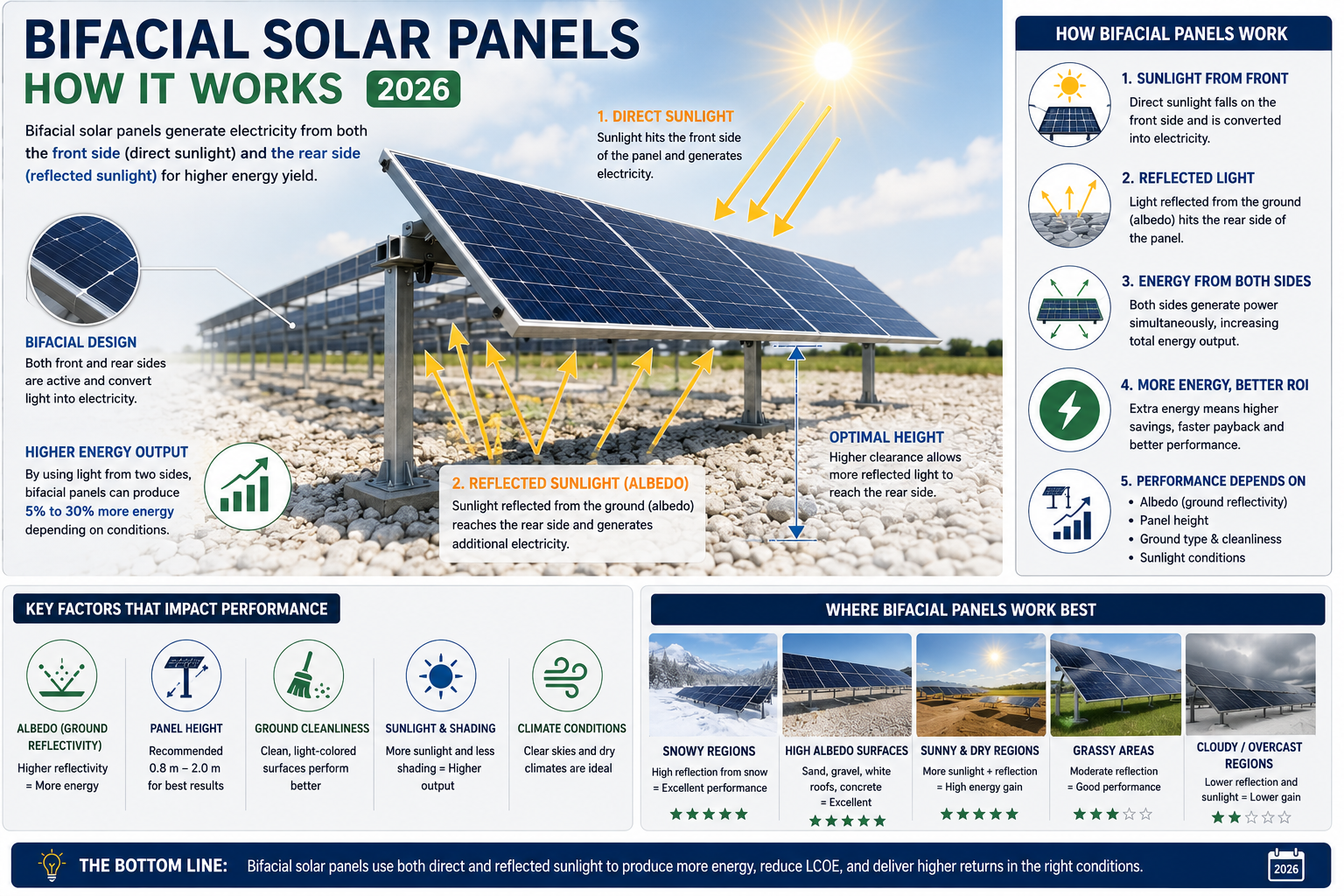
To understand bifacial technology, imagine a solar panel installed several feet above the ground.
Sunlight hits the front of the panel directly.
Some sunlight also reaches the ground around and underneath the panel. A portion of this light is reflected upward toward the back of the panel.
The rear solar cells capture some of this reflected light.
So instead of relying only on direct sunlight hitting the front, the module can also use some of the available reflected and diffuse light from behind.
The energy flow looks like this:
Sunlight
↓
Direct light → Front solar cells → Electricity
and
Light reflected from ground → Rear solar cells → Additional electricity
This is the main idea behind bifacial solar technology.
However, the rear side needs access to light.
If the panel is installed directly against an opaque roof or structure, there may be very little useful light reaching the rear cells.
That means the theoretical advantage of bifacial technology can be greatly reduced.
Bifacial Gain: The Most Important Number You Should Understand
One of the most misunderstood terms in bifacial solar is bifacial gain.
Bifacial gain refers to the additional energy generated by the rear side compared with the energy that would have been produced by the front side under the relevant reference conditions.
For example, imagine a system where the front side produces 10,000 kWh per year.
If the rear side contributes another 800 kWh, the additional gain would be approximately:
8%
The total production would therefore be:
10,800 kWh
This does NOT mean the panel’s rated power suddenly changes from 600W to 648W in every situation.
The actual gain depends on the installation environment.
Research has shown that bifacial gain can vary substantially depending on ground reflectivity, panel elevation and system geometry. Under low-reflectivity conditions, gains can be relatively modest, while higher albedo surfaces and elevated mounting can produce much larger gains.
How Much More Electricity Can Bifacial Solar Panels Produce?
There is no single percentage that applies to every installation.
In real projects, additional energy can range from relatively small gains to significantly higher gains under optimized conditions.
A useful way to think about it is:
Low rear-side light
Small bifacial gain
Moderate rear-side light
Moderate bifacial gain
Highly reflective ground + elevated installation
Potentially much higher bifacial gain
For example, a panel installed close to a dark roof may receive little useful rear-side radiation.
The same panel installed above a reflective surface with sufficient clearance can receive substantially more rear-side light.
Therefore:
Bifacial panel ≠ guaranteed 20% extra electricity.
The installation design determines how valuable the second side actually becomes.
What Is Albedo and Why Does It Matter?
If you want to understand bifacial solar panels properly, you need to understand albedo.
Albedo is essentially a measure of how much sunlight a surface reflects.
A dark surface absorbs more sunlight and generally has lower reflectivity.
A bright surface reflects more sunlight and generally has higher albedo.
For example:
| Surface | Approximate Reflectivity |
| Dark Roof | Low |
| Grass | Moderate |
| Concrete | Moderate to High |
| White Roof | High |
| Light-colored gravel | High |
| Snow | Very High |
This is why the surface underneath bifacial panels can have a major effect on their rear-side production.
Research into bifacial PV has shown that increasing albedo and raising modules above the ground can significantly increase bifacial gain.
Why Panel Height Matters
Panel height is another factor many buyers overlook.
If a panel is mounted extremely close to a surface, the rear side has less opportunity to receive reflected light.
When the panel is elevated:
- More ground area becomes visible to the rear side
- More reflected light can reach the cells
- Rear-side irradiance can increase
- Bifacial gain can improve
This is one reason bifacial panels can be particularly attractive for ground-mounted solar farms.
For a typical residential rooftop installation, however, the benefit can be smaller because the rear side may have limited exposure.
Bifacial Solar Panels vs Monofacial Solar Panels
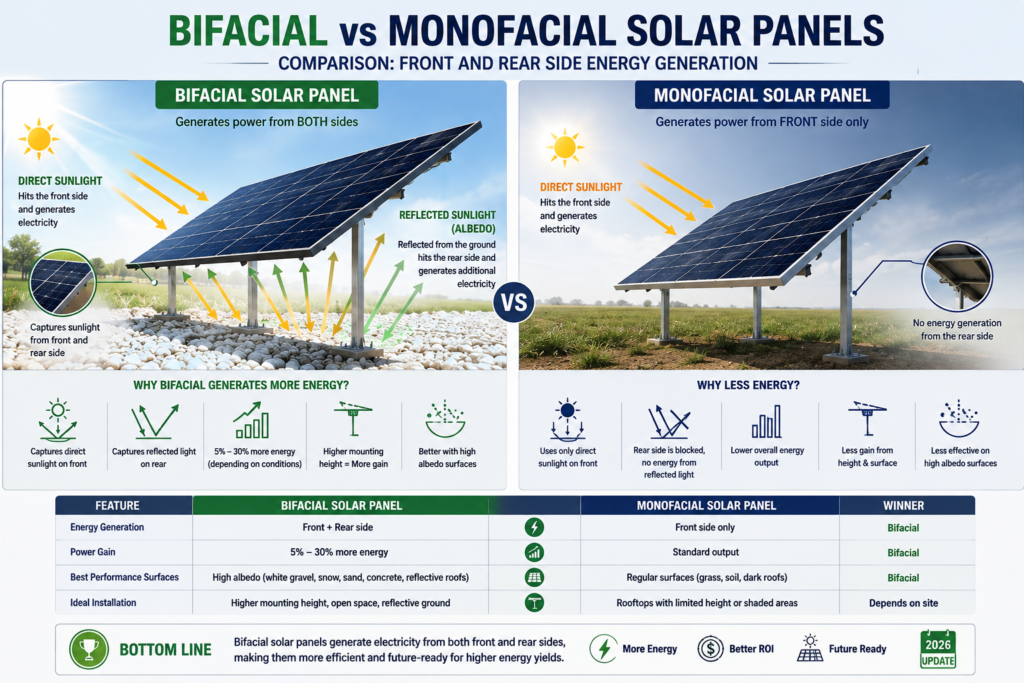
| Feature | Bifacial Panel | Monofacial |
| Front-side generation | Yes | Yes |
| Rear-side generation | Yes | Primarily No |
| Rear light utilization | Yes | Limited |
| Potential energy gain | Higher in suitable installations | Baseline |
| Installation requirements | More Important | Simpler |
| Best environment | Open/elevated systems | Almost anywhere |
| Ground reflectivity importance | Higher | Lower |
| Cost | Can be higher | Often lower |
| Large solar farms | Excellent | Excellent |
| Rooftop suitability | Depends on installation | Very good |
The important point is that bifacial is not automatically better in every situation.
If the rear side receives almost no light, paying extra for bifacial capability may not provide much additional value.
What Is a Dual-Glass Bifacial Solar Panel?
Many modern bifacial panels use a glass-glass construction.
Instead of having glass on the front and an opaque polymer backsheet, the module uses transparent glass on both sides.
This allows sunlight to reach the rear cells.
A typical structure can be:
Front glass
↓
Solar cells
↓
Rear glass
This design can provide additional protection for the cells and can be particularly useful in demanding outdoor environments.
However, glass-glass modules can also be heavier than traditional glass-backsheet panels.
That means the mounting structure must be designed for the actual module weight.
Bifacial Solar Panels and N-Type TOPCon Technology
One of the biggest developments in the current solar market is the combination of N-type cells and bifacial technology.
N-type TOPCon modules are now widely promoted by major manufacturers, including Jinko, Trina and other leading brands.
In Pakistan’s 2026 market, popular high-power panels around the 580W–650W class increasingly use N-type technologies, with bifacial designs commonly available.
Why N-type?
N-type solar cells can offer several advantages compared with many older P-type technologies, including:
- High efficiency
- Lower degradation potential
- Good temperature performance
- Strong low-light characteristics
- Compatibility with modern high-power module designs
The exact performance still depends on the manufacturer’s cell architecture and module design.
TOPCon vs Older PERC Technology
PERC was one of the major technologies behind the previous generation of high-efficiency solar panels.
TOPCon has increasingly become one of the leading technologies in newer modules.
This transition matters because modern bifacial panels are increasingly combined with N-type architectures.
A modern panel may therefore be marketed as:
N-type + TOPCon + bifacial + dual glass
These terms describe different aspects of the module.
They should not be treated as interchangeable.
For example:
N-type = cell type
TOPCon = cell architecture
Bifacial = ability to generate from both sides
Dual glass = module construction
A single solar panel can have all four characteristics.
Latest Bifacial Solar Panel Features in 2026
The bifacial market has moved beyond simply making the rear side active.
Modern modules increasingly focus on higher power density, improved durability, better temperature behavior, lower degradation, and improved compatibility with high-current inverters.
Some important trends in 2026 include:
1. N-Type Cell Technology
N-type modules have become mainstream in many markets.
2. TOPCon Bifacial Modules
TOPCon is now widely used in high-efficiency bifacial products.
3. Higher Wattage
Panels in the approximately 580W–650W+ range are increasingly common in markets such as Pakistan, depending on the manufacturer and module format.
4. Improved Temperature Performance
Manufacturers are increasingly focusing on reducing power losses under high operating temperatures.
This is particularly important for hot regions.
5. Lower Degradation
Modern N-type technologies can offer improved long-term degradation characteristics compared with many older generations.
6. Glass-Glass Construction
Dual-glass bifacial modules remain an important design for long-term durability and rear-side light transmission.
7. Better High-Current Compatibility
Modern high-power modules can have higher operating currents, making inverter MPPT input specifications increasingly important.
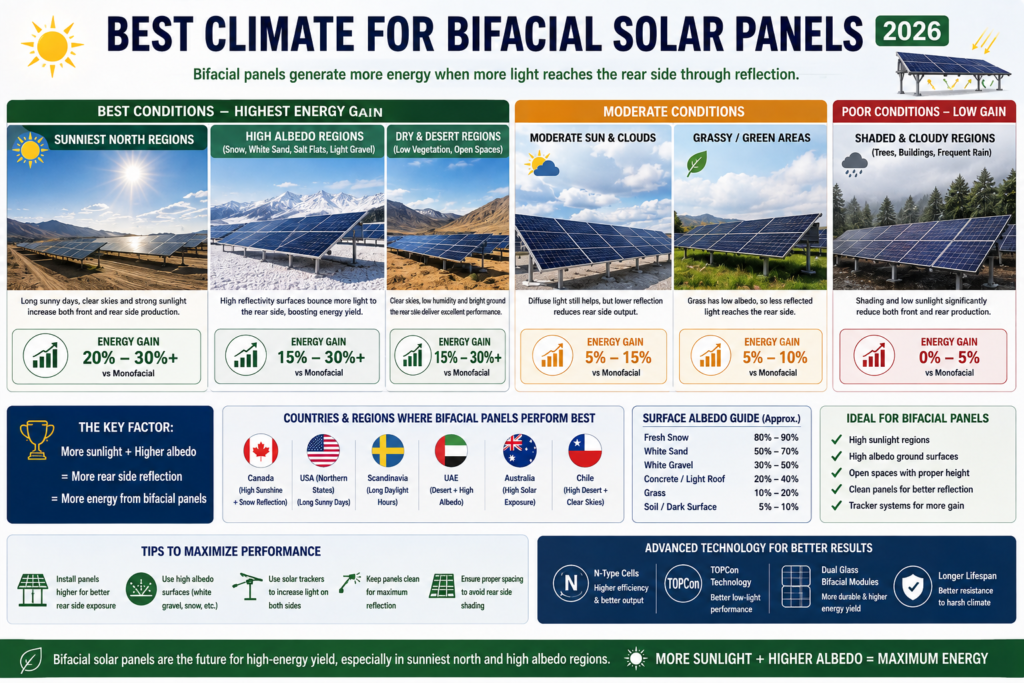
Bifacial Solar Panels and Climate: Which Countries Are Best
Bifacial solar panels can perform differently depending on sunlight, climate, ground conditions, and installation environment. The sections below explore which countries and climates are most suitable for bifacial panels—and where their benefits may be more limited.
Why Bifacial Solar Panels Are Interesting for Pakistan
Pakistan has several conditions that can make modern bifacial panels attractive.
The country receives strong sunlight across much of the year, but solar panels also face:
- High temperatures
- Dust
- Air pollution
- Seasonal smog
- Roof heat
- Strong sunlight
- Occasional heavy rain
- Limited cleaning in some installations
A bifacial panel can potentially benefit from reflected light, particularly when installed above a suitable reflective surface.
But there is an important difference between a properly elevated bifacial installation and a typical rooftop system.
Are Bifacial Solar Panels Good for Pakistani Rooftops?
Yes, but the installation matters.
If a bifacial panel is mounted several inches or more above a light-colored roof, some light can reach the rear.
If it is mounted very close to a dark surface, the rear-side benefit may be much smaller.
Therefore, Pakistani homeowners should not buy bifacial panels simply because the dealer says:
“Bifacial gives 20–30% more electricity.”
Ask instead:
How much rear-side irradiance will my actual installation receive?
That is the more important question.
Bifacial Solar Panels in Pakistan’s Hot Weather
High temperature is an important consideration for solar panels in Pakistan.
Solar cells generally produce less power as their operating temperature rises.
Therefore, the panel’s temperature coefficient matters.
When comparing two bifacial panels, don’t only compare:
- Wattage
- Efficiency
- Price
Also check:
- Temperature coefficient
- Degradation rate
- Operating temperature range
- Warranty
- Cell technology
A panel with a slightly lower headline wattage can sometimes be a better long-term choice if its thermal and reliability characteristics are stronger.
Are Bifacial Solar Panels Suitable for Every Climate?
Bifacial solar panels can work in almost any region where conventional solar panels can operate, but the amount of extra energy produced from the rear side can vary greatly from one climate and location to another.
This is an important distinction.
A bifacial panel does not need a hot or extremely sunny climate to work. What matters most is the amount and quality of solar radiation reaching both sides of the module.
Climate affects bifacial performance through several factors, including:
- Solar irradiance
- Cloud cover
- Snow
- Rain
- Humidity
- Dust
- Temperature
- Ground reflectivity
- Seasonal changes in ground conditions
- Panel mounting height
Research from the National Laboratory of the Rockies shows that bifacial performance depends strongly on geographic location, albedo, system geometry, rear-side irradiance and self-shading.
So instead of asking:
“Is bifacial solar good for this country?”
A better question is:
“Does this location provide enough useful rear-side irradiance to make bifacial technology worthwhile?”
Bifacial Solar Panels in Hot and Sunny Climates
Hot, sunny regions can be excellent locations for bifacial solar systems.
Examples include:
- Pakistan
- India
- United Arab Emirates
- Saudi Arabia
- Oman
- Qatar
- Egypt
- Australia
- Parts of Mexico
- Southwestern United States
These regions generally have strong solar resources.
However, high sunlight alone does not guarantee high bifacial gain.
The ground surface underneath the panels also matters.
For example, a bifacial array installed above a light-colored or reflective surface can receive more rear-side radiation than the same array installed close to a dark surface.
Why deserts can be attractive
Many desert environments have:
- Strong solar irradiance
- Large open areas
- Limited shading
- High ground clearance possibilities
- Suitable conditions for large ground-mounted solar farms
Large utility-scale projects can also optimize panel spacing, tilt and mounting height to improve rear-side irradiance.
But deserts have a problem: dust
Dust and sand can accumulate on solar modules and reduce front-side performance.
If dust becomes heavy, the overall energy production can fall even if the panel has excellent bifacial technology.
Therefore, in desert climates, cleaning and maintenance can be just as important as panel efficiency.
PV output generally decreases as cell temperature rises.
Therefore, when comparing panels, check the temperature coefficient rather than looking only at the maximum wattage.
Best Pakistani applications
Bifacial panels can make particular sense for:
Commercial rooftops + elevated structures + solar carports + ground-mounted solar farms.
For a small residential rooftop, the economics should be checked carefully before paying a large premium for bifacial technology.
Bifacial Solar Panels in India
India is another potentially strong market for bifacial solar technology.
Many regions have:
- High solar irradiance
- Large-scale solar farms
- Open land
- Hot climates
- Large commercial and industrial installations
Ground-mounted bifacial systems can benefit from appropriate ground clearance and reflective surfaces.
However, dusty conditions in some regions mean cleaning and maintenance remain important.
For large Indian solar projects, bifacial panels can be especially attractive when the project layout is designed specifically to maximize rear-side irradiance.
Bifacial Solar Panels in the Middle East
Countries such as:
- Saudi Arabia
- UAE
- Oman
- Qatar
- Jordan
have excellent solar resources and significant potential for bifacial solar.
Large utility-scale solar farms in these regions can take advantage of:
- Strong sunlight
- Large open areas
- High module elevation
- Optimized row spacing
- Reflective ground surfaces
The major challenge: dust and sand
Desert environments can create significant soiling.
If dust covers the front side, less sunlight reaches the cells.
Dust can also change the optical environment around the rear side.
Therefore, bifacial projects in desert climates should include an appropriate soiling and cleaning strategy.
Bifacial Solar Panels in Australia
Australia is one of the world’s strongest solar markets and has excellent conditions for large-scale PV.
Bifacial panels can be useful in:
- Utility-scale solar farms
- Commercial systems
- Ground-mounted installations
- Agricultural applications
Large open spaces allow designers to optimize:
- Panel height
- Tilt
- Row spacing
- Ground reflectivity
Australia also has a wide range of climates, so the ideal bifacial design can vary significantly from one region to another.
Bifacial Solar Panels in the United States
Bifacial solar panels are used in multiple regions of the United States.
They can be particularly attractive for large ground-mounted solar projects where the rear side has good exposure.
The United States also demonstrates an important point about bifacial technology:
Cold climates are not necessarily bad for bifacial panels.
In regions with snow, the ground can become highly reflective.
Snow has a high albedo, meaning it can reflect significant solar radiation toward the rear side of elevated bifacial modules.
Field research has specifically examined bifacial systems under snowy conditions and found that accurate energy estimation needs to account for the changing rear-side irradiance caused by snow cover.
Bifacial Solar Panels in Canada and Northern Europe
At first glance, cold and cloudy regions may appear unsuitable for bifacial solar.
That is not necessarily true.
Countries and regions such as:
- Canada
- Norway
- Sweden
- Finland
- Northern Germany
- Denmark
- The Netherlands
can still use bifacial solar technology.
The important advantage in snowy regions is high ground albedo.
Fresh snow can reflect a large amount of sunlight.
If the bifacial panel is mounted high enough, reflected light from snow can reach the rear side.
This can increase rear-side irradiance during periods when snow is present.
However, there is an important limitation:
Snow can also cover the panel itself.
If snow remains on the front surface, direct solar generation can drop significantly.
Therefore, the benefits of high-albedo snow must be considered together with snow accumulation, panel angle, cleaning and local weather.
Bifacial Solar Panels in Cloudy and Rainy Climates
Countries such as:
- United Kingdom
- Ireland
- Netherlands
- Belgium
- Parts of Germany
- New Zealand
experience more cloud cover and rainfall than many desert regions.
Does that make bifacial solar useless?
No.
Solar panels can still generate electricity from diffuse sunlight.
In fact, research on bifacial PV shows that geographic conditions do not simply divide into “good sunny countries” and “bad cloudy countries.” Bifacial systems can provide performance gains across a wide range of locations, although the size of the gain depends on albedo, irradiance and system design.
However, cloudy locations usually have lower total solar irradiance than very sunny regions.
Therefore, the economic advantage of bifacial technology should be evaluated using the annual energy yield, not simply the bifaciality percentage printed on the datasheet.
Bifacial Solar Panels in Tropical and Humid Climates
Tropical regions such as:
- Indonesia
- Malaysia
- Thailand
- Philippines
- Singapore
- Parts of Brazil
- Central America
can use bifacial solar panels.
These areas can have:
- Strong sunlight
- High humidity
- Frequent rainfall
- Cloud cover
- Vegetation
- Moisture
Bifacial panels can work well, especially when mounted above suitable ground or reflective surfaces.
However, tropical installations should pay close attention to:
- Moisture resistance
- Module encapsulation
- Corrosion protection
- Mounting structure
- Drainage
- Vegetation growth
- Cleaning
A ground-mounted bifacial system surrounded by tall vegetation may lose some of its rear-side advantage because vegetation can block or absorb reflected light.
Bifacial Solar Panels in Coastal Areas
Coastal locations can also use bifacial solar panels.
However, the environment can be more demanding because of:
- Salt spray
- Humidity
- Corrosion
- Wind
- Moisture
For coastal installations, check the manufacturer’s environmental certifications and corrosion-resistance specifications.
The mounting structure is especially important.
A high-quality solar module installed on a poor-quality structure can still experience long-term problems.
Bifacial Solar Panels in Snowy Regions: Advantage or Disadvantage?
Snow creates a unique situation.
Potential advantage
Snow has high reflectivity.
That means sunlight reflected from snow can increase rear-side irradiance.
Potential disadvantage
Heavy snow can cover the front of the panel and reduce direct generation.
So snowy climates can be both:
A challenge and an opportunity.
The actual result depends on:
- Snow depth
- Snow duration
- Panel tilt
- Panel height
- Snow shedding
- Ground clearance
- Seasonal sunlight
NREL research has specifically highlighted that snow-covered ground can substantially change albedo and therefore needs to be incorporated into bifacial performance calculations.
Climate Comparison: Where Are Bifacial Panels Most Suitable?
| Climate / Region | Bifacial Suitability | Main Reason |
| Pakistan | Excellent to very good | Strong sunlight + suitable elevated systems |
| India | Excellent to very good | Strong solar resource + large solar farms |
| Saudi Arabia | Excellent | High irradiance + large open areas |
| UAE | Excellent | Strong sunlight + utility-scale applications |
| Australia | Excellent | Strong solar resource + large land availability |
| Southwestern USA | Excellent | High irradiance + large ground-mounted projects |
| Canada | Good | Snow can provide high albedo |
| UK | Good | Works with diffuse light, but lower solar resource |
| Netherlands | Good | Diffuse light + reflective surfaces can help |
| Tropical Asia | Good | Strong solar resource but clouds/humidity vary |
| Coastal regions | Good | Works, but corrosion protection is important |
| Very dusty deserts | Good | Excellent sunlight, but soiling is a major issue |
| Heavily shaded locations | Poor | Rear and front irradiance are limited |
| Panels mounted directly on dark surfaces | Limited | Little useful rear-side light |
This table should be treated as a general guide, not a guarantee of performance. Actual bifacial gain requires site-specific modeling.
Where Are Bifacial Solar Panels NOT the Best Choice?
Bifacial panels are not ideal for every installation.
You may get limited value when:
1. The panel is mounted directly against a roof
There is very little rear-side light.
2. The surface underneath is very dark
A dark surface generally reflects less sunlight.
3. The rear side is shaded
Mounting rails, structures, walls or nearby objects can block rear irradiance.
4. The installation has very little clearance
The rear side has limited visibility of the surrounding ground.
5. The additional cost is too high
If a bifacial module costs substantially more but produces only a small amount of additional energy, the financial return may not justify the premium.
6. The site has severe soiling
Heavy dust can reduce the overall output of the system.
7. There is very limited sunlight
In heavily shaded locations, neither the front nor rear side can generate much energy.
Best Climate Conditions for Bifacial Solar Panels
If you are looking for the ideal combination, these conditions are particularly attractive:
High sunlight
More available solar radiation means more potential electricity.
Reflective ground
Higher albedo can increase rear-side irradiance.
Elevated mounting
More clearance can expose the rear side to reflected light.
Low shading
Less obstruction means more useful radiation.
Large open area
Allows better row spacing and system optimization.
Clean environment
Less soiling helps maintain both system efficiency and energy yield.
The Real Answer: Bifacial Panels Can Work Worldwide
The biggest misconception is that bifacial solar panels are only suitable for deserts or extremely sunny countries.
They are not.
Bifacial PV can work across a broad range of climates.
What changes from one location to another is the amount of additional energy the rear side can realistically contribute.
A desert installation may benefit from high sunlight and reflective ground.
A snowy installation may benefit from high snow albedo.
A cloudy installation may still benefit from diffuse radiation.
A tropical installation can benefit from strong solar resources but needs careful consideration of clouds, humidity and vegetation.
A coastal installation can work well but requires corrosion-resistant equipment.
Therefore, the best approach is not to ask whether a country’s climate is “good” or “bad” for bifacial solar.
Instead, evaluate:
Solar irradiance + albedo + panel height + shading + weather + soiling + system layout + electricity value.
That combination determines whether bifacial technology makes financial and technical sense at a particular site.
Does Dust Reduce Bifacial Panel Performance?
Yes.
Dust can reduce front-side sunlight, and heavy accumulation can also reduce the amount of useful light reaching the rear side.
This is particularly important in dusty areas.
Regular cleaning can help maintain energy production.
However, the cleaning schedule should be based on local conditions rather than an arbitrary rule.
A panel near a dusty road may require more frequent cleaning than one installed in a cleaner environment.
Bifacial Panels and Rain
Rain can temporarily help remove some dust from the surface.
However, rain should not be considered a complete cleaning solution.
Bird droppings, oily deposits, dust, and other contaminants may remain even after rainfall.
The glass surface should therefore be inspected periodically.
Where Are Bifacial Solar Panels Best Used?
Bifacial panels are particularly attractive in installations where the rear side has good access to sunlight.
Ground-mounted solar farms
This is one of the strongest applications.
Elevated structures
Higher clearance can improve rear-side exposure.
Carports
The space beneath the panel can allow useful light to reach the rear.
Agricultural solar systems
Depending on the design, elevated bifacial modules can provide electricity while allowing land to remain useful for agriculture.
Reflective rooftops
White or highly reflective roofs can improve rear-side irradiance.
Utility-scale solar projects
Large projects can optimize:
- Row spacing
- Ground reflectivity
- Panel height
- Tilt
- Orientation
- to maximize bifacial gain.
Where Bifacial Panels May Not Provide Much Extra Benefit
Bifacial technology is less attractive when the rear side is heavily blocked.
Examples include:
- Panels mounted directly on opaque surfaces
- Very low-clearance installations
- Dark surfaces with low reflectivity
- Installations with rear shading
- Poorly designed structures
In such cases, most of the electricity may still come from the front.
Do Bifacial Panels Need a Special Inverter?
Not necessarily.
The inverter does not need to be “bifacial” simply because the solar panels are bifacial.
However, the electrical characteristics of the actual panels must be compatible with the inverter.
Pay particular attention to:
- Maximum PV voltage
- MPPT voltage range
- Maximum input current
- Number of MPPTs
- Maximum PV power
Modern high-power bifacial panels can have relatively high operating currents.
This means inverter input specifications should be checked carefully.
Bifacial Panels With Hybrid Inverters
Bifacial panels can be used with hybrid inverters.
The system can be designed as:
Bifacial solar array → Hybrid inverter → Home loads
with:
Battery ↔ Hybrid inverter
and:
Utility grid ↔ Hybrid inverter
This allows solar energy to serve household loads, charge batteries, and interact with the grid according to the inverter and local regulations.
Bifacial Panels Without Batteries
Bifacial panels can also be used in battery-free systems.
For example:
Bifacial solar panels → Grid-tied inverter → Home
During sunlight hours, the bifacial solar array can supply electricity to household loads through a grid-tied inverter, which converts the solar power into usable AC electricity for the home.
If production exceeds consumption, the surplus can potentially be exported to the grid depending on the applicable local rules and approved system configuration.
For Pakistan, anyone planning a grid-connected system should check the current applicable regulations and utility requirements rather than relying on old net-metering information.
How Many Bifacial Solar Panels Do You Need?
The number depends on the panel’s rated power.
For example, suppose you use 600W panels.
5kW system
5,000 ÷ 600 = 8.33
You would need approximately:
9 × 600W panels = 5.4kW
10kW system
10,000 ÷ 600 = 16.67
Approximately:
17 × 600W panels = 10.2kW
But remember:
Bifacial gain is additional energy production; it should not simply be added to the panel’s nameplate wattage when sizing the inverter.
The inverter and array should be designed using the manufacturer’s electrical specifications and the expected operating conditions.
Bifacial Solar Panel Efficiency
Efficiency and bifaciality are two different concepts.
Efficiency
Efficiency tells you how effectively the panel converts incident sunlight into electricity on the front side under specified test conditions.
Bifaciality
Bifaciality describes how strongly the rear side performs relative to the front side under defined conditions.
For example, a module might have a high front-side efficiency and also a high bifaciality factor.
That does not mean the rear side automatically receives enough sunlight to generate the same power as the front.
What Is Bifaciality Factor?
The bifaciality factor is commonly expressed as a percentage comparing rear-side electrical performance with front-side performance under defined testing conditions.
A simplified example:
If the front side produces 100 units under a specified condition and the rear side produces 80 units under the corresponding condition, the bifaciality factor would be approximately:
80%
But remember:
80% bifaciality does not mean 80% more electricity.
It means the rear side has strong generation capability if it receives suitable irradiance.
This distinction is extremely important.
Bifacial Solar Panel Installation: What Matters Most?
If you want to maximize bifacial gain, installation design is critical.
1. Panel Height
More clearance can expose more of the rear surface to reflected light.
2. Ground Surface
A reflective surface can increase rear-side irradiance.
3. Row Spacing
Proper spacing can reduce shading between rows.
4. Panel Orientation
Orientation affects the distribution of sunlight across the day.
5. Tilt Angle
Tilt should be optimized for the location and project objectives.
6. Rear-Side Shading
Avoid structures that unnecessarily block the rear surface.
7. Mounting Structure
The structure should not obstruct a large portion of the rear side.
Can You Install Bifacial Panels on a Normal Roof?
Yes.
But the benefit depends on the roof design.
If the panel is installed on a conventional dark roof with very little clearance, the additional rear-side generation may be modest.
If the panel is installed on an elevated structure above a reflective roof, the rear side may receive more useful light.
Therefore, bifacial panels can work on rooftops, but they are not automatically optimized just because they are mounted on a roof.
Best Bifacial Solar Panel Brands Worldwide in 2026
Several major manufacturers offer modern bifacial solar modules.
Important global brands include:
LONGi Solar
LONGi is one of the world’s largest solar manufacturers and offers high-efficiency module families using modern cell technologies.
Its current product portfolio includes newer high-efficiency architectures and bifacial products.
In Pakistan, LONGi is one of the most frequently discussed premium solar-panel brands.
JinkoSolar
JinkoSolar is another major global manufacturer.
Its Tiger Neo family has become particularly well known for N-type technology and high-power bifacial modules.
Jinko’s newer products are widely discussed in Pakistan’s residential and commercial solar market.
Trina Solar
Trina Solar is a major global PV manufacturer with high-power bifacial module families.
Its Vertex product line is widely used in residential, commercial and utility-scale installations.
Canadian Solar
Canadian Solar is another major international manufacturer with bifacial and high-efficiency module products.
Canadian Solar panels are also widely available in Pakistan.
JA Solar
JA Solar is another major manufacturer offering N-type and bifacial modules.
Its modules are used in residential, commercial and utility-scale projects worldwide.
Other Major Names
Depending on market availability, buyers may also encounter:
- Risen Energy
- Astronergy
- Qcells
- REC
- AIKO
- Tongwei
The exact models and availability can change quickly, so buyers should verify the current manufacturer’s product datasheet before purchasing.
Popular Bifacial Solar Panel Brands in Pakistan
The Pakistani solar market has increasingly moved toward high-power N-type and bifacial modules.
Among the brands frequently seen or discussed in Pakistan are:
- LONGi
- JinkoSolar
- Canadian Solar
- Trina Solar
- JA Solar
- Astronergy
- Risen
- AIKO
Current Pakistani market comparisons commonly highlight LONGi, Jinko and Canadian Solar, with Trina and JA Solar also widely discussed.
However, brand name alone is not enough.
The exact model matters.
A manufacturer may sell multiple panel series with different:
- Cell technologies
- Wattages
- Efficiency
- Dimensions
- Warranty periods
- Bifaciality
- Temperature coefficients
- Degradation rates
Always compare the actual model number.
LONGi vs Jinko vs Trina vs Canadian Solar Bifacial Panels
There is no universal “best” brand.
A better approach is to compare the exact models.
| Feature | LONGi | JinkoSolar | Trina Solar | Canadian Solar |
| N-type products | Yes | Yes | Yes | Yes |
| Bifacial modules | Yes | Yes | Yes | Yes |
| TOPCon products | Yes/depending on series | Yes | Yes | Yes |
| High-power modules | Yes | Yes | Yes | Yes |
| Global presence | Very strong | Very strong | Very strong | Very strong |
| Pakistan availability | Strong | Strong | Strong | Strong |
| Best choice | Depends on model | Depends on model | Depends on model | Depends on model |
Recent Pakistani comparisons show that these brands are among the main options buyers consider, with newer N-type modules commonly reaching above 22% efficiency depending on model.
What About LONGi Hi-MO X10?
LONGi’s newer-generation high-efficiency products have attracted significant attention in 2026.
The Hi-MO X10 family is part of the industry’s movement toward higher efficiency and advanced cell architectures.
For Pakistani buyers, it is particularly relevant because high-power bifacial modules in this class are being considered for residential systems.
However, don’t buy a panel simply because it says “X10.”
Check:
- Exact model number
- Rated wattage
- Efficiency
- Bifaciality
- Voc
- Vmp
- Isc
- Imp
- Product warranty
- Performance warranty
- Dimensions
What About Jinko Tiger Neo?
JinkoSolar’s Tiger Neo range is another important N-type product family.
Tiger Neo modules are widely used in modern solar installations and are available in high-power bifacial configurations.
The Pakistani market is increasingly seeing high-power Jinko N-type bifacial modules, including models around the 580W–650W class and above depending on the product generation.
What About Trina Vertex?
Trina’s Vertex family is another important name in high-power solar modules.
Modern Vertex modules are available in high-power configurations and can be found in bifacial designs.
Trina is particularly relevant for buyers who want to compare module warranty, temperature performance, efficiency and physical dimensions alongside LONGi and Jinko.
Are Bifacial Solar Panels More Expensive?
They can be, although the price difference varies by manufacturer and market.
The important question is not:
“Is the bifacial panel more expensive?”
The better question is:
“Will the additional energy justify the additional cost?”
For a well-designed ground-mounted system, the answer can be attractive.
For a rooftop where the rear side receives almost no light, the economic advantage may be much smaller.
How to Calculate Whether Bifacial Is Worth It
Consider these five factors:
1. Extra upfront cost
How much more does the bifacial module cost?
2. Expected bifacial gain
How much additional annual energy can realistically be expected?
3. Electricity value
How much is each additional kWh worth to you?
4. Installation cost
Will you need a more elevated or specialized structure?
5. Lifetime
How long will the system operate?
A small increase in energy generation every year can become significant over decades.
Bifacial Solar Panels: Advantages
1. More Energy From the Same Module
The rear side can generate additional electricity.
2. Better Use of Reflected Light
Light that would otherwise be wasted can contribute to generation.
3. Excellent for Ground-Mounted Systems
Elevated structures can provide strong rear-side exposure.
4. Good Long-Term Technology
Modern bifacial modules are increasingly paired with advanced N-type cell technologies.
5. Dual-Glass Durability
Many bifacial modules use glass-glass construction.
6. Strong Potential in Reflective Environments
White roofs and bright ground surfaces can improve rear-side irradiance.
7. High Power Density
Modern bifacial panels are available at increasingly high wattages.
Bifacial Solar Panels: Disadvantages
1. Higher Initial Cost in Some Markets
The module and installation structure may cost more.
2. Installation Matters More
Poor installation can eliminate much of the bifacial advantage.
3. Heavier Modules
Dual-glass construction can increase module weight.
4. Rear-Side Shading Can Reduce the Benefit
Structures, cables and other obstacles can block rear-side light.
5. Not Every Roof Is Suitable
A low-clearance dark roof may provide limited rear-side irradiance.
6. Marketing Claims Can Be Misleading
Claims such as “30% more power” should not be accepted without understanding the test conditions and installation assumptions.
The Biggest Mistake Buyers Make With Bifacial Panels
The biggest mistake is focusing on bifaciality percentage instead of the installation environment.
Suppose Panel A has excellent bifaciality.
But it is installed:
- Very close to a dark roof
- Under a large structure
- With rear-side shading
Its actual bifacial gain may be limited.
Panel B might have slightly different specifications but be installed:
- Higher above the ground
- Over a reflective surface
- With excellent rear exposure
- With optimized row spacing
Panel B could potentially deliver more useful rear-side energy.
Therefore:
The installation can be just as important as the panel.
What Should You Check Before Buying a Bifacial Solar Panel?
Use this checklist.
Panel specifications
- Rated power
- Front-side efficiency
- Bifaciality factor
- Voc
- Vmp
- Isc
- Imp
- Temperature coefficient
- Maximum system voltage
- Operating temperature
Construction
- Glass-glass or glass-backsheet
- Cell technology
- Frame design
- Junction box
- Connector type
Long-term reliability
- Product warranty
- Performance warranty
- Degradation rate
- Manufacturer reputation
Installation
- Panel height
- Ground reflectivity
- Rear-side clearance
- Row spacing
- Shading
- Roof structure
System compatibility
- Inverter MPPT voltage
- Maximum inverter input current
- Maximum PV power
- Number of MPPTs
- String configuration
How to Avoid Fake or Low-Quality Solar Panels in Pakistan
This is especially important when buying expensive solar equipment.
Don’t rely only on:
- Dealer claims
- WhatsApp pictures
- Printed stickers
- “Tier-1” written on an advertisement
Instead:
Verify the model number
Compare it with the manufacturer’s official documentation.
Check the serial number
Where manufacturer verification is available, use it.
Request the original datasheet
Compare every major specification.
Check physical condition
Look for:
- Broken glass
- Frame damage
- Scratches
- Cell cracks
- Delamination
- Water damage
Compare electrical specifications
A genuine panel should have specifications consistent with the manufacturer’s published model.
Bifacial Solar Panels and Net Metering
Bifacial panels can be used in grid-connected solar systems, but the panel type itself does not determine whether a system qualifies for grid export.
Bifacial solar panels can generate more electricity than a comparable monofacial system when conditions are favorable. If the system produces more electricity than the home consumes, the excess power may be exported to the grid under the applicable regulations. This process is commonly associated with net metering, although the exact rules and compensation vary by location.
Eligibility depends on the applicable local regulations, utility requirements, inverter configuration, approvals and other technical conditions.
Therefore, if you are installing a bifacial system in Pakistan specifically for grid export, always check the current rules in force at the time of installation rather than relying on an old article or dealer statement.
Bifacial Solar Panels vs Solar Trackers
Large solar farms sometimes combine bifacial panels with tracking systems.
A tracker changes the panel’s orientation during the day to follow the sun.
Bifacial panels can potentially benefit from additional rear-side irradiance while the tracker improves front-side solar capture.
However, trackers add:
- Mechanical complexity
- Maintenance requirements
- Higher upfront costs
Therefore, fixed-tilt bifacial systems remain very important.
Research has found that optimized bifacial tracking systems can produce substantial energy improvements under certain geographic and design conditions, but the economics depend strongly on location and project configuration.
Are Bifacial Solar Panels the Future?
Bifacial technology is already part of the modern solar market rather than simply being a future concept.
The more important trend is the combination of:
N-type cells + advanced cell architecture + bifacial design + dual-glass construction + higher module power
This combination is helping manufacturers produce increasingly powerful solar modules.
The future will likely involve continued improvements in:
- Cell efficiency
- Module power
- Degradation
- Temperature performance
- Manufacturing cost
- Bifacial energy capture
- Inverter compatibility
- System-level optimization
Bifacial Solar Panels: What Is Actually New in 2026?
The major change is not simply that bifacial panels exist.
The industry has moved toward high-power N-type modules where bifacial capability is increasingly integrated into mainstream products.
In Pakistan, recent market comparisons show strong interest in approximately 580W–650W+ N-type bifacial modules, including products from major manufacturers such as LONGi and Jinko.
This means a buyer in 2026 should not compare only:
Bifacial vs monofacial
Instead, compare the complete technology package:
Cell technology + efficiency + bifaciality + temperature coefficient + degradation + warranty + dimensions + price per watt.
That is a much smarter way to select a panel.
Conclusion: Are Bifacial Solar Panels Worth Buying in 2026?
Bifacial solar panels are one of the most useful developments in modern solar technology—but their real advantage depends on the installation.
The biggest mistake is to think that buying a bifacial panel automatically means getting 20%, 30%, or 40% more electricity.
It doesn’t.
The rear side needs light.
The more useful light reaches the back of the module, the greater the potential bifacial gain.
For large ground-mounted projects, solar carports, elevated structures and reflective environments, bifacial technology can be extremely attractive.
For a typical home rooftop, the decision requires more careful analysis.
In 2026, the most interesting modules combine:
N-type cells + advanced cell technology + bifacial design + dual-glass construction + high efficiency + high power output.
For Pakistani buyers, brands such as LONGi, JinkoSolar, Trina Solar, Canadian Solar and JA Solar are among the major names worth comparing. But the smartest purchase is not necessarily the most expensive or highest-wattage panel.
Before buying, compare the exact model’s efficiency, bifaciality, temperature coefficient, degradation rate, warranty, electrical specifications, dimensions, price per watt and installation requirements.
Most importantly, ask one question before paying extra for bifacial technology:
“How much sunlight will actually reach the back of my panels?”
That answer will tell you much more about the value of bifacial solar than the word “bifacial” printed on the box.
Do bifacial solar panels work from both sides?
Yes. Their front and rear surfaces can generate electricity when exposed to suitable solar radiation.
Do bifacial panels produce twice as much electricity?
No. They do not automatically produce double the electricity. The rear-side contribution depends on the amount of light reaching the back of the panel.
How much more power can a bifacial solar panel produce?
The additional output varies by installation. Ground reflectivity, panel height, spacing, shading and system design can have a major effect.
Are bifacial solar panels better than monofacial panels?
They can be better when the rear side receives useful light. In a poorly designed installation with almost no rear-side exposure, the advantage may be limited.
Are bifacial solar panels good for Pakistan?
Yes, particularly when installed with adequate rear clearance and suitable reflective surfaces. Pakistan’s strong solar resource makes high-efficiency bifacial technology attractive, but hot temperatures and dust should also be considered.
Which bifacial solar panel is best in Pakistan?
There is no single best panel for every project. LONGi, Jinko, Trina, Canadian Solar and JA Solar are among the major brands buyers commonly compare. The exact model, warranty, efficiency, price and availability should be evaluated.
Are bifacial panels good for rooftops?
Yes, but their benefit depends on rear-side exposure. An elevated installation over a reflective surface can provide more benefit than a panel mounted very close to a dark roof.
Do bifacial panels need special mounting?
They do not necessarily require a completely different mounting system, but the structure should allow sufficient rear-side light exposure if you want to maximize bifacial gain.
Are dual-glass panels better?
Dual-glass construction can offer durability and allows light to reach the rear side in bifacial designs, but it can also increase weight. The complete module specification should be evaluated.
Are TOPCon panels bifacial?
Many TOPCon modules are bifacial, but TOPCon and bifacial describe different characteristics. TOPCon refers to cell technology, while bifacial describes the ability to generate from both sides.
Can bifacial panels charge batteries?
Yes. They can be used with compatible charge controllers and hybrid/off-grid inverters to charge batteries.
Can bifacial panels work without batteries?
Yes. They can be used in grid-connected systems where the solar energy is converted by a suitable inverter and used by household or commercial loads.
Do bifacial panels work on cloudy days?
Yes. Solar panels can generate electricity from diffuse sunlight, although production is normally lower than during strong direct sunlight.
Do bifacial panels generate electricity from moonlight?
Technically, solar cells can respond to extremely weak light, but moonlight is far too weak to provide useful electricity for a practical solar system.
Do bifacial panels need white ground?
No. White or highly reflective surfaces can improve rear-side generation, but bifacial panels can work over many surfaces.