Home Solar System Without Battery: Complete Guide to Cost, Benefits, Installation & How It Works in 2026
Can you install a home solar system without a battery? Yes. A battery-free solar system can be a practical and cost-effective option for homes that are connected to the electricity grid.
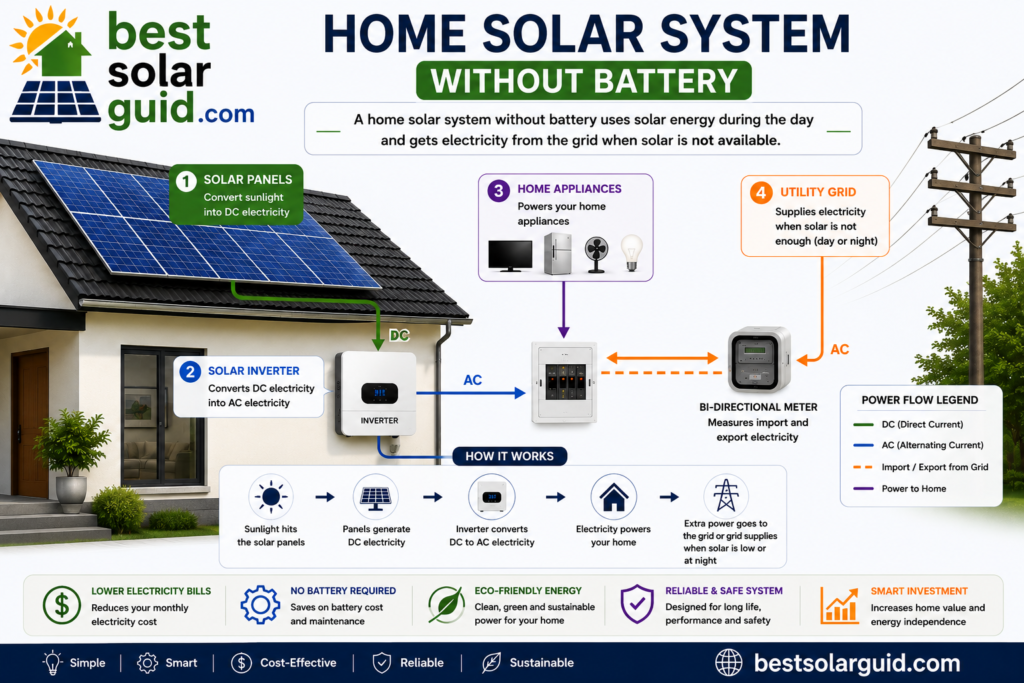
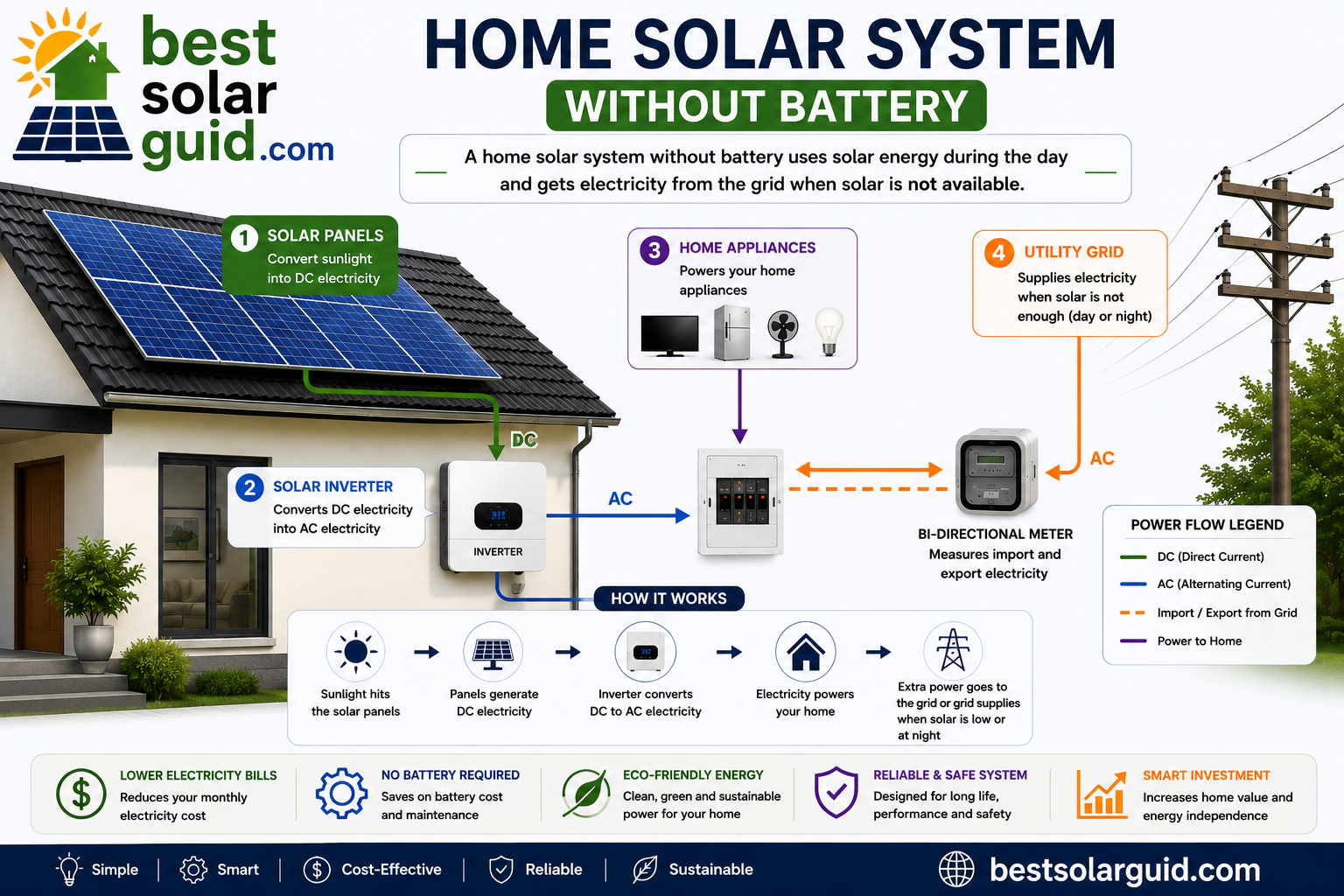
During the day, solar panels generate electricity that can be used directly by your home. When solar production is lower than your electricity demand, the grid can supply the difference. If your system is approved for electricity export, excess solar power may also be sent to the grid according to your local utility rules.
The biggest advantage of a home solar system without a battery is the lower upfront cost. You avoid the expense, maintenance, and eventual replacement of battery storage. However, there is an important limitation: a standard grid-tied solar system usually does not provide backup power during a grid outage.
This guide explains how a home solar system without a battery works, how many panels you may need, installation requirements, costs, benefits and drawbacks, inverter selection, energy savings, and whether this type of system is right for your home in 2026.
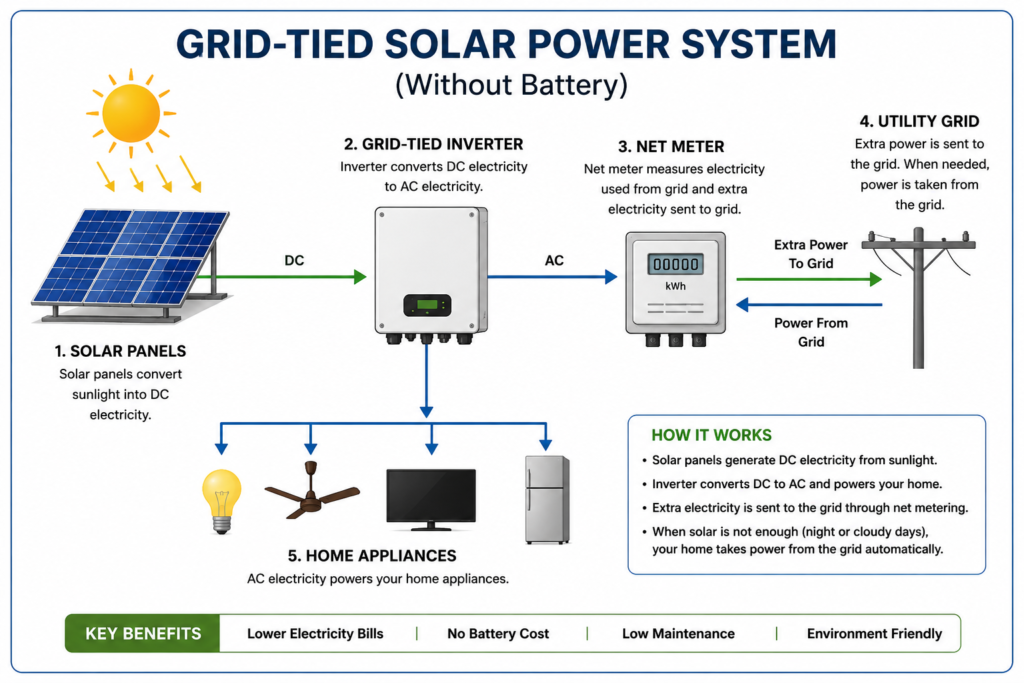
By the end of this guide, you will understand how battery-free solar works and what to consider before installing one.
Table of context :
- Can a Home Solar System Work Without a Battery?
- What Is a Home Solar System Without Battery?
- How Does a Battery-Free Solar System Work?
- What Happens to Solar Energy Without a Battery?
- Can You Use a Home Solar System Without Battery at Night?
- Can a Home Solar System Without Battery Work During a Power Outage?
- Main Components of a Home Solar System Without Battery
- How Many Solar Panels Does a Home Need Without a Battery?
- How to Calculate the Right Home Solar System Size
- Why Daytime Electricity Use Is So Important Without a Battery
- Can You Run an Air Conditioner With Solar Without a Battery?
- Can You Run a Refrigerator Without a Battery?
- Can You Run a Water Pump Without a Battery?
- Can You Run a Washing Machine Without a Battery?
- Can Solar Panels Work on Cloudy Days Without a Battery?
- Does Dust Reduce Solar Panel Performance?
- Does Hot Weather Affect Solar Panel Output?
- Benefits of a Home Solar System Without Battery
- Drawbacks You Should Know
- Home Solar System Without Battery vs Battery System
- How Much Does a Home Solar System Without Battery Cost?
- Is It Worth It?
- What Are the Requirements for a Home Solar System Without Battery?
- Installation Process
- How to Get More Value From a Home Solar System Without Battery
- How to Choose Solar Panels for a Batteryless Home System
- Maintenance Tips
- Can You Add a Battery Later?
- How to Choose the Right Inverter
- Net Metering and Net Billing in Pakistan: What Changed in 2026?
- Why Self-Consumption Matters More in Pakistan in 2026
- Is a Home Solar System Without Battery Safe?
- Is a Home Solar System Without Battery Environmentally Friendly?
- Common Mistakes to Avoid
- Who Should Choose a Home Solar System Without Battery?
- Who Should Consider Battery Storage?
- Questions to Ask a Solar Installer Before Buying
- Home Solar System Without Battery: Pros and Cons at a Glance
- Frequently Asked Questions
- Conclusion: Is a Home Solar System Without Battery Right for Your Home?
Can a Home Solar System Work Without a Battery?
Yes. A home solar system can operate without battery storage, particularly when it is connected to the utility grid.
During daylight hours, solar panels generate electricity and the home can use that electricity directly. If solar production is greater than the home’s current demand, the excess electricity may be exported to the grid if the system and local utility rules allow it.
When solar production is not enough, such as in the evening or at night, a grid-connected home can draw electricity from the utility grid.
In simple terms:
Daytime: Solar → Home
Extra solar: Solar → Grid, where export is permitted
Low solar production: Grid → Home
Night: Grid → Home
This is why a battery is not required for every home solar installation. In fact, current residential solar guidance continues to describe grid-tied, battery-free systems as a common configuration.
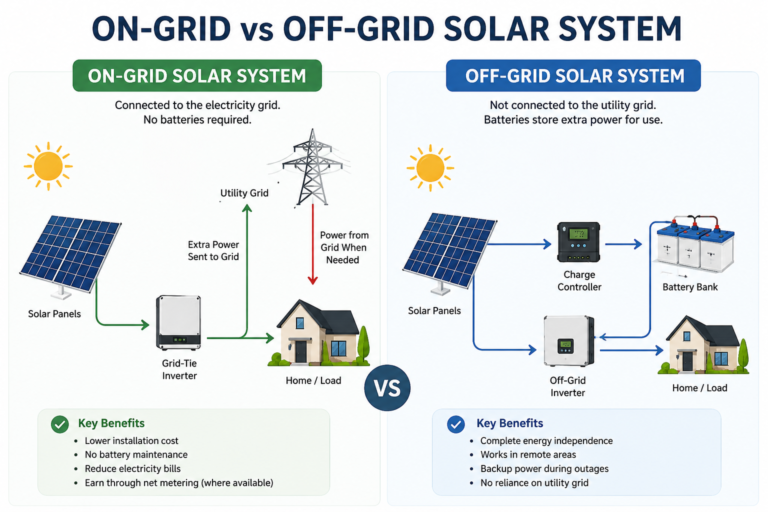
If you are unsure whether an on-grid or off-grid system is better for your home, it is important to understand how the two systems differ. Our guide to On-Grid vs Off-Grid Solar Systems explains their working methods, battery requirements, costs, advantages, and limitations so you can choose the right system for your needs.
What Is a Home Solar System Without Battery?
A home solar system without battery is a residential solar photovoltaic (PV) system that generates electricity from sunlight without using battery storage.
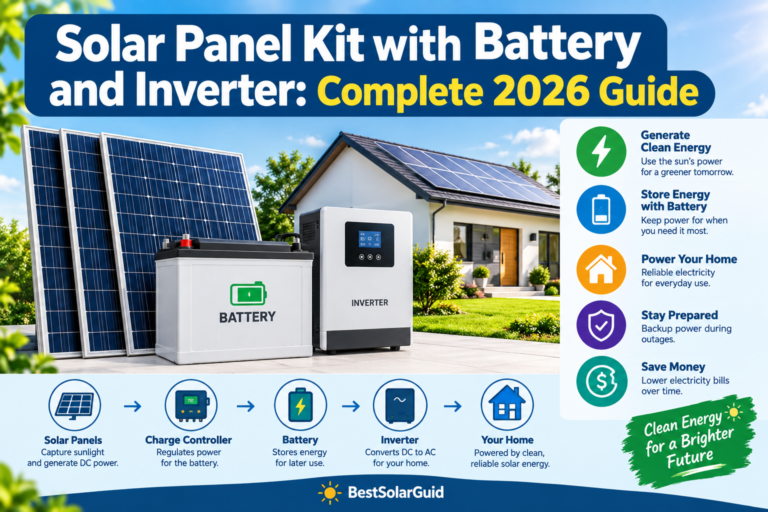
The system normally consists of solar panels, an inverter, mounting equipment, electrical wiring, protection equipment, and the necessary metering or grid-connection equipment.
The solar panels produce DC electricity. The inverter converts that electricity into AC electricity that can be used by household appliances.
Unlike a solar-plus-battery system, there is no battery bank storing unused solar energy for later use.
A typical grid-connected system works like this:
Sunlight → Solar Panels → Inverter → Home
If the home needs less electricity than the solar system is producing:
Solar → Home + Excess → Grid
When solar production falls below household demand:
Solar + Grid → Home
The exact treatment of excess electricity depends on the local electricity market, utility rules, meter configuration, and approved interconnection arrangement.
How Does a Home Solar System Without Battery Work?
A battery-free solar system follows a straightforward process:
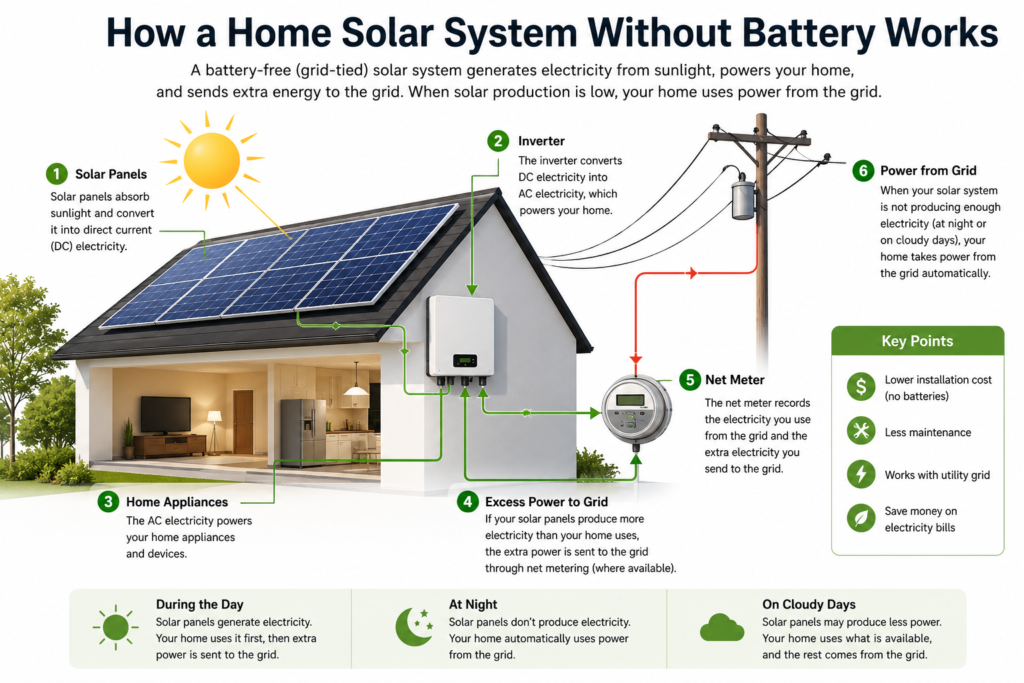
1. Solar Panels Capture Sunlight
Solar panels contain photovoltaic cells that convert sunlight into DC electricity.
The amount of electricity produced changes throughout the day. Production is generally lower in the early morning and late afternoon and higher when solar conditions are stronger.
Clouds, shading, dust, temperature, panel orientation, and other factors can also affect production.
2. The Inverter Converts DC Electricity Into AC
Solar panels produce direct current (DC), while most household appliances use alternating current (AC).
The solar inverter performs this conversion.
The inverter is also responsible for important control and grid-interconnection functions in a grid-connected solar system.
The inverter therefore should not be selected simply because it has a certain advertised wattage. It needs to match the solar array, household electrical system, and applicable grid requirements.
3. Your Home Uses Solar Electricity
When solar energy is available, it can be used by appliances operating in your home.
For example, if your solar system is producing 4 kW while your home is using 3 kW, approximately 3 kW can be consumed by the home’s loads while the remaining production may become surplus.
This direct use of solar energy is called self-consumption.
The more solar electricity you can use directly, the less electricity you may need to purchase from the grid at that moment.
4. Excess Electricity May Go to the Grid
If the solar system produces more electricity than the home is using, the excess may flow into the utility grid if the system is approved and configured for export.
How that exported electricity is treated financially is different from one country or utility to another.
Some systems may receive a credit or compensation, while other arrangements may have different rules.
Therefore, never assume that every home solar system automatically receives the same value for exported electricity.
5. The Grid Supplies Electricity When Solar Is Not Enough
Imagine your home needs 5 kW but your solar system is currently producing only 2 kW.
The solar system can provide the available solar generation, while the grid can supply the remaining demand in a normal grid-connected arrangement.
This is one of the main reasons a batteryless grid-connected system can work well for homes without needing to generate enough solar power for every appliance at every moment.
What Happens to Solar Energy Without a Battery?
Without a battery, solar electricity is not stored inside your home for later use.
Instead, it is generally:
- Used by your home immediately;
- Exported to the grid when export is permitted and there is excess generation; or
- Curtailed or otherwise handled according to the system’s control arrangement when it cannot be used or exported.
This is a major difference between solar-only and solar-plus-battery systems.
A battery allows excess electricity generated during the day to be stored and used later. Without one, your system is designed around real-time solar production and your connection to the grid.
Can You Use a Home Solar System Without Battery at Night?
Not directly from the solar panels.
Solar panels need sunlight to generate electricity, so they do not provide normal solar production after sunset.
If your home has a grid-connected batteryless solar system, electricity can normally come from the grid at night.
For example:
Morning: Solar + Grid → Home
Sunny afternoon: Solar → Home
Evening: Solar decreases → Grid supplies more
Night: Grid → Home
This means a home solar system without battery can reduce your daytime electricity purchases, but it does not store your daytime solar energy for nighttime use.
Can a Home Solar System Without Battery Work During a Power Outage?
This is one of the most important questions to understand before buying solar.
A standard grid-tied solar system without battery storage normally shuts down when the utility grid goes down.
This is not because the solar panels suddenly stop receiving sunlight. It is because conventional grid-connected inverters are designed to disconnect from a failed grid rather than continue energizing a potentially de-energized utility network.
This safety function helps prevent dangerous backfeeding while utility workers are repairing the electrical network. Current residential solar guidance also identifies loss of power during a blackout as a major limitation of conventional solar-only grid-tied systems.
So remember:
Solar panels + sunshine do not automatically mean backup electricity during a blackout.
Some specialized systems can provide limited or backup-capable solar operation without conventional battery storage, but these are not the same as a standard grid-tied installation and require specific inverter and electrical configurations.
If reliable backup power is your main goal, discuss the required backup architecture with a qualified solar professional before installation.
Main Components of a Home Solar System Without Battery
Although this system does not include batteries, it still consists of several essential components that work together to generate and deliver electricity efficiently.
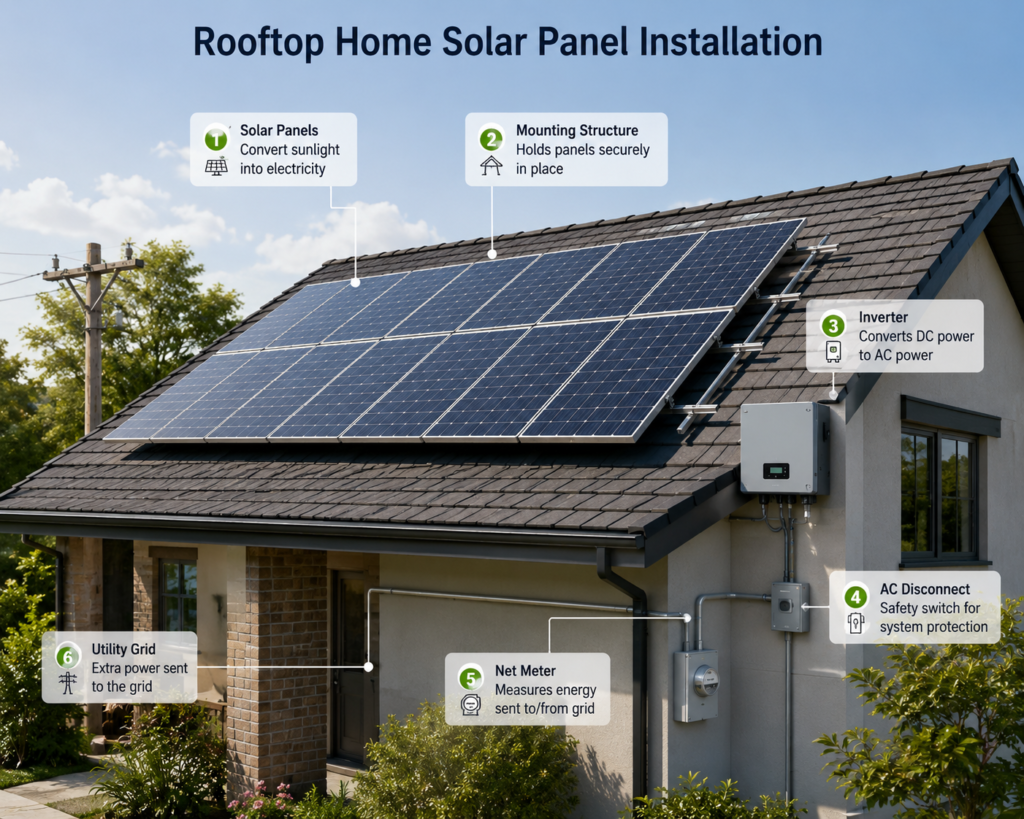
1. Solar panels
Solar panels are the heart of the system. They capture sunlight and convert it into direct current (DC) electricity. Modern monocrystalline panels are the most efficient option for residential installations because they generate more power while taking up less roof space.
2. Solar Inverter
The inverter converts DC electricity into alternating current (AC), which powers household appliances. It also synchronizes your solar system with the utility grid, ensuring a smooth flow of electricity.
3. Mounting Structure
A durable mounting system secures the solar panels to your roof or on the ground. Proper installation ensures maximum sunlight exposure and protects the panels from harsh weather conditions.
4. Net Meter (Where Available)
A net meter records both the electricity you consume from the grid and the excess electricity your solar system exports. Depending on your local utility provider, you may receive bill credits for the energy you send back to the grid.
5. Electrical Wiring and Safety Equipment
Cables, disconnect switches, circuit breakers, and surge protection devices safely connect all components and help protect the system from electrical fault.
How Many Solar Panels Does a Home Need Without a Battery?
There is no single number that works for every home.
The required number depends on your electricity consumption and the capacity of each panel.
For example:
If you want a 5 kW solar array and use 500 W panels:
5,000 ÷ 500 = 10 panels
If you use 550 W panels:
5,000 ÷ 550 ≈ 9.1 panels
The actual design must use a practical whole number of panels and also satisfy the inverter’s voltage and current limits.
The number of panels alone does not tell you how much electricity the system will produce each day.
How to Calculate the Right Home Solar System Size
A better approach is to start with your actual electricity use.
Step 1: Check Your Electricity Bills
Review several months of electricity bills.
Look for your monthly energy consumption, usually expressed in kWh or units.
Step 2: Calculate Your Average Consumption
For example, if a home uses approximately 600 kWh in a month:
600 ÷ 30 = 20 kWh per day
This is only the household’s average energy use. This figure shows your average daily electricity consumption. Your actual solar system size should then be estimated based on solar production, system losses, and your location.
Step 3: Check When You Use Electricity
This is especially important when there is no battery.
Ask yourself:
- Do you use air conditioning during the day?
- Do you run water pumps during daylight?
- Is someone working from home?
- Do you use washing machines during the day?
- Are major appliances mostly used after sunset?
A home that uses a large amount of electricity during the day may get more direct value from a batteryless solar system.
Step 4: Check Your Roof
The roof needs enough usable area for the planned solar array.
Also check:
- Shade
- Orientation
- Tilt
- Roof condition
- Nearby buildings
- Water tanks
- Chimneys
- Trees
- Other rooftop equipment
Step 5: Estimate Solar Production
Solar output depends on location and system conditions.
An installer should account for:
- Solar resource
- Weather
- Panel specifications
- Temperature
- Shading
- Orientation
- Tilt
- Inverter efficiency
- Wiring losses
- Soiling
Why Daytime Electricity Use Is So Important Without a Battery
This is one of the biggest differences between a batteryless system and a solar-plus-battery system.
Suppose two homes use exactly the same amount of electricity each month.
Home A
Most electricity is used between 9 AM and 5 PM.
Home B
Most electricity is used between 7 PM and midnight.
Home A may be able to use a larger portion of its solar electricity directly.
Home B will depend more heavily on the grid after sunset because there is no battery storing the afternoon solar production.
So when comparing solar options, do not ask only:
“How much electricity do I use?”
Also ask:
“When do I use it?”
Can You Run an Air Conditioner With Solar Without a Battery?
Yes, a properly designed grid-connected solar system can supply an air conditioner without battery storage when sufficient solar power is available.
Air conditioning can actually be a useful daytime load because cooling demand often increases while sunlight is available.
However, the system must be sized appropriately.
If the home is running several air conditioners, a water pump, refrigerator, kitchen appliances, and other large loads simultaneously, the total demand may be greater than the solar system’s current output.
In that situation, the grid can provide the difference in a normal grid-connected setup.
Can You Run a Refrigerator Without a Battery?
Yes.
A refrigerator can operate in a grid-connected home without a dedicated solar battery.
During the day, solar electricity can contribute to its operation. When solar production is insufficient, the grid can supply electricity.
The refrigerator therefore does not need a battery simply because the home has solar panels.
Can You Run a Water Pump Without a Battery?
Yes.
A water pump can operate using electricity from a grid-connected solar system without battery storage, provided the system is correctly designed for the pump’s electrical requirements.
If possible, using flexible loads such as water pumping during strong solar-production hours can increase direct solar consumption.
Can You Run a Washing Machine Without a Battery?
Yes.
A washing machine can use solar electricity directly when the system is producing enough power.
Running flexible appliances during daylight can help a homeowner use more of the electricity produced by the panels instead of relying on grid electricity at that time.
Can Solar Panels Work on Cloudy Days Without a Battery?
Yes, solar panels can still generate electricity under cloudy conditions, although production can be much lower than under strong sunlight.
The exact reduction depends on cloud thickness, solar conditions, panel technology, orientation, and other factors.
If solar production falls below household demand, a grid-connected system can normally obtain the remaining electricity from the grid.
Does Hot Weather Affect Solar Panel Output?
Yes.
Solar panels need sunlight, but high cell temperatures can reduce the electrical output of many PV modules.
This means a very hot day is not necessarily the same as a perfect solar-production day.
When comparing panels, it is useful to consider their temperature characteristics as well as their rated wattage and efficiency.
Does Dust Reduce Solar Panel Performance?
It can.
Dust, dirt, bird droppings, and other material on the panel surface can reduce the sunlight reaching the photovoltaic cells.
The effect depends on how much soiling has accumulated and the local climate.
Homes in dusty or dry areas may need more frequent inspection and cleaning.
Benefits of a Home Solar System Without Battery
1. Lower Upfront Cost
One of the biggest advantages is that you do not have to purchase a battery bank and its associated equipment.
This can significantly reduce the initial investment compared with a solar-plus-storage system.
2. Simpler System
A batteryless solar system has fewer major components.
There is no battery to size, charge, discharge, monitor, cool, or eventually replace.
3. Lower Battery-Related Maintenance
Without a battery, you avoid battery-specific maintenance and degradation concerns.
The solar system still requires appropriate inspection and monitoring, but there is no storage system to manage.
4. No Battery Replacement Cost
Solar panels and batteries have different lifespans and degradation characteristics.
A batteryless system removes future battery replacement from the system’s ownership costs.
5. Excellent for Daytime Electricity Consumption
If your household uses substantial electricity while the sun is shining, solar power can be consumed directly.
This can be particularly useful for homes using:
- Air conditioners
- Water pumps
- Washing machines
- Refrigerators
- Home office equipment
- Fans
- Other daytime appliances
6. Less Equipment Space
Without a battery bank, there is no need to dedicate space to large storage equipment.
7. Can Be a Cost-Effective Way to Reduce Grid Consumption
A batteryless system can reduce the amount of electricity purchased from the grid during solar-producing hours.
The actual financial benefit depends on electricity prices, solar production, self-consumption, export rules, and the cost of the installation.
Disadvantages of a Home Solar System Without Battery
1. No Stored Solar Energy at Night
This is the biggest limitation.
Your panels cannot provide stored daytime energy after sunset because there is no battery.
2. Standard Grid-Tied Systems Usually Shut Down During Outages
A conventional grid-connected solar system normally stops operating when the utility grid goes down.
Therefore, solar panels alone should not be considered a complete backup solution.
3. More Dependence on the Grid After Sunset
If your home consumes significant electricity at night, you will continue to rely on grid electricity unless another energy source is available.
4. Solar Production Changes During the Day
Solar output is not constant.
Clouds, shading, temperature, season, dust, and changing sunlight all affect production.
5. Export Electricity May Have Different Value
Excess electricity sent to the grid may not have the same financial value as electricity used directly by your home.
This makes local electricity tariffs and export rules important when calculating the economics of your system.
Home Solar System Without Battery vs. Battery System
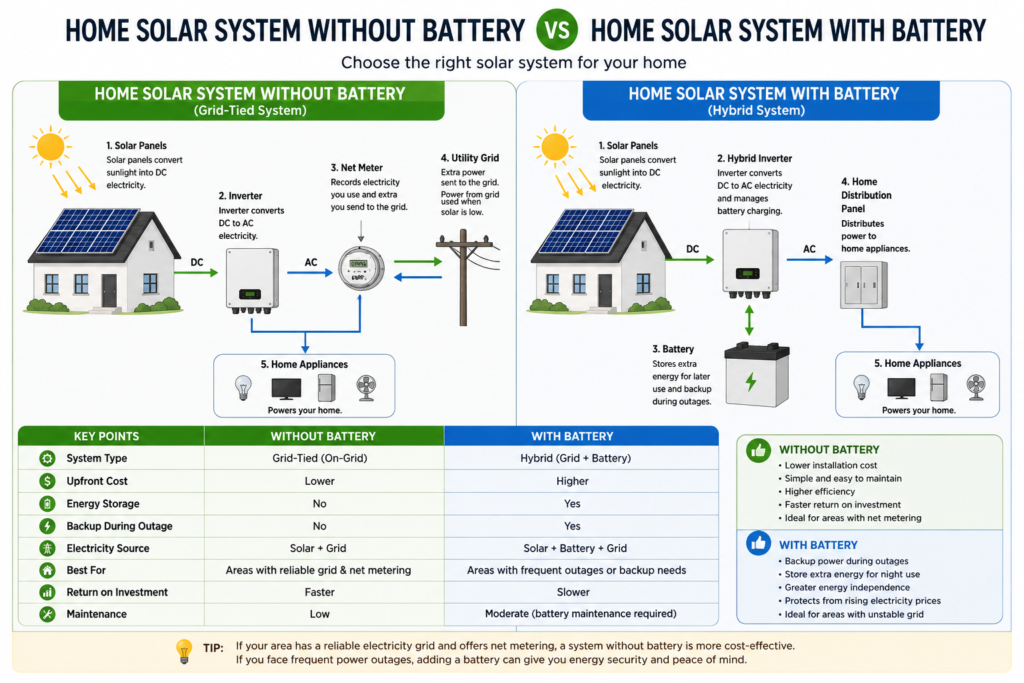
| Feature | Without Battery | With Battery |
| Initial Cost | Lower | Higher |
| Maintenance | Minimal | Moderate |
| Backup During Power Outages | No | Yes |
| Energy Storage | No | Yes |
| Return on Investment | Faster | Usually slower |
| Suitable for Grid-Connected Homes | Excellent | Excellent |
| Suitable for Frequent Power Outages | Limited | Highly suitable |
| Battery Replacement Cost | None | Required Eventually |
Which one should you choose?
A home solar system without a battery is generally the better option if:
- You have a reliable electricity grid.
- Net metering is available in your area.
- You want to reduce your upfront investment.
- Your primary goal is lowering electricity bills.
A battery-based system may be more suitable if:
- Power outages are common.
- You need backup electricity for essential appliances.
- You want greater energy independence.
How Much Does a Home Solar System Without Battery Cost in Pakistan 2026?
The cost of a home solar system without a battery depends mainly on the system size, solar panel brand, inverter, mounting structure, wiring, protection equipment, installation charges, and the complexity of the roof or electrical connection.
Because a battery is not included, a battery-free on-grid system generally costs less than a comparable solar system with battery storage. However, prices can vary significantly between suppliers and equipment brands, so the figures below should be treated as estimated market ranges rather than fixed prices.
Estimated Cost of a Solar System Without Battery in Pakistan
| Solar System Size | Estimated 2026 Cost Without Battery | Typical Use |
|---|---|---|
| 3 kW | PKR 380,000–500,000 | Small home or limited daytime loads |
| 5 kW | PKR 650,000–750,000 | Average home with moderate electricity use |
| 8 kW | PKR 850,000–1,050,000 | Larger home with higher daytime loads |
| 10 kW | PKR 1,000,000–1,300,000 | Large home or heavy daytime electricity use |
These are approximate 2026 Pakistan market ranges for battery-free/grid-connected systems. The final quotation can be higher or lower depending on the panel wattage and brand, inverter type and brand, mounting structure, wiring distance, protection equipment, installation conditions, taxes, and any applicable grid-connection or documentation costs. Current market listings also show substantial variation between suppliers, which is why homeowners should compare itemized quotations rather than choosing a system based only on the headline price.
What Is Included in the Cost?
A typical battery-free home solar installation may include:
- Solar panels
- Grid-tied or compatible solar inverter
- Mounting structure
- DC and AC cables
- Protection devices and electrical equipment
- Installation labor
- Required meter or grid-connection equipment, where applicable
A battery is not included in these estimates.
What Are the Requirements for a Home Solar System Without Battery?
Before installation, your home should be assessed for several things.
Suitable Roof Space
You need enough usable roof area for the planned solar array.
Good Sun Exposure
Heavy shade from trees, buildings, walls, water tanks, or other structures can reduce production.
Structurally Sound Roof
The roof must be suitable for the mounting system.
If the roof needs major repairs, it is better to address those problems before installing solar panels.
Suitable Electrical System
The home’s electrical infrastructure should be assessed for:
- Main panel
- Wiring
- Breakers
- Earthing
- Service capacity
- Inverter connection
- Cable routes
Correct Inverter
The inverter must be compatible with the solar array and electrical grid.
Proper Protection Equipment
Appropriate electrical protection and isolation equipment should be included in the design.
Utility Approval Where Required
Grid-connected systems may require permits, inspections, approvals, or specific metering arrangements depending on the location.
Installation Process of a Home Solar System Without Battery
Installing a home solar system without a battery involves several important steps to ensure safety, efficiency, and long-term performance.
If you are planning a residential solar installation in Pakistan, the process involves more than simply installing solar panels. You also need to consider system size, roof space, inverter selection, electrical protection, wiring, and grid-connection requirements. For a detailed step-by-step explanation, see our guide to Solar Installation in Pakistan, including costs, requirements, the installation process, and tips for choosing an installer.
A professional installation usually follows several stages.
Step 1: Analyze Your Electricity Bills
The installer should understand how much electricity you use and, ideally, when you use it.
Step 2: Conduct a Site Survey
The installer checks:
- Roof condition
- Roof space
- Shading
- Orientation
- Tilt
- Electrical system
- Inverter location
- Cable routes
Step 3: Calculate the Required System Size
The system is sized according to your electricity consumption, site conditions, solar resource, and applicable limits.
Step 4: Select Solar Panels
Consider:
- Rated power
- Efficiency
- Temperature characteristics
- Dimensions
- Warranty
- Manufacturer reputation
- Availability
Step 5: Select the Inverter
The inverter should be matched to the solar array and electrical system.
Do not choose an inverter simply because it is the cheapest option.
Step 6: Install the Mounting Structure
The mounting system is installed securely according to the roof type and design requirements.
Step 7: Install the Solar Panels
The panels are positioned and connected according to the electrical design.
Step 8: Install DC and AC Protection
Required protection equipment, disconnects, breakers, surge protection, grounding, and other components are installed as applicable.
Step 9: Install the Inverter
The inverter is installed in an appropriate location according to manufacturer requirements and local electrical practices.
Step 10: Connect the Solar System to the Home
The inverter’s AC output is connected to the home’s electrical system according to the approved design.
Step 11: Complete Testing
The installer checks system operation, electrical connections, protection equipment, inverter performance, and monitoring.
Step 12: Complete Grid Connection Requirements
Where required, utility approval, inspection, metering, or interconnection procedures must be completed before the system operates as an approved grid-connected installation.
How to Get More Value From a Home Solar System Without Battery
One of the smartest strategies is to use more of your solar electricity while it is being generated.
For example, when practical, you can schedule flexible appliances during daylight hours:
- Washing machine
- Water pump
- Dishwasher
- Water heater
- Air conditioning
- Other flexible household loads
The goal is simple:
Use more solar directly and buy less electricity from the grid at the same time.
This is particularly important when exported electricity has less financial value than electricity you would otherwise purchase from the grid.
How to Choose Solar Panels for a Batteryless Home System
Do not choose panels based only on their advertised wattage.
Consider:
Panel efficiency
Higher efficiency can be useful when roof space is limited.
Temperature coefficient
This helps you understand how panel performance changes as the panel gets hotter.
Dimensions
A physically larger panel may have higher wattage but may not fit your roof as efficiently.
Warranty
Check both product warranty and performance warranty.
Degradation
Solar modules gradually lose some output over time. Compare the manufacturer’s stated degradation terms.
Manufacturer reputation
Look at product availability, warranty support, and long-term reliability.
How to Choose the Right Inverter
The inverter deserves as much attention as the panels.
Consider:
- Inverter capacity
- Maximum PV input
- MPPT range
- Maximum input current
- Efficiency
- Grid compatibility
- Monitoring
- Protection features
- Warranty
- Service availability
- Future expansion options
If you may add a battery later, tell the installer before purchasing the inverter.
Some inverter architectures are easier to integrate with future storage than others.
The right inverter depends on the type of solar system you plan to install. A battery-free home system will generally use a grid-tied inverter, while an off-grid system typically requires an inverter that can work with battery storage. If you are considering an off-grid setup, read our detailed guide to Off-Grid Solar Inverters to learn how they work, what components they require, and how to choose the right size.
Can You Add a Battery Later?
In many cases, a solar system can be expanded with battery storage later, but this depends on the inverter and system architecture.
If future battery storage is important to you, mention it during the initial design.
A slightly different inverter or electrical configuration today may make a future upgrade easier.
Do not assume that every batteryless solar inverter can simply have a battery connected later.
Common Mistakes to Avoid When Buying a Home Solar System Without Battery
Mistake 1: Choosing the Cheapest Quotation
A low price may mean cheaper equipment, fewer protections, lower-quality installation, or missing services.
Always compare specifications.
Mistake 2: Ignoring Daytime Electricity Usage
A batteryless system works best when you can use a good portion of solar generation directly.
Mistake 3: Ignoring Shading
Even partial shading can affect production depending on the system design.
Mistake 4: Choosing an Inverter Without Checking Compatibility
The inverter needs to match the solar array and grid requirements.
Mistake 5: Assuming Solar Will Work During Every Blackout
A standard grid-tied batteryless system normally shuts down during a grid outage.
Mistake 6: Believing Panel Wattage Tells the Whole Story
Higher wattage does not automatically mean better performance for your particular roof.
Mistake 7: Ignoring Future Electricity Needs
If you plan to add more air conditioners, electric appliances, or an electric vehicle, consider those future loads before finalizing the system size.
Mistake 8: Using Outdated Net-Metering Information
Electricity-export rules and compensation arrangements can change.
Always verify the latest applicable rules before making a financial decision.
How Long Does a Home Solar System Without Battery Last?
Different components have different lifespans.
Solar panels are designed for long-term outdoor operation and generally come with long performance warranties.
The inverter typically has a different service life and may need replacement before the solar panels.
Other components such as mounting hardware, cables, connectors, and protection equipment also require inspection over time.
Therefore, when calculating the long-term cost of solar, do not look only at the panel warranty.
Maintenance Tips
A battery-free solar system requires very little maintenance, but regular care helps maximize its efficiency.
- Clean the solar panels every few months to remove dust, leaves, and bird droppings.
- Inspect the panels for cracks or physical damage after severe weather.
- Monitor your system’s energy production using the inverter or monitoring app.
- Schedule a professional inspection every few years to check wiring and electrical connections.
- Trim nearby trees if they begin to cast shade on the panels.
With proper maintenance, high-quality solar panels can continue producing electricity efficiently for 25 years or more.
Net Metering and Net Billing in Pakistan: What Changed in 2026?
Pakistan’s rooftop solar regulatory framework changed significantly in 2026. Under NEPRA’s Prosumer Regulations 2026, new prosumers are subject to a net-billing arrangement rather than the previous one-to-one net-metering model. Electricity imported from the grid is billed at the applicable consumer tariff, while surplus electricity exported to the grid is compensated at the National Average Energy Purchase Price (NAEPP). For CY 2026, NEPRA’s power-purchase-price forecast puts the NAEPP at Rs. 8.13 per kWh; however, the applicable rate may be revised under the regulatory framework. Existing prosumers with valid agreements executed before February 9, 2026 have separate transitional provisions under the 2026 amendments.
Why Self-Consumption Matters More in Pakistan in 2026
Under the 2026 net-billing framework, self-consumption has become even more important for homeowners using solar without a battery. When solar panels are generating electricity, using that power directly for appliances such as air conditioners, water pumps, washing machines, and other high-consumption loads can be more financially beneficial than exporting the same electricity to the grid. For this reason, homeowners considering a battery-free solar system should look beyond total system capacity and also consider their daytime electricity consumption when planning the system.
Common Mistakes to Avoid
Many homeowners can avoid unnecessary costs and performance issues by avoiding these common mistakes:
- Choosing the cheapest equipment instead of trusted brands.
- Installing a system without first calculating household energy needs.
- Ignoring roof shading caused by trees or nearby buildings.
- Hiring inexperienced or unlicensed installers.
- Skipping regular maintenance and system inspections.
- Not checking whether net metering or other incentives are available in your area.
Taking the time to plan your installation carefully can improve system performance and increase long-term savings.
Is a Home Solar System Without Battery Safe?
A properly designed and professionally installed solar system can be safe.
However, solar installations involve DC electricity, AC electricity, rooftop work, electrical equipment, and weather exposure.
Do not attempt unsafe electrical modifications yourself simply to reduce installation costs.
Use qualified professionals and follow applicable electrical, structural, fire, and utility requirements.
Is a Home Solar System Without Battery Environmentally Friendly?
Solar electricity can reduce reliance on electricity generated from fossil fuels, depending on the local electricity mix.
A batteryless system also avoids the additional materials and manufacturing associated with battery storage.
However, solar equipment still requires raw materials, manufacturing, transportation, installation, and eventual recycling or disposal.
So the most accurate description is that solar is a low-carbon electricity technology, not a technology with zero environmental impact.
Who Should Choose a Home Solar System Without Battery?
A batteryless solar system may be a strong option if:
- You want to reduce your electricity bills.
- You use a significant amount of electricity during daylight.
- You have a suitable roof.
- Your grid is reasonably reliable.
- You want a lower initial investment.
- You do not require solar backup during outages.
- Your local utility arrangement makes grid-connected solar financially attractive.
Who Should Consider Battery Storage?
Battery storage may be worth considering if:
- Your area experiences frequent power outages.
- You need backup electricity for essential appliances.
- You want to use solar energy after sunset.
- You want greater energy independence.
- Your electricity-export arrangement makes storing excess solar more attractive.
The right choice depends on your priorities, electricity usage, local rules, and budget.
Questions to Ask a Solar Installer Before Buying
Before signing a solar contract, ask:
- What total solar capacity do I actually need?
- Which exact panel model will you install?
- What is the panel efficiency?
- Which inverter model are you proposing?
- Is the inverter compatible with my grid?
- How much electricity is the system expected to generate annually?
- How much of my solar electricity can I use directly?
- What happens to excess electricity?
- What happens to the system during a power outage?
- What protection equipment is included?
- Is roof assessment included?
- What warranties are provided?
- Is monitoring included?
- Who handles utility approval?
- Are installation and commissioning included?
- Can I add a battery later?
- Are there any additional charges?
A trustworthy installer should be able to answer these questions clearly.
Home Solar System Without Battery: Pros and Cons at a Glance
| Pros | Cons |
| Lower initial cost | No stored solar energy at night |
| Simpler system | Usually no blackout backup |
| No battery replacement | Greater grid dependence after sunset |
| Less battery-related maintenance | Solar production changes throughout the day |
| Excellent for daytime loads | Export rules affect financial value |
| Can reduce electricity bills | Future battery upgrade may require compatible equipment |
Conclusion: Is a Home Solar System Without Battery Right for Your Home?
A home solar system without battery can be a smart and practical choice for homeowners who want to reduce their electricity bills without paying the additional cost of battery storage. During sunny hours, solar panels can supply electricity directly to your home, while a grid-connected system can use electricity from the grid when solar production is not enough. However, without a battery, you cannot store daytime solar energy for use at night, and a standard grid-tied system usually cannot keep your home powered during a grid outage.
Before choosing a batteryless solar system, look beyond the number of panels and consider your actual electricity consumption, daytime usage, roof space, sunlight, shading, grid reliability, inverter, installation quality, and local utility rules. If your home uses a significant amount of electricity during the day and your main goal is reducing electricity costs, a batteryless system can be an excellent option. If your priority is nighttime solar power, backup during frequent outages, or greater energy independence, battery storage may be worth considering.
The best solar system is not necessarily the biggest or most expensive one. It is the system that matches the way your home actually uses electricity.
Can a solar system work without a battery?
Yes. A grid-tied solar system can operate efficiently without a battery as long as it is connected to the utility grid. It uses grid electricity whenever solar production is insufficient.
Who should choose a battery-free solar system?
A battery-free solar system is ideal for homeowners who:
Do not require backup power during outages.
Have a reliable utility grid.
Want to reduce electricity bills.
Prefer lower installation and maintenance costs.
Is a home solar system without battery cheaper?
Usually, yes. Removing the battery reduces the upfront cost and eliminates battery-related maintenance and future replacement costs.
Can I run an AC on solar without a battery?
Yes, if the solar system is properly sized and the available solar production is sufficient for the AC and other loads operating at the same time.
Can I run a refrigerator without a battery?
Yes. A grid-connected solar system can supply part or all of the refrigerator’s electricity demand when solar production is available.
How many solar panels do I need for my home?
It depends on your electricity consumption, panel wattage, roof space, solar conditions, shading, system losses, and desired solar capacity.
Is an on-grid solar system without battery the same as a batteryless solar system?
An on-grid system describes a system connected to the utility grid, while batteryless describes a system without battery storage. An on-grid system can operate without a battery, but grid-connected systems can also include batteries.
Can an off-grid home use solar without a battery?
A completely off-grid home generally needs battery storage or another reliable generation source to provide electricity when solar production is unavailable.
Can I add a battery later?
Possibly. It depends on the inverter and the original system design. If you may want storage in the future, discuss this with your installer before purchasing the initial system.
Is solar without a battery good for homes in Pakistan?
It can be, particularly for homes with significant daytime electricity consumption and a suitable grid-connected setup. However, local grid conditions, electricity tariffs, export arrangements, and current regulations should be checked before installation.
Does a batteryless solar system eliminate my electricity bill?
Not necessarily. Solar can significantly reduce electricity purchases, but your final bill depends on your consumption, solar generation, grid use, fixed charges, export arrangements, and applicable electricity rates.