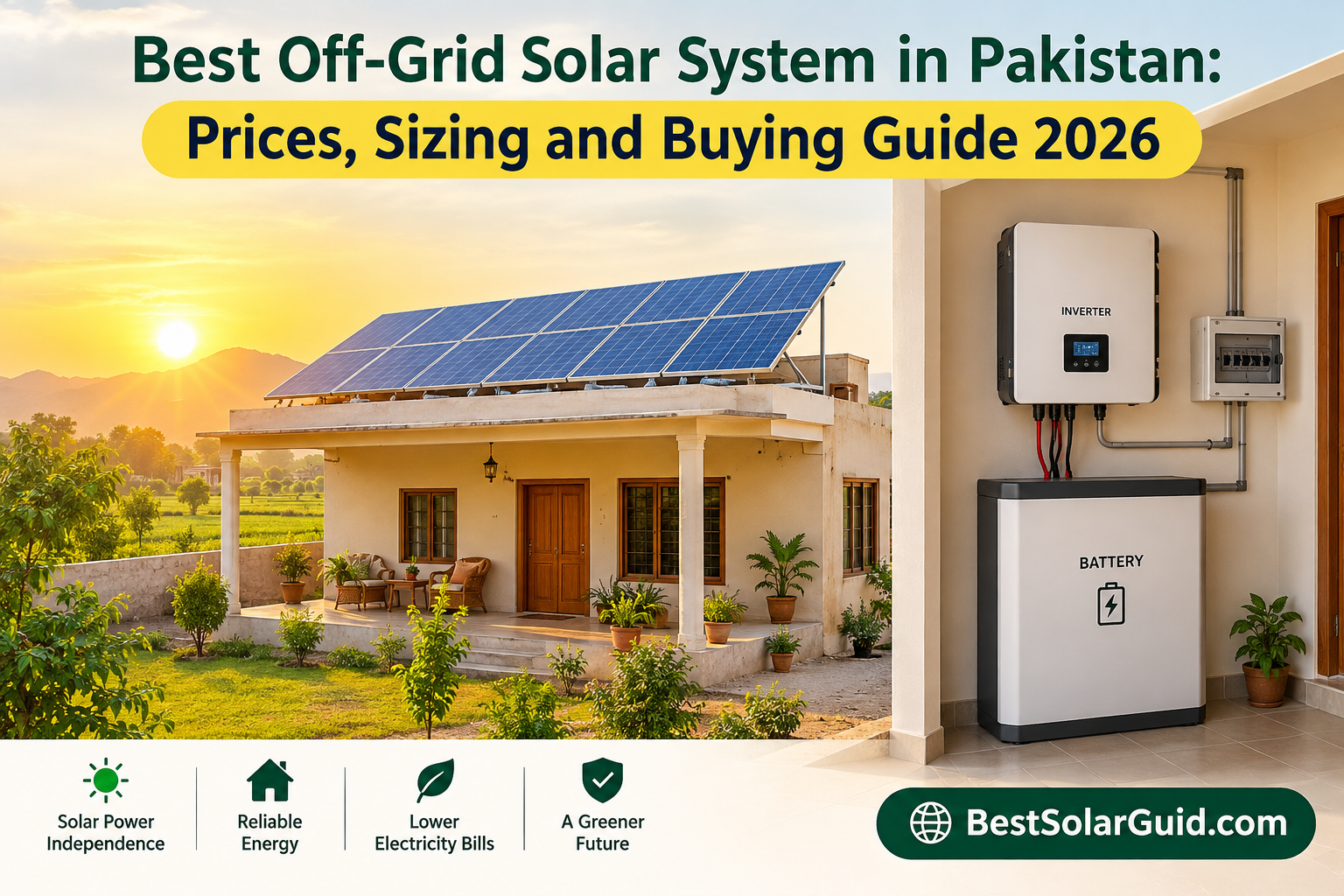
Best Off-Grid Solar System in Pakistan: Prices, Sizing and Buying Guide
Ask ten people in Pakistan for the best off-grid solar system and you will hear ten different brands. That is because the best system is not one product. It is the one that fits your home, your appliances, your city’s weather and your budget.
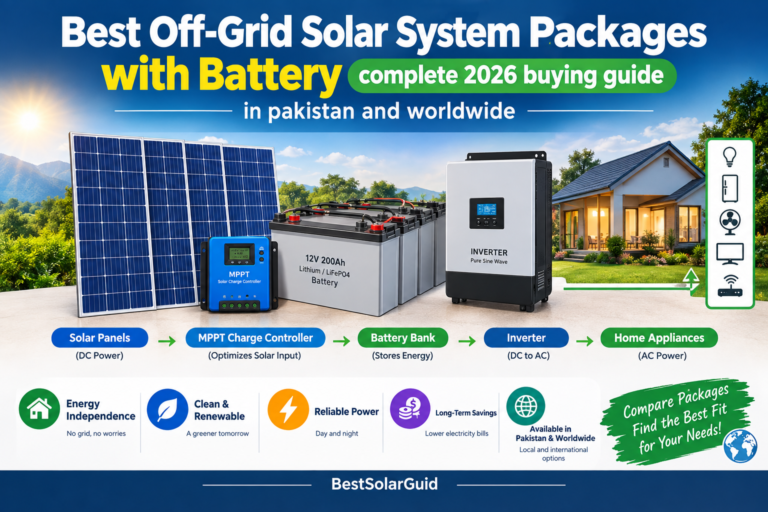
An off-grid solar system runs without depending on the national grid. Panels make power in the day, batteries store it, and an inverter turns it into the electricity your fans, fridge and lights use at night. If any one of those parts is too small, you will notice it on the first cloudy evening or the first long load shedding.
This guide keeps things simple. You will learn how to work out what you need, which system type suits you, what it costs in Pakistan in 2026, and what to check before you pay anyone.
Table of Contents
- What Is an Off-Grid Solar System?
- Off-Grid, On-Grid or Hybrid: What Suits Pakistan?
- What Makes an Off-Grid Solar System “the Best”?
- The Main Parts of an Off-Grid System
- How to Size Your System in 4 Steps
- Which Battery Is Best in Pakistan?
- How to Choose the Right Inverter
- How Much Does an Off-Grid Solar System Cost in Pakistan?
- Do You Still Need a Backup Generator?
- Common Mistakes to Avoid
- Quick Buying Checklist
- Frequently Asked Questions
- Final Thoughts
What Is an Off-Grid Solar System?
An off-grid solar system is a complete small power plant for one home, farm, shop or cabin. It has no connection to the utility network, so everything you use must be made or stored by your own equipment.
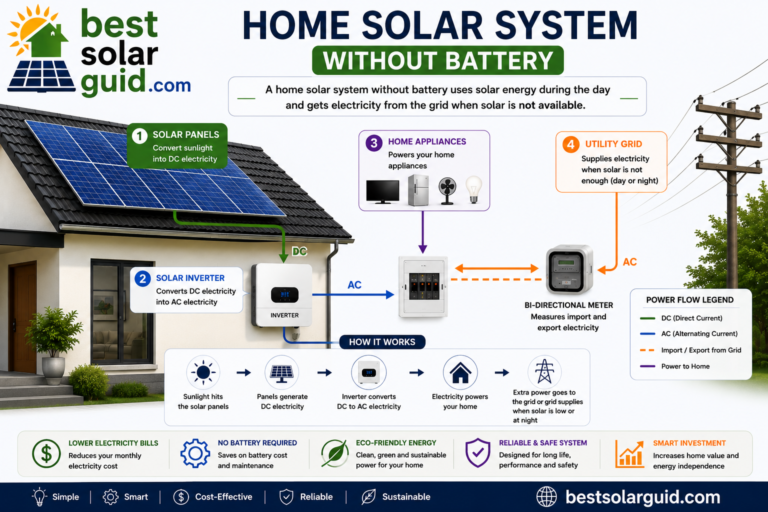
That is the big difference from a grid-tied system, which sends extra power to the grid and pulls it back when needed. With off-grid, your battery is the safety net. This is why planning matters so much more.
If you want to understand the grid-connected option, read our guide to what is a grid-tied solar inverter and how it works.
Off-Grid, On-Grid or Hybrid: What Suits Pakistan?
Before you choose, understand the three options.
| System | Battery? | Works in load shedding? | Best for |
|---|---|---|---|
| On-grid | No | No (shuts down when the grid goes) | Homes with steady supply who want lower bills |
| Hybrid | Yes | Yes | City homes and shops with regular outages |
| Off-grid | Yes | Yes, fully independent | Farms, remote houses, areas with no or very weak supply |
Most city homes in Pakistan stay connected to the grid, because the grid works as a free backup. Full off-grid makes sense mainly where there is no dependable connection, or where you want complete independence.
There is another reason many buyers now lean towards batteries. Under Pakistan’s 2026 net billing rules, you pay the normal retail tariff for imported units, while exported units are credited at the national average energy purchase price. In simple words, one exported unit is worth less than one imported unit, so using your own solar power directly, or storing it, is usually smarter than exporting extra. Luminey
What Makes an Off-Grid Solar System “the Best”?
A good system does these five things:
- Covers your real daily energy use, not a guess.
- Survives your worst weather, such as foggy winter days or monsoon clouds.
- Starts heavy appliances like fridges, water pumps and ACs without tripping.
- Can grow later, so adding a battery or panels does not mean starting from zero.
- Has local support, with spare parts and a technician nearby.
The last point is often forgotten. A famous brand that nobody in your city can repair is a worse choice than a solid brand you can service within a week.
The Main Parts of an Off-Grid System
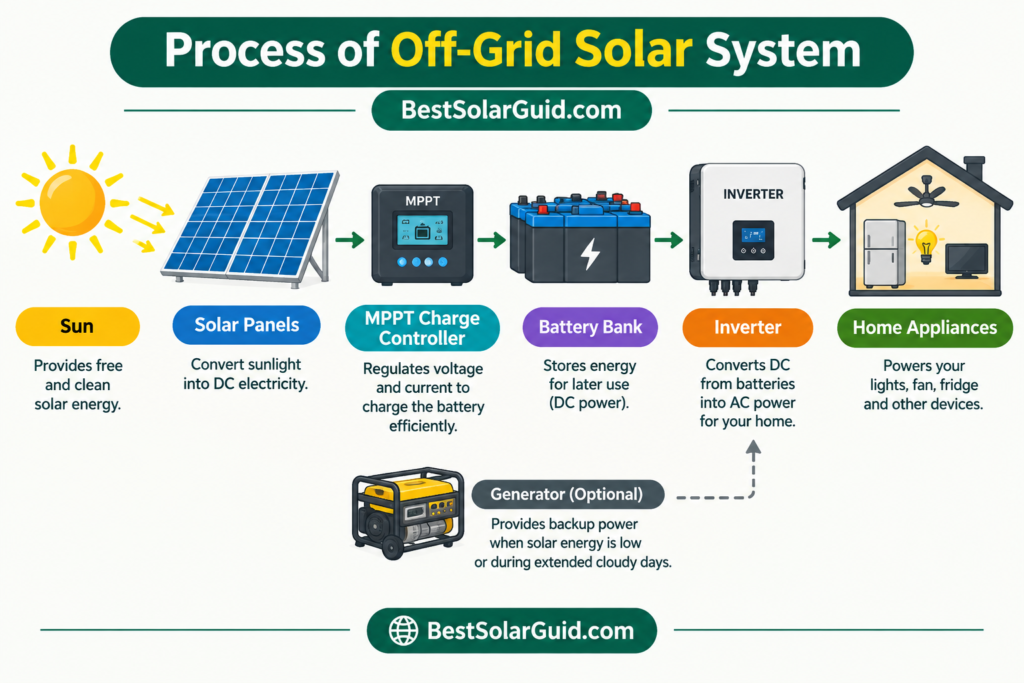
Solar panels turn sunlight into DC power. More panels means faster charging and better performance in weak light.
Charge controller (MPPT) sits between panels and battery. It protects the battery and gets extra energy out of the panels. Most off-grid inverters have one built in.
Battery bank stores energy for night and cloudy days. It is usually the most costly part and decides how comfortable daily life will be.
If you are comparing battery sizes, check our guide to 5 kWh batteries to understand how much energy they can store and what they can power.
Inverter changes battery DC power into AC power for your appliances. Its size decides what you can run at the same moment.
Choosing the right inverter is important for an off-grid system, so you can also compare the best solar inverters for different system sizes.
Structure, cables, breakers and earthing are not exciting, but poor wiring is a top reason systems fail or become unsafe.
Monitoring (an app or display) shows battery level, solar input and usage, so you can catch problems early.
How to Size Your System in 4 Steps
This is the part most guides rush. Here is a plain method with an example.
Step 1: Find your daily energy use
Multiply each appliance’s watts by the hours you use it, then add everything up. You can also take your monthly units (kWh) from your electricity bill and divide by 30.
Example: your home uses about 10 kWh per day.
Step 2: Size the battery
Decide how many days of backup you want. For many Pakistani homes on a weak grid, one day of backup is a practical start. In remote off-grid homes, plan for two days or more.
Example: 10 kWh × 2 days = 20 kWh. Batteries should not be drained to zero, so with lithium iron phosphate (LiFePO4) plan for roughly 22 to 24 kWh in total.
Step 3: Size the solar panels
Divide daily use by your area’s peak sun hours, then add about 25% for system losses. Much of Pakistan gets strong sun for most of the year, but foggy winter days in Punjab and northern areas can cut output sharply.
Example: 10 kWh ÷ 5 sun hours = 2 kW, plus losses = about 2.5 kW. Because of winter, aim for 3.5 to 4 kW of panels.
Size for your worst month, not your best. Sizing for summer and then being disappointed in December is the most common story.
Step 4: Size the inverter
Add the watts of everything that may run together. Then check the startup surge of motors, because fridges, pumps and ACs can pull two to three times their normal power for a moment.
Example: fridge, fans, lights, TV, laptop and a water pump together may need 2.5 kW running and 4 kW at startup. A 5 kW inverter would handle this comfortably.
Which Battery Is Best in Pakistan?
| Battery type | Lifespan | Upkeep | Upfront cost | Verdict |
|---|---|---|---|---|
| LiFePO4 lithium | Long | Very low | Higher | Best choice for most buyers |
| Tubular lead-acid | Shorter | Regular water checks | Lower | Fine for tight budgets |
| AGM / Gel | Medium | Low | Medium | Small or backup use |
Two Pakistan-specific tips:
- Heat is the enemy. Summer temperatures shorten battery life. Keep batteries in a shaded, ventilated spot, never on a hot rooftop or in a closed metal box.
- Check communication. Choose a battery that talks to the inverter through its BMS, so charging is automatic and safe.
Always read the warranty. A good one states the number of cycles and the capacity the battery must still hold, not only the number of years.
How to Choose the Right Inverter
- Pure sine wave output protects fridges, TVs and computers.
- Continuous and surge rating should match your loads, as shown in the sizing steps.
- Battery voltage. Larger systems work better at 48V because it needs thinner cables and wastes less energy. Small systems may use 12V or 24V.
- Built-in MPPT cuts the number of boxes to install.
- Generator input helps if you plan to add a generator later.
- Approved and supported. Prefer brands that are sold and serviced locally, with a clear warranty.
How Much Does an Off-Grid Solar System Cost in Pakistan?
Prices in Pakistan change often, and most public figures come from sellers’ own pages, so treat these as a planning guide and ask for written quotes.
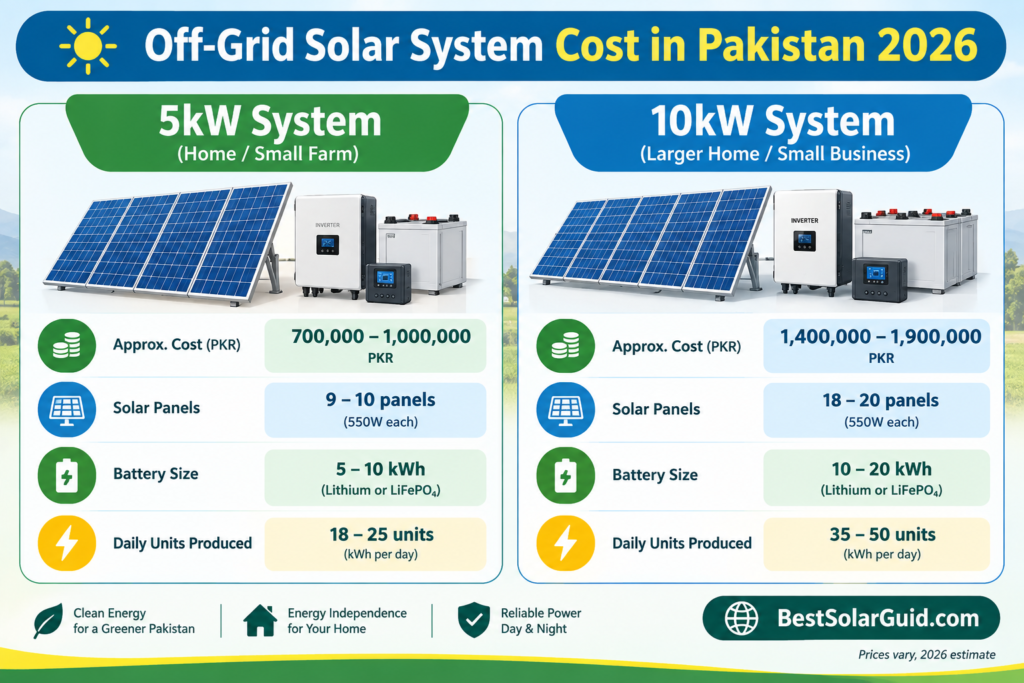
Approximate cost by system size
3kW to 5kW (small to medium homes)
- Seller listings for a 5kW system run from about PKR 550,000 for basic on-grid to PKR 1,700,000 for premium hybrid systems with batteries. Solar-price
- Another installer puts a 5kW hybrid system with a lithium battery at roughly PKR 771,000 to 1,093,000 installed. Free Energy
- A 5kW system is about 8 to 10 panels and suits homes using roughly 400 to 700 units a month. Hajvery Solar
10kW (large homes, offices, small shops)
- One guide gives a complete 10kW range of PKR 850,000 to 2.8 million, with hybrid lithium systems at PKR 1.3 to 2.8 million. Luminey
- Another seller lists a 10kW hybrid with lithium at about PKR 1.4 to 1.7 million. Free Energy
- For fully independent systems in remote areas, one listing shows PKR 1.35 million to 1.50 million or more. Solar Panel Rates
- A well-designed 10kW system can produce about 35 to 45 units a day in Pakistan. Luminey
Where the money goes
- Inverter: off-grid inverters start around PKR 35,000 for small models and reach PKR 300,000 or more for 10kW-class units, with 5kW to 6kW models listed at PKR 100,000 to 250,000. W11Stop
- Battery: usually the biggest single cost in an off-grid setup. Its price depends mostly on kWh capacity and brand.
- Panels and structure: depends on panel brand, wattage and whether you need an elevated mounting frame.
- Wiring, protection and installation: never skip this. It often adds a meaningful share on top of equipment.
Why quotes look so different
One installer notes that a very low quote may simply leave out the battery, protection devices, or installation work that another seller includes. Compare quotes line by line: panel brand and watts, inverter model, battery kWh and brand, structure, cables, breakers, earthing and installation. Luminey
Ways to keep the cost down
- Reduce your load first. Inverter ACs, LED lights and an efficient fridge can shrink the system you need.
- Size the battery for realistic backup, not a once-a-year worst case.
- Choose an inverter and battery that are proven to work together.
- Ask each installer for an itemised quote and a written warranty.
Do You Still Need a Backup Generator?
For fully off-grid homes, often yes. Some stretches of monsoon or fog are long enough that covering them with extra panels and batteries would double your cost. A small generator that starts automatically when the battery drops is usually the cheaper answer. Think of it as insurance, not failure. A well-sized system should still run on solar alone for most of the year.
Common Mistakes to Avoid
- Sizing from a brochure, not from your bills. Measure first.
- Ignoring winter fog and monsoon clouds. Plan for your weakest month.
- Buying a battery with no proper BMS or warranty. Cheap unbranded cells can cost more in the end.
- Choosing an inverter too small for startup surges. The fridge or pump will suffer.
- Mixing old and new batteries. They drag each other down.
- Thin cables and loose connections. They waste energy and can cause fires.
- Shade and dust on panels. Even a small shadow or a dusty surface cuts output, so clean panels regularly.
- Leaving no room to grow. Pick a system that allows more batteries and panels later.
- Skipping safety gear. Use proper fuses, breakers, surge protection and earthing.
- Choosing only the cheapest quote. Check what it leaves out.
Quick Buying Checklist
- I know my daily kWh use and peak load.
- I sized for winter sun and 1 to 3 days of backup.
- The battery is LiFePO4, or I have a clear reason to choose another type.
- The inverter is pure sine wave and handles my startup surges.
- The inverter and battery are confirmed compatible.
- The warranty covers cycles and remaining capacity, not just years.
- Spare parts and a technician are available in my city.
- The quote includes structure, wiring, protection and installation.
- I compared at least three itemised quotes.
Frequently Asked Questions
What is the best off-grid solar system for a home in Pakistan?
For most homes, a system with LiFePO4 batteries, an MPPT charge controller and a pure sine wave inverter works best. Size it from your own daily use and winter sunlight, not from a general “5kW fits everyone” claim.
How much does a 5kW off-grid solar system cost in Pakistan?
Listings vary widely. One installer quotes about PKR 771,000 to 1,093,000 for a 5kW hybrid system with a lithium battery, while other seller listings range up to PKR 1,700,000 for premium hybrid setups. The battery and brand choices cause most of the difference .
How much does a 10kW solar system cost in Pakistan?
One guide puts a complete 10kW system between PKR 850,000 and 2.8 million, with hybrid lithium systems costing more than plain on-grid. Ask for an itemised quote to see exactly what is included.
How many solar panels do I need to go off-grid?
It depends on daily use and sun hours. A home using 10 kWh a day usually needs about 3.5 to 4 kW of panels once you plan for winter, which is roughly 9 to 10 panels of 400 to 450 watts each.
How big should my battery be?
Multiply daily use by the backup days you want, then add a small buffer. For 10 kWh a day and two days of backup, plan for about 22 to 24 kWh of lithium capacity.
Is lithium or tubular battery better for solar in Pakistan?
Lithium is better for most buyers because it lasts longer, needs almost no maintenance and gives more usable energy. Tubular batteries cost less upfront but need water checks and usually get replaced sooner.
Can I run an air conditioner on an off-grid solar system?
Yes, but plan for it. An AC has a high startup surge and drains batteries fast. An inverter-type AC uses far less power, and a bigger inverter and battery bank will be needed if you run it for many hours.
Do I need a generator with my off-grid system?
Not always, but it helps in places with long cloudy or foggy spells. An auto-start generator is often cheaper than oversizing panels and batteries.
What is the difference between off-grid and hybrid solar?
Off-grid has no connection to the utility at all. Hybrid stays connected to the grid but also has a battery, so it can use the grid when available and the battery during outages.
How long does an off-grid solar system last?
Panels often last 25 years or more. One installer lists inverters at roughly 8 to 12 years and lithium batteries at roughly 5 to 10 years, depending on use and depth of discharge. Good installation and cooling help all of them last longer.
Can I install an off-grid system myself?
Small portable units are often DIY-friendly. For larger systems with high-voltage DC and big batteries, use a qualified installer. Wrong wiring can cause fires and may void warranties.
How do I make my system last longer?
Keep batteries cool, avoid draining them fully every day, clean the panels, check connections once or twice a year, and watch your monitoring app for early warning signs.
Final Thoughts
The best off-grid solar system in Pakistan is the one that is sized honestly, built from compatible parts, and backed by support you can reach. Measure your real usage, plan for your weakest month, choose LiFePO4 batteries and a properly rated inverter, and compare itemised quotes.
Do that, and you get what solar promises: steady power, lower stress during outages, and freedom from unpredictable bills.