400 Watt Solar Panel: Complete Guide to Size, Output, Efficiency, Cost & Uses in 2026
A 400 watt solar panel is a popular photovoltaic (PV) panel designed to produce up to 400 watts of electrical power under standard test conditions. It can be used for homes, small solar systems, RVs, cabins, off-grid applications, and commercial projects.
Although newer solar panels with 500W, 600W, and even higher power ratings are increasingly common, 400W solar panels remain useful because they offer a good balance between power output, physical size, efficiency, and installation flexibility.
But does a 400W solar panel actually produce 400 watts all day? How much electricity can it generate? How many 400W panels do you need for a home? What battery and inverter can you use with it? And is a 400 watt solar panel still worth buying in 2026?
This complete guide answers all of these questions.
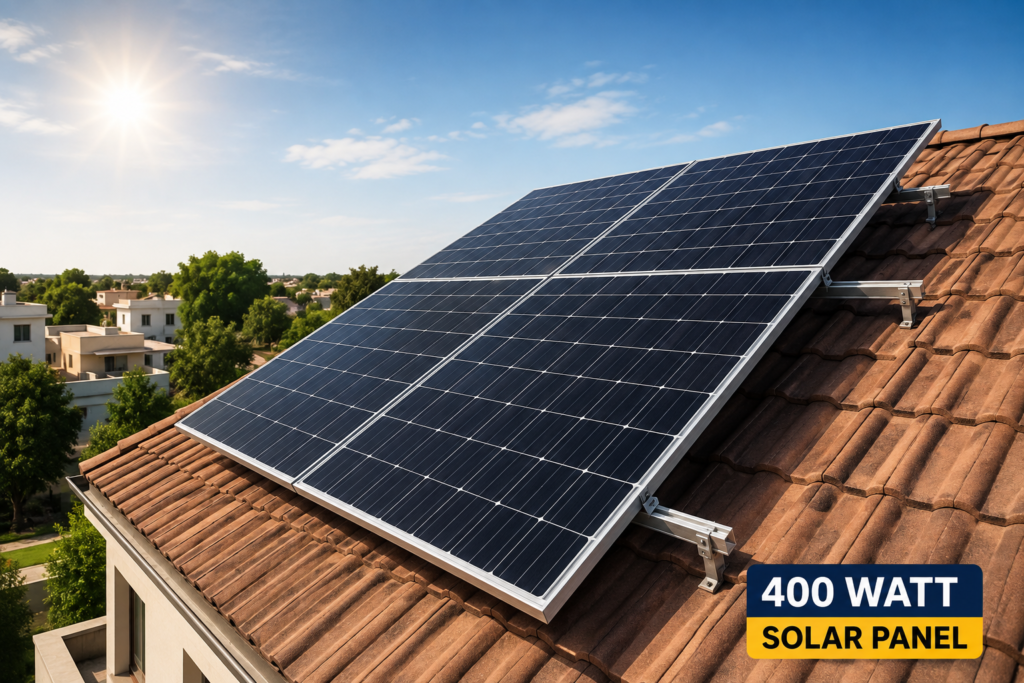
Table of content
- What Is a 400 Watt Solar Panel?
- How Much Electricity Does a 400W Solar Panel Produce?
- How Many Units of Electricity Can a 400W Panel Generate?
- 400W Solar Panel Size and Dimensions
- 400W Solar Panel Efficiency
- What Technology Is Used in 400W Solar Panels?
- 400W Monocrystalline Solar Panel
- 400W Solar Panel Voltage and Current
- What Is the Difference Between 400W and 500W Solar Panels?
- How Many 400W Solar Panels Do You Need?
- Can a 400W Solar Panel Power a House?
- Can a 400W Solar Panel Run a Refrigerator?
- 400W Solar Panel With Battery
- 400W Solar Panel for RVs
- 400W Solar Panel for Off-Grid Systems
- 400W Solar Panel for Home Use
- Factors That Affect 400W Solar Panel Output
- How Long Do 400W Solar Panels Last?
- What Should You Check Before Buying a 400W Solar Panel?
- Advantages of 400W Solar Panels
- Disadvantages of 400W Solar Panels
- 400W Solar Panel vs 550W Solar Panel
- 400W Solar Panel Price
- 400W Solar Panels in Pakistan
- 400W Portable Solar Panel Price in Pakistan (2026)
- Frequently Asked Questions
- Final Verdict
What Is a 400 Watt Solar Panel?
A 400 watt solar panel is a solar module with a maximum rated power output of 400 watts under Standard Test Conditions (STC).
The panel uses photovoltaic cells to convert sunlight into direct-current (DC) electricity. That electricity can then be used directly by compatible equipment, sent through a solar inverter to power AC appliances, or stored in a battery for later use.
The important point is that 400 watts is the panel’s rated maximum power, not the amount of electricity it produces continuously throughout the day.
Actual output changes depending on:
- Amount of sunlight
- Time of day
- Weather
- Panel orientation
- Installation angle
- Temperature
- Dust and dirt
- Shading
- Cable losses
- Inverter efficiency
- Panel condition
A 400W panel may reach close to its rated output around the strongest part of a sunny day under favorable conditions, but its power will normally be lower during mornings, evenings, cloudy weather, or very hot conditions.
How Much Electricity Does a 400W Solar Panel Produce?
A 400W solar panel has a rated capacity of 0.4 kilowatts (kW).
A simple theoretical calculation is:
400 watts × peak sunlight hours = daily energy production
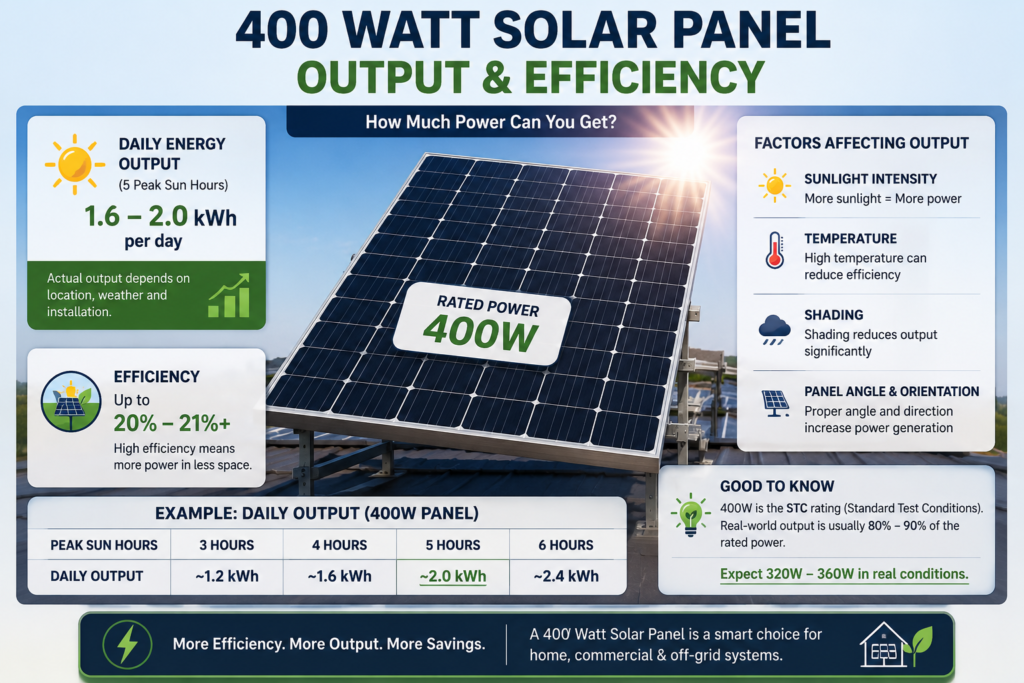
For example, if a location receives 5 peak sun hours:
400W × 5 hours = 2,000Wh
That equals:
2 kWh per day
However, this is only an estimate. Real-world production will normally be lower because of temperature, wiring, inverter, dust, shading, orientation, and other system losses.
A useful planning formula is:
Daily energy = Panel wattage × Peak sun hours × System efficiency
For example:
400W × 5 × 0.80 = 1,600Wh
So the panel might produce around 1.6 kWh of usable energy per day under those assumed conditions.
The actual result will vary significantly by location and installation.
How Many Units of Electricity Can a 400W Panel Generate?
Electricity companies often measure energy in kilowatt-hours (kWh). One kWh is commonly called one “unit” of electricity.
If a 400W panel produces approximately 1.6–2.0 kWh per day under favorable conditions, that would equal roughly:
- 1.6–2.0 units per day
- 48–60 units per month
- 584–730 units per year
These are illustrative estimates, not guaranteed production figures.
Your actual annual production can be considerably different depending on your location, weather, system orientation, shading, and equipment.
400W Solar Panel Size and Dimensions
There is no single universal physical size for a 400W solar panel.
Modern 400W residential panels commonly use a form factor around 1.7–1.8 meters long and approximately 1.1 meters wide, although exact dimensions vary by manufacturer and model. Older 72-cell 400W panels can be longer and narrower.
A modern example may be approximately:
- Length: 1.65–1.78 m
- Width: 1.0–1.14 m
- Thickness: around 30–40 mm
- Weight: approximately 18–25 kg
Always check the manufacturer’s datasheet before purchasing because two panels with the same 400W rating can have different dimensions and weights.
Why Panel Size Matters
Panel dimensions are important when planning:
- Rooftop solar systems
- RV installations
- Balcony solar
- Ground-mounted systems
- Small rooftops
- Limited installation spaces
A higher-efficiency 400W panel may produce the same rated power using a smaller physical footprint than an older, less-efficient panel.
This is one reason efficiency should be considered together with wattage.
400W Solar Panel Efficiency
Solar panel efficiency tells you how effectively a panel converts sunlight into electricity.
Many modern residential panels in the 400W class fall around the 20%–22% efficiency range, although exact efficiency varies between models and technologies.
For example:
- Panel A: 400W at 19% efficiency
- Panel B: 400W at 22% efficiency
Both are rated at 400W under STC, but Panel B can achieve that output with a smaller or more power-dense surface area.
Is Higher Efficiency Always Better?
Not necessarily.
If you have plenty of roof space, the difference in efficiency may be less important than:
- Price
- Warranty
- Degradation rate
- Temperature coefficient
- Build quality
- Manufacturer reputation
- Availability of replacement panels
If your roof space is limited, however, higher efficiency becomes more valuable because you can generate more power from the same area.
What Technology Is Used in 400W Solar Panels?
400W panels can use different solar-cell technologies.
Monocrystalline 400W Solar Panels
Monocrystalline panels are widely used in residential solar systems.
They generally offer:
- High efficiency
- Good power density
- Long operating life
- Strong performance in modern rooftop designs
For many homeowners, a 400W monocrystalline panel is a practical choice.
TOPCon Solar Panels
TOPCon is a newer high-efficiency solar-cell technology that has become increasingly common in the solar market.
TOPCon modules can provide strong efficiency and improved performance characteristics compared with many older-generation panels.
If you are buying a 400W panel in 2026, it is worth checking whether the model uses newer cell technology rather than focusing only on the wattage.
PERC Solar Panels
PERC technology was widely used in previous generations of solar panels and remains available in some markets.
However, the solar industry has increasingly moved toward newer technologies, including TOPCon and other high-efficiency cell architectures.
400 Watt Bifacial Solar Panels
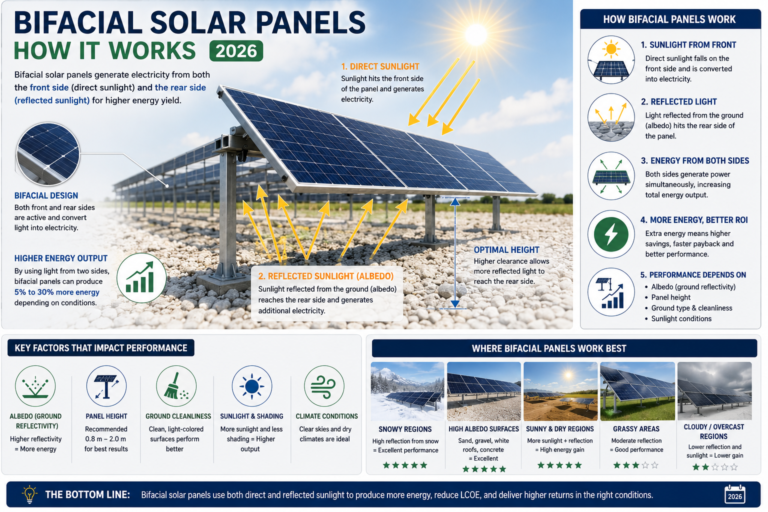
400 watt bifacial solar panels can generate electricity from both the front and rear sides of the panel by capturing direct and reflected sunlight. They can be particularly useful in locations with reflective surfaces, such as light-colored roofs, ground-mounted systems, or areas with high solar exposure. For a more detailed explanation, see our guide to bifacial solar panels.
400W Monocrystalline Solar Panel
A 400W monocrystalline solar panel is a panel that combines a 400W power rating with monocrystalline solar cells.
these panels are commonly suitable for:
- Residential rooftops
- Small off-grid systems
- RVs
- Cabins
- Small commercial installations
- Solar backup systems
The main advantage is the combination of relatively high power output and good efficiency without requiring an extremely large panel.
400W Solar Panel Voltage and Current
Wattage alone is not enough when designing a solar system.
You also need to understand:
- Voc — Open-circuit voltage
- Vmp — Voltage at maximum power
- Isc — Short-circuit current
- Imp — Current at maximum power
A typical 400W module may have operating voltage in the roughly 30–40V range and current around 10–13A, but the exact specifications vary significantly by model.
For example, a panel might have specifications similar to:
| Specification | Example |
|---|---|
| Rated power | 400W |
| Maximum power voltage (Vmp) | ~30–40V |
| Maximum power current (Imp) | ~10–13A |
| Open-circuit voltage (Voc) | ~35–50V |
| Short-circuit current (Isc) | ~10–14A |
| Efficiency | ~19–22% |
| Technology | Monocrystalline |
These numbers are examples, not universal specifications. Always use the exact manufacturer’s datasheet when designing a system.
What Is the Difference Between 400W and 500W Solar Panels?
The biggest difference is their rated power.
| Feature | 400W Panel | 500W Panel |
| Rated power | 400W | 500W |
| Number needed for 4kW | 10 | 8 |
| Number needed for 5kW | 13 | 10 |
| Roof area | Usually smaller | Often larger |
| Energy per panel | Lower | Higher |
| Installation flexibility | Good | Depends on size |
| Availability in 2026 | Still available | Increasingly common |
A 500W panel is not automatically better.
For example, if a 500W panel is substantially larger and your roof has difficult dimensions, several 400W panels may fit the available space more efficiently.
The correct choice depends on power density, roof dimensions, electrical compatibility, price, and availability.
How Many 400W Solar Panels Do You Need?
The number of panels depends on the size of the solar system you want.
For a 1kW Solar System
Each panel = 400W
1,000 ÷ 400 = 2.5
Therefore, you would need 3 panels, giving:
3 × 400W = 1,200W
For a 2kW Solar System
2,000 ÷ 400 = 5
You need:
5 × 400W = 2,000W
For a 3kW Solar System
3,000 ÷ 400 = 7.5
You would need:
8 panels = 3,200W
For a 4kW Solar System
4,000 ÷ 400 = 10
You need:
10 panels = 4,000W
For a 5kW Solar System
5,000 ÷ 400 = 12.5
You would need:
13 panels = 5,200W
However, the final number should not be selected using wattage alone. The inverter’s MPPT voltage and current limits, maximum PV input, panel Voc, temperature effects, and local electrical requirements must also be considered.
Can a 400W Solar Panel Power a House?
A single 400W solar panel is not enough to power an entire modern home.
It can contribute useful electricity, but a typical home requires multiple panels.
For example, a 400W panel could help supply energy for smaller loads such as:
- LED lighting
- Fans
- Wi-Fi equipment
- Small electronics
- Charging devices
- Some DC appliances
The actual appliances it can run depend on their power consumption and whether the system includes batteries and an inverter.
For a complete home solar system, multiple panels are normally required.
Can a 400W Solar Panel Run a Refrigerator?
It can contribute enough daily energy to operate a refrigerator, but the answer is not as simple as comparing 400W with the refrigerator’s rated wattage.
Refrigerators cycle on and off, and their compressor can draw higher power when starting.
A practical system may therefore require:
- Solar panel capacity
- Proper inverter
- Battery storage if backup is required
- Appropriate surge capacity
- Correct wiring and protection
A single 400W panel may generate enough energy over a day to contribute significantly to refrigerator consumption in a suitable location, but it does not guarantee uninterrupted operation.
400W Solar Panel With Battery
A 400W panel can be connected to a battery-based solar system through a suitable solar charge controller or compatible inverter.
For example, a small off-grid system might contain:
400W solar panel → MPPT charge controller → battery → inverter → AC appliances
The battery stores excess solar energy during the day so it can be used when sunlight is unavailable.
What Battery Size Is Suitable for a 400W Panel?
There is no single battery size that is correct for every 400W panel.
Battery selection depends on:
- Daily energy consumption
- Desired backup time
- Battery voltage
- Battery chemistry
- Charge-controller limits
- Solar availability
- Inverter size
For example, a 400W panel connected to a 12V battery system can provide useful charging power, but the charge controller must be correctly sized for the panel’s voltage and current.
400W Solar Panel Without a Battery
A 400W panel can also be used in a battery-free solar system.
In a grid-connected system, solar electricity can be converted into AC electricity by a grid-tied inverter and used by household appliances.
The basic arrangement is:
Solar panel → Grid-tied inverter → Home loads → Utility grid
During sunny periods, the solar system can reduce the amount of electricity purchased from the grid.
However, a typical grid-tied system does not automatically provide backup power during a grid outage. Backup operation requires equipment specifically designed for that purpose.
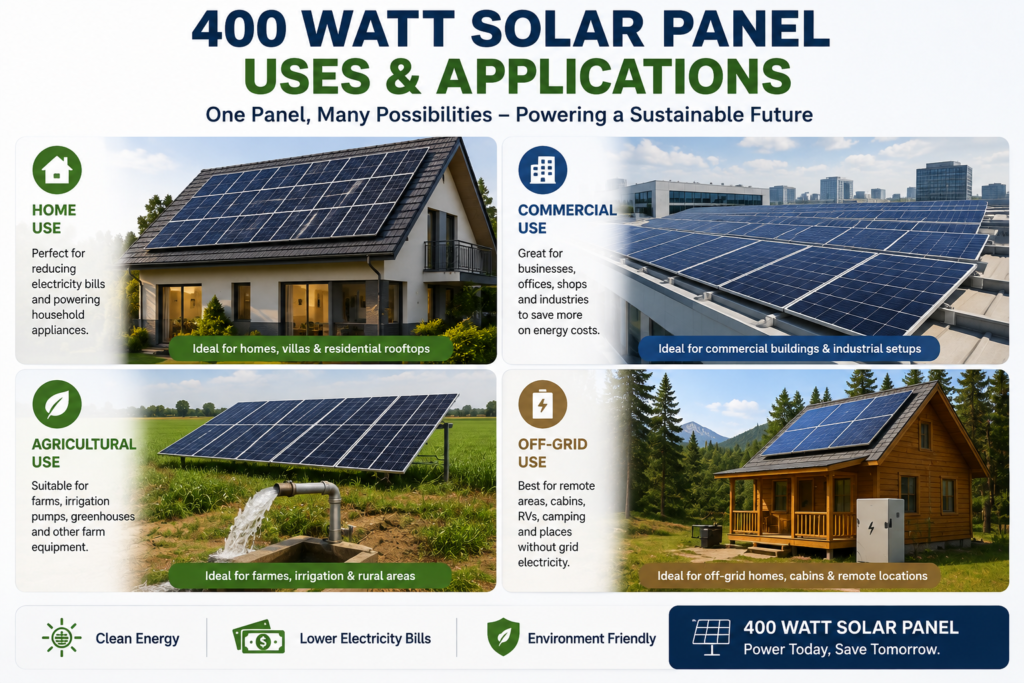
400W Solar Panel for RVs
400W is also a useful solar capacity for RV and camper applications.
An RV system could use:
- One 400W panel
- MPPT charge controller
- Battery bank
- Inverter
- DC loads
However, the panel must physically fit the available roof space.
Flexible 400W panels are another option for some mobile applications, although rigid panels are generally more robust for permanent installations.
400W Solar Panel for Off-Grid Systems
A 400W panel can be useful in small off-grid systems for:
- Cabins
- Remote buildings
- Small farms
- Security systems
- Water pumping applications
- Remote communications
- Outdoor equipment
For an off-grid system, battery capacity becomes particularly important because solar production and electricity demand do not always occur at the same time.
400W Solar Panel for Home Use
For homeowners, a 400W panel is best viewed as one building block of a larger solar array.
For example:
10 × 400W panels = 4kW solar array
The final system size should be based on your home’s electricity consumption, available roof space, local sunlight conditions, inverter requirements, and desired energy production.
Factors That Affect 400W Solar Panel Output
A panel’s 400W rating is measured under standardized laboratory conditions. Real-world output can be different.
1. Sunlight
More solar irradiance generally means more power.
2. Temperature
Solar panels normally lose power as cell temperature rises above the reference test temperature.
The temperature coefficient listed on the datasheet helps estimate this effect.
3. Shading
Even partial shading can significantly reduce output depending on the panel design and system configuration.
4. Dust and Dirt
Dust, bird droppings, and other deposits can block sunlight and reduce generation.
5. Panel Angle
The panel should be positioned appropriately for its location to maximize annual solar exposure.
6. Orientation
The best orientation depends on geographic location and system design.
7. System Losses
Energy can also be lost through:
- Wiring
- Connectors
- Inverter conversion
- Charge controllers
- Mismatch between modules
This is why actual electricity production should never be calculated from the 400W rating alone.
How Long Do 400W Solar Panels Last?
A quality solar panel is designed for long-term outdoor operation and can continue producing electricity for decades.
However, solar panels gradually degrade over time.
This means a panel that initially produces a certain amount of power will slowly produce slightly less as it ages.
When buying a 400W panel, look for:
- Product warranty
- Performance warranty
- Annual degradation rate
- Manufacturer reputation
- Certification
- Resistance to environmental conditions
A good warranty is often more useful than simply choosing the panel with the highest wattage.
What Should You Check Before Buying a 400W Solar Panel?
Don’t choose a panel based only on the “400W” label.
Check the following specifications.
1. Power Rating
Confirm that the panel is genuinely rated at 400W under STC.
2. Efficiency
Higher efficiency can be valuable when roof space is limited.
3. Dimensions
Measure the available installation area before buying.
4. Weight
Make sure the mounting structure can safely support the panel.
5. Voc and Vmp
These values must be compatible with your inverter or charge controller.
6. Isc and Imp
These current ratings are important for correct electrical system design.
7. Temperature Coefficient
A better temperature coefficient can help maintain output during hot conditions.
8. Warranty
Check both the product warranty and performance warranty.
9. Certifications
Look for appropriate safety and quality certifications for your market.
10. Manufacturer Datasheet
Always verify specifications using the manufacturer’s official datasheet rather than relying solely on a seller’s advertisement.
Advantages of 400W Solar Panels
400W solar panels offer several advantages.
Good Power Output
A single panel provides a useful amount of power for residential and small solar systems.
Fewer Panels Than Older Low-Wattage Modules
Compared with 250W or 300W panels, a 400W module can reduce the number of panels needed for the same total system capacity.
Good Roof Utilization
Modern 400W panels can provide a strong balance between physical size and power output.
Wide Range of Applications
They can be used in homes, RVs, cabins, small commercial systems, and off-grid applications.
Easy System Expansion
A system can sometimes be expanded by adding additional compatible panels, provided the inverter and electrical design allow it.
Disadvantages of 400W Solar Panels
There are also some disadvantages.
They Are No Longer the Highest-Wattage Option
In 2026, many newer residential and commercial solar panels are available at significantly higher wattages.
Availability Can Vary
Some markets increasingly focus on 500W+ panels, meaning certain 400W models may become harder to find.
Larger Than Small Portable Panels
A rigid 400W panel can be too large for some small portable applications.
Wattage Does Not Guarantee Energy Production
A 400W rating does not mean the panel produces 400W continuously.
Are 400W Solar Panels Still Worth It in 2026?
Yes, but it depends on your project.
For a new large rooftop installation, higher-wattage modules may reduce the number of panels and potentially simplify some installation layouts.
However, a 400W panel can still be a very good choice when:
- You have a small or irregular roof
- You are replacing an existing panel
- You need a particular physical size
- You are building a small solar system
- You need compatibility with existing equipment
- A quality 400W panel is available at a good price
The best solar panel is not necessarily the one with the highest wattage. The best panel is the one that provides the right combination of power, efficiency, size, quality, price, warranty, and compatibility for your system.
400W Solar Panel vs 550W Solar Panel
The solar market has moved toward larger modules in many regions.
A 550W panel can produce more power per module than a 400W panel, meaning fewer panels may be required for the same total array capacity.
For example:
4,000W system
Using 400W panels:
4,000 ÷ 400 = 10 panels
Using 550W panels:
4,000 ÷ 550 ≈ 7.27
So approximately 8 panels would be required to exceed 4kW.
But physical dimensions, voltage, current, inverter compatibility, roof layout, and availability must also be considered.
400W Solar Panel Price
The price of a 400W solar panel varies significantly depending on:
- Country
- Brand
- Cell technology
- Efficiency
- Warranty
- New or used condition
- Market supply
- Shipping
- Taxes and import costs
For this reason, it is better to compare price per watt rather than looking only at the price of one panel.
The formula is:
Price per watt = Panel price ÷ Panel wattage
For example, if a 400W panel costs $100:
$100 ÷ 400 = $0.25 per watt
This makes it easier to compare panels with different wattage ratings.
400W Solar Panels in Pakistan
400W solar panels can still be found in Pakistan, although the local market has increasingly shifted toward higher-wattage modules.
Current market sources indicate that 550W–580W and higher panels are now more common in many Pakistani solar installations, while 400W panels remain useful for smaller systems and specific installation requirements.
If you are buying a 400W panel in Pakistan, compare:
- Price per watt
- Panel technology
- Manufacturer
- Efficiency
- Warranty
- Dimensions
- Availability of matching panels
- Inverter compatibility
Don’t choose a panel only because its advertised price is low.
400W Portable Solar Panel Price in Pakistan (2026)
A 400W foldable/portable solar panel is the go-to choice for off-grid basecamps, larger power stations, and running appliances like camping fridges. In Pakistan, prices depend heavily on whether you go local/generic or an imported branded panel, since branded units carry import duty, sales tax, and currency conversion costs on top of the base price.
| Panel Type / Brand | Wattage | Approx. Price (PKR) |
|---|---|---|
| Local/generic foldable (Daraz, Hall Road) | 400W | Rs. 60,000 – 90,000 |
| Renogy 400W Foldable Suitcase (imported) | 400W | Rs. 100,000 – 140,000 |
| MHPOWOS / generic Chinese brand (imported) | 400W | Rs. 90,000 – 130,000 |
| Anker SOLIX PS400 (imported, premium) | 400W | Rs. 220,000 – 280,000 |
| Jackery SolarSaga 400W (imported, premium) | 400W | Rs. 230,000 – 290,000 |
| EcoFlow 400W (imported, premium) | 400W | Rs. 200,000 – 260,000 |
| Rigid 400W panel (non-portable, for comparison) | 400W | Rs. 16,000 – 34,000 |
Final Verdict: Should You Buy a 400W Solar Panel?
A 400 watt solar panel remains a practical and versatile solar module in 2026.
It offers a useful combination of power output, efficiency, manageable panel count, and broad application potential. While the market is moving toward higher-wattage modules, 400W panels can still make sense for homes, small solar systems, RVs, cabins, off-grid projects, and installations where panel size or compatibility matters.
Before buying, don’t focus only on the 400W number. Compare the panel’s efficiency, dimensions, voltage, current, temperature coefficient, degradation rate, warranty, certifications, price per watt, and compatibility with your inverter or charge controller.
The right solar panel is the one that works efficiently as part of the entire solar system—not simply the one with the biggest number printed on its label.
How much power does a 400W solar panel produce?
A 400W solar panel can produce up to 400 watts under Standard Test Conditions. Actual power output changes throughout the day depending on sunlight, temperature, shading, orientation, and system losses.
How many amps does a 400W solar panel produce?
The current depends on the panel’s voltage. Many 400W panels have a maximum-power current in roughly the 10–13A range, but you should always check the exact datasheet for the model you are buying.
How many 400W panels do I need for a 5kW system?
A simple calculation gives 12.5 panels, so you would normally need 13 × 400W panels, producing 5.2kW of nominal DC capacity. The final design must also account for inverter limits and electrical configuration.
Can one 400W solar panel power a refrigerator?
It may generate enough daily energy to contribute substantially to refrigerator operation, but uninterrupted operation also depends on the refrigerator’s consumption, starting surge, inverter, battery, and available sunlight.
Can a 400W solar panel charge a 12V battery?
Yes, a 400W panel can charge a 12V battery system when connected through an appropriately rated solar charge controller. The controller and wiring must be selected according to the panel’s actual voltage and current specifications.
How big is a 400W solar panel?
There is no universal size. Many modern residential 400W panels are approximately 1.7–1.8m long and around 1.1m wide, while other 400W designs can be significantly different. Always check the manufacturer’s datasheet.
Are 400W solar panels good for homes?
Yes. A 400W panel can be an excellent building block for a residential solar array, particularly where its dimensions, price, efficiency, and electrical characteristics fit the installation.
Are 400W solar panels outdated?
Not necessarily. They are no longer among the highest-wattage modules available in 2026, but they remain useful for residential, small-scale, mobile, and replacement applications.
How much electricity does a 400W solar panel produce per day?
Depending on location and conditions, a 400W panel may produce roughly 1.5–2.0+ kWh per day under favorable conditions. This is an estimate, not a guarantee.
Is a 400W solar panel better than a 500W panel?
Not automatically. A 500W panel has a higher power rating, but a 400W panel may be better for a particular roof or system if its dimensions, price, efficiency, warranty, and electrical characteristics are more suitable.
What are the dimensions of a 400W solar panel?
The dimensions depend on the panel’s technology and manufacturer. Before installation, check the product datasheet for the exact length, width, thickness, and weight.
What can a 400W solar panel power?
A 400W solar panel can generate electricity for small household appliances and electronic devices, depending on sunlight and daily energy consumption. It may help power devices such as lights, fans, routers, laptops, and other low-power appliances when sufficient solar energy is available.
How much does a 400W solar panel cost?
The price of a 400W solar panel varies by brand, technology, quality, and market conditions. Prices can also differ between Pakistan and other countries, so it is best to compare current prices from reputable suppliers.