Solar Plate Fitting in Islamabad: Cost, Process, Best Angle & Expert Tips (2026)
If you are planning solar plate fitting in Islamabad, choosing the right panels is only one part of the job. Proper fitting, mounting, wiring, panel direction, roof assessment, and safety protection are equally important for getting good performance from a solar system.
A poorly fitted solar panel can lose energy because of shading, an unsuitable angle, weak mounting, incorrect wiring, or poor ventilation. On the other hand, a professionally fitted system can produce reliable electricity for many years with relatively low maintenance.
This complete guide explains solar plate fitting in Islamabad, including the installation process, fitting cost, roof requirements, ideal panel direction and angle, mounting structures, wiring, safety precautions, common mistakes, and how to choose a reliable installer.
Quick answer: Solar plate fitting in Islamabad normally involves a site survey, roof and shading assessment, mounting-structure installation, solar panel fixing, DC/AC wiring, earthing and protection, inverter connection, testing, and system commissioning. The final fitting cost depends on system size, roof type, mounting structure, cable length, accessibility, and installation complexity.
Table of Contents
- What Is Solar Plate Fitting?
- Why Proper Solar Plate Fitting Matters
- Solar Plate Fitting Process in Islamabad
- Step-by-Step Solar Panel Installation
- Best Direction for Solar Plates in Islamabad
- What Is the Best Solar Panel Angle in Islamabad?
- Types of Solar Mounting Structures
- Solar Plate Fitting Cost in Islamabad
- What Is Included in Solar Installation Cost?
- Factors That Increase Fitting Cost
- Roof Requirements Before Solar Plate Fitting
- Shading Problems in Islamabad
- Solar Panel Wiring and Electrical Protection
- Earthing and Surge Protection
- How Long Does Solar Plate Fitting Take?
- Common Solar Installation Mistakes
- How to Choose a Solar Installer in Islamabad
- Solar Plate Fitting Checklist
- Maintenance After Installation
- Frequently Asked Questions
- Final Verdict
What Is Solar Plate Fitting?
Solar plate fitting means securely installing solar panels on a roof, mounting structure, or another suitable location and connecting them to the rest of the solar system.
In Pakistan, people commonly use the term solar plate for what is technically called a solar panel.
Solar plate fitting is more than simply placing panels on a roof. A proper installation includes:
- Checking the roof condition
- Measuring the available space
- Checking shade from trees and buildings
- Selecting the correct mounting structure
- Setting the panel direction and angle
- Securing the panels properly
- Connecting DC cables
- Installing electrical protection
- Providing proper earthing
- Connecting the panels to the inverter
- Testing the complete system
The goal is to create a solar installation that is safe, stable, weather-resistant, and capable of producing electricity efficiently.
Why Proper Solar Plate Fitting Matters
You can purchase high-quality solar panels, but poor installation can still reduce the performance of your entire system.
1. Better Energy Production
Solar panels need good exposure to sunlight. Incorrect orientation, unnecessary shading, or a poor installation angle can reduce electricity production.
2. Stronger Roof Installation
Islamabad can experience strong winds, rain, and seasonal weather changes. The mounting structure needs to be properly anchored and suitable for the roof.
3. Better Panel Ventilation
Panels should not be installed directly against the roof. A suitable mounting arrangement leaves space underneath the panels for airflow.
4. Reduced Electrical Risk
Correct DC/AC wiring, breakers, surge protection, and earthing are important parts of a safe installation.
5. Easier Maintenance
A well-planned installation makes it easier to inspect, clean, repair, and replace components later.
Solar Plate Fitting Process in Islamabad
A professional solar installation usually follows these stages:
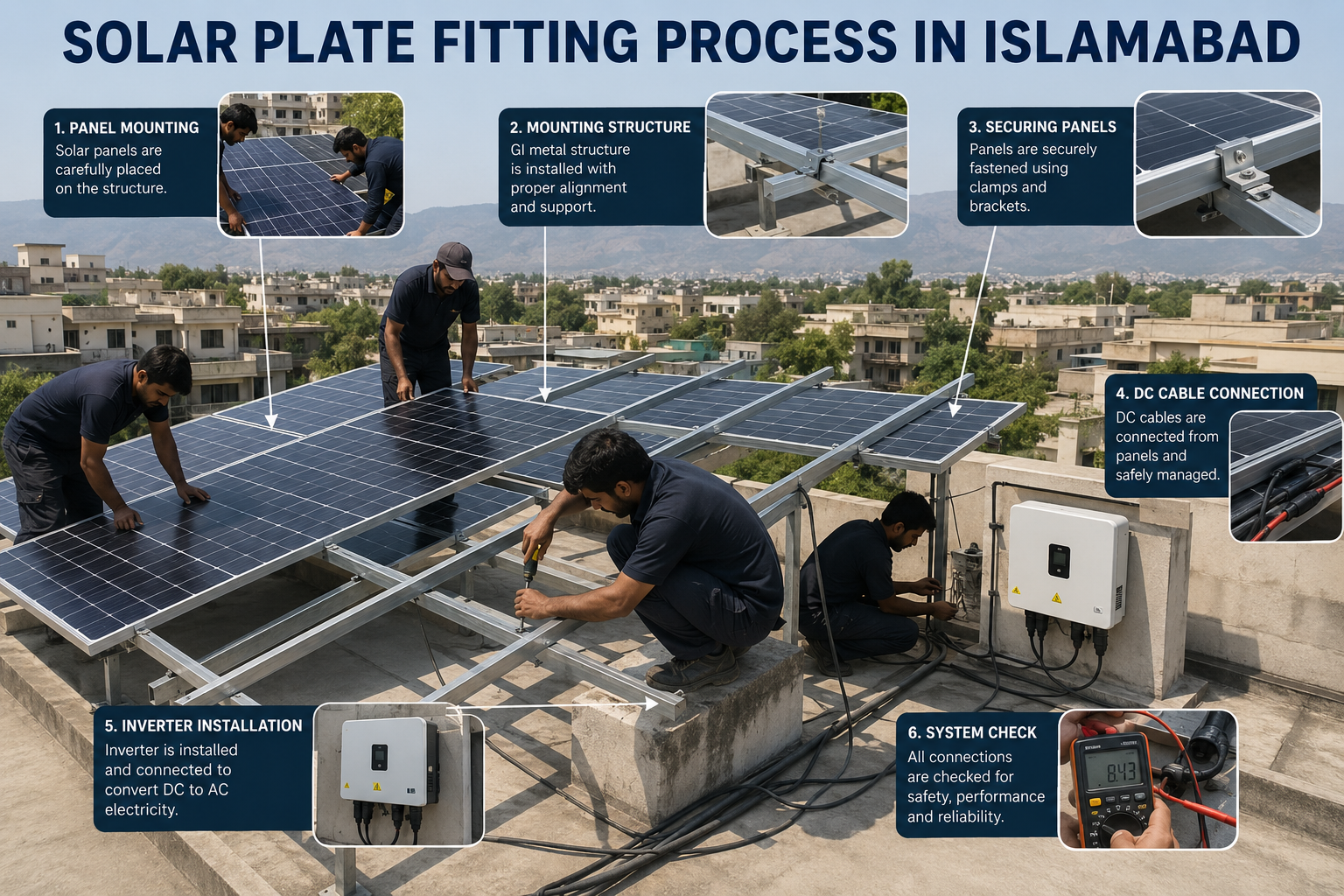
Site Survey → Energy Assessment → Roof Inspection → System Design → Mounting Structure → Panel Fitting → Wiring → Protection & Earthing → Inverter Connection → Testing → Commissioning
Let’s look at each stage.
Step 1: Site Survey
Before fitting the panels, the installer should inspect your property.
The survey should consider:
- Roof size
- Roof type
- Available installation area
- Direction of the roof
- Possible shading
- Roof strength
- Access to the roof
- Distance between panels and inverter
- Cable route
- Location of the inverter
- Location of electrical protection equipment
A good installer should not give you a final technical design simply by looking at your electricity bill.
The actual roof matters.
Step 2: Check Your Electricity Consumption
Your solar system should be designed around your electricity usage.
For example, your installer may review:
- Monthly electricity units
- Electricity bills
- Daytime electricity consumption
- Number of air conditioners
- Fans
- Refrigerators
- Water pumps
- Washing machines
- TVs and computers
- Other major appliances
This is particularly important under the changing economics of grid-connected solar.
A system should not be oversized simply because you have enough roof space.
Step 3: Roof Inspection
The installer should check whether your roof can safely support the mounting system.
Important things to inspect include:
- Concrete condition
- Cracks
- Waterproofing
- Roof age
- Existing structures
- Water drainage
- Parapet walls
- Access paths
- Existing water tanks
- Satellite dishes
- Shade from nearby trees
If the roof already has waterproofing, installers should take care not to create unnecessary leakage points.
Step 4: Design the Solar Layout
After the survey, the installer should prepare a panel layout.
A good layout should consider:
- Maximum sunlight exposure
- Minimal shading
- Panel spacing
- Roof access
- Maintenance access
- Cable routing
- Wind exposure
- Future maintenance
The installer should avoid filling every available inch of roof space if doing so creates shading or makes maintenance difficult.
Step 5: Install the Mounting Structure
The mounting structure supports the solar panels.
Common materials include:
- Galvanized steel
- Aluminum
- Other corrosion-resistant mounting materials
The structure should be strong enough for the installation environment and properly secured.
The correct structure depends on:
- Roof type
- Panel size
- Number of panels
- Panel orientation
- Wind exposure
- Roof construction
- Desired tilt
A cheap structure may reduce the initial installation cost, but replacing a damaged structure later can be much more expensive.
Step 6: Fit the Solar Plates
Once the structure is ready, the solar panels are positioned and secured.
Installers should ensure that:
- Panels are properly aligned
- Clamps are correctly positioned
- Panels are securely fixed
- Panels are not unnecessarily shaded
- Cables are protected
- Connectors are properly fitted
- There is enough ventilation beneath the panels
The panels should not be handled carelessly because damage to the frame, glass, junction box, or connectors can create problems later.
Best Direction for Solar Plates in Islamabad
For Islamabad, south-facing solar panels are generally a strong starting point for maximizing annual sunlight exposure, particularly for fixed rooftop systems.
However, the exact orientation depends on the roof design.
An installer should consider:
- True south vs. roof direction
- Nearby buildings
- Trees
- Parapet walls
- Seasonal shadows
- Available roof area
- Panel layout
A slightly different orientation may sometimes be more practical if the alternative avoids significant shading.
Avoid choosing panel direction based only on what looks attractive on the roof.
The objective is maximum useful sunlight throughout the day.
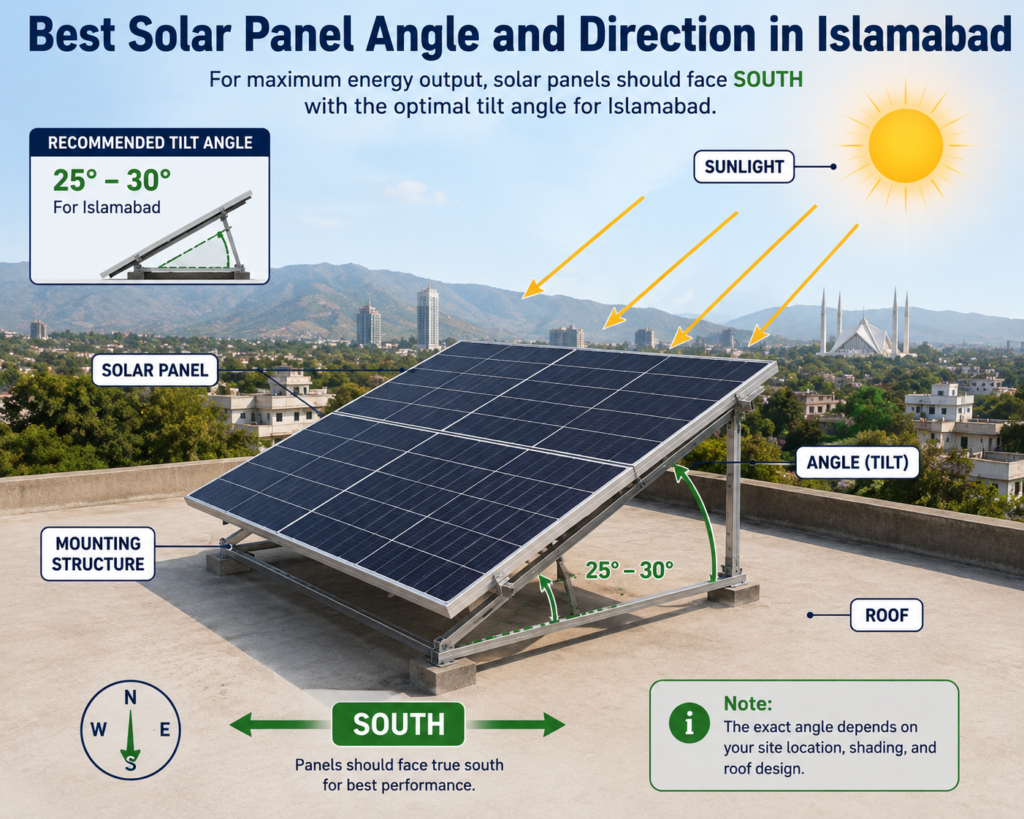
What Is the Best Solar Panel Angle in Islamabad?
The panel tilt should be selected according to the location, roof design, panel layout, and the desired generation profile.
For a fixed rooftop system in Islamabad, a moderate south-facing tilt is generally appropriate, but there is no single angle that is perfect for every property.
Why?
Because increasing or decreasing the tilt can affect:
- Annual energy production
- Summer performance
- Winter performance
- Wind loading
- Roof space
- Row-to-row shading
A professional installer should calculate the layout rather than using the same angle for every roof.
Important Tip
If an installer tells you:
“This is the best angle for every house in Islamabad.”
ask them to explain how they determined it.
A professional design should consider the actual roof and surrounding environment.
Types of Solar Mounting Structures
1. Fixed Rooftop Structure
This is one of the most common options for residential solar systems.
The panels remain at a fixed angle.
Advantages:
- Simple
- Reliable
- Relatively low maintenance
- Lower mechanical complexity
2. Adjustable Mounting Structure
An adjustable structure allows the panel angle to be changed.
It can be useful in certain installations, but it may cost more and requires additional structural consideration.
3. Elevated Structure
An elevated structure raises the panels higher above the roof.
It may be useful where:
- Roof space is shared
- There are obstacles
- Additional clearance is required
- Roof access needs to be maintained
However, higher structures can experience greater wind loading and therefore require careful engineering.
Solar Plate Fitting Cost in Islamabad
The solar plate fitting cost in Islamabad depends on the size and complexity of the installation.
It is important to distinguish between:
Panel price + installation/fitting cost + complete solar system cost
These are not the same thing.
Current published 2026 market guides show that installation labor can vary considerably by system size and project complexity. For example, one Pakistan market guide lists installation labor around PKR 15,000–22,000 for a 3kW system and PKR 20,000–30,000 for a 5kW on-grid system, while Islamabad-focused installed-system estimates are higher when mounting, wiring, inverter and other components are included.
Therefore, don’t judge a quotation simply by asking:
“How much is solar plate fitting per panel?”
Instead, ask for a complete written breakdown.
A Solar Installation Quote May Include:
| Item | What It Covers |
|---|---|
| Solar panels | Number, wattage and brand |
| Mounting structure | Roof support and panel mounting |
| DC cables | Panel-to-inverter connections |
| AC cables | Inverter-to-electrical-system connection |
| Protection | Breakers, isolators and surge protection |
| Earthing | Electrical safety |
| Installation labor | Fitting and wiring work |
| Transportation | Delivery and movement of equipment |
| Inverter installation | Mounting and connection |
| Commissioning | Testing and system startup |
| Net billing/net metering services | If included in the package |
Why Prices Differ Between Installers
Two companies may quote very different prices for what appears to be the same solar system.
The difference may come from:
- Panel brand
- Panel wattage
- Inverter brand
- Mounting structure quality
- Cable quality
- Protection equipment
- Earthing system
- Roof difficulty
- Labor quality
- Warranty
- After-sales support
- Net billing/net metering services
- Transportation
So, the cheapest quotation is not automatically the best quotation.
What Can Increase Solar Plate Fitting Cost in Islamabad?
Several factors can increase the installation cost.
Complex Roof
A simple flat concrete roof is generally easier to work on than a complicated roof.
Long Cable Runs
If the panels are far from the inverter or main electrical panel, additional cable and installation work may be required.
Elevated Structures
Higher structures require more material and careful engineering.
Difficult Roof Access
If equipment must be carried through difficult access points, labor costs can increase.
Shading Problems
If trees or nearby structures create shade, the installer may need to redesign the panel layout.
Additional Electrical Work
Upgrading the electrical distribution board, protection equipment, or wiring can increase the project cost.
Roof Requirements Before Solar Plate Fitting
Before installation, check these important points.
Roof Strength
The roof should be structurally suitable for the mounting system.
Waterproofing
Ask how the installer will prevent water leakage around mounting points.
Drainage
Do not block existing water drainage paths.
Shading
Check shadows from:
- Trees
- Water tanks
- Neighboring buildings
- Boundary walls
- Chimneys
- Satellite dishes
- Rooftop rooms
Maintenance Access
Leave a practical path for future inspection and cleaning.
A roof completely covered with panels may look impressive, but if technicians cannot safely reach the panels later, maintenance becomes difficult.
Shading: A Major Issue for Islamabad Rooftops
Shading deserves special attention in Islamabad.
Some residential areas have mature trees and buildings that can cast shadows over rooftops at different times of the day.
Even when the roof looks sunny at noon, it may receive shade in the:
- Morning
- Afternoon
- Winter months
- Early or late parts of the day
The installer should therefore check the roof throughout the useful sunlight period rather than making a decision from a single observation.
Why Shading Matters
Solar panels are connected into electrical strings. Depending on the system design, shading on one or more panels can affect the output of the associated string.
That is why panel placement is just as important as panel quantity.
Solar Panel Wiring and Electrical Protection
Solar plate fitting is not complete when the panels are physically installed.
The electrical side must also be done correctly.
A typical system may include:
- Solar panels
- DC cables
- DC isolator/protection
- Inverter
- AC cables
- AC protection
- Surge protection
- Distribution board
- Earthing system
Cable selection should be based on the electrical design, current, distance, installation conditions, and applicable requirements.
Avoid extremely cheap cables simply to reduce the quotation.
Earthing and Surge Protection
A professional solar installation should include appropriate electrical safety measures.
These may include:
- Proper earthing
- AC protection
- DC protection
- Surge protection devices
- Appropriate isolators
- Correct cable management
This is particularly important because the system is installed outdoors and is exposed to weather conditions.
Ask the installer:
“Please show me exactly what protection and earthing equipment is included in my quotation.”
Do not accept vague statements such as “complete protection included.”
Ask for the actual equipment list.
Where Should the Solar Inverter Be Installed?
The inverter should be installed in a location that is:
- Well ventilated
- Protected from unnecessary direct sunlight
- Protected from rain
- Accessible for maintenance
- Away from excessive heat
- Suitable for the manufacturer’s installation requirements
The inverter should not simply be installed wherever there is an empty wall.
Its location affects:
- Cable length
- Heat dissipation
- Maintenance
- Safety
- Overall installation quality
How Long Does Solar Plate Fitting Take in Islamabad?
The actual physical installation of a residential solar system can often be completed within a few working days, depending on system size, roof complexity, equipment availability, and weather.
The complete project timeline can be much longer if you include:
- Site survey
- Equipment procurement
- Installation
- Testing
- Utility paperwork
- Bidirectional meter/net billing process
These should not be treated as one single timeline.
For example, Solar Citizen currently describes a typical 5–10kW Islamabad installation as around 2–4 weeks from contract to commissioning, followed by a separate period for IESCO activation.
Always ask your installer:
“How many days will the physical fitting take?”
and separately:
“How long will the utility/net billing process take?”
Solar Plate Fitting Mistakes You Should Avoid
1. Choosing the Cheapest Installer
Low price can sometimes mean cheaper structure, cables, protection equipment, or inexperienced labor.
Compare the complete specification, not just the final price.
2. Ignoring Shading
More panels do not automatically mean more electricity if several panels are heavily shaded.
3. Using a Weak Mounting Structure
The panels may last for decades, so the structure should also be designed for long-term outdoor exposure.
4. Poor Cable Management
Loose cables can be exposed to water, heat, abrasion, and mechanical damage.
5. Blocking Roof Drainage
Mounting structures should not interfere with normal rainwater drainage.
6. No Proper Earthing
Never treat earthing as an optional cosmetic item.
7. Installing Panels Without Considering Maintenance
Leave safe access for cleaning and inspection.
8. Accepting a Quote Without a Detailed Specification
A quotation should clearly state:
- Panel brand
- Panel wattage
- Number of panels
- Inverter model
- Structure material
- Cable specifications
- Protection equipment
- Earthing
- Installation charges
- Warranty
- Additional charges
How to Choose a Solar Installer in Islamabad
Before hiring an installer, ask these questions.
1. Will you conduct a physical site survey?
A serious installer should understand your roof before finalizing the design.
2. What mounting structure will you use?
Ask about the material, thickness, corrosion protection, and fixing method.
3. What panel and inverter models are included?
Do not accept only a brand name. Ask for the exact model numbers.
4. What electrical protection is included?
Ask about DC/AC protection, isolators, surge protection, and earthing.
5. What warranty do I receive?
Separate:
- Product warranty
- Performance warranty
- Installation/workmanship warranty
6. Who handles after-sales service?
Find out what happens if the inverter develops a fault or the system underperforms.
7. What happens if my roof leaks?
This is especially important for rooftop installations.
Ask the installer about responsibility for any installation-related waterproofing issue.
8. Can you provide previous installation examples?
Look for evidence of completed installations rather than relying only on advertisements.
Before choosing an installer, it is helpful to understand the complete solar installation process and requirements in Pakistan. Our detailed guide covers the complete process, costs, requirements, and important factors to consider when choosing an installer.
Solar Plate Fitting Checklist for Islamabad
Before signing a solar installation contract, use this checklist:
☐ Site survey completed
☐ Roof condition checked
☐ Shading assessed
☐ Panel layout provided
☐ Panel direction discussed
☐ Panel tilt discussed
☐ Mounting structure specified
☐ Panel model confirmed
☐ Inverter model confirmed
☐ DC cables specified
☐ AC cables specified
☐ DC protection included
☐ AC protection included
☐ Surge protection discussed
☐ Earthing included
☐ Inverter location confirmed
☐ Waterproofing discussed
☐ Installation timeline confirmed
☐ Warranty written in the quotation
☐ After-sales support explained
☐ Utility/net billing responsibilities clarified
Maintenance After Solar Plate Fitting
Solar panels generally require relatively little maintenance, but that does not mean you can completely ignore them.
Clean the Panels When Necessary
Dust, bird droppings and other dirt can reduce sunlight reaching the cells.
Islamabad generally experiences different dust and rainfall conditions throughout the year, so cleaning frequency should depend on actual panel condition rather than a fixed schedule.
Check the Cables
Look for:
- Loose cables
- Damaged insulation
- Exposed connections
- Water damage
- Cable sagging
Monitor Solar Production
Your inverter monitoring system can help you identify unusual drops in production.
If production suddenly falls, possible causes include:
- Shading
- Dirt
- Inverter fault
- Cable problem
- Panel fault
- Weather
- Electrical issues
Solar Plate Fitting vs Solar System Installation
These terms are often used interchangeably, but they can mean different things.
Solar plate fitting mainly refers to physically mounting and connecting the solar panels.
Complete solar installation covers the entire system, including:
- Panels
- Mounting structure
- Inverter
- Wiring
- Protection
- Earthing
- Electrical connections
- Testing
- Commissioning
- Utility-related work where applicable
So, if a company advertises a low solar plate fitting price, ask whether the price covers only labor or the complete installation.
Is Solar Plate Fitting Worth It in Islamabad?
For many homes and businesses, rooftop solar can significantly reduce dependence on grid electricity.
But the quality of the installation matters.
The best solar system is not necessarily the one with:
- The largest number of panels
- The cheapest price
- The biggest inverter
A good system is one that is properly sized, correctly fitted, safely wired, appropriately protected, and designed for the actual roof and electricity consumption.
Islamabad’s rooftops can have their own challenges, including trees, neighboring buildings, roof structures, and seasonal weather. A proper site survey can identify these problems before you spend money.
Final Verdict
If you are searching for solar plate fitting in Islamabad, don’t think of the job as simply putting solar panels on a roof.
A successful installation starts with the right system size and roof survey, followed by proper panel positioning, a strong mounting structure, safe wiring, adequate protection, and careful testing.
Before hiring an installer, compare at least two or three detailed quotations and make sure you know exactly what is included.
The most important questions are:
Where will the panels be installed?
How will they be mounted?
What happens with shading?
What protection and earthing will be installed?
What exactly is included in the fitting cost?
Who is responsible for after-sales service?
A professionally planned installation can help you get better long-term performance from your solar investment while reducing the risk of avoidable installation and maintenance problems.
How much does solar plate fitting cost in Islamabad?
There is no single fitting price because installation depends on system size, roof type, structure, cable length, accessibility, and electrical work. Current 2026 market estimates show installation labor ranging from tens of thousands of rupees for residential systems, while a complete installed solar system costs considerably more because it includes panels, inverter, mounting, wiring, protection and other components.
Which direction should solar plates face in Islamabad?
For a fixed rooftop installation, south-facing panels are generally a good starting point for maximizing annual sunlight. However, the actual roof layout and shading conditions should determine the final orientation.
What is the ideal solar panel angle in Islamabad?
There is no single angle that is perfect for every rooftop. The installer should consider Islamabad’s location, roof design, shading, panel layout and structural requirements before selecting the final tilt.
Can solar panels be installed on any roof?
Not necessarily. The roof should be structurally suitable, accessible, and capable of supporting the mounting arrangement. Shading and waterproofing should also be considered.
How many solar panels do I need for my house?
It depends on your electricity consumption, panel wattage, available roof area, shading and the system size you need.
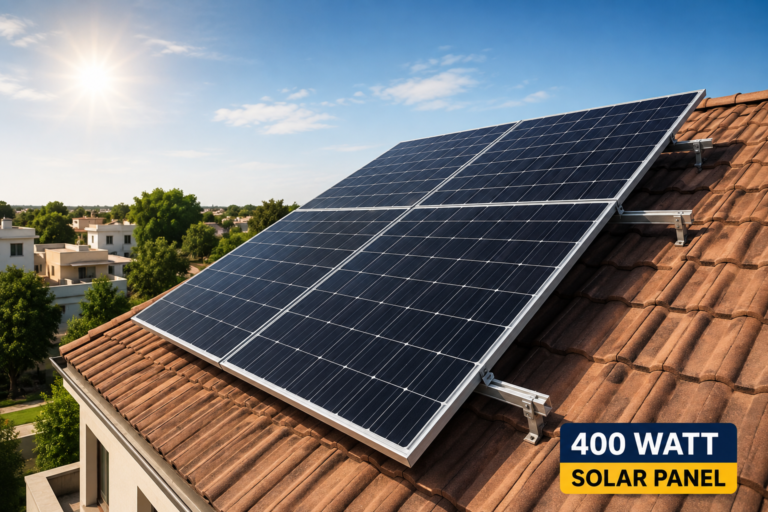
For example, a system using 585W panels would require fewer panels than the same-sized system using 400W panels.
Is solar fitting possible on a small Islamabad roof?
Yes, but the available roof area becomes an important design limitation. Higher-wattage, higher-efficiency panels can help produce more power from limited space.
Do solar panels work during cloudy weather?
Yes. Solar panels can still generate electricity in cloudy conditions, but output is normally lower because less sunlight reaches the panels.
Will an on-grid solar system work during a power outage?
Normally, a standard grid-tied system shuts down during a grid outage because of anti-islanding safety requirements.
If you want backup power during outages, you generally need a suitable hybrid system with battery storage.
How often should solar panels be cleaned?
Clean them when dirt or bird droppings visibly accumulate or when production appears to be affected. The ideal frequency depends on the local environment and weather.
Should I choose solar plate fitting based only on price?
No.
Compare the complete specification, including panels, inverter, mounting structure, wiring, protection, earthing, workmanship warranty and after-sales support.