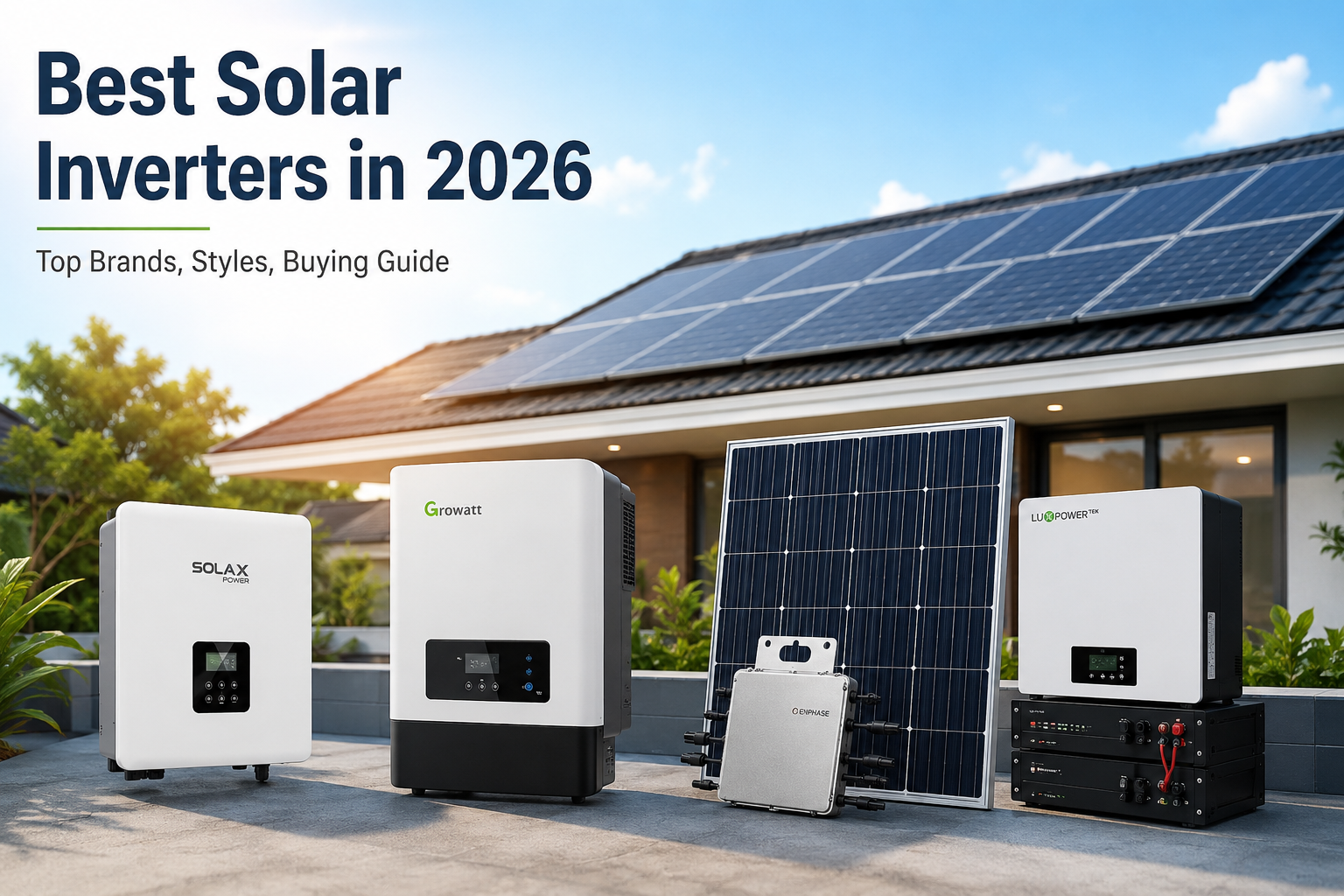
Best Solar Inverters in 2026: Top Brands, Buying Guide & Expert Reviews
Solar energy has become one of the fastest-growing sources of clean electricity worldwide. As more homeowners and businesses install solar panels, choosing the right solar inverter has become just as important as selecting high-quality panels.
A solar inverter is often called the brain of a solar power system because it converts the electricity generated by solar panels into usable power for your home or business. A reliable inverter not only improves system efficiency but also increases safety, enhances monitoring, and extends the overall lifespan of your solar installation.
However, with hundreds of inverter models available, choosing the best solar inverter can be confusing. Should you buy a hybrid inverter? Is a microinverter better than a string inverter? Which brands are the most reliable? Which inverter performs best in countries with frequent power outages, such as Pakistan, and which brands dominate international markets?
Before choosing the best solar inverter, it’s important to understand how different solar systems work. If you’re considering a battery-free setup, read our complete guide on Home Solar System Without Battery.
This comprehensive guide answers all of these questions. Whether you’re installing a small residential solar system, planning an off-grid setup, or investing in a commercial project, you’ll learn everything you need to know before making a purchase.
By the end of this guide, you’ll understand:
- What a solar inverter does
- The different types of solar inverters
- Which inverter is best for your needs
- The world’s leading inverter brands
- Popular solar inverter brands in Pakistan
- The key features to compare before buying
Let’s begin with the basics.
Table of Contents
- What Is a Solar Inverter?
- Why Choosing the Right Solar Inverter Matters
- How Does a Solar Inverter Work?
- Types of Solar Inverters
- Key Features to Look for Before Buying
- Top 10 Best Solar Inverters in 2026
- Which Solar Inverter Should You Choose?
- Best Solar Inverter Brands in Pakistan
- World’s Best Solar Inverter in 2026
- Solar Inverter Comparison Table
- Buying Guide
- Frequently Asked Questions
- Final Verdict
What Is a Solar Inverter?
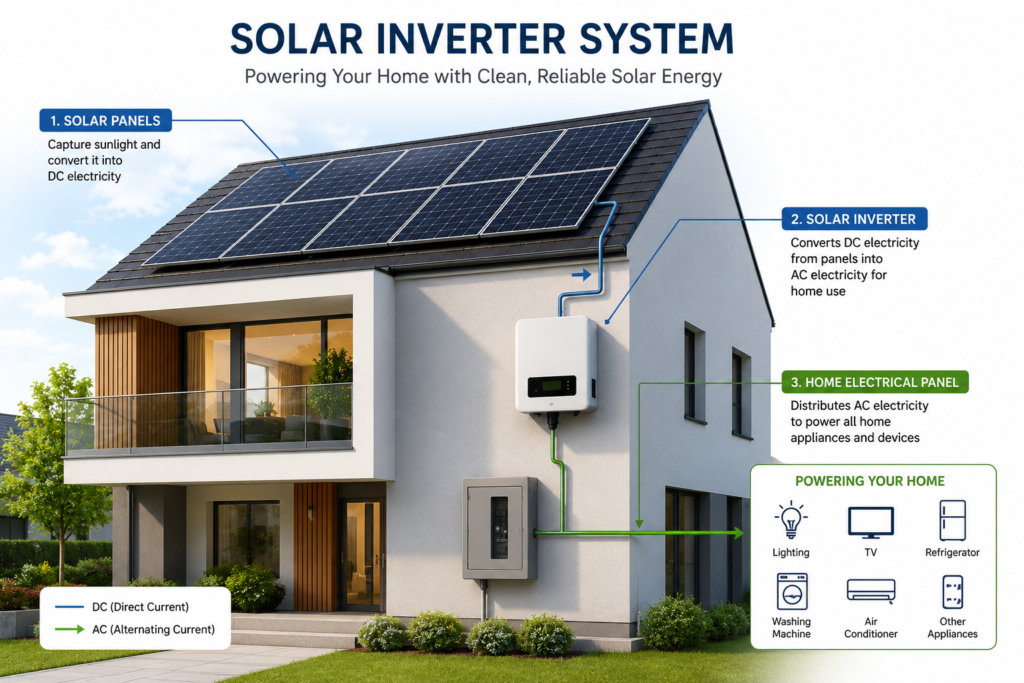
A solar inverter is an electronic device that converts the direct current (DC) electricity produced by solar panels into alternating current (AC) electricity that powers household appliances, offices, and industrial equipment.
Without a solar inverter, electricity generated by solar panels cannot be used by most homes or connected to the utility grid.
In addition to converting electricity, modern solar inverters perform several important functions, including:
- Monitoring solar energy production
- Maximizing energy efficiency through MPPT technology
- Protecting the system from electrical faults
- Communicating with battery storage systems
- Supporting net metering in many countries
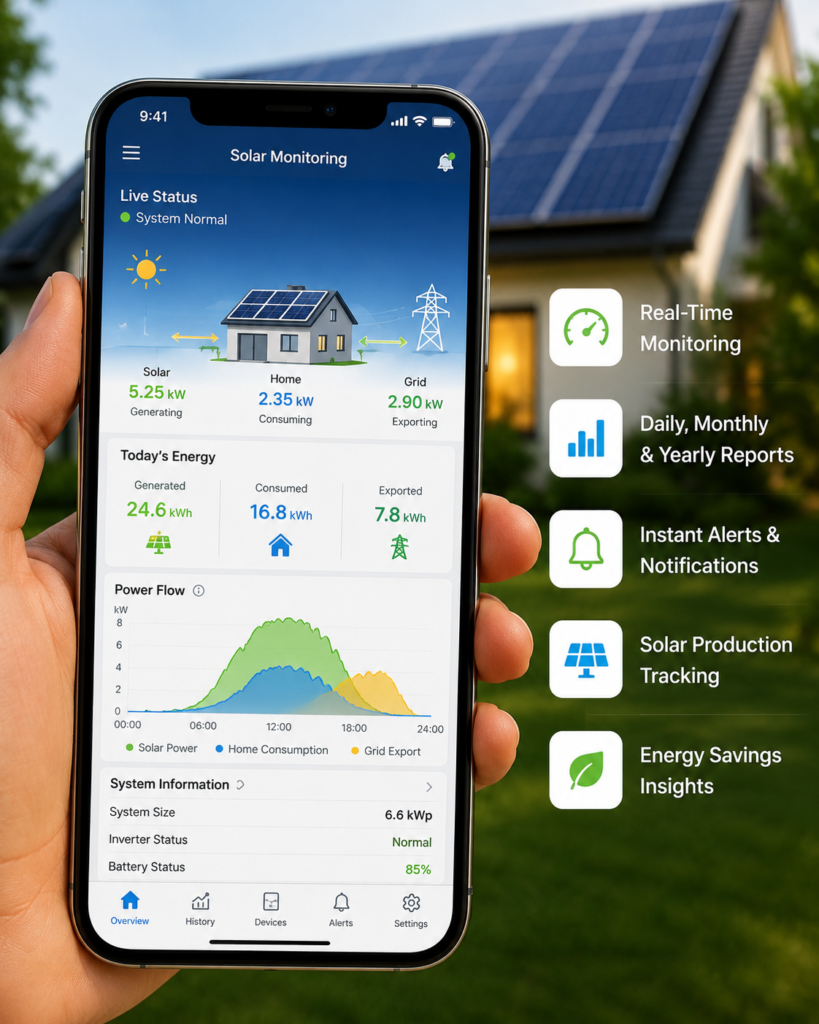
- Providing real-time performance data through mobile apps
Because the inverter controls how efficiently your solar system operates, many solar professionals consider it one of the most important components of any installation.
Why Choosing the Right Solar Inverter Matters
Many first-time buyers focus mainly on solar panels and overlook the inverter. In reality, choosing the wrong inverter can reduce your system’s efficiency, limit future upgrades, and increase maintenance costs.
A high-quality inverter offers several benefits:
Higher Energy Production
Efficient inverters convert more solar energy into usable electricity, helping you reduce your electricity bills.
Better System Reliability
Premium inverter brands are designed to operate for many years with fewer failures and better performance in different weather conditions.
Smart Monitoring
Most modern inverters connect to Wi-Fi, allowing you to monitor energy production, system health, and electricity usage from your smartphone.
Battery Compatibility
If you plan to add battery storage in the future, choosing a hybrid-compatible inverter today can save money and simplify future upgrades.
Improved Safety
Modern solar inverters include advanced safety features such as:
- Surge protection
- Arc fault detection
- Ground fault protection
- Automatic shutdown during grid failures (for grid-tied systems)
These features help protect both your home and your solar investment.
How Does a Solar Inverter Work?
Although solar inverters use advanced electronics, their basic operation is straightforward.
Step 1: Solar Panels Generate DC Power
When sunlight reaches your solar panels, they produce direct current (DC) electricity.
Step 2: The Inverter Converts DC into AC
The inverter converts DC electricity into alternating current (AC), which powers household appliances such as lights, refrigerators, air conditioners, televisions, washing machines, and computers.
Step 3: Electricity Is Used by Your Home
The converted electricity is supplied to your home’s electrical system.
Step 4: Excess Energy Is Managed
Depending on your system, extra electricity may:
- Be exported to the utility grid through net metering
- Charge a battery bank
- Be stored for backup power
- Power additional electrical loads
This process happens automatically throughout the day.
Types of Solar Inverters
Different solar systems require different types of inverters. Understanding the main categories will help you choose the right solution for your home or business.
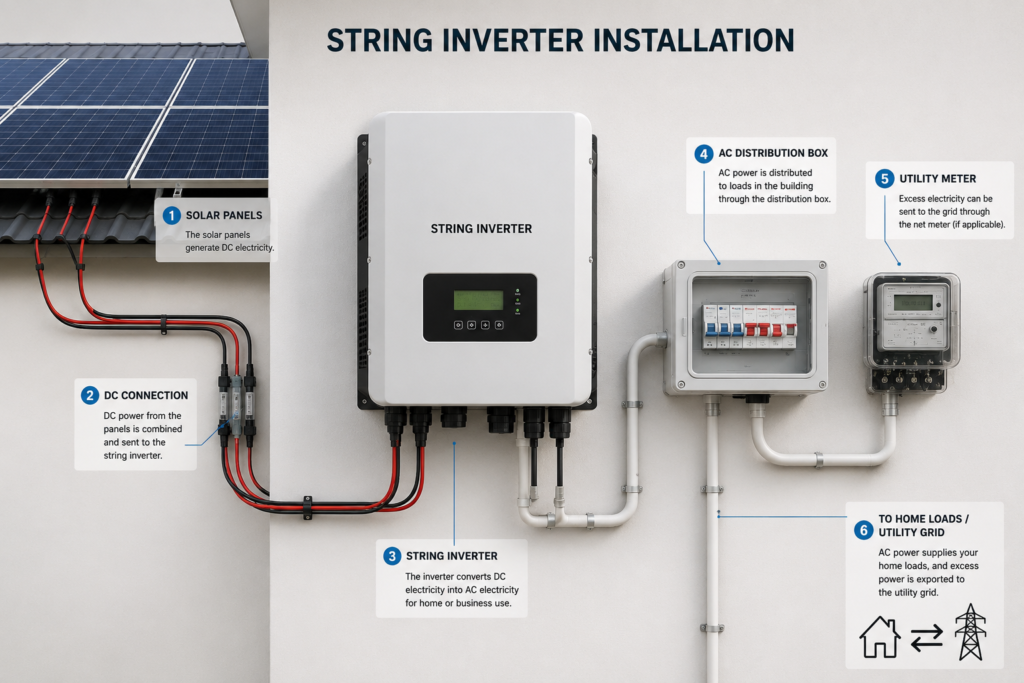
1. String Inverters
String inverters are the most common choice for residential and commercial solar systems.
In this setup, multiple solar panels are connected together in a series, known as a string, and all panels send electricity to one inverter.
Advantages
- Widely available
- Affordable
- Proven technology
- Easy installation
- Low maintenance
Disadvantages
- Shading on one panel can reduce the performance of the entire string.
- Less flexibility for complex roof designs.
Best for: Homes with simple roofs and consistent sunlight.
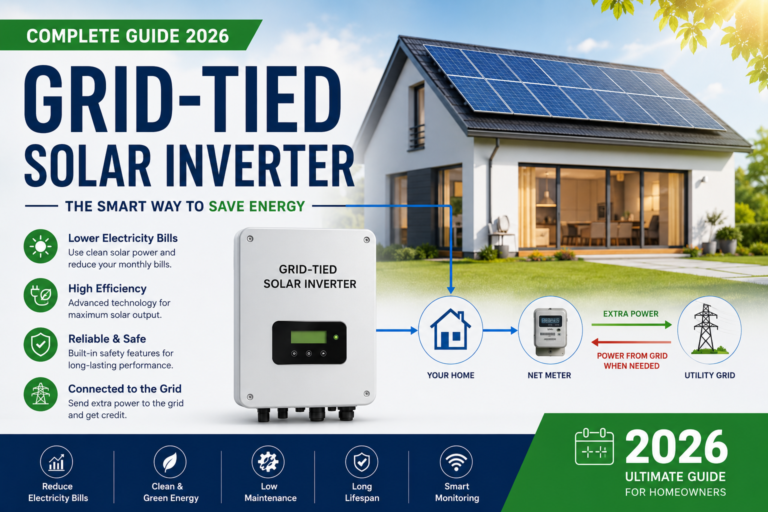
If you’re planning a grid-connected installation, our detailed guide on What Is a Grid-Tie Solar Inverter? explains how these systems work and why they are popular for residential solar projects.
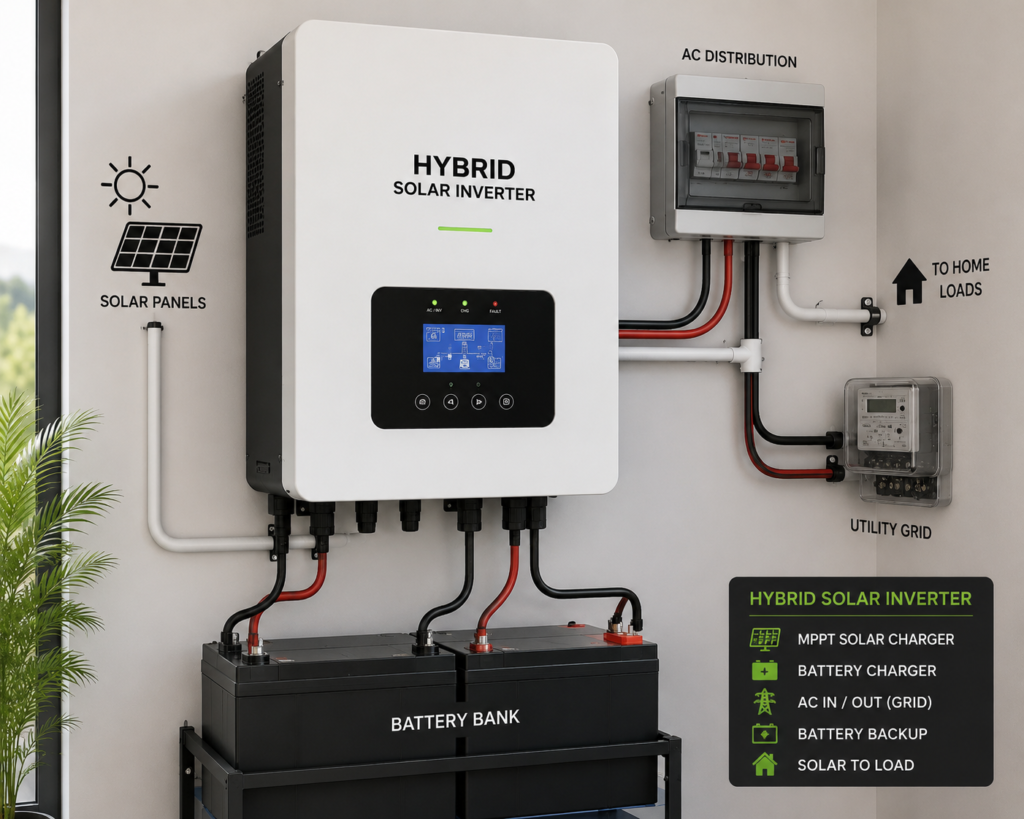
2. Hybrid Solar Inverters
Hybrid inverters combine a standard solar inverter with battery management capabilities.
They can power your home directly from solar panels, charge batteries during the day, and use stored energy when sunlight is unavailable.
As electricity prices rise and energy independence becomes more important, hybrid inverters are becoming increasingly popular worldwide.
Advantages
- Ideal for self-consumption
- Battery-ready
- Backup power during outages (with compatible systems)
- Better energy management
- Supports future battery expansion
Disadvantages
- Higher initial cost
- Installation may be more complex
Best for: Homeowners planning to add battery storage or reduce dependence on the electricity grid.
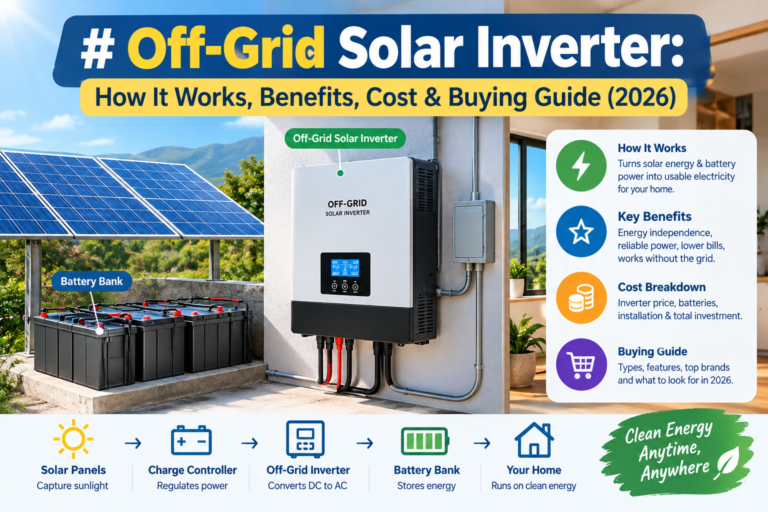
For a detailed explanation of standalone solar systems, read our complete guide on Off-Grid Solar Inverter.
3. Off-Grid Inverters
Off-grid inverters are designed for locations that do not have access to the utility grid.
These systems work with batteries to provide electricity day and night.
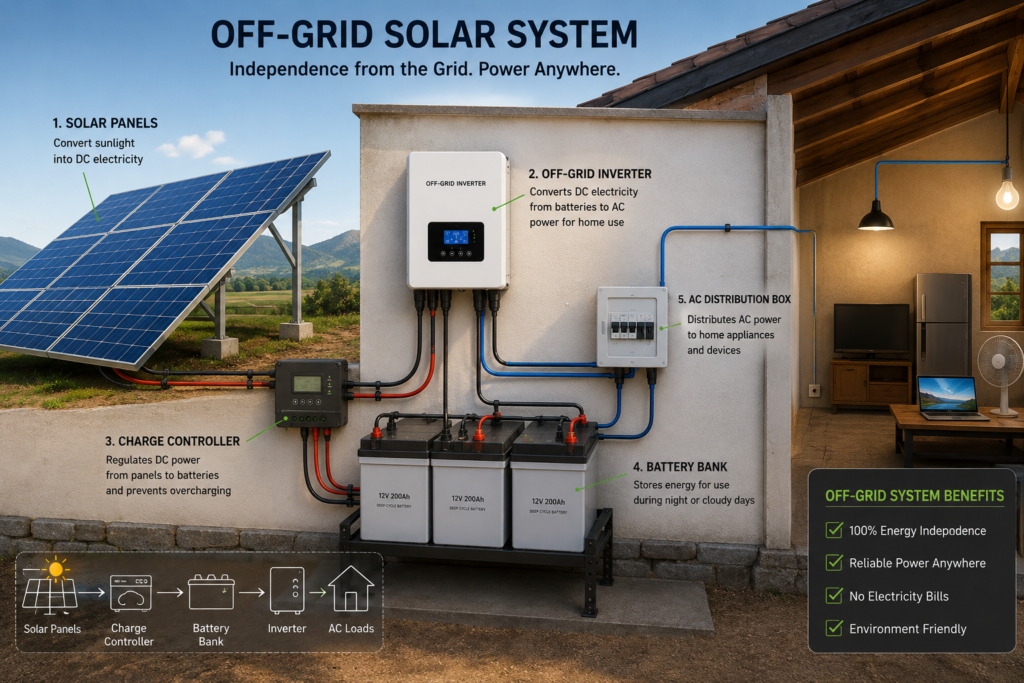
They are commonly used in:
- Remote homes
- Cabins
- Farms
- Rural communities
- Areas with unreliable electricity
Advantages
- Suitable for remote locations
- Complete energy independence
- Reliable backup during power outages
Disadvantages
- Requires battery storage
- Higher installation costs
- Battery maintenance may be necessary
Best for: Remote properties and regions with limited or unreliable grid access.
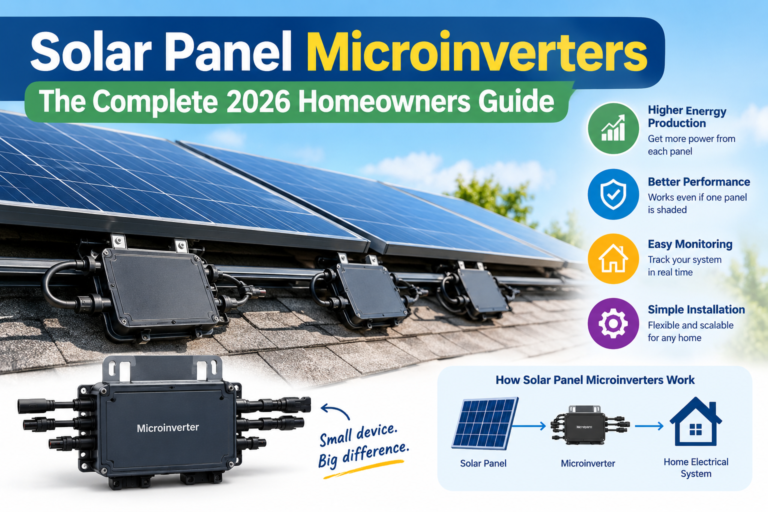
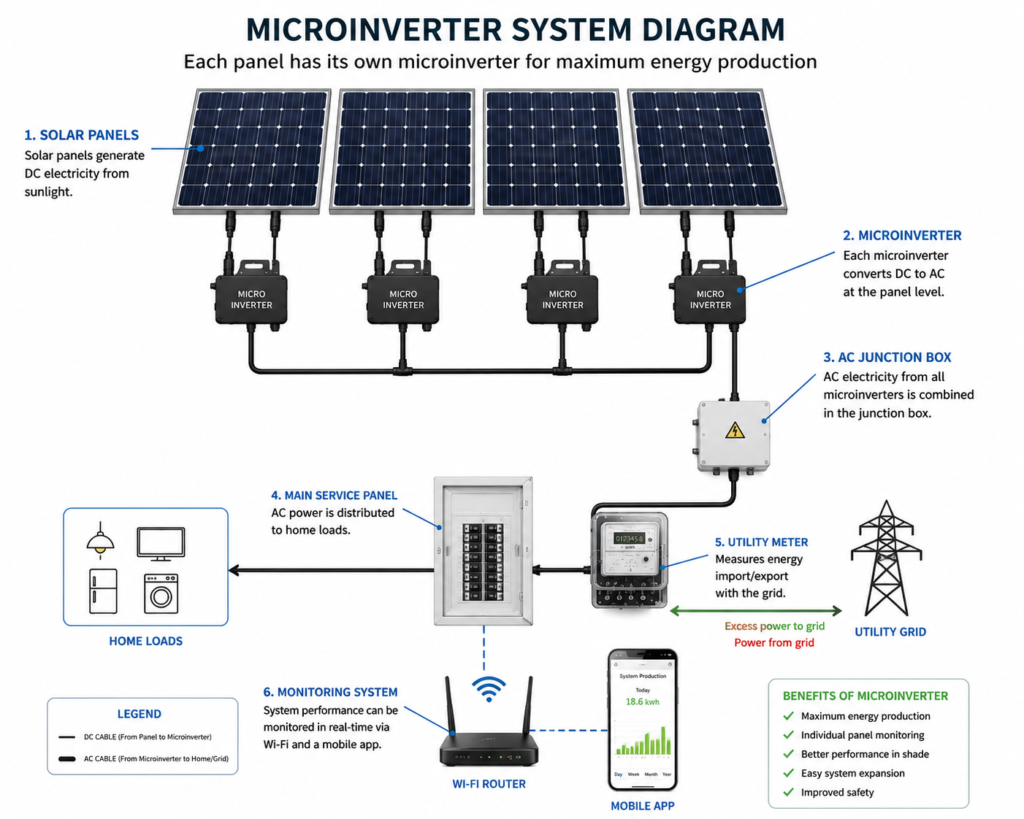
4. Microinverters
Unlike string inverters, microinverters are installed behind each individual solar panel.
Each panel operates independently, so shading or reduced performance on one panel does not affect the others.
Advantages
- Higher efficiency on shaded roofs
- Individual panel monitoring
- Improved system flexibility
- Easier future expansion
Disadvantages
- Higher upfront cost
- More components to install
Best for: Homes with multiple roof angles, partial shading, or complex roof layouts.
Want to learn more about this technology? Check out our complete Solar Panel Microinverter guide for a detailed explanation of how microinverters improve system performance.
5. Power Optimizer Systems
Power optimizer systems combine optimizers installed on each panel with a central inverter.
They offer many of the benefits of microinverters while keeping a centralized inverter.
Advantages
- Better energy production
- Improved monitoring
- Reduced impact of shading
- High system efficiency
Disadvantages
- Higher cost than standard string inverter systems
Best for: Homes where some panels experience shading but a full microinverter system is not necessary.
Which Type of Solar Inverter Is Best?
There is no single “best” inverter for every situation. The right choice depends on your budget, roof design, energy goals, and whether you plan to add batteries in the future.
Still deciding between different solar system types? Read our detailed comparison of On-Grid vs Off-Grid Solar System to find the best option for your energy needs.
As a general guide:
- Choose a String Inverter if you want a cost-effective solution for a roof with little or no shading.
- Choose a Hybrid Inverter if you want battery compatibility and greater energy independence.
- Choose an Off-Grid Inverter if your property is not connected to the utility grid.
- Choose Microinverters if your roof has shading or multiple orientations.
- Choose a Power Optimizer System if you want improved efficiency without installing microinverters on every panel.
Top 10 Best Solar Inverters in 2026
After understanding the different types of solar inverters, the next step is choosing a reliable brand. While there are dozens of manufacturers in the market, only a handful consistently deliver excellent performance, high efficiency, smart monitoring, and long-term reliability.
The following inverters are among the most trusted choices for homeowners and businesses around the world.
| Brand | Best for | Inverter type | Efficiency | Smart Monitoring |
| Enphase | Homes with shading | Microinverter | Excellent | ✔ |
| SolarEdge | Residential systems | Power Optimizer | Excellent | ✔ |
| Huawei | Smart Homes | Hybrid/String | Excellent | ✔ |
| Sungrow | Home & Commercial | Hybrid/String | Excellent | ✔ |
| Fronius | Premium residential | String | Excellent | ✔ |
| SMA Solar | Large installations | String | Excellent | ✔ |
| Growatt | Budget-friendly homes | Hybrid/String | Very Good | ✔ |
| GoodWe | Home battery systems | Hybrid | Excellent | ✔ |
| Solis | Affordable performance | Hybrid/String | Very Good | ✔ |
| Deye | Backup power systems | Hybrid | Excellent | ✔ |
1. Enphase – Best Overall Microinverter
Enphase is widely regarded as one of the world’s leading solar inverter manufacturers. Instead of using one central inverter, Enphase installs a small microinverter behind each solar panel.
This allows every panel to work independently, improving energy production even when one part of the roof is shaded.
Key Features
- Industry-leading microinverter technology
- Individual panel monitoring
- Excellent mobile app
- High reliability
- Battery integration available
Pros
- Very reliable
- Outstanding performance on shaded roofs
- Easy system expansion
- Excellent monitoring tools
Cons
- Higher upfront cost
- Installation costs can be higher than string inverter systems
Best For: Homes with multiple roof directions or partial shading.
2. SolarEdge – Best for Maximum Energy Production
SolarEdge combines a central inverter with power optimizers installed behind each solar panel.
This design allows every panel to operate at its maximum potential, increasing total energy production compared to traditional string inverters.
Key Features
- Strong safety features
- Power optimizer technology
- Excellent monitoring platform
- High efficiency
- Battery compatibility
Pros
- Excellent performance
- Great monitoring
- Ideal for partially shaded roofs
- Reliable technology
Cons
- Slightly more expensive than basic string inverters
- Requires optimizers on every panel
Best For: Homeowners who want maximum solar output.
3. Huawei – Best Smart Solar Inverter
Huawei has become one of the fastest-growing solar inverter brands worldwide.
Its inverters combine artificial intelligence, cloud monitoring, battery compatibility, and high conversion efficiency.
Key Features
- AI-powered monitoring
- Hybrid-ready models
- Quiet operation
- High efficiency
- Compact design
Pros
- Advanced technology
- Excellent smartphone app
- Battery-ready
- Highly efficient
Cons
- Availability varies by region
- Some advanced features require compatible equipment
Best For: Smart homes and future-ready solar systems.
4. Sungrow – Best Value for Money
Sungrow is one of the largest inverter manufacturers in the world and is trusted in residential, commercial, and utility-scale solar projects.
Its products are known for combining excellent performance with competitive pricing.
Key Features
- High efficiency
- Reliable cooling system
- Battery-compatible models
- User-friendly monitoring
- Wide power range
Pros
- Good warranty
- Excellent value
- Trusted worldwide
- Easy installation
Cons
- Premium models cost more than entry-level brands
Best For: Homeowners looking for premium quality without premium pricing.
5. Fronius – Best Premium String Inverter
Fronius has built a strong reputation for engineering quality and long-term reliability.
Many professional solar installers recommend Fronius for homeowners seeking premium performance.
Key Features
- Long service life
- Active cooling technology
- Excellent efficiency
- Strong monitoring platform
Pros
- Outstanding build quality
- Reliable performance
- Excellent customer reputation
- Easy maintenance
Cons
- Premium pricing
- Cooling fan may produce slight noise
Best For: Homeowners looking for long-term reliability.
6. SMA Solar – Best for Large Residential and Commercial Systems
SMA Solar is one of the oldest and most respected inverter manufacturers.
Its products are commonly used in commercial buildings and larger residential installations.
Key Features
- German engineering
- High efficiency
- Excellent safety features
- Strong global support
Pros
- Trusted worldwide
- Proven reliability
- Excellent durability
- Ideal for larger systems
Cons
- Higher initial investment
- Premium product pricing
Best For: Large residential and commercial projects.
7. Growatt – Best Budget-Friendly Solar Inverter
Growatt has become extremely popular because it offers modern features at an affordable price.
It is widely used in homes, apartments, and small businesses.
Key Features
- Easy installation
- Affordable pricing
- Hybrid models available
- Wi-Fi monitoring
- Battery compatibility
Pros
- Excellent value
- Beginner-friendly
- Good efficiency
- Popular worldwide
Cons
- Premium brands offer slightly better long-term performance
Best For: Homeowners with limited budgets.
8. GoodWe – Best Hybrid Solar Inverter
GoodWe is especially well known for its hybrid inverter technology.
Its products make it easy to combine solar panels with battery storage for greater energy independence.
Key Features
- Hybrid technology
- Battery backup support
- Smart monitoring
- Quiet operation
- High efficiency
Pros
- Excellent battery integration
- Reliable performance
- Easy installation
- Future-ready
Cons
- Some models cost more than basic string inverters
Best For: Homes planning battery storage.
9. Solis – Best Affordable String Inverter
Solis has gained worldwide popularity by offering dependable performance at competitive prices.
Its products are commonly installed in residential and commercial solar systems.
Key Features
- High efficiency
- Compact design
- Reliable operation
- Easy maintenance
- Smart monitoring
Pros
- Affordable
- Good warranty
- Easy to install
- Excellent value
Cons
- Monitoring platform is simpler than some premium competitors
Best For: Budget-conscious homeowners.
10. Deye – Best Hybrid Inverter for Backup Power
Deye has become one of the fastest-growing hybrid inverter brands, especially in countries where power outages are common.
Its hybrid systems can work with batteries, generators, and utility power, making them highly flexible.
Key Features
- Hybrid technology
- Generator compatibility
- Battery support
- Smart energy management
- Backup power capability
Pros
- Excellent during grid outages
- Flexible installation options
- High efficiency
- Great for battery systems
Cons
Advanced settings may require professional installation
Best For: Homes that experience frequent electricity interruptions.
Which Solar Inverter Should You Choose?
Best Solar Inverter for Home
The best solar inverter for home use depends on your electricity needs, solar panel capacity, battery plans, and whether your home is connected to the grid. For most residential systems, a string inverter can be a practical and cost-effective choice, while microinverters can work well for homes with partial shading or panels installed in different directions. If you want battery backup, a hybrid solar inverter is often a better option because it can manage solar power, batteries, and grid electricity in one system. When choosing an inverter for your home, consider efficiency, inverter capacity, battery compatibility, monitoring features, warranty, and local after-sales support.
Best Solar PV Inverter
The best solar PV inverter is one that efficiently converts the DC electricity produced by solar panels into usable AC electricity for your home or business. The right choice depends on the size and design of your solar PV system. A string inverter is commonly used for standard installations, while microinverters can be useful when individual panel-level optimization is important. When comparing solar PV inverters, look at conversion efficiency, maximum power capacity, operating voltage range, monitoring features, safety protections, warranty, and compatibility with your solar panels. Choosing an inverter that matches your PV system can help improve performance and reliability over time.
Best Solar Panel Inverter
The best solar panel inverter should match the size, configuration, and electrical characteristics of your solar panels. For a simple rooftop system with panels facing the same direction and receiving similar sunlight, a string inverter can provide an efficient and affordable solution. If your panels experience different levels of sunlight because of shading or different roof orientations, microinverters may provide better panel-level performance. Before buying, check the inverter’s power rating, efficiency, MPPT range, panel compatibility, monitoring options, and warranty. A properly matched inverter can help your solar panels deliver more usable electricity throughout their operating life.
Best Inverter for Solar
There is no single inverter that is best for every solar system because the ideal choice depends on the user’s needs and installation conditions. String inverters are often suitable for standard grid-connected solar systems, while hybrid inverters are a better option for users who want battery storage and backup power. Microinverters can be useful for systems with shading or complex roof layouts, and off-grid inverters are designed for systems that operate without a utility grid connection. When choosing the best inverter for solar, consider your system size, electricity usage, battery requirements, shading conditions, budget, efficiency, warranty, and availability of local technical support.
Every homeowner has different energy needs. The best inverter for your neighbor may not be the best choice for your home.
Here are some recommendations based on common situations:
| If You Need… | Recommended Brand |
| Best overall performance | Enphase |
| Best smart features | Huawei |
| Best value for money | Sungrow |
| Best premium quality | Fronius |
| Best commercial solution | SMA Solar |
| Best budget option | Growatt |
| Best hybrid inverter | GoodWe |
| Best backup power | Deye |
| Best affordable string inverter | Solis |
| Best optimizer system | SolarEdge |
Expert Tip
When comparing solar inverters, don’t focus only on the purchase price. Consider efficiency, warranty, monitoring features, after-sales support, compatibility with batteries, and the availability of local service centers. A slightly higher upfront investment in a trusted brand can often provide better long-term value through improved performance and reliability.
Best Solar Inverter Brands in Pakistan
Pakistan has experienced rapid growth in solar energy adoption over the past few years. Rising electricity prices, frequent power outages, and increasing awareness of renewable energy have encouraged homeowners and businesses to invest in solar systems.
Today, the Pakistani market offers a mix of internationally recognized inverter brands and locally established companies. The best choice depends on your budget, electricity consumption, battery requirements, and the availability of after-sales service in your area.
1. Inverex
Inverex is one of Pakistan’s most recognized solar brands. Its hybrid inverters are widely installed in homes and small businesses because they are designed to perform well under local conditions.
Best For
- Residential solar systems
- Hybrid installations
- Areas with frequent load shedding
Why People Choose Inverex
- Reliable hybrid technology
- Battery compatibility
- Easy-to-use mobile monitoring
- Strong dealer network across Pakistan
2. SolarMax
SolarMax has built a solid reputation by offering affordable and dependable solar inverters.
It is a popular option for homeowners looking for a balance between performance and price.
Best For
- Budget-conscious homeowners
- Residential installations
- Small commercial projects
Highlights
- User-friendly interface
- Stable performance
- Good value for money
3. Knox
Knox hybrid inverters have become increasingly popular because of their modern features and competitive pricing.
Many homeowners choose Knox when they want battery backup without paying premium prices.
Best For
- Hybrid solar systems
- Battery backup
- Medium-sized homes
Advantages
- Reliable backup performance
- Smart monitoring
- High efficiency
4. MaxPower
MaxPower is another well-known name in Pakistan’s solar industry.
Its products are commonly used in residential installations and are appreciated for their straightforward operation.
Best For
- Homeowners
- Small offices
- Everyday residential use
5. Crown
Crown has expanded its presence in Pakistan by offering affordable solar solutions for residential customers.
Although it may not have the same global recognition as some international manufacturers, it remains a practical choice for many budget-focused buyers.
Best For
- Entry-level solar systems
- Budget installations
International Brands Widely Available in Pakistan
Many globally trusted inverter brands are also available through Pakistani distributors.
These include:
- Huawei
- Sungrow
- Growatt
- Solis
- GoodWe
- Deye
These brands are especially popular for larger residential projects, commercial installations, and customers looking for advanced smart monitoring, higher efficiency, and long-term reliability.
World’s Best Solar Inverter in 2026
The world’s best solar inverter in 2026 is the one that delivers high efficiency, long-term reliability, and strong warranty support for your specific system. Among the top 10 best solar inverters in 2026, brands like Huawei, Sungrow, SMA, SolarEdge, Enphase, and Fronius are ranked highest worldwide.
Huawei and Sungrow lead in global sales, SMA and Fronius are trusted for durability, and Enphase and SolarEdge are best for shaded rooftops. For hybrid and off-grid setups, Victron, Growatt, and Deye are popular choices. Whichever you pick, look for 97% or higher efficiency, a 10-year warranty, battery compatibility, and good local service.
Here are some of the most respected inverter brands globally.
Enphase (United States)
Enphase pioneered modern microinverter technology and is widely trusted for residential solar systems, especially on roofs with partial shading.
Ideal for:
- Homes with complex roof layouts
- Maximum energy production
- Individual panel monitoring
SMA Solar (Germany)
SMA is known for exceptional engineering quality and is frequently chosen for commercial and industrial solar projects.
Ideal for:
- Utility-scale projects
- Large residential systems
- Commercial buildings
Fronius (Austria)
Fronius has built a reputation for premium engineering, long service life, and excellent customer support.
Ideal for:
- Premium residential systems
- Long-term investments
- High-performance installations
Huawei (China)
Huawei has become one of the world’s fastest-growing inverter manufacturers.
Its AI-powered monitoring and hybrid technology make it a favorite among homeowners seeking advanced features.
Ideal for:
- Future battery expansion
- Smart homes
- Hybrid systems
Sungrow (China)
Sungrow is one of the world’s largest inverter manufacturers and supplies products for homes, businesses, and utility-scale solar farms.
Ideal for:
- Residential
- Commercial
- Utility projects
GoodWe (China)
GoodWe specializes in hybrid solar solutions and battery-ready systems.
Ideal for:
- Home battery storage
- Energy independence
- Backup power
Growatt (China)
Growatt is well known for delivering reliable products at competitive prices.
Ideal for:
- Budget-friendly homes
- First-time solar buyers
- Small businesses
Solis (China)
Solis has become one of the fastest-growing inverter brands because it offers dependable performance with excellent value.
Ideal for:
- Residential systems
- Commercial systems
- Budget-conscious buyers
Deye (China)
Deye hybrid inverters are especially popular in countries where electricity reliability is a challenge.
Their compatibility with batteries and generators makes them highly versatile.
Ideal for:
- Backup power
- Hybrid systems
- Homes with frequent outages
How to Choose the Best Solar Inverter
Choosing the right inverter is about more than simply picking a well-known brand. The best option should match your energy needs, budget, and future plans.
Before making a decision, consider the following factors.
1. System Size
Larger solar systems require higher-capacity inverters.
Always choose an inverter that is appropriately sized for your solar panel system.
2. Grid Connection
Ask yourself:
- Will your system be connected to the electricity grid?
- Will it operate completely off-grid?
- Do you want battery backup?
The answers will determine whether you need an on-grid, off-grid, or hybrid inverter.
3. Battery Compatibility
Even if you don’t plan to install batteries today, choosing a battery-ready hybrid inverter can make future upgrades much easier.
4. Efficiency
Look for high conversion efficiency.
A more efficient inverter converts a greater percentage of your solar energy into usable electricity, reducing energy losses.
5. Warranty
A good warranty often reflects the manufacturer’s confidence in its product.
Longer warranty coverage can also reduce long-term ownership costs.
6. Smart Monitoring
Modern solar inverters often include mobile apps that allow you to:
- Monitor energy production
- Track electricity consumption
- Receive fault notifications
- Review historical performance
These features make it easier to keep your solar system operating efficiently.
7. Local Service and Support
One of the most overlooked factors is after-sales service.
Choose a brand that has authorized dealers, spare parts, and technical support available in your country or region.
Reliable local support can save time and money if maintenance or repairs are ever needed.
Expert Buying Tips
If you’re buying your first solar inverter, keep these recommendations in mind:
- Match the inverter size to your solar panel capacity.
- Consider a hybrid inverter if you may add batteries in the future.
- Check the warranty terms and local service availability.
- Compare efficiency, monitoring features, and compatibility—not just the price.
- Work with a qualified installer to ensure the inverter is correctly sized and configured for your system.
By focusing on long-term value instead of only the initial purchase cost, you can choose an inverter that delivers reliable performance for many years.
Common Mistakes to Avoid When Buying a Solar Inverter
Investing in a solar inverter is a long-term decision. While many buyers focus only on price, overlooking other important factors can lead to lower energy production, higher maintenance costs, and reduced system performance. Avoid these common mistakes before making your purchase.
1. Choosing the Cheapest Inverter
A low-priced inverter may seem like a good deal, but cheaper models often have lower efficiency, shorter warranties, and limited after-sales support.
Tip: Consider overall value rather than just the purchase price.
2. Buying the Wrong Inverter Size
An inverter that is too small may limit your system’s output, while an oversized inverter may not operate at its optimal efficiency.
Tip: Always have your inverter properly sized based on your solar panel capacity and expected electricity consumption.
3. Ignoring Future Battery Plans
Many homeowners initially install only solar panels but later decide to add battery storage.
If your inverter is not battery-compatible, upgrading can become expensive.
Tip: Consider a hybrid inverter if you may install batteries in the future.
4. Ignoring Local Service Availability
Even the best inverter may eventually require maintenance or technical support.
Choosing a brand with local service centers and spare parts can save time and money.
5. Overlooking Warranty Coverage
Warranty terms vary between manufacturers.
A longer warranty often reflects greater confidence in product quality.
Before buying, check:
- Warranty length
- What’s covered
- Local warranty support
- Replacement process
6. Not Comparing Smart Features
Modern inverters offer features such as:
- Mobile monitoring
- Wi-Fi connectivity
- Remote troubleshooting
- Performance alerts
- Energy usage reports
These tools make system management much easier.
Solar Inverter Maintenance Tips
Solar inverters generally require very little maintenance, but regular inspections can help extend their lifespan and maintain peak performance.
Keep the Inverter Clean
- Dust and dirt can reduce cooling efficiency.
- Use a soft, dry cloth to clean the exterior. Avoid spraying water directly onto the unit.
Ensure Proper Ventilation
- Never block the cooling vents.
- Adequate airflow helps prevent overheating.
Monitor Performance Regularly
- Use the manufacturer’s monitoring app to check:
- Performance trends
- Daily energy production
- System warnings
- Fault notifications
Schedule Professional Inspections
Having your entire solar system inspected every few years can help identify loose connections, wiring issues, or component wear before they become major problems.
Final Verdict
A solar inverter is one of the most important investments in any solar power system. It determines how efficiently your solar panels convert sunlight into usable electricity and plays a major role in the overall performance, safety, and reliability of your installation.
If your home has a simple roof with minimal shading, a quality string inverter can provide excellent performance at a competitive price. If you want battery backup and greater energy independence, a hybrid inverter is often the smarter long-term investment. Homes with complex roof layouts or partial shading may benefit most from microinverters or power optimizer systems.
For homeowners in Pakistan, brands such as Inverex, SolarMax, Knox, Huawei, Sungrow, Growatt, GoodWe, Solis, and Deye are among the most widely used options. Internationally, trusted manufacturers like Enphase, SolarEdge, SMA Solar, Fronius, Huawei, Sungrow, GoodWe, Growatt, Solis, and Deye continue to lead the market because of their reliability, advanced technology, and strong customer support.
Before making your final decision, compare efficiency, warranty, smart monitoring features, battery compatibility, and local service availability. Working with a qualified solar installer can also help ensure that the inverter you choose is properly matched to your energy needs.
With the right solar inverter, you can maximize energy production, reduce electricity costs, and enjoy dependable clean energy for many years.
Which solar inverter is best overall?
There is no single best inverter for every situation. Enphase, SolarEdge, Huawei, Sungrow, Fronius, SMA, GoodWe, Growatt, Solis, and Deye are among the most trusted brands worldwide. The right choice depends on your budget, roof design, and energy requirements.
Which solar inverter is best for home use?
Hybrid and string inverters from Huawei, Sungrow, GoodWe, Growatt, and Fronius are excellent choices for residential solar systems.
Which inverter is best for off-grid solar systems?
Off-grid and hybrid inverters from Deye, Growatt, GoodWe, and Inverex are popular options for homes that require battery backup and energy independence.
Which solar inverter is best for net metering?
Grid-tied inverters from Huawei, Sungrow, Fronius, Solis, SMA, and SolarEdge are widely used for net-metering systems, subject to local utility regulations.
Which inverter is best for areas with frequent power outages?
Hybrid inverters with battery support are generally the best choice because they can continue supplying electricity during grid outages when paired with compatible batteries.
How long does a solar inverter last?
Most quality solar inverters last between 10 and 15 years, while premium models can last even longer with proper installation and maintenance.
Can I use solar panels without an inverter?
No. Solar panels generate direct current (DC), while most homes and appliances use alternating current (AC). An inverter is required to convert the electricity into a usable form.
Is a hybrid inverter worth buying?
Yes, especially if you plan to install batteries now or in the future. Hybrid inverters offer greater flexibility and can reduce future upgrade costs.
What is inverter efficiency?
Efficiency measures how much DC electricity from the solar panels is converted into usable AC electricity. Higher efficiency generally means less energy loss.
Can one inverter power an entire house?
Yes, provided it is correctly sized for your solar system and household electricity demand.