Lifespan of Solar Panel Batteries: How Long Do They Really Last in 2026?
Solar panels can continue producing electricity for decades, but the battery used to store that solar energy normally has a shorter lifespan. This makes battery life one of the most important factors to consider when designing a solar power system.
So, what is the lifespan of solar panel batteries?
There is no single number that applies to every battery. A modern lithium solar battery can commonly provide around 10–15 years of useful service, while many lead-acid batteries have a shorter useful life. However, the actual lifespan depends on battery chemistry, charging and discharging patterns, depth of discharge, temperature, cycle count, installation quality, and maintenance. Current 2026 sources generally place modern home lithium batteries around the 10–15-year range, while broader estimates vary according to battery type and usage.
More importantly, a battery does not suddenly become useless when it reaches a particular birthday. Battery capacity gradually declines over time. A battery advertised as having a 10-year life may still operate after 10 years, but with reduced storage capacity and potentially different performance.
This complete guide explains the lifespan of solar panel batteries, what determines battery life, how lithium compares with lead-acid technology, what cycle life and depth of discharge mean, how hot weather affects batteries, when replacement is necessary, and how to get the longest possible service from your battery.
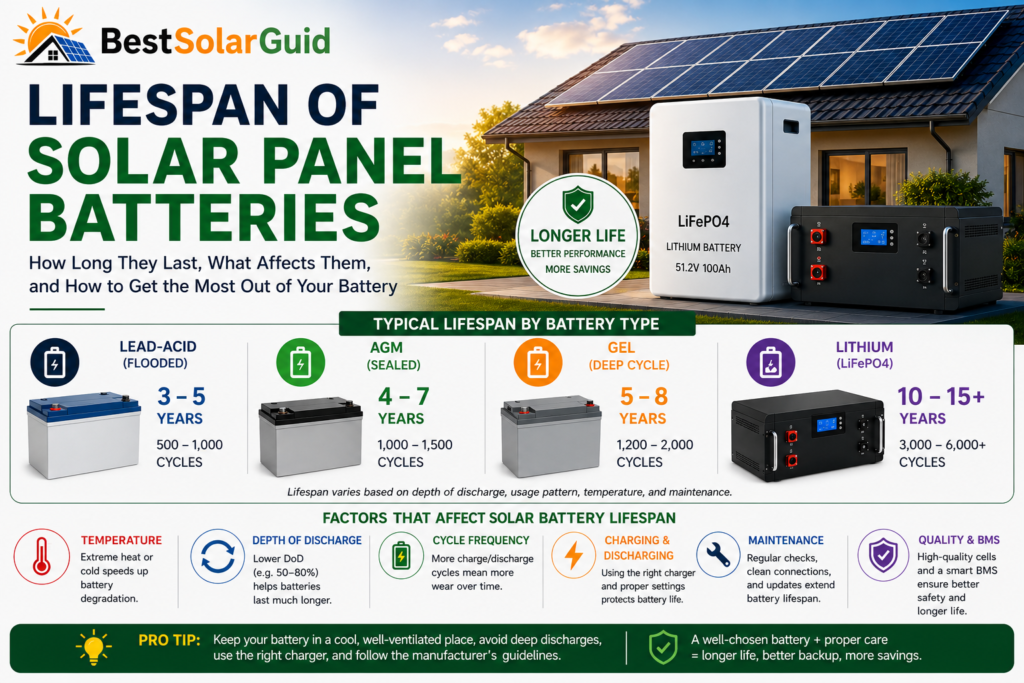
Table of content
- How Long Do Solar Panel Batteries Last?
- What Does Solar Battery Lifespan Actually Mean?
- Solar Battery Lifespan by Battery Type
- Lithium vs Lead-Acid Solar Battery Lifespan
- What Is Solar Battery Cycle Life?
- What Is Depth of Discharge (DoD)?
- Does Depth of Discharge Affect Solar Battery Lifespan?
- Calendar Aging vs Cycle Aging
- What Causes Solar Batteries to Degrade?
- How Does Temperature Affect Solar Battery Lifespan?
- How Long Do Solar Batteries Last in Pakistan?
- Solar Battery Lifespan Around the World: What Changes by Climate?
- How to Extend the Lifespan of Solar Panel Batteries
- What Is Battery Management System (BMS)?
- How Do You Know When a Solar Battery Needs Replacement?
- What Does End-of-Life Mean for a Solar Battery?
- Solar Battery Warranty: What Should You Check?
- Solar Battery Lifespan vs Solar Panel Lifespan
- Does a Larger Solar Battery Last Longer?
- How Much Does Solar Battery Replacement Cost?
- How to Calculate the Approximate Life of a Solar Battery
- Is a Solar Battery Worth It?
- Final Verdict: What Is the Best Solar Battery for Long Life?
- Frequently Asked Questions
- Conclusion
How Long Do Solar Panel Batteries Last?
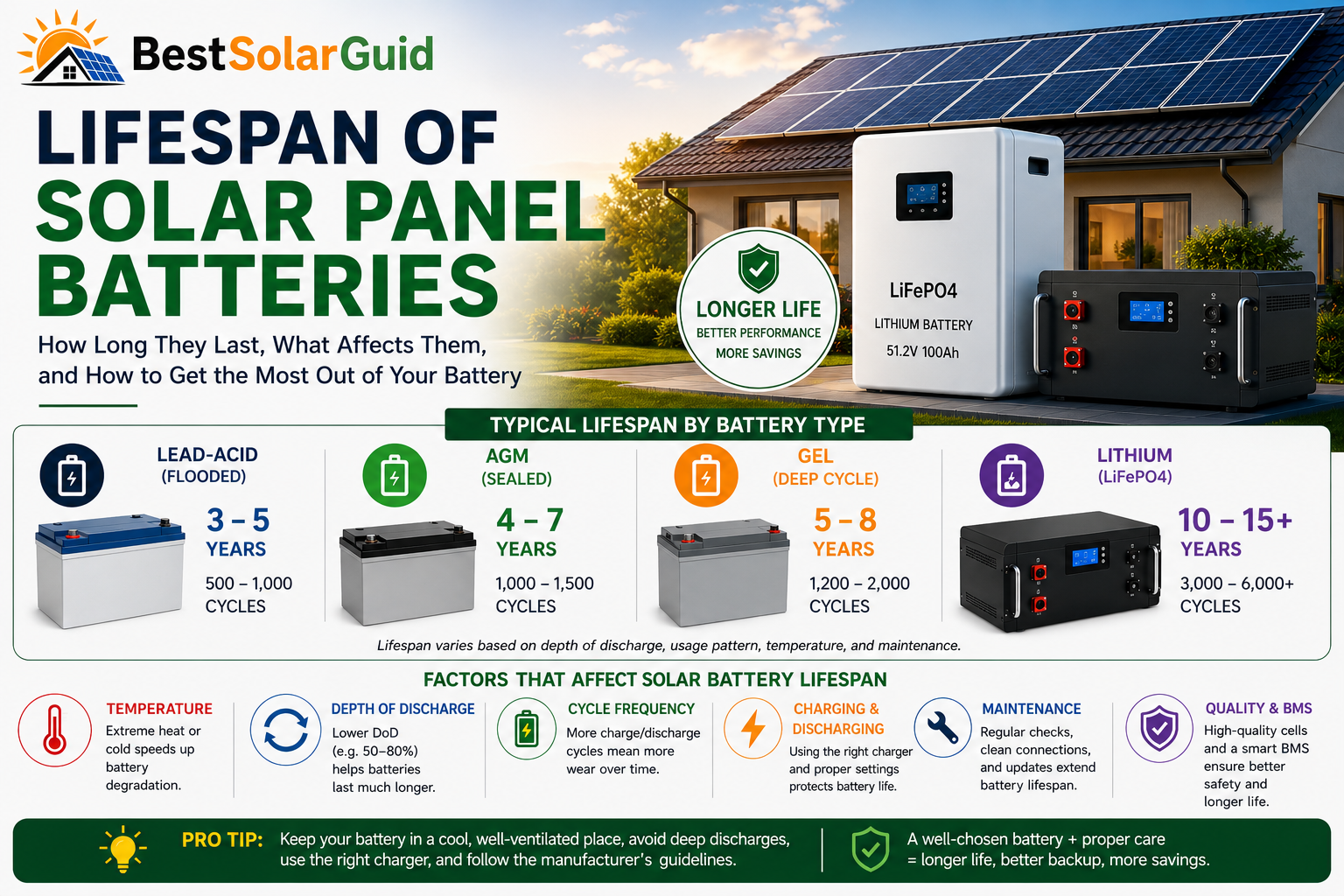
The expected lifespan depends mainly on the battery chemistry.
| Battery Type | Typical Useful Lifespan | General Characteristics |
|---|---|---|
| Flooded Lead-Acid | About 3–7 years | Lower upfront cost, more maintenance |
| AGM Lead-Acid | About 4–8 years | Sealed, lower maintenance |
| Gel Lead-Acid | About 4–8 years | Deep-cycle applications |
| Lithium-Ion | About 8–15 years | High efficiency and cycle life |
| LiFePO4 | About 10–15+ years | Long cycle life and good suitability for daily cycling |
These figures are general ranges, not guarantees. Actual performance depends on the battery manufacturer, operating conditions, DoD, temperature, charging profile, and how frequently the battery is cycled.
For modern residential solar systems, lithium batteries—particularly LiFePO4 (lithium iron phosphate)—are increasingly common because of their high cycle life and long service life.
What Does Solar Battery Lifespan Actually Mean?
The word lifespan can be misleading when talking about batteries.
It does not necessarily mean:
“The battery will work perfectly for exactly 10 or 15 years and then stop.”
Instead, batteries gradually lose their ability to store and deliver energy.
A battery may begin its life with a certain amount of usable capacity. As it ages, that capacity decreases.
For example, a new:
10 kWh battery
may eventually retain less than its original usable capacity after years of cycling and calendar aging.
The battery may still function, but it may provide less backup time.
Therefore, when comparing solar batteries, you should look beyond the advertised number of years.
Pay attention to:
- Cycle life
- Warranty period
- Guaranteed end-of-warranty capacity
- Depth of discharge
- Round-trip efficiency
- Operating temperature
- Maximum charge and discharge rate
- Battery management system
Solar Battery Lifespan by Battery Type
Lithium-Ion Solar Batteries
Lithium-ion batteries are among the most widely used technologies in modern residential energy storage.
A quality lithium battery can commonly provide around 10–15 years of useful service, although actual lifespan varies considerably between products and operating conditions.
Their main advantages include:
- High energy density
- High efficiency
- Good usable capacity
- Low maintenance
- High cycle life
- Compact design
- Good performance for frequent cycling
However, “lithium-ion” is a broad category. Different lithium chemistries can have different characteristics.
Lithium-ion batteries have become one of the most popular choices for modern solar energy storage because of their long cycle life, high efficiency, and low maintenance requirements. Learn more about lithium-ion solar batteries and how they compare with other battery technologies.
LiFePO4 Solar Batteries
LiFePO4, or lithium iron phosphate, has become particularly important in solar energy storage.
It is widely used in stationary battery applications because of its combination of cycle life, safety characteristics, and long-term performance.
Some manufacturers specify thousands of cycles for LiFePO4 batteries under defined operating conditions. For example, current manufacturer information can specify around 6,000–8,000 cycles at particular DoD conditions, but these figures should always be interpreted according to the manufacturer’s test conditions rather than treated as a universal number.
Why LiFePO4 is popular for solar storage
- Long cycle life
- Suitable for frequent daily cycling
- High usable capacity
- Low routine maintenance
- Good thermal stability
- Integrated battery-management systems in many products
But a higher advertised cycle count does not automatically mean a better battery.
Always check the conditions under which that cycle count was measured.
Lead-Acid Solar Batteries
Lead-acid batteries have been used in off-grid and backup solar systems for many years.
They generally cost less initially than lithium batteries, but their useful life can be considerably shorter, especially under frequent deep cycling.
Common lead-acid types include:
Flooded Lead-Acid
These batteries may require regular maintenance and proper ventilation.
AGM Batteries
Absorbent Glass Mat batteries are sealed and generally require less routine maintenance than flooded batteries.
Gel Batteries
Gel batteries are also sealed and can be used for deep-cycle applications when properly designed and operated.
Lead-acid batteries can still be useful where lower initial cost is more important than maximum cycle life.
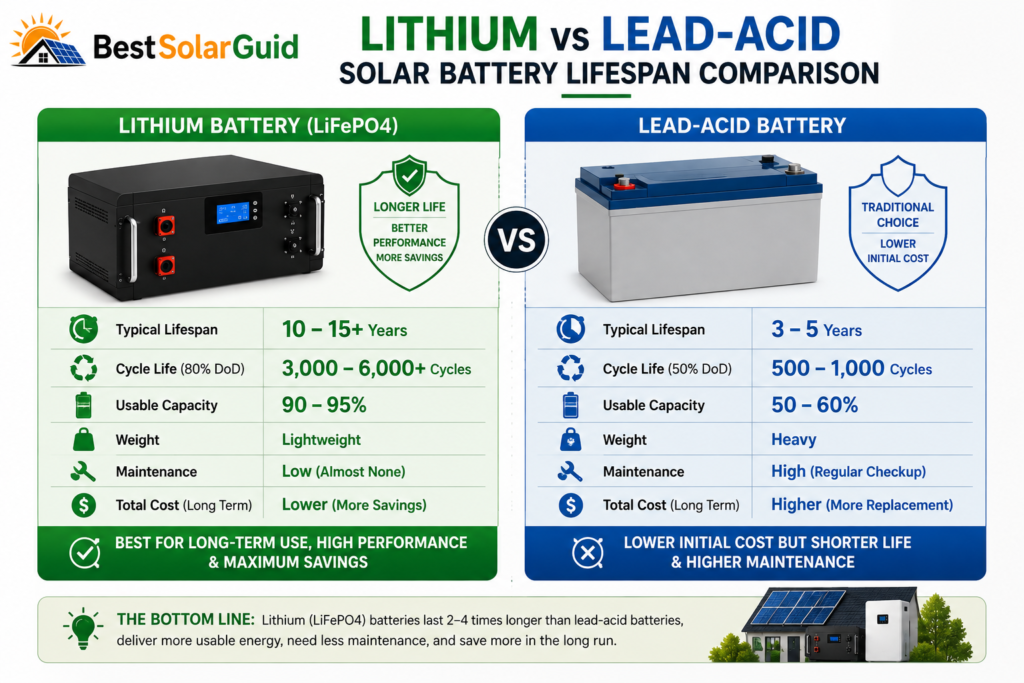
Lithium vs Lead-Acid Solar Battery Lifespan
This is one of the most important comparisons for anyone buying a solar battery.
| Feature | Lithium / LiFePO4 | Lead-Acid |
|---|---|---|
| Typical lifespan | Around 10–15 years | Often around 3–8 years |
| Cycle life | Generally much higher | Generally lower |
| Usable capacity | Generally higher | More limited |
| Deep cycling | Better suited | Can accelerate degradation |
| Maintenance | Low | Higher for some types |
| Weight | Lighter | Heavier |
| Upfront cost | Higher | Lower |
| Long-term value | Often strong | Depends on application |
The most important point is this:
Do not compare batteries only by purchase price.
A cheaper battery may need replacement sooner, while a more expensive lithium battery may provide substantially more cycles and usable energy over its lifetime.
What Is Solar Battery Cycle Life?
Cycle life tells you approximately how many charge-discharge cycles a battery can complete before its capacity reaches a specified end-of-life level.
Suppose a battery has a stated cycle life of:
6,000 cycles
If it experiences approximately one equivalent full cycle every day:
6,000 ÷ 365 ≈ 16.4 years
But this does not mean the battery is guaranteed to last 16.4 years.
Why?
Because cycle-life testing is performed under specific conditions.
Those conditions may include:
- Specific DoD
- Specific temperature
- Specific charging rate
- Specific discharge rate
- Defined end-of-life capacity
Real-world operation can be different.
Therefore, cycle life should be used together with the warranty and calendar-life information, not by itself.
What Is Depth of Discharge (DoD)?
Depth of Discharge (DoD) describes how much of a battery’s capacity has been used.
For example, if a 10 kWh battery supplies 8 kWh before recharging:
DoD = 80%
If it supplies 5 kWh:
DoD = 50%
Depth of discharge is important because battery lifespan is affected by how deeply the battery is cycled.
In general, repeated deep cycling can increase battery stress, although the exact effect depends heavily on the battery chemistry and manufacturer’s design.
Modern lithium batteries are generally designed to tolerate deeper cycling better than many traditional lead-acid batteries.
Does Depth of Discharge Affect Solar Battery Lifespan?
Yes.
A battery that is repeatedly pushed through very deep cycles may experience more degradation than one operated within a moderate DoD range.
However, you should not simply assume that “50% DoD is always best.”
Modern batteries are designed with different operating specifications.
The correct approach is:
Follow the manufacturer’s recommended DoD and operating limits.
A battery with a high permitted DoD can provide more usable energy from the same nominal capacity.
Calendar Aging vs Cycle Aging
Solar batteries age in two major ways.
Calendar Aging
Calendar aging occurs simply because time passes.
A battery can degrade even when it is not completing large numbers of cycles.
Factors such as:
- Temperature
- State of charge
- Storage conditions
- Battery chemistry
can influence calendar aging.
Cycle Aging
Cycle aging occurs as the battery is repeatedly charged and discharged.
For a solar system that cycles its battery every day, cycle aging can be particularly important.
The total battery lifespan is therefore influenced by both time and usage.
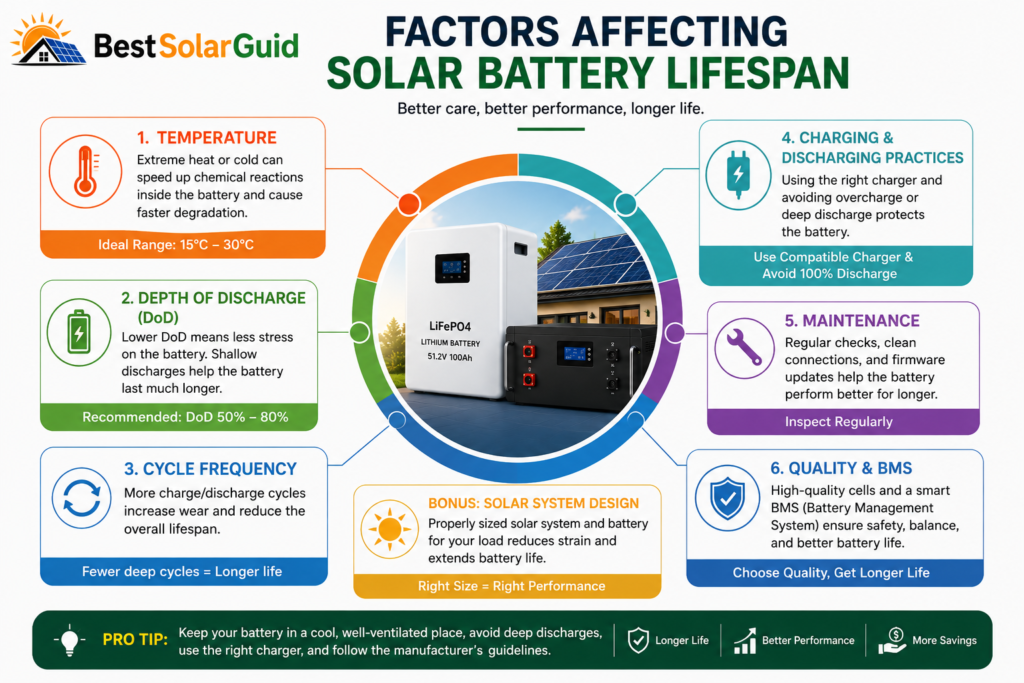
What Causes Solar Batteries to Degrade?
Several factors can shorten the lifespan of solar panel batteries.
1. Excessive Heat
High temperatures can accelerate battery degradation.
This is especially important in hot climates.
2. Frequent Deep Discharge
Regularly using a very large percentage of battery capacity can increase stress on some battery technologies.
3. Excessive Charging or Discharging Rates
Charging or discharging beyond the manufacturer’s specifications can increase battery stress and heat.
4. Poor Installation
Incorrect wiring, poor ventilation, incompatible equipment, or improper configuration can negatively affect battery performance and safety.
5. Poor Battery Quality
Battery cells, electronics, thermal management, and the battery-management system all influence long-term reliability.
6. Incorrect Charging
Improper voltage or charging settings can reduce battery life.
7. Long Periods at Unsuitable State of Charge
How a battery is stored and maintained when it is not being actively cycled can also affect aging.
How Does Temperature Affect Solar Battery Lifespan?
Temperature is one of the most important environmental factors affecting battery life.
Very high temperatures can accelerate chemical degradation.
Very low temperatures can also affect performance and, for some lithium batteries, require specific charging precautions.
This is particularly important in countries with hot summers.
Solar Batteries in Hot Climates
If your solar battery is installed in a region where summer temperatures become very high, avoid placing it in an unnecessarily hot location.
Depending on the manufacturer’s requirements, appropriate installation may involve:
- Shade
- Controlled indoor temperature
- Adequate ventilation
- Thermal management
- Protection from direct sunlight
Always follow the battery manufacturer’s specified operating temperature range.
How Long Do Solar Batteries Last in Pakistan?
Pakistan’s growing use of residential solar makes battery lifespan an important consideration, particularly for households that use batteries for backup power and daily energy storage. Pakistan can experience very high temperatures during summer, so battery installation conditions deserve particular attention. A battery installed in a poorly ventilated or excessively hot location may experience more thermal stress than one operating within the manufacturer’s recommended temperature range. Homeowners should therefore consider the battery’s temperature specifications, installation location, cooling or ventilation requirements, daily cycling pattern, and warranty before making a purchase.
For Pakistani solar users, a good-quality lithium or LiFePO4 battery can be an attractive long-term option because these technologies are designed for frequent cycling and generally require less routine maintenance than traditional flooded lead-acid batteries. However, battery chemistry alone does not guarantee a long lifespan. Correct sizing, compatible inverter settings, appropriate depth of discharge, temperature management, and professional installation all play an important role in determining how long the battery remains useful.
Solar Battery Lifespan Around the World: What Changes by Climate?
The lifespan of solar panel batteries can vary from one region to another because climate, installation conditions, electricity usage, and battery cycling patterns are different worldwide. In hot regions such as Pakistan, India, the Middle East, parts of Africa, southern Europe, and Australia, high ambient temperatures can make thermal management and proper battery placement particularly important. In moderate climates such as parts of the United Kingdom, Germany, France, and other northern European countries, batteries may generally operate in more favorable temperature conditions, although cold winters can still affect battery performance and charging requirements. In colder regions such as Canada, northern Europe, and parts of the northern United States, battery systems may require temperature-controlled or appropriately protected installation because very low temperatures can reduce performance and can impose charging limitations on some lithium battery systems. Meanwhile, countries such as Australia, the United States, China, Japan, and countries across Europe are seeing growing use of battery storage alongside solar as energy systems place greater value on storing electricity and shifting it to periods of higher demand. The International Energy Agency reports that battery storage is taking on an increasingly important role in electricity systems globally, while Australia’s national home-battery support program illustrates the growing importance of residential solar-plus-storage.
The key point is that there is no single worldwide lifespan for a solar battery. A high-quality battery installed in a suitable environment and operated within the manufacturer’s recommended temperature, charging, and depth-of-discharge limits can generally achieve much better long-term performance than the same type of battery exposed to excessive heat, extreme cold, or improper operating conditions. Therefore, when comparing the lifespan of solar panel batteries worldwide, homeowners should consider not only the battery chemistry and advertised cycle life but also their local climate, installation environment, daily energy usage, cycling frequency, and manufacturer’s warranty conditions.
How to Extend the Lifespan of Solar Panel Batteries
You cannot stop battery aging completely, but proper operation can help maximize useful life.
Use the Recommended Depth of Discharge
Do not repeatedly push the battery beyond its recommended operating range.
Keep the Battery at a Suitable Temperature
Avoid unnecessary exposure to extreme heat or cold.
Use a Compatible Inverter
The inverter should be compatible with the battery’s voltage, charging requirements, communication system, and power specifications.
Avoid Overloading
Do not continuously demand more power than the battery is designed to deliver.
Maintain Proper Charging
Use the manufacturer’s recommended charging settings.
Keep the Installation Clean and Safe
The battery area should meet the manufacturer’s requirements for ventilation, clearance, moisture protection, and access.
Monitor Battery Performance
Modern batteries may provide monitoring through an inverter, BMS, or dedicated application.
Monitoring can help identify unusual:
- Temperature
- Voltage
- State of charge
- Faults
- Capacity changes
before they become major problems.
What Is Battery Management System (BMS)?
A Battery Management System (BMS) is an important component of many modern lithium battery systems.
The BMS can monitor and manage conditions such as:
- Cell voltage
- Battery temperature
- State of charge
- Charging
- Discharging
- Overvoltage
- Undervoltage
- Overcurrent
Depending on the design, the BMS can help protect the battery from operating conditions that could cause damage.
For lithium solar batteries, a quality BMS is therefore an important part of the overall battery system.
How Do You Know When a Solar Battery Needs Replacement?
A solar battery does not necessarily need replacement simply because it reaches a particular age.
Instead, look for changes in performance.
Common warning signs include:
- Much shorter backup time
- Noticeable capacity loss
- Frequent battery faults
- Unexpected shutdowns
- Difficulty charging
- Unusual heating
- Physical swelling or damage
- Significant voltage problems
- Battery-management warnings
If the battery shows physical damage, swelling, leaking, unusual odor, or excessive heat, do not attempt a DIY repair. Follow the manufacturer’s safety instructions and contact a qualified technician.
What Does End-of-Life Mean for a Solar Battery?
End-of-life does not necessarily mean the battery stops working completely.
Battery manufacturers commonly define end-of-life using a remaining-capacity threshold or other performance criteria.
For example, a warranty may guarantee that the battery retains a certain percentage of its original capacity after a specified number of years or energy throughput.
This is why you should ask:
“What capacity will this battery be guaranteed to retain at the end of its warranty?”
rather than simply asking:
“How many years does it last?”
That distinction can make a major difference when comparing batteries.
Solar Battery Warranty: What Should You Check?
A long warranty is useful, but read the actual warranty terms.
Check:
Warranty duration
How many years are covered?
Guaranteed capacity
How much of the original capacity is guaranteed at the end of the warranty?
Cycle or throughput limit
Is the warranty limited by cycles or total energy throughput?
Temperature requirements
Does the warranty require operation within a specified temperature range?
Installation requirements
Does the manufacturer require professional installation?
Approved equipment
Does the battery need to be paired with a specific inverter or approved system?
A “10-year warranty” does not automatically mean 100% capacity for 10 years.
Solar Battery Lifespan vs Solar Panel Lifespan
One of the most important financial considerations is that batteries generally do not last as long as solar panels.
Modern solar panels can operate for 25 years or longer, while many home battery systems have useful lives measured in roughly 10–15 years, depending on technology and conditions.
This means a homeowner with a 25-year solar installation may need to replace the battery at least once during the system’s lifetime.
For example:
Solar panels: 25+ years
Modern lithium battery: around 10–15 years
These are broad expectations rather than guarantees.
When calculating the total cost of your solar system, include potential future battery replacement.
Does a Larger Solar Battery Last Longer?
Not automatically.
A larger battery does not inherently have a longer chemical lifespan.
However, if the same amount of energy is used from a larger battery, the battery may experience shallower cycling.
Example
Suppose a home needs approximately 5 kWh of battery energy per day.
A 10 kWh battery would use:
5 ÷ 10 × 100 = 50%
of its nominal capacity.
A 5 kWh battery would be asked to supply:
5 ÷ 5 × 100 = 100%
of its nominal capacity.
The larger battery therefore has a different cycling profile.
But this does not mean you should simply buy the biggest battery available.
The battery should be correctly sized according to:
- Daily energy consumption
- Solar production
- Backup requirements
- Inverter capacity
- Budget
- Expected cycling
How Much Does Solar Battery Replacement Cost?
The replacement cost depends on several factors:
- Battery chemistry
- Capacity
- Brand
- Country
- Installation
- Inverter compatibility
- Labor
- Electrical modifications
For this reason, comparing only the purchase price can be misleading.
A better comparison is:
Total lifetime cost ÷ useful years of service
A battery that costs more initially but lasts considerably longer may provide better long-term value.
How to Calculate the Approximate Life of a Solar Battery
A simple theoretical calculation is:
Estimated years = Total cycle life ÷ equivalent full cycles per year
For example:
6,000 cycles ÷ 365 cycles per year = approximately 16.4 years
But remember:
This is a theoretical cycle-based estimate, not a guaranteed service life.
Calendar aging, temperature, DoD, charging conditions, and the manufacturer’s end-of-life definition can all change the actual result.
Is a Solar Battery Worth It?
A solar battery can be valuable if your main goal is:
- Backup power
- Using more of your own solar energy
- Reducing dependence on the grid
- Energy shifting
- Greater energy independence
But battery storage isn’t automatically the best choice for every solar system.
If your grid is reliable and your electricity pricing does not strongly reward battery storage, the financial payback may be different from a home that experiences frequent outages or has strong time-of-use price differences.
The decision should therefore be based on your energy consumption, electricity rates, solar production, outage pattern, battery cost, and expected battery lifespan.
Not every solar system requires battery storage. If your goal is to understand how a solar system can operate without energy storage, see our complete guide to solar system without battery.
Final Verdict: What Is the Best Solar Battery for Long Life?
If long-term lifespan is your primary concern, a high-quality LiFePO4 lithium battery is generally one of the strongest choices for modern residential solar storage.
But don’t choose a battery simply because its advertisement says “10 years,” “15 years,” or “6,000 cycles.”
A genuinely good solar battery should have:
- Long cycle life
- Strong warranty
- Meaningful capacity-retention guarantee
- Appropriate DoD
- Reliable BMS
- Suitable temperature range
- Good inverter compatibility
- Proper safety certifications
- Reliable after-sales support
The best battery is the one that matches your solar system and operating conditions, not necessarily the one with the highest advertised specification.
Conclusion
Understanding the lifespan of solar panel batteries is essential before investing in a solar energy storage system.
Unlike solar panels, which can continue producing electricity for decades, batteries gradually lose capacity as they age and cycle. Modern lithium and LiFePO4 batteries can commonly provide around 10–15 years of useful service, while traditional lead-acid technologies generally have shorter lifespans.
However, the number of years is only part of the story.
Depth of discharge, cycle life, temperature, charging conditions, battery quality, installation, and maintenance can all influence how long your battery remains useful.
If you want to maximize your investment, choose a battery based on its cycle life, warranty, guaranteed capacity retention, operating conditions, safety features, and compatibility with your solar system—not simply its initial price.
A properly selected and correctly operated battery can provide reliable energy storage for many years and make your solar system significantly more useful, especially when backup power and energy independence are important.
How long do solar panel batteries last?
The lifespan of solar panel batteries varies by chemistry and operating conditions. Modern lithium batteries commonly provide around 10–15 years of useful service, while lead-acid batteries often have shorter useful lives.
What solar battery lasts the longest?
High-quality LiFePO4 lithium batteries are among the longest-lasting options commonly used in modern residential solar energy storage.
Can a solar battery last 20 years?
Some batteries may continue operating for 20 years, but you should not assume that a particular battery will provide its original performance for that long. Always check the manufacturer’s warranty, cycle life, and capacity-retention specifications.
How often should a solar battery be replaced?
Many modern lithium batteries may require replacement after roughly 10–15 years, while lead-acid batteries often require replacement sooner. Actual replacement timing depends on degradation and performance rather than age alone.
Does heat reduce solar battery life?
Yes. Excessive heat can accelerate battery degradation. Proper installation and keeping the battery within its recommended operating temperature range are particularly important in hot climates.
Does deep discharge damage solar batteries?
Frequent deep discharge can accelerate degradation, depending on battery chemistry. Follow the manufacturer’s recommended DoD rather than assuming one universal discharge limit applies to every battery.
Is lithium better than lead-acid for solar?
For many residential applications, lithium—especially LiFePO4—offers longer cycle life, greater usable capacity, lower maintenance, and longer service life. Lead-acid can still be attractive where initial purchase cost is the main consideration.
Does a solar battery stop working after its warranty expires?
No. Warranty expiration does not necessarily mean the battery immediately stops working. It may continue operating with gradually reduced capacity, although the manufacturer is no longer obligated to provide warranty coverage after the applicable terms end.
How can I make my solar battery last longer?
Use the battery within its recommended DoD and temperature range, avoid excessive charging or discharge rates, use compatible equipment, follow maintenance requirements, and monitor battery performance.