Pros and Cons of Solar Battery Storage: Benefits, Drawbacks & Is It Worth It in 2026?
Introduction
Solar panels can generate clean electricity during the day, but solar production naturally falls when the sun sets. This creates an important question for homeowners: What happens to excess solar energy during the day, and how can it be used later?
This is where solar battery storage comes in.
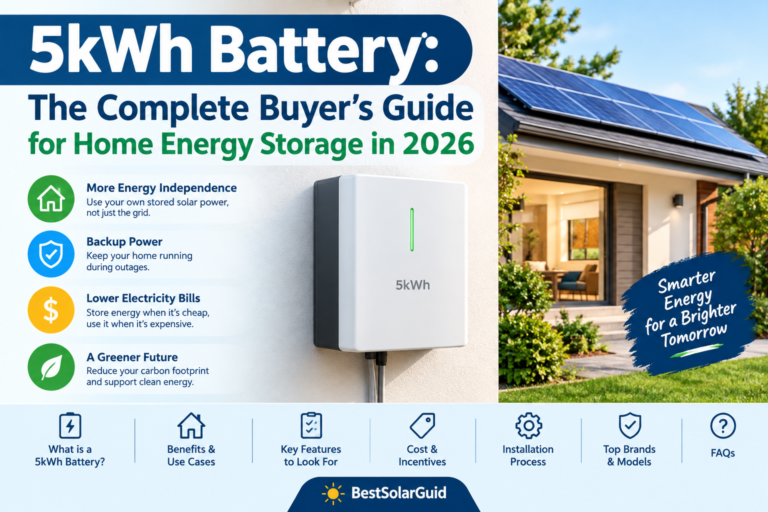
A solar battery stores electrical energy so it can be used later, such as during the evening, at night, or during a power outage when the system is properly designed for backup operation.
Battery storage can provide several advantages, including greater energy independence, higher solar self-consumption, backup power, and reduced dependence on grid electricity. However, batteries also have disadvantages, including higher upfront costs, limited capacity, degradation, additional equipment, and eventual replacement.
So, are solar batteries worth it in 2026?
The answer depends on your electricity usage, local energy prices, solar production, grid reliability, battery cost, and how much you value backup power.
In this guide, we will explain the pros and cons of solar battery storage in simple language so you can decide whether adding a battery to your solar system is the right choice.
Table of Content
- What Is Solar Battery Storage?
- Solar Battery Storage Pros and Cons at a Glance
- Pros of Solar Battery Storage
- Cons of Solar Battery Storage
- Solar Battery Storage vs Solar Without Battery
- Lithium vs Lead-Acid Solar Batteries
- What Is Depth of Discharge and Why Does It Matter?
- What Is Battery Cycle Life?
- How Long Can a Solar Battery Power a Home?
- Does Solar Battery Storage Work During a Blackout?
- Solar Battery Storage in Pakistan
- Hot Climate and Battery Storage
- Important point about Pakistani electricity rules
- Solar Battery Storage Around the World
- How to Choose the Right Solar Battery
- How to Get More Value From Solar Battery Storage
- Who Should Consider Solar Battery Storage?
- Who May Not Need a Solar Battery?
- Is Solar Battery Storage Worth It in 2026?
- Final Verdict: Pros and Cons of Solar Battery Storage
- Frequently Asked Questions
- Conclusion
What Is Solar Battery Storage?
Solar battery storage is a system that stores electricity for later use.
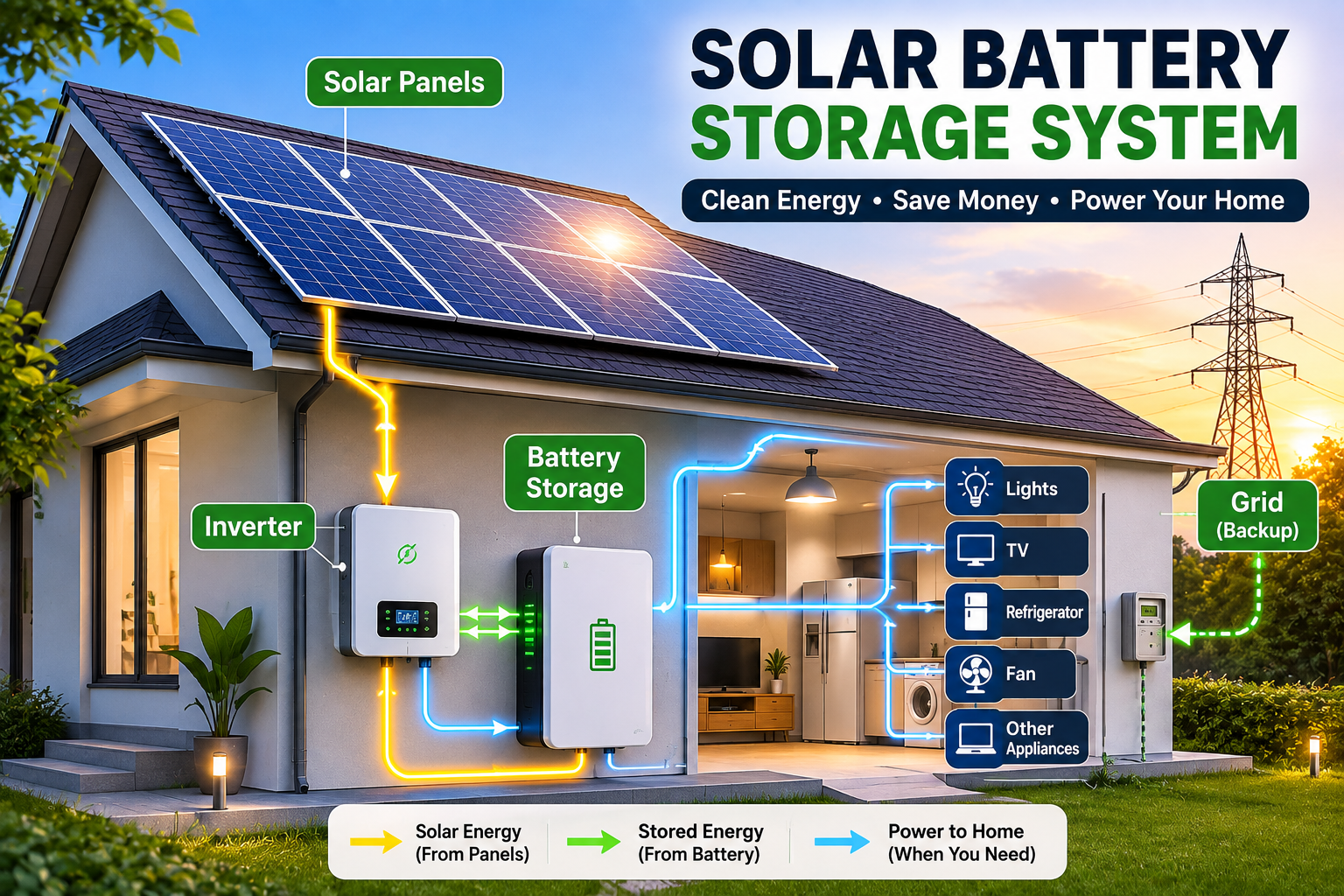
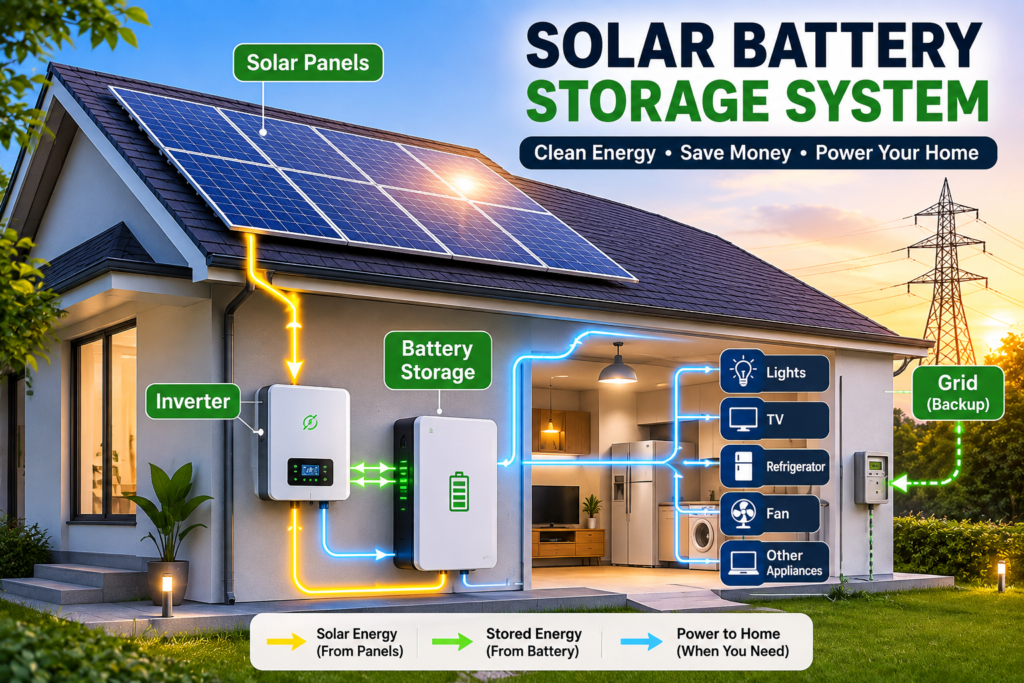
During sunny hours, solar panels produce electricity. Your home uses some of that electricity immediately. If the panels produce more electricity than your home needs, the excess can be stored in a battery or exported to the grid, depending on your system and local electricity rules.
Later, when solar production decreases, the battery can supply some of the stored energy to your home.
A simple energy flow looks like this:
Solar panels → Home → Battery → Home
For a grid-connected system, electricity can also flow between the home and the utility grid.
The main purpose of battery storage is to move electricity from the time it is produced to the time it is needed.
Solar Battery Storage Pros and Cons at a Glance
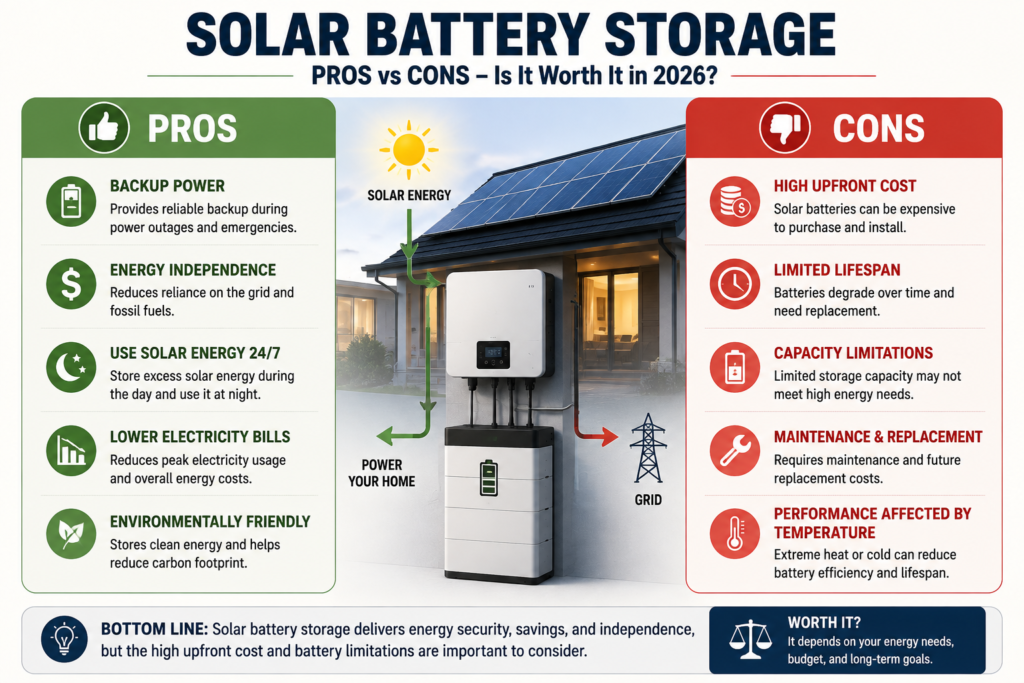
| Pros | Cons |
|---|---|
| Stores excess solar energy | Higher upfront cost |
| Allows solar energy to be used after sunset | Limited storage capacity |
| Can provide backup power | Battery capacity declines over time |
| Can increase solar self-consumption | Batteries eventually need replacement |
| Can reduce grid dependence | Additional equipment is required |
| Supports greater energy independence | System becomes more complex |
| Useful for areas with unreliable electricity | Financial savings vary by location |
| Important for many off-grid systems | Installation space is required |
The right choice depends on your household’s energy needs and local electricity market.
Pros of Solar Battery Storage
1. Use Solar Energy After Sunset
One of the biggest benefits of a solar battery is the ability to store solar electricity during the day and use it later.
Solar panels produce electricity mainly during daylight hours. However, many households consume a large portion of their electricity in the evening.
For example:
- Solar panels produce electricity at noon.
- Your home uses only part of it.
- The battery stores some of the surplus.
- Your home uses that stored energy in the evening.
This can make solar energy more useful throughout the day rather than limiting its use to periods of strong sunlight.
2. Provides Backup Power During Grid Outages
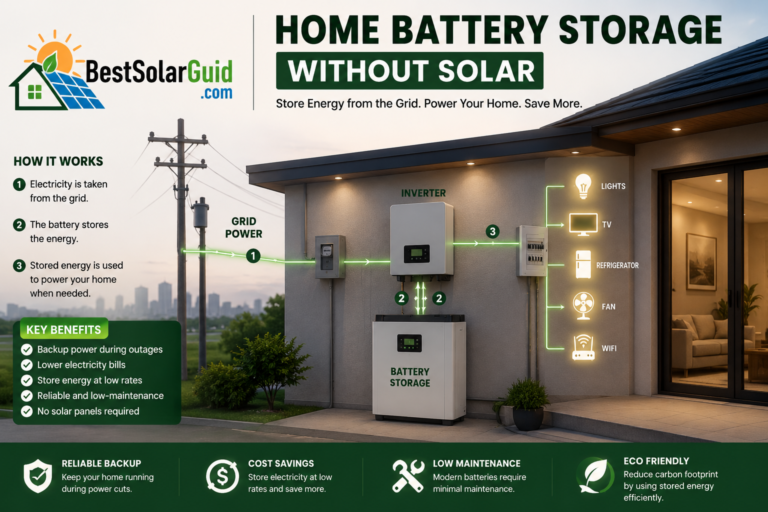
A properly configured solar battery can provide backup electricity when the utility grid goes down.
This is one of the biggest reasons some homeowners choose battery storage.
Depending on the battery capacity and system design, backup power can support important appliances such as:
- Lights
- Refrigerators
- Fans
- Wi-Fi routers
- Security systems
- Computers
- Small appliances
- Selected household circuits
However, not every solar battery system automatically provides backup power.
The inverter, battery, transfer equipment, electrical configuration, and installation must support backup operation.
Before purchasing a battery, always ask the installer exactly which appliances will remain powered during an outage.
3. Greater Energy Independence
Solar batteries can reduce your dependence on electricity from the grid.
Instead of immediately exporting surplus solar electricity and later buying electricity from the grid, you may be able to store part of your own solar production and use it later.
This can be particularly useful for homeowners who want:
- Greater energy independence
- More control over electricity usage
- Less reliance on the grid
- Protection against some grid interruptions
Battery storage does not make a home completely energy independent by itself. The system still needs sufficient solar generation and enough battery capacity for the household’s requirements.
4. Increases Solar Self-Consumption
Solar panels often generate their highest output during the middle of the day.
But household electricity demand may be higher in the morning and evening.
This creates a mismatch:
Solar production: highest during daylight
Household demand: often higher in the morning and evening
A battery helps bridge this gap.
By storing surplus solar energy during the day and using it later, a homeowner can potentially increase the percentage of solar electricity used directly within the home.
5. Can Reduce Grid Electricity Purchases
When stored solar energy is used instead of electricity purchased from the grid, grid consumption can decrease.
This can potentially reduce electricity bills.
However, battery storage does not automatically guarantee financial savings.
The actual benefit depends on:
- Electricity rates
- Solar production
- Battery efficiency
- Battery size
- Battery cost
- Export compensation
- How frequently the battery is used
- Local electricity regulations
A battery should therefore be evaluated according to your actual electricity situation rather than simply assuming that more storage always means more savings.
6. Can Be Valuable With Time-of-Use Electricity Rates
Some electricity markets have different electricity prices at different times of the day.
If electricity is more expensive during peak hours, a battery can potentially store solar electricity earlier and discharge it when electricity prices are higher.
This can improve the value of stored energy.
However, this benefit depends heavily on the local electricity tariff.
If electricity prices remain the same throughout the day, time-of-use savings may not be significant.
7. Useful in Areas With Frequent Power Outages
For households that regularly experience power interruptions, the value of a battery is not limited to electricity savings.
A battery can provide energy resilience.
This may be especially valuable for:
- Homes
- Small businesses
- Remote properties
- Farms
- Areas with unreliable electricity
- Households that depend on essential electrical equipment
In these situations, homeowners may consider the reliability benefit just as important as the financial return.
8. Makes Off-Grid Solar More Practical
Battery storage is particularly important for off-grid solar systems.
An off-grid home cannot depend on the utility grid when solar production falls.
The battery can provide energy during:
- Nighttime
- Cloudy weather
- Periods of low solar production
- Temporary reductions in solar generation
Off-grid systems therefore require careful battery sizing.
The battery must be large enough to meet expected loads while the solar array must produce enough energy to recharge it.
9. Can Help Reduce Dependence on Fossil-Fuel Backup Generators
In some applications, battery storage can reduce the need to operate a backup generator.
A solar-plus-battery system can store renewable electricity and provide it when solar production is unavailable.
However, for homes that require very long backup periods, especially during several days of poor weather, a generator or additional energy storage may still be considered depending on the system design.
Cons of Solar Battery Storage
1. Higher Upfront Cost
The biggest disadvantage of adding a battery is usually the additional investment.
A solar battery system can require spending on:
- Battery
- Inverter or compatible hybrid inverter
- Backup equipment
- Wiring
- Protection equipment
- Installation
- Electrical upgrades
- Permits or approvals where applicable
Battery costs vary significantly by country and system size.
For example, a current U.S. market estimate puts a typical installed residential battery system at around $15,647, but this figure should not be used as a Pakistan price because local equipment, labor, taxes, currency, and installation conditions are different.
For Pakistan and other markets, homeowners should obtain current local quotations rather than relying on a foreign price estimate.
2. Solar Batteries Have a Limited Lifespan
Solar batteries do not last forever.
Battery performance gradually changes as the battery experiences:
- Charging cycles
- Discharging cycles
- Temperature stress
- Calendar aging
- Chemical degradation
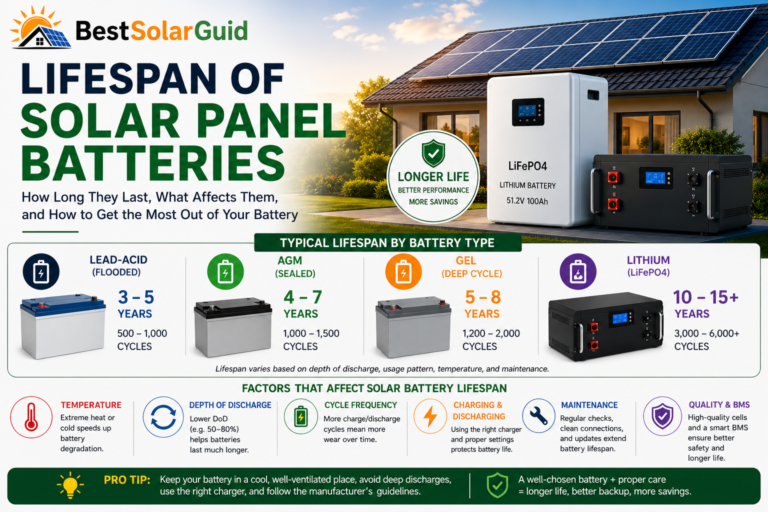
Many modern home batteries are designed for years of service, and 10-year product warranties are common among battery manufacturers, although warranty conditions differ between products.
A warranty should not be confused with a guarantee that the battery will perform exactly like a new battery for the entire warranty period.
Always check the manufacturer’s actual warranty terms.
Battery lifespan is an important factor when calculating the long-term value of solar storage. For a detailed look at battery degradation, expected lifespan, and the factors that affect battery life, see our guide to solar panel battery lifespan.
3. Battery Capacity Degrades Over Time
Battery degradation means the battery gradually loses some of its original energy-storage capability.
A new battery may be able to store a certain amount of usable energy. After years of cycling and aging, its available capacity may be lower.
The speed of degradation depends on:
- Battery chemistry
- Temperature
- Depth of discharge
- Charging conditions
- Discharging conditions
- Number of cycles
- Battery quality
- Installation environment
This is why battery warranties often specify a minimum retained capacity or other performance conditions.
4. A Battery Cannot Power Unlimited Loads
A common misunderstanding is:
“If I buy a battery, my entire house will run normally during a blackout.”
That is not necessarily true.
Battery systems have two important specifications:
Energy capacity
Measured in kilowatt-hours (kWh).
This tells you how much energy the battery can store.
Power output
Measured in kilowatts (kW).
This tells you how much power the system can deliver at one time.
A battery may have plenty of stored energy but still be unable to run several high-power appliances simultaneously if the inverter and battery output are not large enough.
5. Large Homes May Need Multiple Batteries
A household with high electricity consumption may need more storage capacity.
For example, a home that wants backup for:
- Air conditioning
- Water pumps
- Refrigerators
- Kitchen appliances
- Fans
- Lighting
- Electronics
may require a much larger battery system than a home that only wants to keep essential lights, refrigeration, and communication equipment running.
Adding multiple battery modules increases the overall investment.
6. Batteries Eventually Need Replacement
Battery replacement should be considered when calculating the long-term cost of a solar-plus-storage system.
Instead of asking only:
“How much does the battery cost today?”
also consider:
“How much value will this battery provide throughout its useful life?”
and:
“What could replacement cost in the future?”
Battery technology and prices can change significantly over time, so future replacement costs are difficult to predict precisely.
7. Installation Requires Suitable Space
A battery needs an appropriate installation location.
Depending on the system, space may be needed for:
- Battery modules
- Inverter
- Disconnects
- Protection equipment
- Wiring
- Monitoring equipment
The installation location should meet the manufacturer’s requirements for temperature, moisture, clearances, ventilation where applicable, and safety.
This is especially important in very hot climates.
8. Battery Systems Add Complexity
A solar system without storage can be simpler than a solar-plus-battery system.
Adding a battery introduces additional components and control systems.
A typical system may include:
Solar panels → Inverter → Battery → Home → Grid
These components must be properly matched and configured.
Incorrect installation can reduce performance and may create safety or warranty problems.
9. Batteries Are Not Maintenance-Free
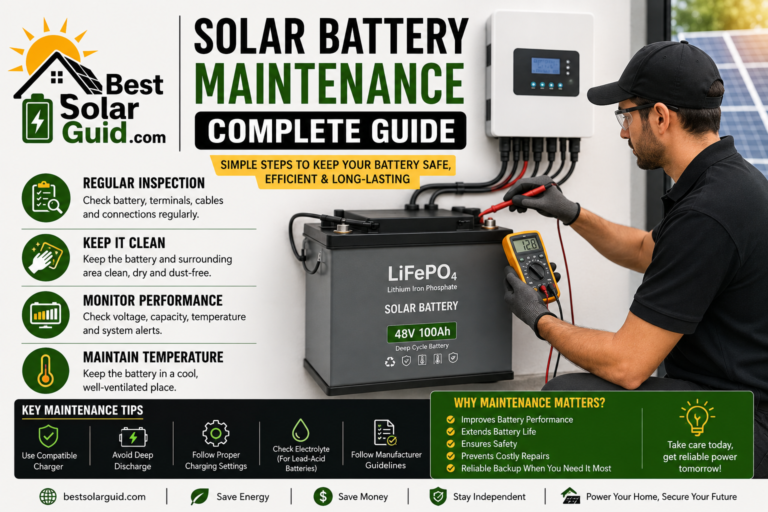
Modern lithium batteries generally require relatively little routine maintenance compared with some older battery technologies.
However, homeowners should still monitor:
- Battery health
- State of charge
- Temperature
- System warnings
- Inverter performance
- Charging and discharging behavior
Lead-acid batteries can require more maintenance depending on their design and operating conditions.
10. A Battery Is Not Financially Worthwhile for Every Home
This is one of the most important points to understand.
A battery can be technically useful but still not provide an attractive financial return.
For example, a battery may be less financially attractive if you:
- Have a very reliable grid
- Use most electricity during daylight
- Receive favorable compensation for exported solar energy
- Have relatively low electricity prices
- Rarely experience outages
- Have a limited budget
On the other hand, battery storage may become more valuable if you:
- Experience frequent outages
- Use significant electricity after sunset
- Have expensive peak electricity rates
- Receive low compensation for exported solar electricity
- Highly value backup power
Solar Battery Storage vs Solar Without Battery
Before buying a battery, compare both options.
| Feature | Solar Without Battery | Solar + Battery |
|---|---|---|
| Upfront cost | Lower | Higher |
| Nighttime use of solar energy | Limited | Yes |
| Backup capability | Usually limited or unavailable | Possible with suitable equipment |
| Solar self-consumption | Can be lower | Can be higher |
| Energy independence | Moderate | Higher |
| System complexity | Lower | Higher |
| Battery replacement | Not required | Eventually required |
| Space requirement | Lower | Higher |
| Best for | Lower-cost solar | Storage, backup and greater independence |
A battery is therefore not automatically better.
It simply provides additional energy-storage and backup capabilities.
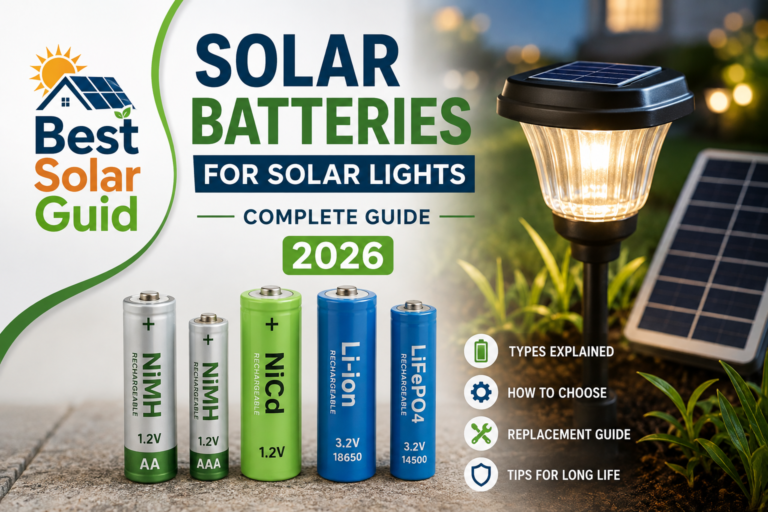
Lithium vs Lead-Acid Solar Batteries
Lithium-Ion Solar Batteries
Lithium-ion batteries are widely used in modern residential energy storage.
Their advantages can include:
- High energy density
- Good efficiency
- Long cycle life
- Low routine maintenance
- High usable capacity
LiFePO4 Solar Batteries
LiFePO4 stands for lithium iron phosphate.
This lithium chemistry is widely used for stationary energy storage because it offers a combination of cycle life, safety characteristics, and durability.
For many residential solar systems, LiFePO4 is an attractive option for homeowners who want frequent daily cycling and long-term use.
Lead-Acid Solar Batteries
Lead-acid batteries have been used in solar systems for many years.
Their potential advantages include:
- Lower initial cost
- Established technology
- Wide availability
However, they are generally heavier than lithium batteries and can have different cycle-life and usable-capacity characteristics.
For systems that require frequent daily cycling, lithium technology can often provide better long-term performance, although the right choice depends on budget, system design, and local availability.
What Is Depth of Discharge and Why Does It Matter?
Depth of Discharge (DoD) refers to how much of a battery’s available capacity is used.
For example, if a battery has a 10 kWh nominal capacity and you use 8 kWh from it, the discharge depth is approximately 80%.
Battery manufacturers specify recommended operating ranges because repeatedly using a battery very deeply can affect its long-term performance.
This is one reason why usable battery capacity is more important than simply looking at the advertised nominal capacity.
What Is Battery Cycle Life?
A battery cycle represents energy being charged into and discharged from the battery.
Cycle life is important because a battery designed for frequent daily cycling needs to withstand repeated charge and discharge events.
However, cycle count alone should not determine your purchase decision.
Also consider:
- Warranty period
- Guaranteed capacity
- Energy throughput
- DoD
- Temperature range
- Charging limits
- Manufacturer requirements
Two batteries with similar advertised cycle counts can have different warranty conditions and real-world performance.
How Long Can a Solar Battery Power a Home?
There is no universal answer.
Runtime depends on:
Usable battery capacity ÷ household electricity demand
For example, suppose a battery has:
10 kWh usable capacity
and a home is consuming approximately:
1 kW
at a particular average load.
A simplified calculation would be:
10 kWh ÷ 1 kW = 10 hours
In real use, the result can be different because of:
- Inverter losses
- Battery reserve settings
- Changing household loads
- Battery efficiency
- Temperature
- High-power appliances
Therefore, homeowners should calculate backup runtime using their actual essential loads, rather than assuming a battery will run the entire house for a fixed number of hours.
Does Solar Battery Storage Work During a Blackout?
It can, but the system must be designed for backup operation.
Many standard grid-connected solar systems shut down during a grid outage for safety reasons.
A battery-backed system can be designed to disconnect from the grid and continue supplying selected loads or the home, depending on the equipment.
Before purchasing a system, ask:
- Does the battery provide backup power?
- Is whole-home or partial-home backup supported?
- What is the maximum backup power?
- Which appliances can operate together?
- How long can the battery provide power?
- Does the system require additional backup equipment?
Solar Battery Storage in Pakistan
Solar battery storage can be particularly useful in Pakistan because many households consider solar energy not only for reducing electricity costs but also for improving power reliability.
For Pakistani homeowners, important factors include:
- Electricity tariffs
- Grid reliability
- Household electricity consumption
- Summer temperatures
- Battery chemistry
- Battery warranty
- Installation environment
- Inverter compatibility
- Current electricity and grid-export rules
Hot Climate and Battery Storage
Pakistan experiences very hot conditions in many regions, particularly during summer.
Excessive heat can accelerate battery aging and may reduce performance if the battery operates outside its specified temperature range.
Therefore, battery installation should follow the manufacturer’s temperature and environmental requirements.
A good battery installed in a poor location can perform worse than expected.
Important point about Pakistani electricity rules
Net-metering and distributed-generation rules can change, so do not publish a fixed financial claim about exporting solar electricity without checking the latest applicable Pakistani regulations and utility requirements at the time you update the article.
For a worldwide website, this is especially important because solar-export rules differ from country to country.
Solar Battery Storage Around the World
The value of battery storage varies considerably between countries.
In countries with high electricity prices, batteries can potentially help households use stored solar energy when grid electricity is expensive.
In areas with frequent power outages, backup power can be one of the main reasons to install a battery.
In markets with government incentives, rebates, or battery-support programs, the economics can become more attractive.
For example, Australia’s Cheaper Home Batteries Program provides support for eligible small-scale battery installations, demonstrating how government policy can influence battery adoption.
Globally, battery storage is also becoming a larger part of electricity systems. The International Energy Agency’s 2026 data shows that battery storage additions are being used for applications including energy shifting and grid-support services.
However, there is no single worldwide answer to whether a home battery is financially worthwhile.
Your local electricity price, solar-export rules, incentives, climate, and grid reliability matter.
How to Choose the Right Solar Battery
Don’t choose a battery simply because it has the biggest capacity.
Consider these factors:
1. Usable Capacity
Look at usable kWh rather than only nominal capacity.
2. Power Output
Check the battery and inverter’s continuous and peak power capabilities.
3. Depth of Discharge
Understand how much of the battery capacity can normally be used.
4. Cycle Life
Look at the manufacturer’s cycle-life rating and how it relates to the warranty.
5. Warranty
Check:
- Warranty years
- Minimum guaranteed capacity
- Energy throughput
- Cycle limits
- Operating conditions
- Installation requirements
6. Battery Chemistry
Compare lithium-ion, LiFePO4, and lead-acid according to your needs.
7. Temperature Range
This is especially important in hot climates.
8. Inverter Compatibility
Make sure the battery is officially compatible with your inverter.
9. Safety and Certification
Choose reputable equipment that meets the applicable electrical and battery safety requirements in your market.
How to Get More Value From Solar Battery Storage
A correctly sized battery is usually more useful than simply buying the largest battery available.
Before purchasing, analyze:
- Daily electricity consumption
- Daytime electricity usage
- Evening electricity usage
- Solar generation
- Grid outage frequency
- Essential backup loads
- Electricity prices
- Solar export compensation
- Battery cost
- Battery warranty
If your main goal is backup power, size the system around your essential loads.
If your goal is reducing electricity purchases, analyze your daily solar production and evening consumption.
Who Should Consider Solar Battery Storage?
A battery may be a good fit if you:
- Experience frequent power outages
- Want backup electricity
- Use significant electricity after sunset
- Want greater energy independence
- Have low compensation for excess solar electricity
- Have time-of-use electricity rates
- Want to increase solar self-consumption
- Operate an off-grid solar system
Who May Not Need a Solar Battery?
A battery may be less important if you:
- Have a reliable electricity grid
- Use most of your electricity during daylight
- Receive favorable compensation for exported solar energy
- Have low electricity prices
- Rarely experience outages
- Have a limited budget
In these situations, improving energy efficiency or investing in additional solar generation may sometimes provide greater value.
Is Solar Battery Storage Worth It in 2026?
The answer depends on what you want from your solar system.
If your main goal is backup power and energy independence, a battery can provide significant practical value.
If your main goal is simply the lowest possible upfront cost, solar without a battery may be a better starting point.
If your electricity rates are high in the evening, battery storage can potentially become more valuable.
If your grid is unreliable, the backup benefit may be more important than the financial payback.
The best decision comes from comparing the battery’s:
Upfront cost + usable capacity + efficiency + lifespan + warranty + electricity savings + backup value
against your actual household requirements.
If you are not sure whether battery storage is necessary for your home, compare it with a home solar system without a battery to understand the differences in cost, backup power, and energy usage.
Final Verdict: Pros and Cons of Solar Battery Storage
Solar battery storage is neither universally good nor universally bad.
It is a powerful energy-management tool that can make solar electricity available when the sun is not producing power.
The biggest advantages are:
- Using solar energy after sunset
- Backup power
- Greater energy independence
- Higher solar self-consumption
- Reduced grid dependence
- Better control over when stored energy is used
The biggest disadvantages are:
- Higher upfront cost
- Limited capacity
- Battery degradation
- Eventual replacement
- Additional equipment
- More system complexity
- Location-dependent financial returns
For a homeowner with frequent outages, high evening electricity use, or a strong desire for energy independence, battery storage can be extremely valuable.
For someone with a reliable grid and favorable solar-export economics, the additional investment may not always be justified.
The best solar battery is not necessarily the biggest or most expensive one. It is the one that matches your electricity usage, solar production, backup needs, budget, climate, and local energy rules.
Conclusion
Solar battery storage can make a solar system much more flexible by allowing excess electricity to be stored and used later.
Its biggest strengths are backup power, greater energy independence, increased solar self-consumption, and reduced dependence on grid electricity.
Its biggest weaknesses are higher cost, limited storage capacity, degradation, additional system complexity, and eventual replacement.
For this reason, a battery should not be treated as a mandatory part of every solar installation.
Instead, think about how you actually use electricity.
Do you need power at night?
Do you experience frequent outages?
Do you use a lot of electricity after sunset?
Is exported solar electricity fairly compensated in your area?
Do you want backup power more than a faster financial payback?
Once you answer these questions, it becomes much easier to decide whether solar battery storage is right for you.
In 2026, the smartest solar-storage decision is not simply to buy a battery—it is to choose the right battery size, chemistry, inverter, and operating strategy for your specific energy needs.
What are the main pros and cons of solar battery storage?
The main advantages are backup power, increased solar self-consumption, greater energy independence, and the ability to use stored solar electricity later. The main disadvantages are higher upfront cost, limited capacity, degradation, additional equipment, and eventual replacement.
Is solar battery storage worth it in 2026?
It can be worth it if you need backup power, use significant electricity after sunset, have expensive electricity during certain periods, or want greater energy independence. However, the financial value depends on your local electricity prices, solar-export rules, battery cost, and usage pattern.
What is the biggest advantage of a solar battery?
The biggest advantage is the ability to store solar electricity and use it later, especially when solar panels are not producing enough electricity.
How long do solar batteries last?
Battery life varies by chemistry, manufacturer, operating conditions, temperature, and cycling. Many modern residential batteries are designed for many years of service, and 10-year warranties are common, but the exact warranty and expected life should always be checked for the specific product.
Do solar batteries work during a power outage?
Yes, if the system is specifically designed and installed for backup operation. A normal grid-connected solar system may shut down during a grid outage.
Can a solar battery power an entire house?
It can, depending on battery capacity, inverter power, and household loads. Large appliances such as air conditioners, electric heaters, and pumps can require substantial power.
Are lithium batteries better than lead-acid batteries?
For many modern residential applications, lithium batteries—particularly LiFePO4—offer advantages in cycle life, usable capacity, weight, and maintenance. Lead-acid can still be useful where lower upfront cost is the main priority.
Does a bigger battery always mean more savings?
No. An oversized battery can increase the cost without providing enough additional value. Battery capacity should be matched to solar production, household consumption, backup needs, and local electricity rates.
Can I add a battery to an existing solar system?
Often yes, but compatibility depends on your inverter, battery technology, system architecture, and electrical configuration. Always confirm compatibility with the manufacturer or a qualified installer.
Do solar batteries need maintenance?
Modern lithium batteries generally require relatively little routine maintenance, but they still need appropriate installation, monitoring, and operating conditions. Lead-acid batteries may require more maintenance depending on the type.
Can solar batteries reduce electricity bills?
They can, but savings depend on your electricity tariff, solar production, battery efficiency, battery cost, export compensation, and how the battery is operated.