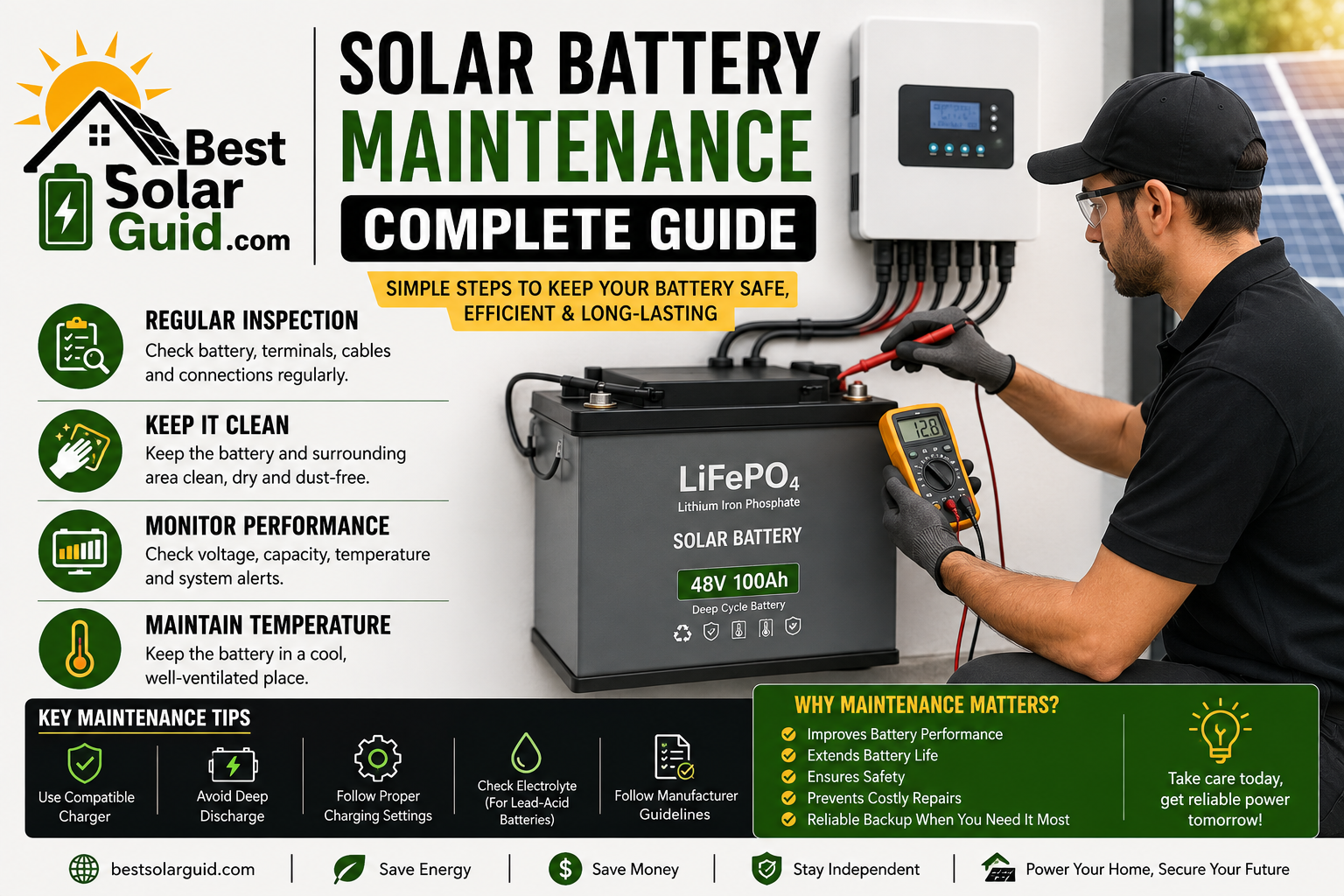
Solar Battery Maintenance: Complete Guide to Make Your Battery Last Longer
Solar batteries are an important part of many solar power systems because they store excess electricity for use at night, during cloudy weather, or when the grid goes down. However, installing a good battery is only the first step. Proper solar battery maintenance can help protect performance, reduce avoidable problems, and extend the useful life of your battery.
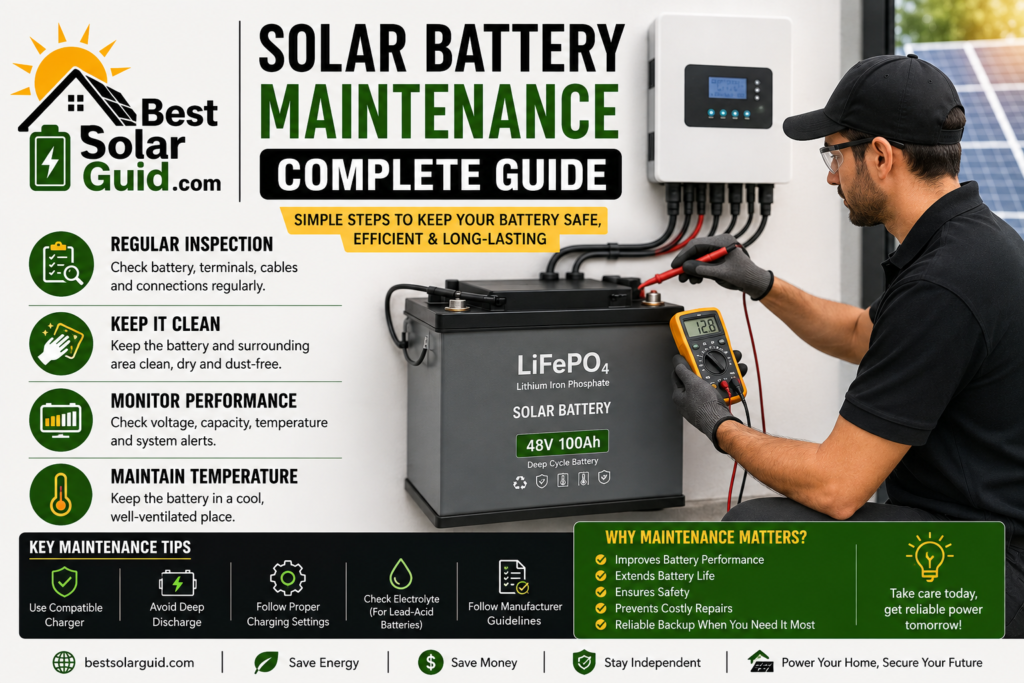
The amount of maintenance required depends heavily on the battery type. Modern lithium-ion batteries usually need very little routine maintenance, while flooded lead-acid batteries require more attention, including checking electrolyte levels and inspecting terminals. AGM and gel batteries are sealed designs and generally need less hands-on maintenance than flooded batteries.
This guide explains how to maintain different types of solar batteries, how often you should check them, what mistakes to avoid, and how to recognize signs that your battery may need professional attention.
Table of content
- What Is Solar Battery Maintenance?
- Why Is Solar Battery Maintenance Important?
- Solar Battery Maintenance by Battery Type
- How to Maintain a Solar Battery: Step-by-Step
- How Often Should You Maintain a Solar Battery?
- Solar Battery Maintenance in Pakistan’s Hot Climate
- Solar Battery Maintenance During Power Outages
- Common Solar Battery Maintenance Mistakes
- Should You Equalize a Solar Battery?
- How to Know When a Solar Battery Needs Attention
- Solar Battery Maintenance vs Battery Replacement
- Can Solar Battery Maintenance Extend Battery Life?
- How Much Does Solar Battery Maintenance Cost?
- Solar Battery Maintenance Checklist
- Solar Battery Maintenance FAQs
- Final Verdict: Is Solar Battery Maintenance Worth It?
What Is Solar Battery Maintenance?
Solar battery maintenance means regularly checking the battery and the equipment around it to make sure the system is operating safely and correctly.
Depending on the battery chemistry, maintenance may include:
- Inspecting the battery and its connections
- Checking terminals for corrosion
- Keeping the battery area clean and dry
- Monitoring temperature
- Checking battery voltage and system status
- Monitoring charging and discharging behavior
- Checking electrolyte levels in flooded lead-acid batteries
- Reviewing the battery’s state of charge
- Checking for unusual smells, swelling, leakage, or excessive heat
- Following the manufacturer’s charging and storage instructions
Not every battery requires all of these tasks. For example, a sealed lithium or AGM battery should not be opened simply because you are following a generic maintenance checklist.
The manufacturer’s manual should always take priority over general maintenance advice.
Why Is Solar Battery Maintenance Important?
A solar battery gradually loses capacity as it ages. This is normal, but poor operating conditions can accelerate degradation.
Three factors are particularly important: depth of discharge, cycling, and operating temperature. Battery life also depends on the chemistry, charging settings, installation conditions, and how frequently the battery is used.
Proper maintenance can help you:
- Detect problems before they become expensive
- Reduce the risk of unexpected backup-power failure
- Keep connections in good condition
- Prevent avoidable corrosion
- Maintain better charging performance
- Protect the battery from unsuitable temperatures
- Improve the reliability of your solar system
- Get more useful life from your battery investment
For homeowners in areas with frequent power outages, including parts of Pakistan, battery reliability can be especially important because the battery may be cycled more frequently than in a home that mainly uses storage for evening energy consumption.
Solar Battery Maintenance by Battery Type
One of the biggest mistakes people make is treating every solar battery the same way.
Different battery chemistries have different maintenance requirements.
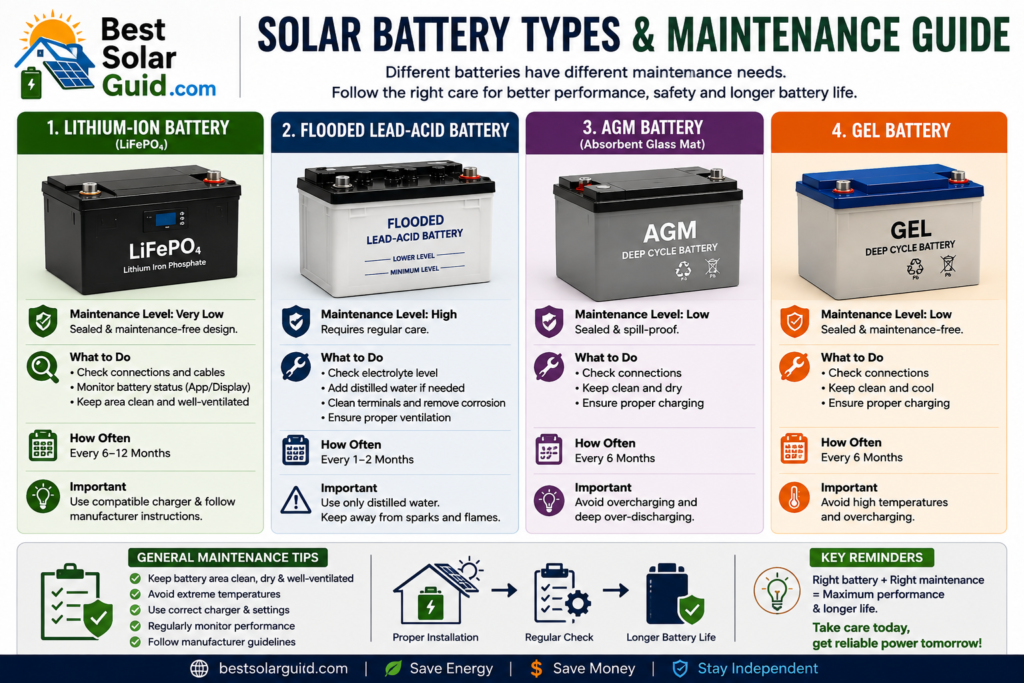
1. Lithium-Ion Solar Battery Maintenance
Lithium-ion batteries, including lithium iron phosphate (LiFePO4) batteries, generally require much less hands-on maintenance than traditional flooded lead-acid batteries.
There is normally no water to refill, and the battery is typically managed by an integrated battery management system (BMS).
For lithium batteries, focus on:
- Keeping the battery within the manufacturer’s temperature range
- Checking the battery monitoring system or app
- Inspecting cables and connections
- Keeping vents and cooling areas unobstructed where applicable
- Using the correct charger and inverter settings
- Avoiding unauthorized changes to charging parameters
- Watching for unusual heating, swelling, error messages, or sudden capacity loss
- Following the manufacturer’s storage instructions
Do not open or attempt to repair a lithium battery yourself. Internal battery servicing should be handled by a qualified professional or the manufacturer.
Modern lithium batteries can also tolerate a greater usable depth of discharge than many lead-acid batteries, but the exact allowable DoD depends on the battery model and its manufacturer’s specifications.
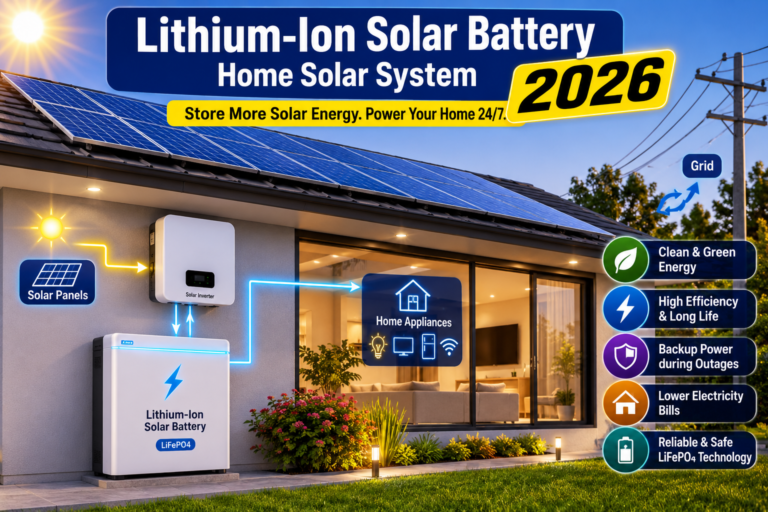
Lithium-ion batteries generally require less hands-on maintenance than traditional lead-acid batteries, but choosing the right battery and understanding its lifespan, cost, and specifications is still important. For a deeper look at these factors, read our complete guide to lithium-ion solar batteries.
2. Flooded Lead-Acid Solar Battery Maintenance
Flooded lead-acid batteries require more regular maintenance.
Depending on the manufacturer’s instructions, maintenance may include:
- Checking electrolyte levels
- Adding distilled or deionized water when required
- Inspecting terminals
- Cleaning corrosion
- Checking ventilation
- Monitoring charging voltage
- Checking battery condition
- Performing equalization only when specifically appropriate
Never add ordinary tap water unless the battery manufacturer specifically says it is acceptable.
Flooded lead-acid batteries can release gases during operation, so adequate ventilation is important. Working around lead-acid batteries also requires appropriate safety precautions because hydrogen gas can create an explosion hazard.
3. AGM Solar Battery Maintenance
AGM batteries are a type of sealed lead-acid battery.
They generally do not require you to check or refill water levels. Their maintenance is mainly visual and electrical:
- Inspect the battery for damage
- Check terminals and cables
- Look for corrosion
- Monitor charging performance
- Keep the battery in an appropriate environment
- Follow the manufacturer’s charging specifications
AGM batteries are sealed and do not require the same water-level maintenance as traditional flooded lead-acid batteries.
4. Gel Solar Battery Maintenance
Gel batteries are also sealed lead-acid batteries and generally require little routine maintenance.
You should still:
- Inspect connections
- Keep the battery clean
- Monitor charging behavior
- Avoid incorrect charging voltages
- Protect the battery from extreme temperatures
- Check for physical damage or leakage
One important point is that gel batteries should not automatically be treated like flooded lead-acid batteries. Charging settings must be appropriate for the specific battery.
How to Maintain a Solar Battery: Step-by-Step
Step 1: Inspect the Battery Regularly
Start with a simple visual inspection.
Look for:
- Cracks
- Swelling
- Leakage
- Corrosion
- Damaged cables
- Loose connections
- Burn marks
- Unusual discoloration
- Excessive heat
- Strange smells
If you notice severe swelling, smoke, burning, significant leakage, or abnormal heat, stop using the system if it is safe to do so and contact a qualified technician.
Do not attempt to open or repair a damaged lithium battery yourself.
Step 2: Keep Battery Terminals and Connections Clean
Loose or corroded connections can cause resistance and heating and may reduce system performance.
For batteries where terminal inspection is appropriate:
- Switch off the system according to the manufacturer’s procedure.
- Follow the manufacturer’s safety instructions.
- Inspect the terminals and cables.
- Look for corrosion or loose connections.
- Have damaged connections repaired by a qualified technician.
Never assume that simply turning an inverter off makes every part of the battery system electrically safe. Some battery and inverter systems can still contain dangerous voltages. Manufacturer safety instructions should be followed before maintenance.
Step 3: Check Electrolyte Levels in Flooded Batteries
This step applies to flooded lead-acid batteries, not sealed lithium, AGM, or gel batteries.
If your battery manufacturer requires electrolyte-level checks:
- Inspect the electrolyte level at the recommended interval.
- Add the specified type of water when necessary.
- Do not overfill.
- Follow the manufacturer’s instructions carefully.
Because battery acid is hazardous, wear appropriate eye and skin protection and work in a properly ventilated area.
Step 4: Monitor Battery Temperature
Temperature has a major effect on battery performance and life.
Avoid placing a battery in a location that becomes excessively hot or cold unless the battery is specifically designed for those conditions.
This is particularly important in hot climates such as Pakistan, where poorly ventilated battery rooms or outdoor installations can become extremely hot during summer.
For lead-acid batteries, charging behavior also changes with temperature, so temperature compensation may be required depending on the charger and battery system.
For lithium batteries, follow the manufacturer’s specific temperature limits because charging and discharging limits can vary by model.
Step 5: Check the Battery’s State of Charge
Your inverter, battery display, monitoring system, or mobile app may show the battery’s state of charge (SoC).
Monitoring SoC helps you understand:
- How much energy remains
- Whether the battery is charging normally
- Whether the battery is frequently reaching very low levels
- Whether your household is using more energy than expected
- Whether the system is behaving differently from normal
A sudden and unexplained change in charging or discharging behavior can be a warning sign.
Step 6: Avoid Unnecessary Deep Discharges
Depth of discharge (DoD) describes how much of a battery’s stored capacity has been used.
For example, if a 10 kWh battery provides 8 kWh before recharging, the depth of discharge is 80%.
Regularly using a battery to its maximum allowable discharge can affect its long-term life, depending on the battery chemistry and manufacturer’s specifications. Lithium-ion batteries generally offer greater usable DoD than traditional lead-acid batteries.
The important rule is:
Do not use a generic DoD number for every battery. Follow your battery manufacturer’s recommended operating limits.
Step 7: Use the Correct Charging Settings
Incorrect charging settings can damage a battery or shorten its useful life.
The inverter or charge controller should be configured for the specific battery chemistry and model.
For example, charging settings for:
- Flooded lead-acid
- AGM
- Gel
- LiFePO4
are not necessarily identical.
Do not copy charging values from another battery just because both batteries have the same nominal voltage.
Victron also recommends following the battery manufacturer’s recommendations because solar charger charging algorithms can differ from AC battery chargers.
Step 8: Keep the Battery Area Clean and Dry
Dust, moisture, insects, and poor ventilation can create problems around electrical equipment.
Keep the battery area:
- Clean
- Dry
- Well ventilated where required
- Free from unnecessary objects
- Away from open flames and ignition sources
- Accessible for safe inspection
Do not place household items, flammable materials, or liquids around a battery installation
How Often Should You Maintain a Solar Battery?
There is no single maintenance schedule for every solar battery.
A practical schedule looks like this:
Monthly
For most systems, perform a quick visual and performance check:
- Check for unusual noises or smells
- Look for physical damage
- Check system alerts
- Review battery performance
- Check the battery monitoring app if available
- Inspect the surrounding area
Every 3–6 Months
Depending on the battery type and manufacturer’s instructions:
- Inspect terminals and cables
- Look for corrosion
- Check ventilation
- Review charging and discharging behavior
- Check battery temperature
- Inspect the battery enclosure
Flooded lead-acid batteries may require more frequent checks.
Annually
Consider a professional inspection, especially for larger or more complex systems.
A technician can check:
- Electrical connections
- Battery performance
- Charging settings
- System safety
- Battery condition
- Inverter/charger operation
Important
The schedule above is a general guide, not a replacement for the manufacturer’s maintenance schedule.
A lithium battery may require very little physical maintenance, while a flooded lead-acid battery may require more frequent inspection.
Solar Battery Maintenance in Pakistan’s Hot Climate
Pakistan’s climate makes temperature management especially important for solar battery systems.
During summer, temperatures inside poorly ventilated rooms, rooftops, garages, and outdoor enclosures can become significantly higher than the surrounding air temperature.
Excessive heat can accelerate battery aging and affect performance.
To protect a solar battery in hot weather:
- Install it in a suitable location
- Avoid direct sunlight where the battery is not designed for outdoor exposure
- Provide the ventilation or cooling specified by the manufacturer
- Keep the battery away from heat-producing equipment
- Monitor temperature when possible
- Never place a battery in an enclosed space that exceeds its rated operating temperature
- Follow the manufacturer’s temperature limits
This is one area where a good installation can be just as important as routine maintenance.
Solar Battery Maintenance During Power Outages
Frequent power outages can increase battery cycling.
If your system is used as backup power, the battery may charge during the day and discharge during outages or at night.
To reduce unnecessary stress:
- Avoid running non-essential high-power appliances from the battery
- Monitor the battery’s state of charge
- Use energy-efficient appliances where possible
- Avoid repeatedly draining the battery to its minimum limit
- Keep the solar charging system properly configured
- Make sure backup loads match the battery’s capacity
If your battery suddenly provides much less backup time than before, investigate the issue rather than assuming the battery simply needs cleaning.
Battery degradation is normal, but a sudden performance drop can indicate a problem.
Common Solar Battery Maintenance Mistakes
1. Treating Every Battery the Same
A lithium battery does not require the same maintenance routine as a flooded lead-acid battery.
2. Adding Water to a Sealed Battery
AGM, gel, and lithium batteries should not be opened to add water.
3. Using Tap Water in Flooded Batteries
Use only the water specified by the manufacturer.
4. Ignoring Corrosion
Corrosion around terminals should not be ignored because poor connections can affect electrical performance.
5. Installing Batteries in Excessive Heat
A battery installed in a very hot, poorly ventilated location can age faster.
6. Changing Inverter Settings Without Understanding Them
Changing charging voltage, float settings, equalization, or other parameters without understanding the battery specifications can cause problems.
7. Repeatedly Deep-Discharging the Battery
Frequently taking a battery to very low charge levels can affect its useful life depending on its chemistry and specifications.
8. Performing DIY Repairs on Lithium Batteries
A damaged lithium battery should be handled by qualified professionals.
9. Ignoring Warning Messages
Modern battery systems often provide alarms or error codes. Repeated warnings should be investigated rather than simply reset.
Should You Equalize a Solar Battery?
Equalization is primarily associated with certain flooded lead-acid batteries.
It involves a controlled charging process intended to help balance cells and reduce electrolyte stratification under appropriate conditions.
However, equalization should not automatically be performed on every battery.
It can be inappropriate for some batteries, particularly sealed batteries and lithium batteries.
Victron’s documentation notes that whether equalization is needed depends on the battery type and manufacturer requirements.
Therefore:
Never enable equalization simply because you read that it can improve battery performance. Check your battery manufacturer’s instructions first.
How to Know When a Solar Battery Needs Attention
Watch for these warning signs:
Shorter Backup Time
If your battery used to power essential loads for many hours but now runs out much faster, its usable capacity may have declined.
Battery Not Reaching Full Charge
Possible causes include:
- Solar production problems
- Incorrect charging settings
- Battery degradation
- Faulty charger/inverter
- Wiring or connection problems
Battery Getting Too Hot
Excessive heat should always be investigated.
Swelling
Battery swelling is a serious warning sign, especially for lithium batteries.
Leakage
Fluid leakage from a battery requires caution and professional attention.
Corroded Terminals
Corrosion can indicate an issue that should be addressed.
Frequent Error Codes
Repeated battery or inverter alarms can indicate charging, temperature, communication, or battery-health problems.
Solar Battery Maintenance vs Battery Replacement
Maintenance cannot stop normal battery aging.
Every rechargeable battery eventually loses some of its original capacity.
The goal of maintenance is to prevent avoidable deterioration and keep the battery operating under suitable conditions.
If the battery is old and its capacity has fallen significantly, cleaning terminals or changing settings will not restore it to its original condition.
A replacement may be necessary when:
- Backup time has fallen significantly
- The battery repeatedly fails to charge
- The battery shows physical damage
- It frequently produces error messages
- It no longer holds an adequate charge
- A professional test confirms significant capacity loss
The exact replacement point depends on battery chemistry, warranty terms, operating history, and the manufacturer’s specifications.
Can Solar Battery Maintenance Extend Battery Life?
Yes, proper operation and maintenance can help maximize a battery’s useful life, but it cannot eliminate normal degradation.
Battery life depends on several factors, including:
- Battery chemistry
- Number of cycles
- Depth of discharge
- Operating temperature
- Charging method
- Installation conditions
- Storage conditions
- Maintenance
- Overall system design
Battery warranties may specify expected performance or cycle-related conditions, so it is worth reading the warranty rather than relying on a generic lifespan estimate.
Proper maintenance can help maximize a battery’s useful life, but battery chemistry, operating temperature, depth of discharge, and charging habits also affect how long it lasts. For a deeper explanation, read our guide on how long solar batteries last and what affects their lifespan.
How Much Does Solar Battery Maintenance Cost?
The cost varies significantly depending on the battery type and the work required.
For lithium-ion batteries, routine maintenance is often limited to inspection and monitoring, so regular maintenance costs can be relatively low.
Flooded lead-acid systems can require additional work such as electrolyte checks, terminal cleaning, and professional inspection.
In Pakistan, costs can vary based on:
- Battery type
- Battery size
- Number of batteries
- System location
- Technician charges
- Required replacement parts
- Corrosion or connection problems
- Whether professional testing is required
Because local service rates change, homeowners should obtain a current quote from a qualified solar technician rather than relying on a fixed online price.
Solar Battery Maintenance Checklist
Use this simple checklist to keep track of your system.
- Check the battery for physical damage
- Look for swelling or leakage
- Inspect terminals and connections
- Check for corrosion
- Monitor battery temperature
- Check the battery’s state of charge
- Review inverter or battery alerts
- Confirm charging settings are correct
- Keep the battery area clean and dry
- Check electrolyte levels if using a flooded battery
- Avoid unnecessary deep discharges
- Keep the battery away from excessive heat
- Follow the manufacturer’s maintenance instructions
- Arrange professional inspection when required
Final Verdict: Is Solar Battery Maintenance Worth It?
Absolutely. Solar battery maintenance does not necessarily mean spending hours working on your battery every month. For modern lithium-ion systems, maintenance may mainly involve monitoring the battery, checking the installation environment, and responding to warnings or unusual behavior.
Traditional flooded lead-acid batteries require more hands-on care, particularly around electrolyte levels, terminals, corrosion, ventilation, and charging.
The most important rule is to maintain the battery according to its chemistry and the manufacturer’s instructions. Keep the battery within its recommended temperature range, avoid inappropriate charging settings and excessive discharge, inspect the system regularly, and get professional help when you notice serious warning signs.
A well-maintained battery cannot avoid normal aging, but good maintenance can help your solar storage system remain safer, more reliable, and useful for as long as possible.
Whether you have a home solar system in Pakistan, an off-grid cabin in the United States, an RV in Australia, or a backup power system elsewhere in the world, the basic principle is the same: the right maintenance starts with knowing your battery type and following its specific operating and maintenance instructions.
How often should a solar battery be maintained?
It depends on the battery chemistry. Lithium-ion batteries usually require very little routine maintenance, while flooded lead-acid batteries need more frequent checks. Follow the manufacturer’s recommended schedule.
Do lithium solar batteries need maintenance?
Lithium solar batteries generally require very little hands-on maintenance. Monitoring temperature, battery status, charging behavior, connections, and system alerts is still important.
Do solar batteries need water?
Only certain flooded lead-acid batteries require water maintenance. Lithium, AGM, and gel batteries are not maintained by adding water.
Can I clean my solar battery?
You can keep the exterior and surrounding area clean according to the manufacturer’s instructions. However, never open a sealed battery or use liquids around electrical connections without following the manufacturer’s cleaning procedure.
How do I maintain a lead-acid solar battery?
Check electrolyte levels when required, inspect terminals, watch for corrosion, maintain proper ventilation, monitor charging, and follow the manufacturer’s recommended maintenance schedule.
How do I maintain a lithium solar battery?
Monitor temperature, state of charge, charging behavior, system alerts, and physical condition. Keep connections and the surrounding area clean and follow the manufacturer’s charging and storage instructions.
Does heat damage solar batteries?
Excessive heat can accelerate battery aging and affect performance. Batteries should be installed and operated within the temperature range specified by the manufacturer.
Should I completely discharge my solar battery?
Generally, you should not routinely discharge a battery beyond its manufacturer’s recommended depth-of-discharge limit. The allowable DoD varies by battery chemistry and model.
Can I perform solar battery maintenance myself?
Simple visual checks and monitoring may be suitable for homeowners. However, electrical work, battery repairs, lithium battery servicing, and work involving exposed battery terminals or acid should be handled by qualified professionals.
How long can a well-maintained solar battery last?
There is no single lifespan for every solar battery. Chemistry, cycles, depth of discharge, temperature, charging practices, and installation conditions all affect useful life. Always check the manufacturer’s warranty and cycle-life specifications.