5kWh Battery: The Complete Buyer’s Guide for Home Energy Storage in 2026
A 5kWh battery is quickly becoming one of the go-to choices for homeowners exploring solar and backup power, offering enough stored energy to keep essentials like your fridge, lights, and Wi-Fi running for hours without breaking the bank or taking up a garage wall. In this guide, we’ll break down exactly what a 5kWh battery can power, how it compares to other sizes, what it costs, and the key factors to weigh before you buy — so you can decide if it’s the right fit for your home.
Table of Contents
- What Is a 5kWh Battery?
- How Much Power Can a 5kWh Battery Actually Run?
- 5kWh Battery vs Other Battery Sizes
- Types of 5kWh Batteries
- Who Should Buy a 5kWh Battery?
- 5kWh Battery Price Guide
- Key Factors to Consider Before Buying
- Installation and Safety Considerations
- Pros and Cons of a 5kWh Battery
- How to Size Your Battery Correctly
- Frequently Asked Questions
- Final Verdict
What Is a 5kWh Battery?
A 5kWh battery is an energy storage unit capable of holding five kilowatt-hours of electricity, enough to power a modest household load for several hours or to keep essential appliances running during a blackout. It has become one of the most searched battery capacities among homeowners exploring solar-plus-storage systems, largely because it strikes a practical balance between price, physical size, and everyday usefulness.
Unlike a car battery or a phone battery, a 5kWh home battery is designed for repeated deep cycling — charging during the day from solar panels or off-peak grid power, then discharging in the evening or during an outage. Most units on the market today use lithium-based chemistry, which offers a longer lifespan and better safety profile than older lead-acid designs.
In simple terms, kilowatt-hours (kWh) measure stored energy, not power delivery. A 5kWh battery tells you how much energy it can hold, while a separate specification — the continuous power rating, measured in kilowatts (kW) — tells you how fast that energy can be delivered. Understanding this distinction is the first step to choosing the right system for your home.
How Much Power Can a 5kWh Battery Actually Run?
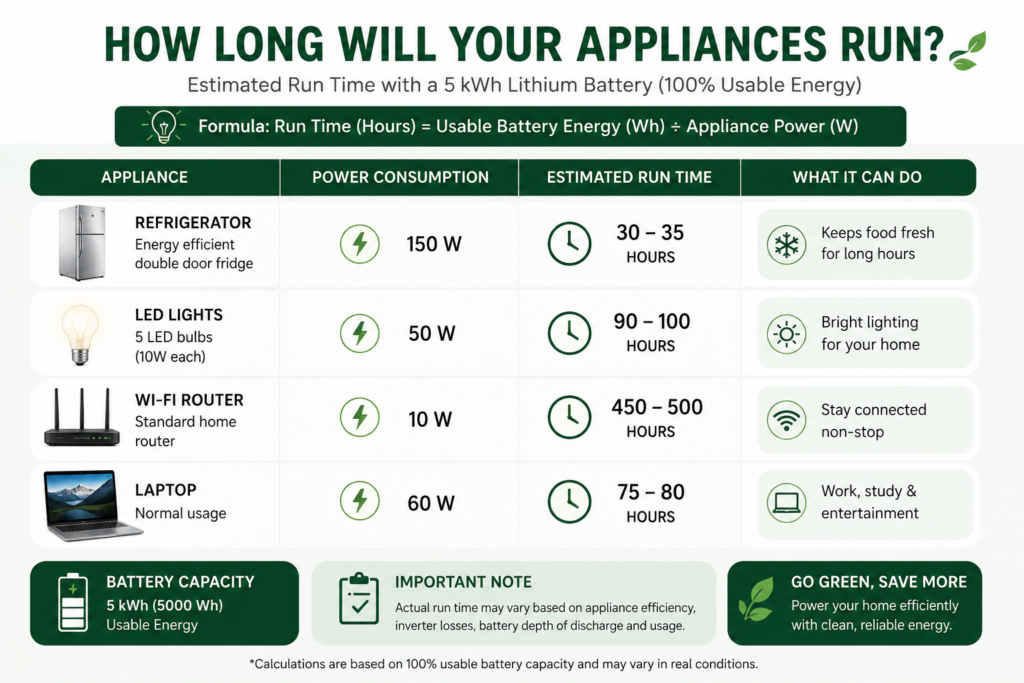
To translate 5kWh into real-world usage, it helps to look at typical household appliances and how long the battery could support them.
- Refrigerator (150W): roughly 33 hours of continuous operation
- LED lighting (10 x 10W bulbs): roughly 50 hours
- Wi-Fi router and modem (20W): several days
- Laptop charging (65W): around 75 charge cycles
- Window AC unit (900W): roughly 5-6 hours
- Well pump (1,000W, intermittent use): several days of intermittent operation
A household running a refrigerator, some lighting, phone chargers, and a Wi-Fi router simultaneously might draw around 300-400 watts on average. At that rate, a fully charged 5kWh battery could realistically last 12-15 hours, making it well-suited for overnight backup or riding out short outages.
It’s worth noting that real-world runtime is always shorter than the theoretical math suggests, because most batteries are not designed to be discharged to zero. This is governed by the depth of discharge rating, covered in more detail later in this guide.
5kWh Battery vs Other Battery Sizes
Choosing the right capacity often comes down to comparing a 5kWh unit against the next size up or down.
5kWh vs 10kWh Battery
A 10kWh battery essentially doubles the storage capacity, which means double the backup time and double the ability to shift solar energy into evening hours. However, it also roughly doubles the upfront cost and requires more physical space and often a larger inverter. A 5kWh unit tends to suit smaller households, apartments, or those primarily wanting backup for essential circuits rather than whole-home coverage. A 10kWh system is generally the better fit for larger homes, families running central air conditioning, or anyone aiming to go substantially off-grid.
5kWh vs 3kWh Battery
A 3kWh battery is the entry point for many residential systems and is typically enough only for a handful of small devices — routers, lights, and phone chargers — for a few hours. Stepping up to 5kWh adds meaningful headroom, allowing a refrigerator to run through the night alongside other essentials. For most homeowners who want more than a token backup solution but aren’t ready to invest in a large whole-home system, 5kWh represents the sweet spot between affordability and genuine usefulness.
Types of 5kWh Batteries
Not all 5kWh batteries are built the same way. The underlying chemistry has a major impact on safety, lifespan, and total cost of ownership.
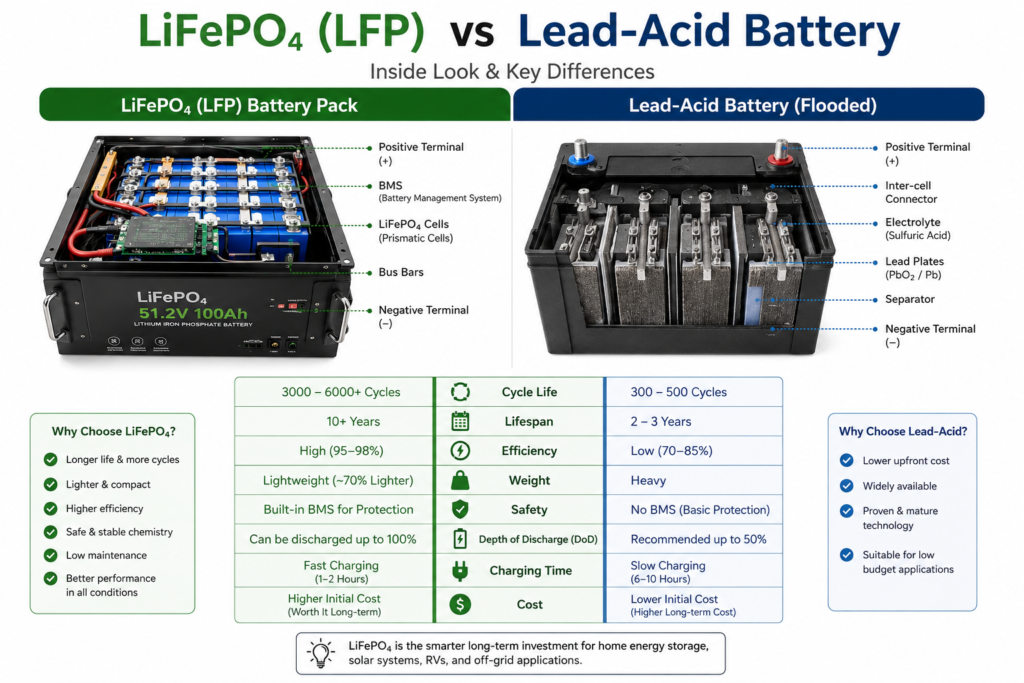
Lithium Iron Phosphate (LiFePO4)
LiFePO4 has become the dominant chemistry in residential energy storage, and for good reason. It offers a longer cycle life, often rated between 4,000 and 6,000 cycles, along with a strong thermal stability profile that reduces fire risk compared to older lithium chemistries. Most reputable 5kWh home battery products sold today, including popular wall-mounted units, use LiFePO4 cells.
Lithium-Ion (NMC)
Nickel Manganese Cobalt (NMC) batteries offer slightly higher energy density, meaning a smaller physical footprint for the same capacity. However, they generally have a shorter cycle life and a somewhat higher thermal risk than LiFePO4. NMC batteries are more common in electric vehicles and some portable power stations rather than fixed home storage systems, though a handful of 5kWh residential products still use this chemistry.
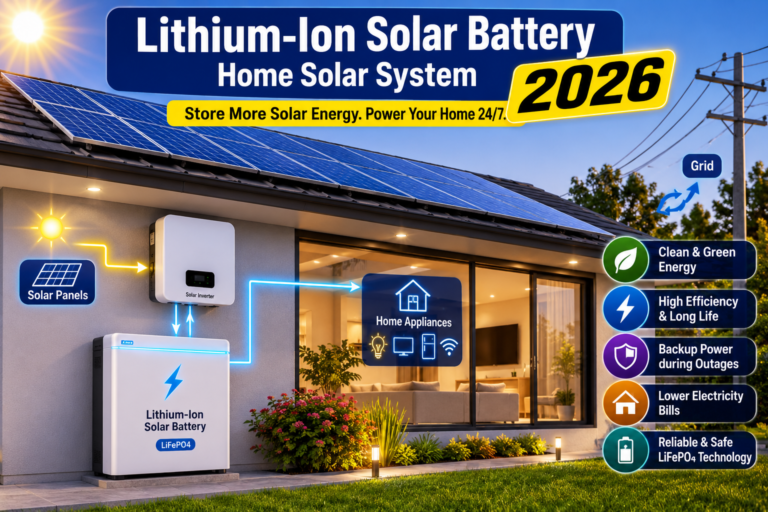
“If you want to explore lithium-ion technology in more depth beyond the 5kWh capacity discussion, our detailed guide on Lithium-Ion Solar Battery covers how these cells perform across different solar setups. It’s a useful read before finalizing your battery chemistry choice.”
Who Should Buy a 5kWh Battery?
A 5kWh battery tends to make the most sense for:
- Apartment or small-home owners who don’t need whole-house backup but want key circuits protected
- Solar panel owners looking to store excess daytime generation for evening use, reducing reliance on grid electricity during peak pricing hours
- Homeowners in areas with occasional, short-duration outages rather than multi-day blackouts
- RV and off-grid cabin owners needing a compact, portable storage solution
- First-time battery buyers wanting to test energy storage before committing to a larger, more expensive system
If your household relies on medical equipment, central air conditioning, or runs a home office requiring guaranteed uptime, a larger capacity battery — or multiple 5kWh units stacked together — is usually a safer choice.
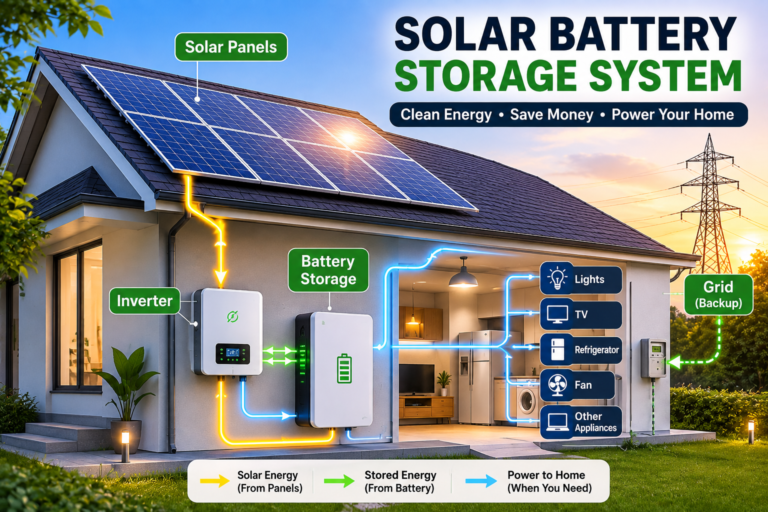
If a 5kWh unit doesn’t quite match your household needs, it’s worth browsing our full roundup of best batteries for solar systems, which compares several capacities and brands side by side. This can help you confirm whether 5kWh is truly the right size for your setup.
5kWh Battery Price Guide
Pricing for a 5kWh battery varies considerably based on chemistry, brand reputation, warranty length, and whether installation is included.
| Battery Type | Typical Price Range (Unit Only) | Typical Price Range (Installed) |
|---|---|---|
| Budget LiFePO4 | $1,500 – $2,500 | $3,000 – $4,500 |
| Mid-range LiFePO4 (branded) | $2,500 – $4,000 | $4,500 – $7,000 |
| Premium/integrated system | $4,000 – $6,000 | $7,000 – $9,500 |
Installation costs depend heavily on whether the battery is paired with an existing solar system, whether new wiring or a subpanel is needed, and local labor rates. Buyers should also factor in potential incentives, as many regions offer rebates or tax credits for residential energy storage that can meaningfully offset the upfront cost.
Key Factors to Consider Before Buying
Depth of Discharge (DoD)
Depth of discharge indicates how much of the battery’s total capacity can safely be used before recharging. A battery with a 90% DoD rating and a 5kWh nominal capacity effectively delivers 4.5kWh of usable energy. Lower DoD ratings protect battery longevity but reduce practical runtime, so this figure matters just as much as the headline capacity number when comparing products.
Round-Trip Efficiency
This metric describes how much energy is lost during a full charge-and-discharge cycle. Most modern lithium batteries achieve 90-95% round-trip efficiency, meaning only a small fraction of stored energy is lost to heat and conversion losses. A lower efficiency rating translates to higher electricity costs over the system’s lifetime.
Cycle Life and Warranty
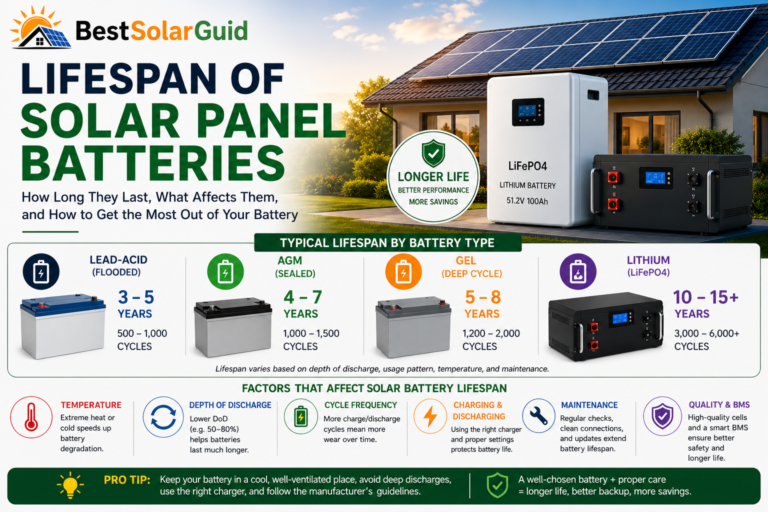
Cycle life refers to how many full charge-discharge cycles a battery can complete before its capacity noticeably degrades. Most quality 5kWh LiFePO4 units are warrantied for 10 years or a set number of cycles, whichever comes first. Always compare the warranty terms closely, since some manufacturers guarantee a minimum retained capacity (commonly 70-80%) at the end of the warranty period, while others simply cover defects.
Cycle life numbers only tell part of the story — real-world battery aging depends on usage patterns, temperature, and charging habits too. For a deeper breakdown, check out our guide on the lifespan of solar panel batteries, which explains what actually affects how long your battery lasts.
Inverter Compatibility
A battery is only as useful as the inverter it’s paired with. Some 5kWh batteries come as an all-in-one unit with a built-in inverter, while others are designed to integrate with an existing solar inverter. Before purchasing, confirm compatibility with your current or planned solar setup to avoid costly mismatches.
Installation and Safety Considerations
Home battery installation should always be performed by a licensed electrician or certified solar installer, both for safety and to preserve warranty coverage. Key considerations include:
- Location: Most 5kWh batteries require a stable, moderate-temperature environment such as a garage, basement, or dedicated utility area, away from direct sunlight and extreme temperature swings.
- Ventilation: While lithium batteries don’t emit fumes like lead-acid alternatives, manufacturers still specify minimum clearance requirements for heat dissipation.
- Permits and codes: Many regions require electrical permits and inspections for battery installations, particularly when tied into the main electrical panel.
- Fire safety: Look for batteries certified to relevant safety standards, which test for thermal runaway resistance and short-circuit protection.
Pros and Cons of a 5kWh Battery
Pros:
- Compact enough for apartments, condos, and smaller properties
- Lower upfront cost than larger whole-home systems
- Sufficient for essential-circuit backup during short outages
- Pairs well with small-to-mid-size solar arrays
- Expandable — many systems allow stacking additional 5kWh units later
Cons:
- Not enough capacity for whole-home backup in larger houses
- May struggle to run high-draw appliances like central AC for extended periods
- Requires careful load management to maximize backup duration
- Adding capacity later can sometimes require matching brand/model for compatibility
How to Size Your Battery Correctly
Before settling on a 5kWh battery, it helps to calculate your actual essential-load requirements. Start by listing the appliances you’d want powered during an outage, noting each one’s wattage (usually printed on a label or in the manual). Add these figures together to estimate your total simultaneous power draw, then multiply your expected runtime by that draw to estimate total energy needed.
For example, a household needing to run a refrigerator (150W), a few lights (50W), a router (20W), and phone charging (20W) for 10 hours would need approximately 2.4kWh — comfortably within a 5kWh battery’s usable capacity even after accounting for depth-of-discharge losses. Households with higher essential loads, or those wanting multi-day backup, should consider stacking two or more 5kWh units or moving up to a larger single system.
Final Verdict
A 5kWh battery represents one of the most practical entry points into home energy storage, offering a meaningful safety net during outages and a genuine tool for reducing electricity costs when paired with solar. It won’t replace a whole-home generator for large properties with heavy energy demands, but for apartments, smaller homes, and anyone wanting to protect essential circuits without a five-figure investment, it hits a sensible balance of price, performance, and footprint. As always, compare depth of discharge, warranty terms, and inverter compatibility carefully before choosing a specific model, since these details affect real-world performance far more than the headline capacity number.
Is a 5kWh battery enough to power a house?
A 5kWh battery can power essential circuits — refrigeration, lighting, Wi-Fi, and small electronics — for roughly half a day to a full day, but it’s generally not sufficient for whole-home backup in larger properties, especially if central heating or cooling is involved.
How long will a 5kWh battery last during a power outage?
Runtime depends entirely on connected load. At a light draw of 200-300 watts, a 5kWh battery can last 12-18 hours. At higher draws above 1,000 watts, runtime drops to just a few hours.
Can I add more batteries later?
Most modern lithium battery systems are modular, allowing additional 5kWh units to be added to increase total capacity, though it’s best to stick with the same brand and model for seamless integration.
How long do 5kWh batteries last before needing replacement?
Quality LiFePO4 batteries typically last 10-15 years or 4,000-6,000 charge cycles before capacity degrades significantly, though this varies by usage patterns and climate conditions.
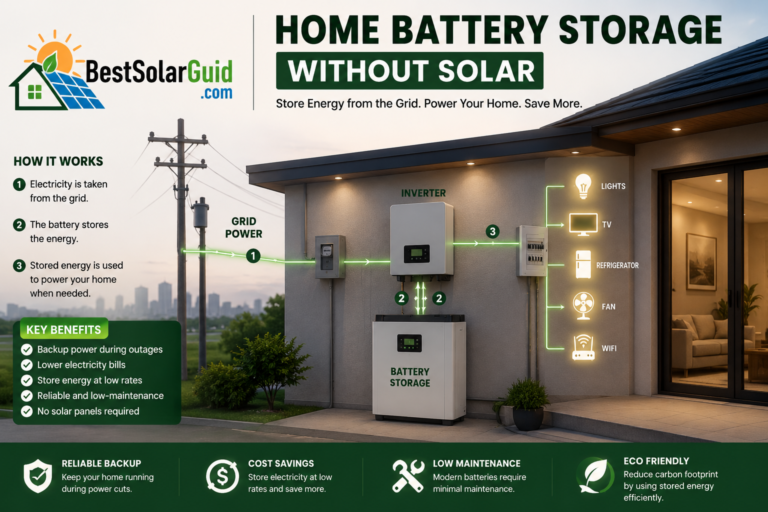
Do I need solar panels to use a 5kWh battery?
No. While batteries are commonly paired with solar for maximum value, they can also be charged directly from the grid during off-peak hours and discharged during peak-price periods or outages, a strategy known as load shifting.