590 Watt Bifacial Solar Panels: Price, Specifications, Benefits & Best Brands in Pakistan (2026)
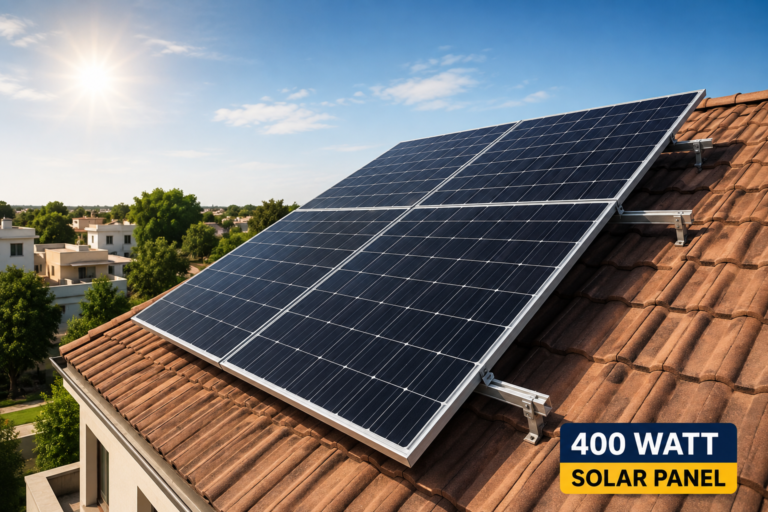
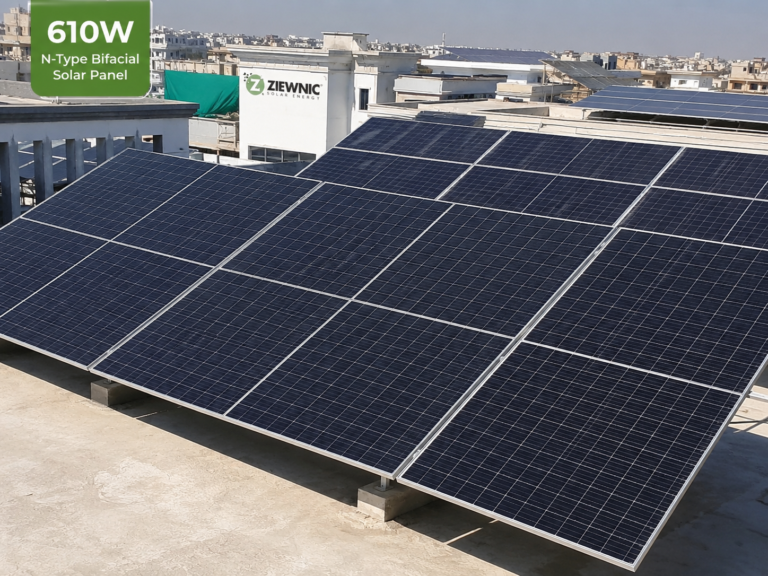
590 watt bifacial solar panels are high-power solar modules designed to generate electricity from both the front and rear sides of the panel. With a rated output of around 590 watts per panel, they can help solar users install higher-capacity systems with fewer panels.
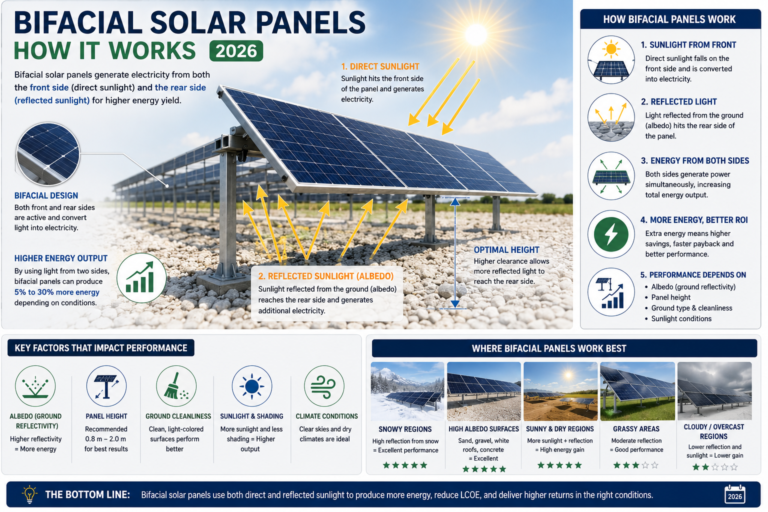
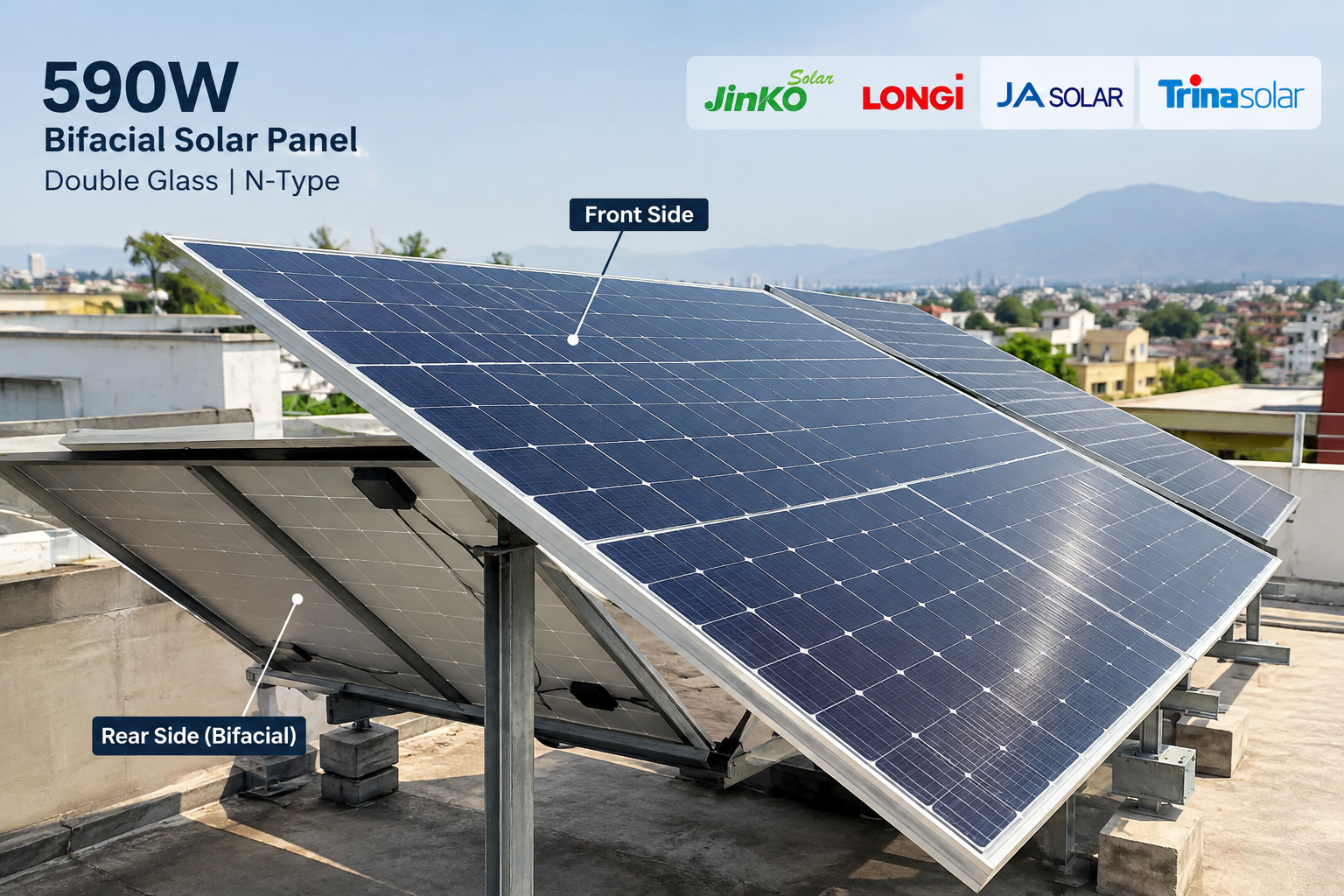
Bifacial technology can also capture reflected and scattered sunlight reaching the rear side of the module. However, the additional energy produced from the back depends on the installation design, panel height, surface reflectivity, shading, and weather conditions.
In Pakistan, 590W bifacial panels are available from major manufacturers such as Jinko Solar, LONGi, JA Solar, Canadian Solar, and Trina Solar. But choosing the right panel requires more than comparing wattage and price.
This guide explains the 590 watt bifacial solar panels price in Pakistan, specifications, efficiency, bifacial gain, popular brands, power generation, installation requirements, advantages, disadvantages, and important buying tips.
Table of Content
- Quick Answer: Are 590W Bifacial Solar Panels Good?
- What Is a 590 Watt Bifacial Solar Panel?
- How Do 590W Bifacial Solar Panels Work?
- 590 Watt Bifacial Solar Panel Price in Pakistan in 2026
- Popular 590W Bifacial Solar Panel Brands in Pakistan
- 590W Bifacial Solar Panel Specifications
- How Much Electricity Does a 590W Solar Panel Produce?
- How Much Extra Power Can a Bifacial Panel Produce?
- Does Roof Color Affect Bifacial Solar Panel Performance?
- Why Panel Height Matters for Bifacial Solar Panels
- 590W Bifacial Solar Panels for Home Solar Systems
- 590W Bifacial Panels for a 10kW Solar System
- 590W Bifacial vs 550W Solar Panels
- Advantages of 590 Watt Bifacial Solar Panels
- Disadvantages of 590 Watt Bifacial Solar Panels
- Are 590W Bifacial Solar Panels Good for Pakistan?
- Solar Panel Temperature and 590W Bifacial Performance
- 590W Bifacial Panel and Inverter Compatibility
- Best Mounting Structure for 590W Bifacial Panels
- Can 590W Bifacial Panels Be Installed on a House Roof?
- 590W Bifacial Solar Panels for Commercial Solar Systems
- Can 590W Bifacial Panels Be Installed on a House Roof?
- 590W Bifacial Solar Panels for Commercial Solar Systems
- What to Check Before Buying a 590W Bifacial Solar Panel
- A-Grade 590W Solar Panels: What Should You Check?
- A-Grade 590W Solar Panels: What Should You Check?
- Common Mistakes When Buying 590W Bifacial Solar Panels
- 590W Bifacial Solar Panel: Pros and Cons at a Glance
- Frequently Asked Questions
- Final Verdict: Should You Buy a 590W Bifacial Solar Panel?
Quick Answer: Are 590W Bifacial Solar Panels Good?
Yes, 590 watt bifacial solar panels can be an excellent choice for residential, commercial, agricultural, and large-scale solar installations.
Their main advantages are:
- High power output
- Electricity generation from the front and rear sides
- Potentially higher energy yield
- Fewer panels required for a particular system size
- Modern N-type options
- High efficiency in many newer models
- Suitable for large rooftop and ground-mounted systems
However, bifacial panels do not automatically produce twice as much electricity. Their additional rear-side generation depends on how much useful light reaches the back of the panel.
What Is a 590 Watt Bifacial Solar Panel?
A 590 watt bifacial solar panel is a photovoltaic module with a front-side rated power output of approximately 590 watts under standard test conditions.
The term bifacial means the panel can generate electricity from both sides.
A conventional monofacial solar panel mainly generates electricity from sunlight falling on its front surface. A bifacial module can also use light reaching its rear side.
The rear side can receive:
- Reflected sunlight
- Diffuse sunlight
- Light reflected from the ground
- Light reflected from a roof or other surface
This additional light can increase the total energy generated by the module.
Important: 590W Does Not Mean 1,180W
A common misunderstanding is that a 590W bifacial panel produces 590W from the front plus another guaranteed 590W from the back.
That is incorrect.
The 590W rating refers to the panel’s rated front-side power under specified test conditions. The rear-side contribution is additional and depends on the actual installation environment.
How Do 590W Bifacial Solar Panels Work?
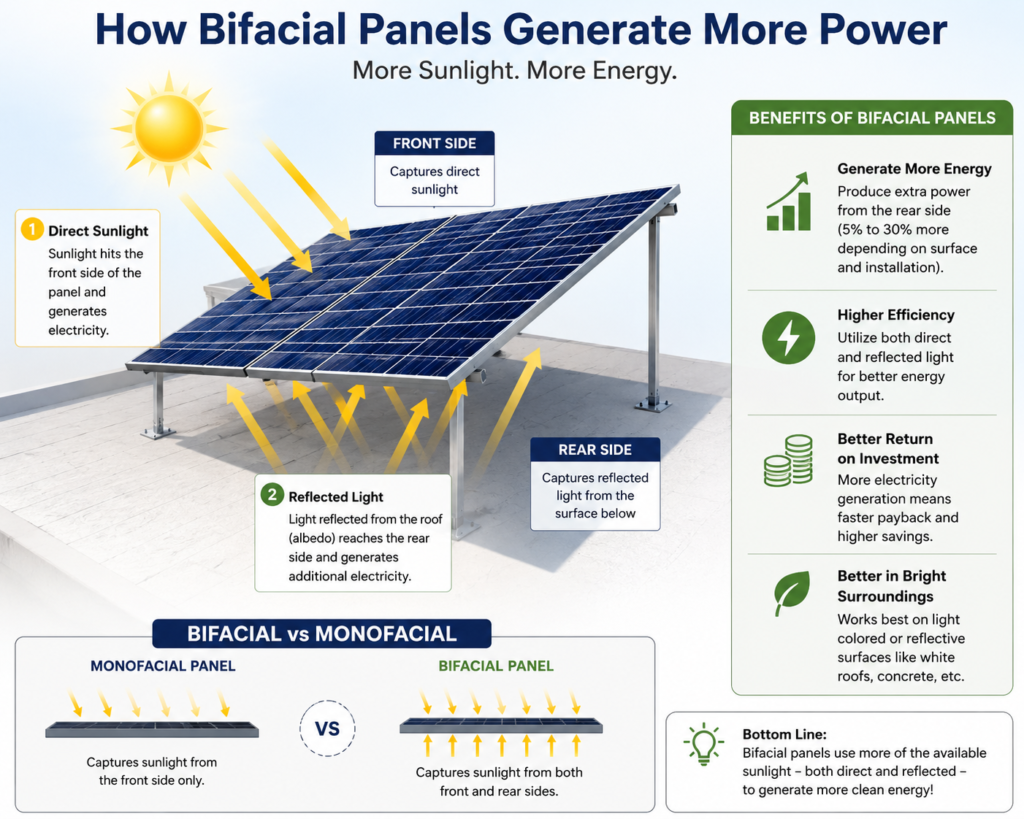
The working principle is straightforward.
Front Side
The front side receives direct sunlight and converts it into electricity through photovoltaic cells.
Rear Side
Some sunlight is reflected from the ground or roof toward the back of the panel. The rear cells can capture part of this light.
The simplified process is:
Sunlight → Front side → Solar cells → Electricity
and:
Reflected/diffuse light → Rear side → Solar cells → Additional electricity
The amount of additional electricity varies from one installation to another.
This is why the mounting structure and surface underneath the panels are important for bifacial systems.
590 Watt Bifacial Solar Panel Price in Pakistan in 2026
The price of a 590 watt bifacial solar panel in Pakistan varies according to the brand, exact model, cell technology, efficiency, warranty, panel grade, seller, and market availability.
For August 2026, a reasonable indicative market range for 590W-class bifacial panels is approximately:
| Brand | Power Class | Approx. Price per Panel in Pakistan |
|---|---|---|
| Jinko Solar | 590W class | PKR 24,000–27,000 |
| LONGi | 590W class | PKR 24,000–27,000 |
| JA Solar | 590W class | PKR 22,500–25,500 |
| Canadian Solar | 590W class | PKR 23,000–27,000 |
| Trina Solar | 590W class | PKR 23,000–27,000 |
These are approximate market prices for August 2026, not fixed manufacturer prices. Solar panel prices can change because of exchange rates, imports, stock availability, seller margins, model changes, and market demand.
Recent Pakistan market listings have shown examples such as:
- Jinko 585/590W: around PKR 24,570–24,900
- LONGi 585/590W: around PKR 23,985–25,740
- JA Solar 585/590/595W: around PKR 22,567–24,862
Before purchasing, confirm the exact model number and current price with the seller.
Price Per Watt
Price per watt is another useful way to compare solar panels.
For example, if a 590W panel costs PKR 25,000:
PKR 25,000 ÷ 590W = approximately PKR 42.37 per watt
However, price per watt should not be the only buying factor. Also compare efficiency, bifaciality, temperature coefficient, degradation, warranty, dimensions, and manufacturer reputation.
Popular 590W Bifacial Solar Panel Brands in Pakistan
Several major manufacturers offer panels in the 590W class or nearby power ranges.
Popular brands include:
- Jinko Solar
- LONGi Solar
- JA Solar
- Canadian Solar
- Trina Solar
The exact wattage and specifications vary between product generations, so always check the exact model number rather than choosing based only on the brand.
Jinko 590W Bifacial Solar Panel
Jinko Solar is one of the major solar module manufacturers, and its Tiger Neo family includes N-type bifacial modules in the 590W class.
Jinko’s documentation includes a 590–610W N-type bifacial dual-glass module. The company highlights N-type technology, bifacial generation, and long-term performance characteristics.
Key reasons to consider Jinko:
- N-type technology
- Bifacial design
- Dual-glass construction
- High power output
- High bifaciality
- Suitable for residential and commercial systems
- Strong global manufacturer presence
When buying a Jinko 590W panel, check the exact Tiger Neo model because specifications can differ between generations.
LONGi 590W Bifacial Solar Panel
LONGi Solar is another major manufacturer of high-power solar modules.
LONGi offers bifacial modules in the 590W-class range across its product families. Different Hi-MO generations can have different specifications, so the exact model should always be verified.
Why consider LONGi?
- High-power solar modules
- Modern cell technology
- Bifacial options
- High efficiency in many models
- Wide global availability
- Suitable for residential, commercial, and utility applications
JA Solar 590W Bifacial Solar Panel
JA Solar offers high-power N-type bifacial modules in the 590W-class range.
Some JA Solar module families include 570W–590W N-type bifacial double-glass panels.
Potential advantages include:
- N-type technology
- Bifacial generation
- Double-glass construction
- High power output
- High efficiency
- Suitable for larger solar systems
Always compare the exact model’s datasheet before purchasing.
Canadian Solar 590W Bifacial Solar Panel
Canadian Solar offers multiple high-power bifacial module families, including N-type TOPCon options.
Canadian Solar has different module generations, so a seller advertising a “Canadian Solar 590W” panel should also provide the exact model number.
Consider these specifications:
- Module efficiency
- Bifaciality
- Temperature coefficient
- Maximum power
- Voc and Vmp
- Isc and Imp
- Dimensions
- Weight
- Warranty
Trina Solar 590W Bifacial Solar Panel
Trina Solar is another established manufacturer offering high-power bifacial modules.
Trina 590W-class panels can be considered for residential, commercial, agricultural, and larger solar projects.
When comparing Trina with Jinko, LONGi, JA Solar, or Canadian Solar, compare the exact model specifications, not only the wattage.
590W Bifacial Solar Panel Specifications
Specifications vary from one model to another, but these are the main values you should check.
Rated Power
Approximately 590W.
Module Efficiency
Efficiency tells you how effectively the panel converts available sunlight into electricity.
A higher-efficiency panel can produce more power from a similar amount of roof space.
Bifaciality
Bifaciality indicates the rear-side performance capability relative to the front side under specified test conditions.
A higher bifaciality rating can be beneficial when the installation provides good rear-side light.
Cell Technology
Many newer 590W-class panels use N-type technologies such as TOPCon, although the exact technology depends on the model.
Glass Construction
Many bifacial panels use dual-glass construction, which can provide a durable design suitable for outdoor installations.
Temperature Coefficient
Solar panels produce less power as their cell temperature increases.
A lower absolute temperature coefficient is generally beneficial in hot climates such as Pakistan.
Dimensions and Weight
590W panels are often physically large.
Always measure your available roof area before purchasing.
How Much Electricity Does a 590W Solar Panel Produce?
A 590W panel has a rated capacity of:
590W = 0.59kW
If it operated at its rated output for one hour:
0.59kW × 1 hour = 0.59kWh
But solar panels do not operate at their rated output throughout the entire day.
A simple example using 5 peak-sun-hours is:
0.59kW × 5 hours = 2.95kWh per day
This is only a simplified theoretical calculation.
Actual generation depends on:
- Sunlight
- Weather
- Temperature
- Panel orientation
- Tilt
- Shading
- Dust
- Inverter losses
- Cable losses
- Panel condition
- Bifacial rear-side contribution
Therefore, do not use 2.95kWh as a guaranteed daily output.
How Much Extra Power Can a Bifacial Panel Produce?
There is no single percentage that applies to every bifacial installation.
The additional rear-side gain depends on:
- Ground or roof reflectivity
- Panel height
- Panel spacing
- Row spacing
- Panel orientation
- Rear-side shading
- Sun position
- Local weather
- Surface albedo
A panel mounted very close to a dark roof may receive little useful rear-side light.
A raised panel installed above a reflective surface may receive considerably more.
Therefore:
Bifacial gain depends on installation design.
Does Roof Color Affect Bifacial Solar Panel Performance?
Yes.
The surface below a bifacial panel can affect how much light is reflected toward the rear.
A lighter or more reflective surface can provide more reflected light than a dark surface.
This is often described using the term albedo.
For example, light-colored surfaces may reflect more sunlight than dark surfaces.
However, changing your roof purely to increase bifacial generation is not always economically worthwhile. The additional cost should be compared with the expected increase in electricity generation.
Why Panel Height Matters for Bifacial Solar Panels
The rear side needs access to light.
If a panel is installed extremely close to the roof, very little light may reach the back.
Increasing the distance between the panel and roof can improve rear-side exposure.
But higher mounting also increases:
- Wind loading
- Structural requirements
- Mounting material
- Installation complexity
- Potential installation cost
The goal is to find a safe and practical mounting height, not simply the highest possible position.
590W Bifacial Solar Panels for Home Solar Systems
590W panels can be useful for residential solar systems when the roof has sufficient space and the inverter is compatible.
For example, a simple calculation for approximately 5kW of panel capacity is:
5,000W ÷ 590W = 8.47 panels
Because you cannot install part of a panel, 9 panels would provide:
9 × 590W = 5,310W
This is approximately a 5.31kW DC array.
The final system design may be different because the installer must consider:
- Inverter capacity
- MPPT voltage range
- Maximum input current
- Roof layout
- Shading
- String configuration
- Electrical requirements
590W Bifacial Panels for a 10kW Solar System
For a system with approximately 10kW of DC panel capacity:
10,000W ÷ 590W = 16.95 panels
17 panels would provide:
17 × 590W = 10,030W
This is approximately a 10.03kW DC array.
However, the number of panels should never be selected using wattage alone. The inverter’s voltage and current limits must also be checked.
590W Bifacial vs 550W Solar Panels
A 590W panel has a higher rated output than a 550W panel, but that does not automatically make it a better purchase.
Compare:
| Factor | 590W Bifacial | 550W Panel |
| Rated output | Higher | Lower |
| Rear-side generation | Yes | Depends on model |
| Panel count for same capacity | Potentially lower | Potentially higher |
| Physical size | Often larger | Often smaller |
| Roof suitability | Depends on roof | May suit smaller roofs |
| Installation requirements | Can be higher | Depends on model |
| Best choice | Depends on system | Depends on system |
If your roof is large and the installation supports bifacial generation, 590W bifacial panels may be attractive.
If your roof has limited space or difficult dimensions, a smaller panel may fit better.
Advantages of 590 Watt Bifacial Solar Panels
1. High Power Output
A 590W panel provides high rated power per module.
This can reduce the number of panels needed for a particular system capacity.
2. Rear-Side Energy Generation
The bifacial design allows the rear side to capture useful reflected and diffuse light.
3. Potentially Higher Energy Yield
With the right installation environment, bifacial panels can produce more total energy than a comparable monofacial installation.
4. Fewer Panels for Large Systems
Higher-wattage modules can reduce the number of individual panels needed.
5. Modern Cell Technologies
Many current 590W-class modules use N-type technologies.
6. Suitable for Large Installations
They can be useful for:
- Commercial buildings
- Factories
- Warehouses
- Agricultural projects
- Ground-mounted solar
- Large residential systems
Disadvantages of 590 Watt Bifacial Solar Panels
1. Large Physical Size
A 590W panel can take up significant roof space.
2. Higher Weight
Dual-glass bifacial panels can be heavier than some single-glass panels.
3. Rear-Side Gain Is Not Guaranteed
If the rear receives little light, the bifacial advantage may be limited.
4. More Careful Installation Design
Panel height, spacing, surface reflectivity, and structure can affect bifacial performance.
5. Potentially Higher Upfront Price
Some bifacial N-type modules can cost more than conventional panels.
Are 590W Bifacial Solar Panels Good for Pakistan?
Yes, they can be a good option for Pakistan, particularly where the installation has:
- Strong sunlight
- Adequate roof or ground space
- Suitable mounting height
- Good rear-side light exposure
- A compatible inverter
- Proper electrical protection
Pakistan’s hot climate makes the temperature coefficient particularly important.
You should also check the panel’s:
- Mechanical load rating
- Temperature specifications
- Hail resistance
- Warranty
- Degradation rate
- Glass construction
Solar Panel Temperature and 590W Bifacial Performance
Solar panels are tested under standard laboratory conditions, but real-world conditions are different.
When panel temperature rises, electrical output generally decreases.
This is why two panels with the same 590W rating can perform differently under high temperatures.
When comparing panels for Pakistan, check the manufacturer’s temperature coefficient of Pmax.
A better temperature coefficient can help limit power loss as module temperature increases.
590W Bifacial Panel and Inverter Compatibility
Before connecting a 590W panel to an inverter, the installer should check the complete electrical specifications.
Important values include:
- Voc
- Vmp
- Isc
- Imp
- Maximum system voltage
- Maximum input current
- MPPT voltage range
The number of panels connected in each string must also be designed correctly.
Do not choose the string configuration based only on the 590W rating.
The panel datasheet and inverter specifications must be matched.
Best Mounting Structure for 590W Bifacial Panels
A suitable mounting structure should:
- Support the panel weight
- Resist expected wind loads
- Provide appropriate panel clearance
- Allow rear-side light exposure
- Protect against corrosion
- Keep panels securely fixed
- Allow maintenance access
For bifacial panels, avoid structures that unnecessarily block the rear surface.
Can 590W Bifacial Panels Be Installed on a House Roof?
Yes.
However, residential roofs often contain:
- Water tanks
- Boundary walls
- Rooftop rooms
- Trees
- Satellite dishes
- Air-conditioning units
- Other equipment
These can create shading and reduce the available installation area.
Because 590W panels can be large, measure your roof before purchasing them.
A professional site survey is strongly recommended.
590W Bifacial Solar Panels for Commercial Solar Systems
High-power bifacial panels can be especially useful for commercial projects.
Businesses may benefit from:
- Higher DC capacity
- Fewer modules
- Potentially higher energy yield
- Efficient use of installation space
- Bifacial generation
Commercial installations can also have more freedom to optimize:
- Panel height
- Row spacing
- Surface reflectivity
- Orientation
- Maintenance access
This can make it easier to take advantage of bifacial technology.
What to Check Before Buying a 590W Bifacial Solar Panel
Don’t buy a panel simply because the seller says “590W bifacial.”
Check these specifications first.
1. Exact Model Number
Always ask for the full model number.
2. Original Datasheet
Request the manufacturer’s datasheet.
3. Efficiency
Compare module efficiency with competing panels.
4. Bifaciality
Check the manufacturer’s bifaciality specification.
5. Temperature Coefficient
Important for hot weather.
6. Product Warranty
Check how many years of product warranty are offered.
7. Performance Warranty
Check the expected degradation and guaranteed output.
8. Dimensions
Make sure the panel fits your available roof area.
9. Weight
Make sure the mounting structure can safely support the panels.
10. Electrical Specifications
Check Voc, Vmp, Isc and Imp.
A-Grade 590W Solar Panels: What Should You Check?
In Pakistan, sellers may use terms such as:
- A Grade
- B Grade
- Original
- Non-documented
- Used
- Refurbished
Do not rely only on the seller’s description.
Ask for:
- Exact model number
- Serial number
- Manufacturer documentation
- Warranty details
- Physical inspection
- Confirmation of new condition
Check the panel for:
- Cracked glass
- Frame damage
- Cell damage
- Junction-box damage
- Connector damage
- Discoloration
Common Mistakes When Buying 590W Bifacial Solar Panels
Mistake 1: Choosing Only by Wattage
590W does not automatically mean better quality.
Mistake 2: Expecting Double Power
Bifacial does not mean a 590W panel automatically produces 1,180W.
Mistake 3: Ignoring Roof Dimensions
A high-power panel may not fit your roof layout.
Mistake 4: Ignoring Rear-Side Light
Without useful rear-side light, bifacial gain can be limited.
Mistake 5: Buying the Cheapest Panel
An unusually cheap panel may have different specifications, grade, warranty, or condition.
Mistake 6: Ignoring Temperature Performance
Pakistan’s high temperatures make thermal performance important.
Mistake 7: Not Checking the Datasheet
Always verify the exact model.
Mistake 8: Ignoring Inverter Compatibility
Panel voltage and current must match the inverter’s operating limits.
590W Bifacial Solar Panel Maintenance
Bifacial panels generally do not require complicated maintenance, but regular inspection is useful.
Keep the Panels Clean
Dust and bird droppings can reduce the amount of sunlight reaching the panel.
Clean the panels when dirt visibly accumulates or when performance appears to decline.
Check the Cables
Inspect for:
- Loose cables
- Damaged insulation
- Exposed connections
- Sagging cables
- Water damage
Monitor Solar Generation
If your inverter has monitoring, check production regularly.
A sudden decrease may indicate:
- Shading
- Dirt
- Inverter problems
- Electrical faults
- Panel damage
590W Bifacial Solar Panel: Pros and Cons at a Glance
| Pros | Cons |
| High 590W rated output | Large panel size |
| Front and rear generation | Rear-side gain depends on installation |
| Potentially higher energy yield | Can be heavier |
| Fewer panels for larger systems | May require stronger mounting |
| Many N-type options | Some models cost more |
| Good for commercial projects | Not ideal for every roof |
| Suitable for reflective surfaces | Requires proper inverter matching |
Final Verdict: Should You Buy a 590W Bifacial Solar Panel?
590 watt bifacial solar panels can be an excellent choice for modern solar systems, particularly when high power output, limited panel count, and additional rear-side generation are valuable.
But don’t choose a panel simply because it says 590W.
Before buying, compare:
- Exact model
- Efficiency
- N-type/TOPCon technology
- Bifaciality
- Temperature coefficient
- Product warranty
- Performance warranty
- Degradation rate
- Dimensions
- Weight
- Price per watt
- Inverter compatibility
- Manufacturer documentation
The most important point is that bifacial performance depends on the complete installation.
A 590W bifacial panel installed above a suitable reflective surface with good rear-side light exposure can take better advantage of bifacial technology than the same panel installed directly above a dark roof with very little rear-side light.
For buyers in Pakistan, compare at least two or three exact models, check the current market price, verify the original datasheet, and choose the panel that provides the best combination of performance, warranty, price, and suitability for your solar system.
RELATED READINGS
What is a 590 watt bifacial solar panel?
A 590 watt bifacial solar panel is a photovoltaic module rated at approximately 590W from its front side that can also generate additional electricity from light reaching its rear side.
What is the price of a 590W bifacial solar panel in Pakistan?
In August 2026, many 590W-class bifacial panels are available in the approximate range of PKR 22,500–27,000 per panel, depending on brand, model, technology, grade, seller, and availability.
Which brand is best for a 590W bifacial solar panel?
Jinko, LONGi, JA Solar, Canadian Solar, and Trina are among the brands worth comparing. There is no single best brand for every project. Compare the exact model specifications and current price.
Is Jinko 590W bifacial a good panel?
jinko’s 590W-class Tiger Neo modules use N-type technology and bifacial dual-glass construction. They can be a strong option, but you should compare the exact model with competing panels before buying.
How much electricity does a 590W solar panel generate?
A simple calculation using five peak-sun-hours gives approximately 2.95kWh before system losses. Actual generation varies according to sunlight, temperature, shading, orientation, dust, inverter losses, and bifacial gain.
Does a bifacial solar panel produce twice the electricity?
No. The 590W rating is not doubled. The rear side can provide additional generation when it receives useful light, but the amount varies by installation.
Are 590W bifacial panels good for homes?
Yes, provided your roof has enough space and the panel dimensions, weight, electrical characteristics, mounting structure, and inverter are suitable.
Are bifacial panels better than monofacial panels?
They can be better in installations where the rear side receives useful reflected or diffuse light. On a roof where the rear side is almost completely blocked, the additional bifacial benefit may be limited.
What is the difference between a 590W bifacial and a 590W monofacial panel?
Both can have a 590W front-side rating, but a bifacial panel can also use light reaching its rear side. A monofacial panel is primarily designed to generate from the front.
Can 590W bifacial panels work in cloudy weather?
Yes. Solar panels can generate electricity in cloudy conditions, but output is normally lower because less sunlight reaches the module.
How long do 590W bifacial solar panels last?
The expected service life and degradation warranty depend on the manufacturer and exact model. Always check the current manufacturer’s warranty instead of relying on a generic lifespan figure.
What inverter is suitable for 590W solar panels?
The correct inverter depends on the number of panels, Voc, Vmp, Isc, Imp, string configuration, MPPT range, and maximum input current. A qualified installer should match the panel datasheet with the inverter specifications.