610W Solar Panels in Pakistan: N-Type Bifacial Price, Specifications, Best Brands & Complete Guide 2026
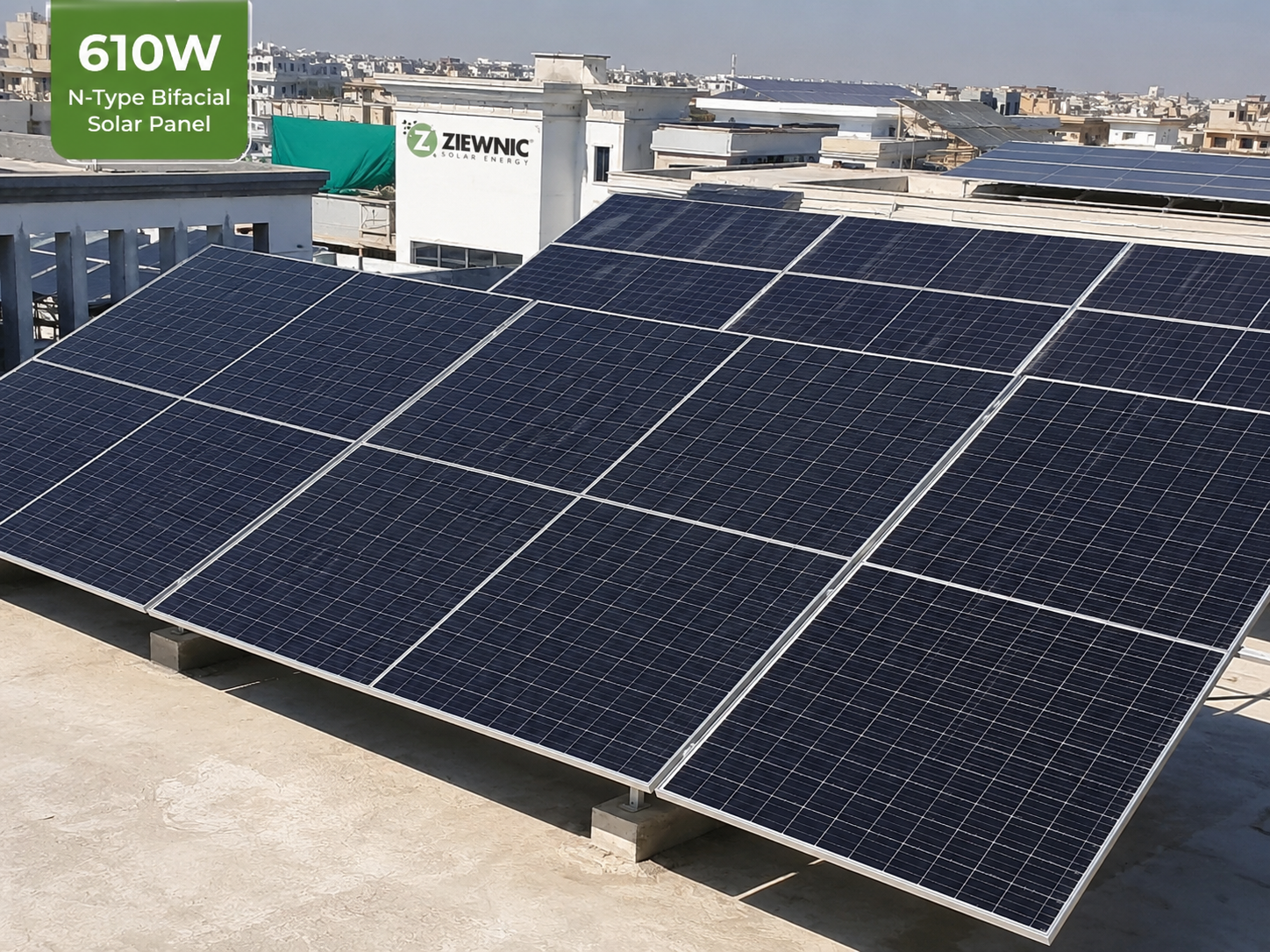
If you are looking for a high-output solar panel for a residential, commercial, or industrial solar system, a 610W solar panel can be an attractive option. Modern 610-watt panels commonly use N-Type cell technology, TOPCon architecture, and bifacial designs to produce more electricity from a relatively large module.
In Pakistan, 610W solar panels are available from well-known manufacturers such as JA Solar, Jinko Solar, LONGi, Trina Solar, and other major brands. However, the exact specifications, efficiency, dimensions, warranty, and price can vary by model.
This guide explains the 610W solar panel price in Pakistan, specifications, expected power generation, bifacial technology, top brands, advantages, disadvantages, and how to choose the right panel for your solar system.
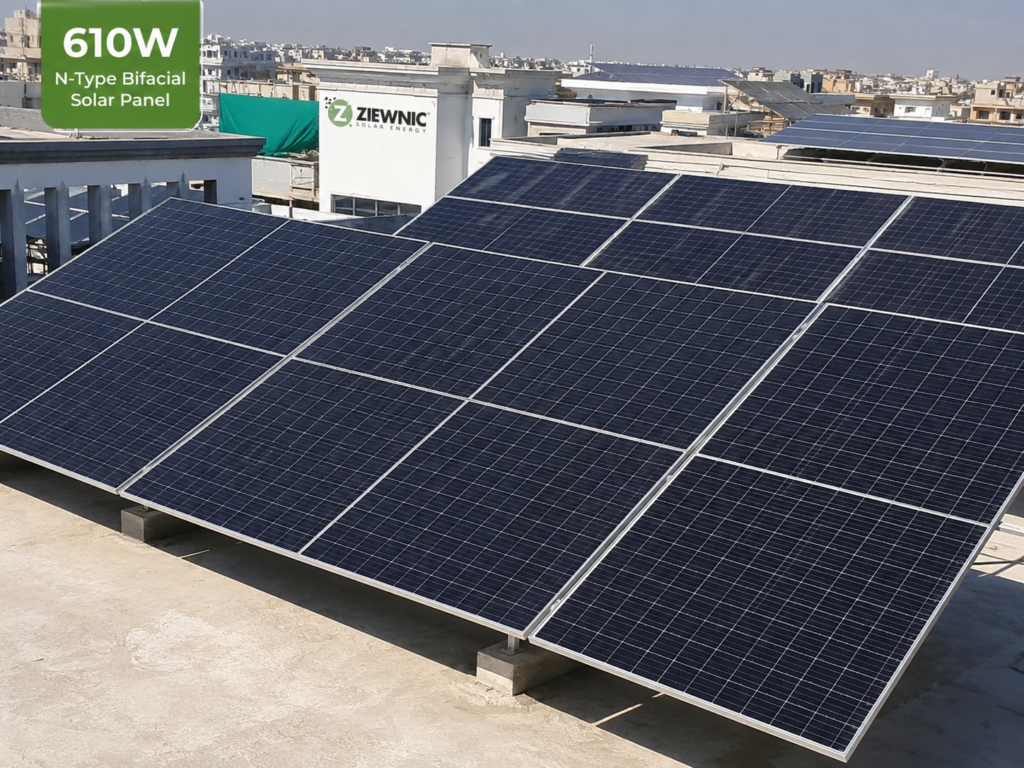
Table of Contents
- 610W Solar Panel Price in Pakistan
- What Is a 610W Solar Panel?
- Best 610W Solar Panel Brands in Pakistan
- JA Solar 610W N-Type Bifacial Solar Panel
- Jinko 610W N-Type Bifacial Solar Panel
- LONGi 610W N-Type Bifacial Solar Panel
- Trina Solar 610W N-Type Bifacial Solar Panel
- 610W Solar Panel Specifications
- How Much Electricity Does a 610W Solar Panel Generate?
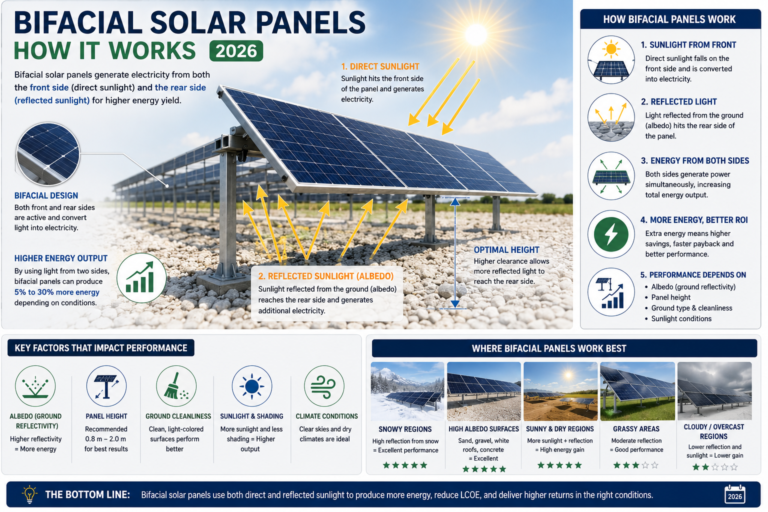
- 610W Bifacial Solar Panels: How Much Extra Power Can They Produce?
- 610W Solar Panel Comparison: JA Solar vs Jinko vs LONGi vs Trina
- How Many 610W Solar Panels Do You Need?
- Advantages and Disadvantages of 610W Solar Panels
- How to Choose the Best 610W Solar Panel
- How to Check Whether a 610W Solar Panel Is Original
- Frequently Asked Questions About 610W Solar Panels
- Final Verdict
610W Solar Panel Price in Pakistan
The price of a 610W solar panel in Pakistan depends on the brand, cell technology, efficiency, bifacial design, warranty, import costs, exchange rates, and local availability.
Current online Pakistani listings show that 610W panels from major brands can be priced differently. For example, one current listing shows a JA Solar 610W N-Type bifacial panel at around Rs. 26,630, while a Jinko 610W N-Type bifacial panel is listed at around Rs. 28,670. A LONGi Hi-MO X7 610W N-Type bifacial panel is listed by the same retailer at around Rs. 27,450. These are indicative online prices rather than a fixed nationwide market rate.
Estimated 610W Solar Panel Price Range
| Brand/Model | Approx. Listed Price* | Technology |
|---|---|---|
| JA Solar 610W | Rs. 26,000–27,000 | N-Type Bifacial |
| Jinko 610W | Rs. 28,000–29,000 | N-Type Bifacial |
| LONGi 610W | Rs. 27,000–28,000 | N-Type Bifacial |
| Trina Solar 610W | Rs. 26,000–27,000 | N-Type Bifacial |
*Prices are indicative and can change according to market conditions, seller, stock, taxes, and model number.
When comparing prices, do not choose a panel simply because it has the lowest price. Check the exact model number, efficiency, warranty, degradation rate, authenticity, and electrical specifications before buying.
What Is a 610W Solar Panel?
A 610W solar panel is a photovoltaic module designed to produce up to 610 watts of DC power under standard test conditions (STC).
The 610W rating does not mean that the panel will continuously produce 610 watts throughout the day. Actual output depends on sunlight intensity, temperature, panel orientation, shading, dust, inverter efficiency, and installation conditions.
Most modern high-wattage 610W modules use advanced N-Type technologies such as TOPCon and may use a bifacial, dual-glass construction.
What Does 610W Mean?
The “610W” refers to the panel’s rated maximum power output under laboratory test conditions.
For example:
610W = 0.61 kW
If a solar system contains 10 panels rated at 610W:
610W × 10 = 6,100W = 6.1kW
This makes high-wattage panels useful when you want to install more system capacity while using fewer individual modules.
Are 610W Panels Suitable for Homes?
Yes, but the physical size of a 610W panel is generally larger than that of older 400W–550W panels.
For residential installations, you should check:
- Available rooftop area
- Roof structure
- Panel dimensions
- Panel weight
- Inverter input voltage and current
- Shading
- Mounting structure
- Installation access
For smaller rooftops, a lower-wattage panel may sometimes provide more practical installation flexibility.
Best 610W Solar Panel Brands in Pakistan
Several major solar manufacturers offer panels around the 610W power class.
Popular options include:
- JA Solar 610W
- Jinko 610W
- LONGi 610W
- Trina Solar 610W
- Canadian Solar 610W
- Other N-Type and bifacial models
The best option depends on the exact model rather than the brand name alone.
When comparing two 610W panels, look at module efficiency, temperature coefficient, degradation rate, warranty, dimensions, weight, bifaciality, operating voltage, operating current, and local availability.
JA Solar 610W N-Type Bifacial Solar Panel
JA Solar is one of the major solar module manufacturers and offers high-wattage N-Type bifacial modules.
A current Pakistani listing for a JA Solar 610W N-Type bifacial panel shows a listed price of approximately Rs. 26,630 and advertises efficiency of up to 22.9%. Availability can change, so buyers should verify the exact model and current stock before purchasing.
JA Solar 610W Technology
The 610W JA Solar model uses N-Type technology and a bifacial configuration. N-Type technology is designed to reduce some of the degradation mechanisms associated with older cell architectures and can provide strong performance over the module’s operating life.
The bifacial design allows the rear side of the module to use reflected and scattered sunlight when the installation environment allows sufficient rear-side illumination.
JA Solar 610W Best Applications
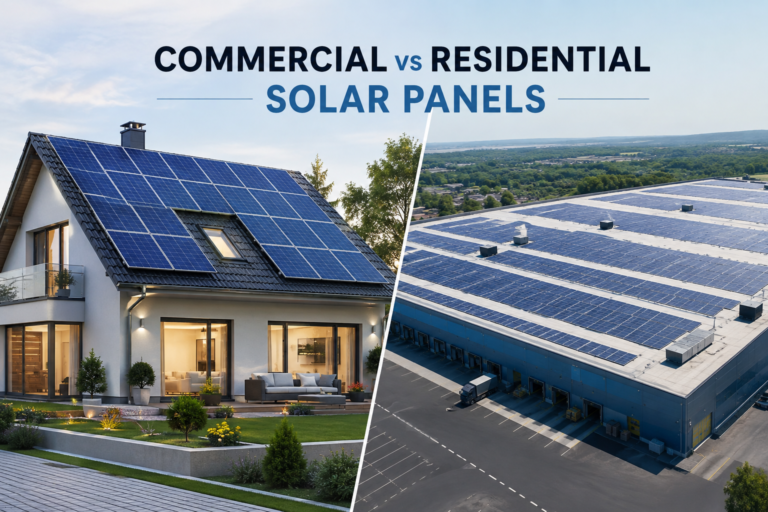
A 610W bifacial module can be suitable for:
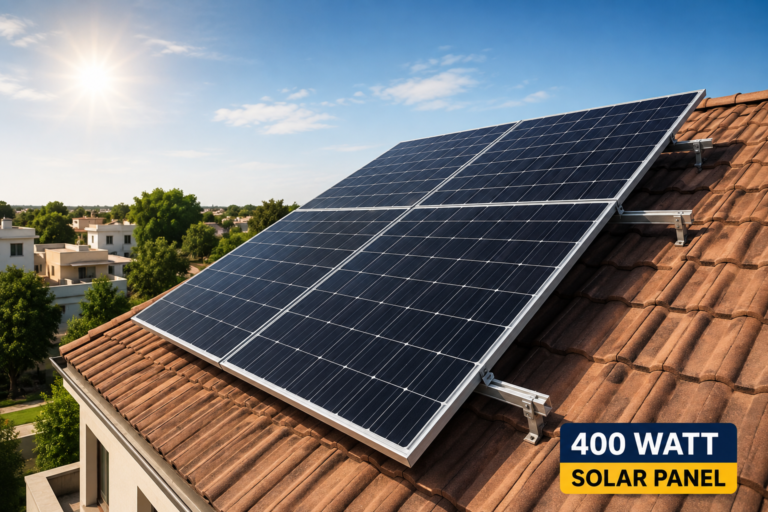
- Large residential rooftops
- Commercial buildings
- Industrial solar systems
- Ground-mounted solar farms
- Warehouses
- Agricultural installations
- Open-area solar projects
For a normal rooftop, however, the installation layout should be checked carefully because high-wattage modules can be physically large.
Jinko 610W N-Type Bifacial Solar Panel
JinkoSolar is another major manufacturer offering high-power N-Type bifacial modules.
A current Pakistani listing shows a Jinko 610W N-Type bifacial solar panel at around Rs. 28,670. The listing describes the panel as using N-Type HOT 2.0 technology and a bifacial dual-glass design.
Jinko 610W Technology
Jinko’s N-Type modules use advanced cell technology designed for high efficiency, low degradation, and improved performance in different lighting conditions.
Bifacial modules can produce electricity from both the front and rear sides, although the actual additional generation depends heavily on installation conditions.
The amount of rear-side energy should therefore not be treated as a guaranteed percentage for every rooftop.
Jinko 610W Applications
Jinko 610W bifacial panels can be considered for:
- Commercial rooftops
- Industrial facilities
- Solar farms
- Large residential systems
- Carports
- Ground-mounted installations
For a rooftop installation, the installer should make sure that the rear side is not completely blocked if bifacial performance is an important part of the system design.
LONGi 610W N-Type Bifacial Solar Panel
LONGi also offers high-wattage N-Type bifacial panels around the 610W class.
A current Pakistani solar panel listing includes a LONGi Hi-MO X7 610W N-Type bifacial panel at approximately Rs. 27,450, while another current price listing shows LONGi Hi-MO X7 610/615W N-Type bifacial modules in the Pakistani market.
LONGi 610W Technology
LONGi’s high-wattage modules use modern N-Type cell technology and bifacial designs in several product families.
Because LONGi has multiple generations and model series, buyers should not assume that every “610W LONGi” panel has identical specifications.
Always check the complete model number and official datasheet before comparing it with JA Solar or Jinko.
LONGi 610W Applications
LONGi 610W panels can be suitable for:
- Residential solar systems with sufficient roof space
- Commercial rooftops
- Industrial projects
- Ground-mounted systems
- Solar farms
- Large-scale distributed solar projects
Trina Solar 610W N-Type Bifacial Solar Panel
Trina Solar is another major manufacturer in the high-wattage solar panel market.
A current Pakistani listing for a Trina Solar 610W N-Type bifacial panel shows a listed price of around Rs. 26,840 and describes the module as using TOPCon technology, dual-glass construction, and a 22.6% efficiency rating.
Trina’s 610W-class modules can be particularly useful for commercial, industrial, and utility-scale installations where higher power per module can reduce the number of panels required.
610W Solar Panel Specifications
The exact specifications of a 610W panel depend on the manufacturer and model number.
Typical specifications to check include:
| Specification | What to Check |
|---|---|
| Rated Power | 610W |
| Cell Type | N-Type / TOPCon or other N-Type technology |
| Module Type | Monofacial or bifacial |
| Efficiency | Approximately 22%+ depending on model |
| Construction | Single-glass or dual-glass |
| Maximum Power Voltage | Check manufacturer datasheet |
| Maximum Power Current | Check manufacturer datasheet |
| Open Circuit Voltage | Check manufacturer datasheet |
| Short Circuit Current | Check manufacturer datasheet |
| Warranty | Product and performance warranty |
| Degradation | Check manufacturer’s warranty terms |
Do not compare panels using wattage alone. A 610W panel with better efficiency, warranty, temperature coefficient, and degradation characteristics may provide better long-term value than another panel with the same rated power.
How Much Electricity Does a 610W Solar Panel Generate?
A 610W panel can theoretically produce up to 0.61kWh of electricity in one hour if it receives ideal conditions at its rated output.
Real-world production is lower and changes throughout the day.
A simple estimate can be made using:
Daily Energy = Panel Capacity × Peak Sun Hours × System Efficiency
For example, if a 610W panel receives an average of 5 peak sun hours and the overall system performance factor is approximately 80%:
0.61 × 5 × 0.80 = 2.44kWh per day
So, under these assumptions, one 610W panel could generate roughly 2.4kWh per day.
This is only an estimate. Actual generation in Pakistan will vary according to location, season, temperature, dust, shading, orientation, tilt, inverter losses, and other factors.
Estimated Monthly Generation
Using the same example:
2.44kWh × 30 days = approximately 73kWh per month
Again, this should not be considered a guaranteed output.
A clean, unshaded panel installed at a suitable angle can perform much better than a panel affected by shading, dust, high temperatures, or poor installation.
610W Bifacial Solar Panels: How Much Extra Power Can They Produce?
A bifacial solar panel generates electricity from both sides.
The front side receives direct sunlight, while the rear side can capture reflected and scattered light.
However, the rear-side gain depends on:
- Ground reflectivity
- Panel height
- Row spacing
- Mounting structure
- Rear-side shading
- Roof or ground color
- Sun position
- Installation geometry
For this reason, claims such as “30% extra power” should not be interpreted as a guaranteed 30% increase on every rooftop.
Bifacial technology generally performs best when the rear side has good exposure to reflected light.
Where Do Bifacial Panels Perform Best?
Bifacial 610W panels can perform particularly well in:
- Open ground-mounted systems
- Solar farms
- Elevated structures
- White or reflective rooftops
- Carports
- Commercial installations with suitable mounting arrangements
On a dark rooftop with the rear side very close to the surface, the additional bifacial contribution may be much smaller.
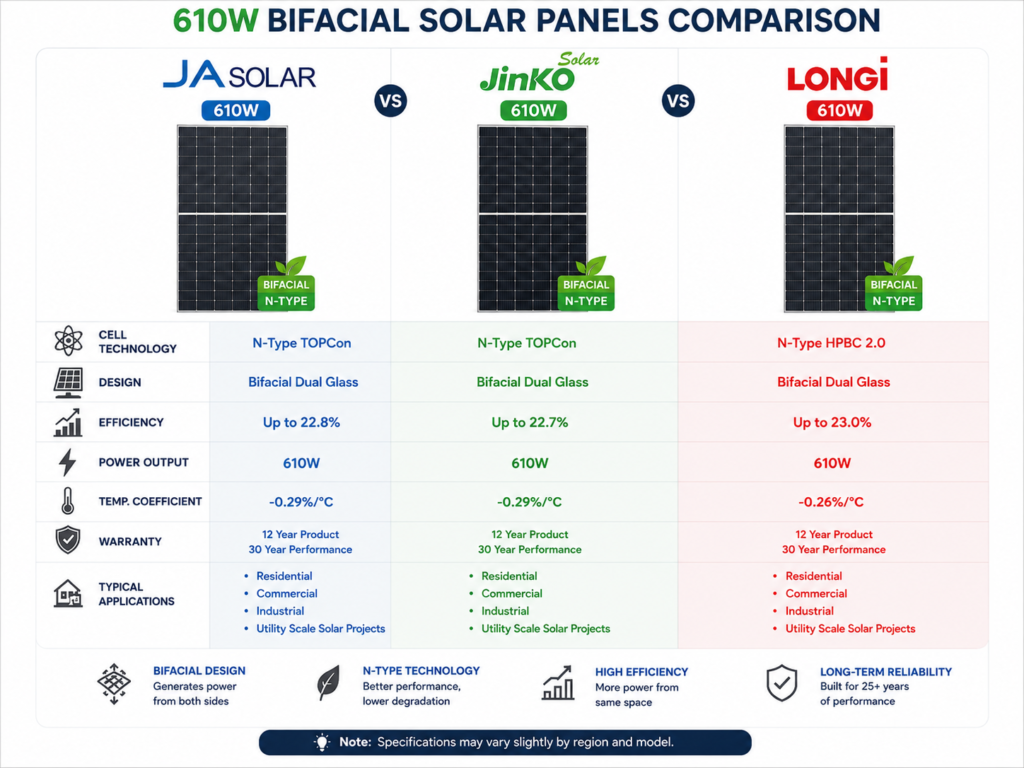
610W Solar Panel Comparison: JA Solar vs Jinko vs LONGi vs Trina
The following comparison is useful as a starting point, but the exact specifications should always be checked against the model-specific datasheet.
| Brand | Typical 610W Class | Technology | Bifacial Options | Best For |
|---|---|---|---|---|
| JA Solar | 610W | N-Type | Yes | Residential, commercial, utility |
| Jinko | 610W | N-Type | Yes | Commercial, industrial, utility |
| LONGi | 610W | N-Type | Yes | Residential, commercial, utility |
| Trina Solar | 610W | N-Type | Yes | Commercial, industrial, utility |
Which 610W Panel Is Better?
There is no universal winner.
JA Solar can be attractive when its 610W model is available at a competitive price and its specifications match your system requirements.
Jinko is a strong option for buyers who want a high-power N-Type bifacial module from a major manufacturer.
LONGi is another strong choice, particularly when the specific Hi-MO model offers good efficiency and pricing.
Trina Solar is worth considering when its 610W-class N-Type bifacial model is available at a competitive price.
The best choice is the panel that provides the right combination of price, efficiency, warranty, degradation, authenticity, electrical compatibility, and availability.
How Many 610W Solar Panels Do You Need?
The number of 610W panels depends on your required system size.
The basic calculation is:
Number of Panels = Required System Capacity ÷ 0.61kW
For example:
3kW Solar System
3 ÷ 0.61 = 4.91
You would need approximately 5 panels, giving:
5 × 610W = 3.05kW
5kW Solar System
5 ÷ 0.61 = 8.20
You would generally need approximately 9 panels:
9 × 610W = 5.49kW
6kW Solar System
6 ÷ 0.61 = 9.84
Approximately 10 panels:
10 × 610W = 6.1kW
10kW Solar System
10 ÷ 0.61 = 16.39
Approximately 17 panels:
17 × 610W = 10.37kW
The final number should be determined according to the inverter’s DC input limits, MPPT voltage range, maximum current, local regulations, and system design.
Advantages and Disadvantages of 610W Solar Panels
Advantages
Higher power per panel:
A 610W module produces more rated power than many older 400W–550W panels.
Fewer panels for the same system size:
Higher wattage can reduce the number of modules required.
N-Type technology:
Modern N-Type designs can offer strong efficiency and lower degradation compared with older technologies.
Bifacial energy generation:
Bifacial models can capture additional light from the rear side when installation conditions are suitable.
Good choice for large systems:
High-wattage modules can be particularly useful for commercial, industrial, and utility-scale projects.
Disadvantages
Large physical size:
Many 610W panels are physically larger than traditional residential modules.
Higher individual panel weight:
The mounting structure and installation team need to be prepared for larger modules.
Bifacial gain is installation-dependent:
A bifacial panel does not automatically generate a fixed percentage of extra electricity.
Compatibility matters:
The panel’s voltage and current must be compatible with the selected inverter and MPPT.
Potentially higher handling requirements:
Large-format modules require careful transportation, lifting, and installation.
How to Choose the Best 610W Solar Panel
Do not choose a 610W solar panel only by looking at its wattage.
Consider these factors before purchasing:
1. Check the Exact Model Number
Two panels from the same brand can have different specifications.
Always ask the seller for the complete model number and datasheet.
2. Compare Efficiency
Higher efficiency means the panel can produce more power from a given roof area.
This is particularly important when rooftop space is limited.
3. Check the Temperature Coefficient
Solar panels generally produce less power as their cell temperature increases.
A better temperature coefficient can help maintain performance during hot weather.
4. Check Warranty and Degradation
Look at both:
- Product warranty
- Linear performance warranty
Also check the manufacturer’s stated annual degradation rate.
For example, Jinko’s current 615–635W N-Type bifacial datasheet states a 30-year linear power warranty and an annual degradation figure of 0.4% for that product family. However, warranty terms vary by exact model, so buyers should verify the relevant datasheet.
5. Check Inverter Compatibility
A 610W panel may have higher voltage and current than older modules.
The installer should calculate the correct panel string configuration according to the inverter’s:
- Maximum DC voltage
- MPPT voltage range
- Maximum input current
- Number of MPPTs
- Maximum PV power
6. Consider Roof Space
A 610W panel is not automatically better for every rooftop.
If the roof has complicated spaces, smaller modules may sometimes provide a more flexible layout.
7. Buy From a Reliable Seller
The seller should provide:
- Original invoice
- Model number
- Datasheet
- Warranty information
- Serial numbers
- Authenticity verification where available
How to Check Whether a 610W Solar Panel Is Original
Because solar panels are a significant investment, authenticity is important.
Before purchasing, check:
- Manufacturer name
- Complete model number
- Serial number
- Barcode
- Manufacturing information
- Datasheet
- Warranty documentation
- Physical label quality
- Seller invoice
Ask the seller to confirm that the model number on the panel matches the manufacturer’s documentation.
Avoid purchasing a panel simply because the seller claims it is “Tier 1.”
A Tier-1 classification is not a substitute for checking the actual model, warranty, condition, authenticity, and seller reputation.
Is 610W better than a 590W solar panel?
A 610W solar panel is not necessarily better than a 590W panel, but it can produce more power from each individual module. A 610W panel has a 20W higher rated output than a 590W panel, which can help reduce the number of panels needed for a larger solar system.
However, wattage is not the only factor to consider. Compare the panel’s efficiency, physical size, N-Type technology, bifacial performance, temperature coefficient, degradation rate, warranty, price, and compatibility with your inverter. If you are considering a high-wattage bifacial panel, see our detailed guide to 590W bifacial solar panels for a comparison of their specifications, performance, and applications.
For a suitable rooftop with enough space, a 610W panel can be an excellent choice. However, a 590W panel may offer better value if it is significantly cheaper or fits your available roof space and system design more effectively.
Final Verdict
A 610W solar panel is a high-power option for modern solar installations, particularly where reducing the number of panels is important. N-Type and bifacial technologies can provide strong efficiency and long-term performance, while bifacial designs can offer additional energy when the rear side receives useful reflected light.
In Pakistan, JA Solar, Jinko, LONGi, and Trina Solar are among the brands worth considering in the 610W class. Current listings show that prices vary significantly by brand and model, so buyers should compare the complete specifications rather than choosing based only on the advertised wattage.
For most buyers, the best 610W solar panel is the one that offers the right balance of price, efficiency, N-Type technology, bifacial performance, warranty, degradation rate, authenticity, and compatibility with the inverter.
Before buying, always verify the exact model number, current market price, official datasheet, warranty, and seller credentials. This can help you avoid paying more for a panel that does not provide better long-term value.
Is a 610W solar panel good for a home?
Yes. A 610W panel can be used in a home solar system if the roof has enough space and the panel is electrically compatible with the inverter.
How much does a 610W solar panel cost in Pakistan?
The price varies by brand, model, technology, seller, and market conditions. Current online listings show 610W models from major brands in roughly the mid-Rs. 20,000s to around Rs. 29,000 per panel, but prices can change quickly.
How many 610W panels are needed for 5kW?
Because each panel is rated at 0.61kW, approximately 9 panels would provide 5.49kW of installed DC capacity. The final design should also consider inverter specifications.
Is a 610W bifacial panel better than a monofacial panel?
It can be, especially when the rear side receives useful reflected light. However, the actual benefit depends on the installation environment.
How much electricity can a 610W panel produce per day?
A simple example using 5 peak sun hours and an 80% overall system factor gives approximately 2.44kWh per day. Actual production varies with weather, location, temperature, shading, dust, orientation, and system losses.
Which is better: JA Solar, Jinko, or LONGi 610W?
All three are major manufacturers. Instead of choosing by brand alone, compare the exact model’s efficiency, degradation rate, warranty, price, electrical specifications, availability, and authenticity.
Are 610W panels suitable for net metering?
A 610W panel itself does not determine whether a system qualifies for grid interconnection or net-metering-related requirements. The complete solar system, inverter, installation, documentation, and applicable local rules must meet the relevant requirements.
Can a 610W panel charge a battery directly?
A 610W solar panel should generally not be connected directly to a conventional battery without an appropriate charge controller or compatible solar power system. The controller or inverter manages voltage, current, and charging safely.
Are 610W solar panels worth buying in 2026?
They can be a good choice when you have sufficient roof space and want high power output per module. However, the best value depends on the exact panel price, efficiency, warranty, system compatibility, and installation conditions.
Is 610W better than a 590W solar panel?
A 610W solar panel is not necessarily better than a 590W panel, but it can produce more power from each individual module. A 610W panel has a 20W higher rated output than a 590W panel, which can help reduce the number of panels needed for a larger solar system.