Solar Charger Without Battery: The Complete 2026 Guide (And Why It Might Be All You Actually Need)
If you’ve been searching for “solar charger without battery,” chances are you’ve already read two or three articles that all say the same thing in different words: it’s a panel, it has no storage, it only works in sunlight. True — but that’s where most guides stop, right when the useful part begins.
This guide goes further. We’ll cover how these chargers actually behave in real sunlight (not lab conditions), why they’re often the smarter buy over a solar power bank, how to size one correctly for your devices, and — because a large part of our readers are in Pakistan dealing with daily load shedding — how to build a genuinely reliable direct-solar setup for home and outdoor use, not just for a weekend hike.
Quick Answer: A solar charger without a battery uses sunlight to supply electricity directly to a compatible device through a suitable regulated output. It can charge a phone during sunny conditions, but charging may become unstable when sunlight changes. Unlike a solar power bank, it cannot store energy for nighttime use. For more reliable charging, connect the solar panel to a compatible power bank or suitable energy-storage system.
Table of Content
- What Exactly Is a Solar Charger Without Battery?
- How Does a Solar Charger Without Battery Work?
- Can You Charge a Phone With a Solar Charger Without a Battery?
- Main Components of a Battery-Free Solar Charger
- Can a Solar Panel Run a Device Directly Without a Battery?
- How Much Power Can You Really Expect?
- What Happens When Clouds Cover the Solar Panel?
- What Happens at Night?
- Solar Charger vs. Solar Power Bank: The Comparison Nobody Explains Properly
- Advantages of a Solar Charger Without Battery
- Disadvantages of a Solar Charger Without Battery
- Is a Solar Charger Without Battery Good for Pakistan?
- Solar Charger Without Battery for Camping
- Solar Charger Without Battery for Emergency Use
- MPPT vs PWM for a Solar Charger Without Battery
- How to Get Better Performance From a Battery-Free Solar Charger
- Buying Guide: What Actually Matters (In Priority Order)
- Solar Charger Without a Battery in Pakistan: A Different Use Case Entirely
- Frequently Asked Questions
- Conclusion
What Exactly Is a Solar Charger Without Battery?
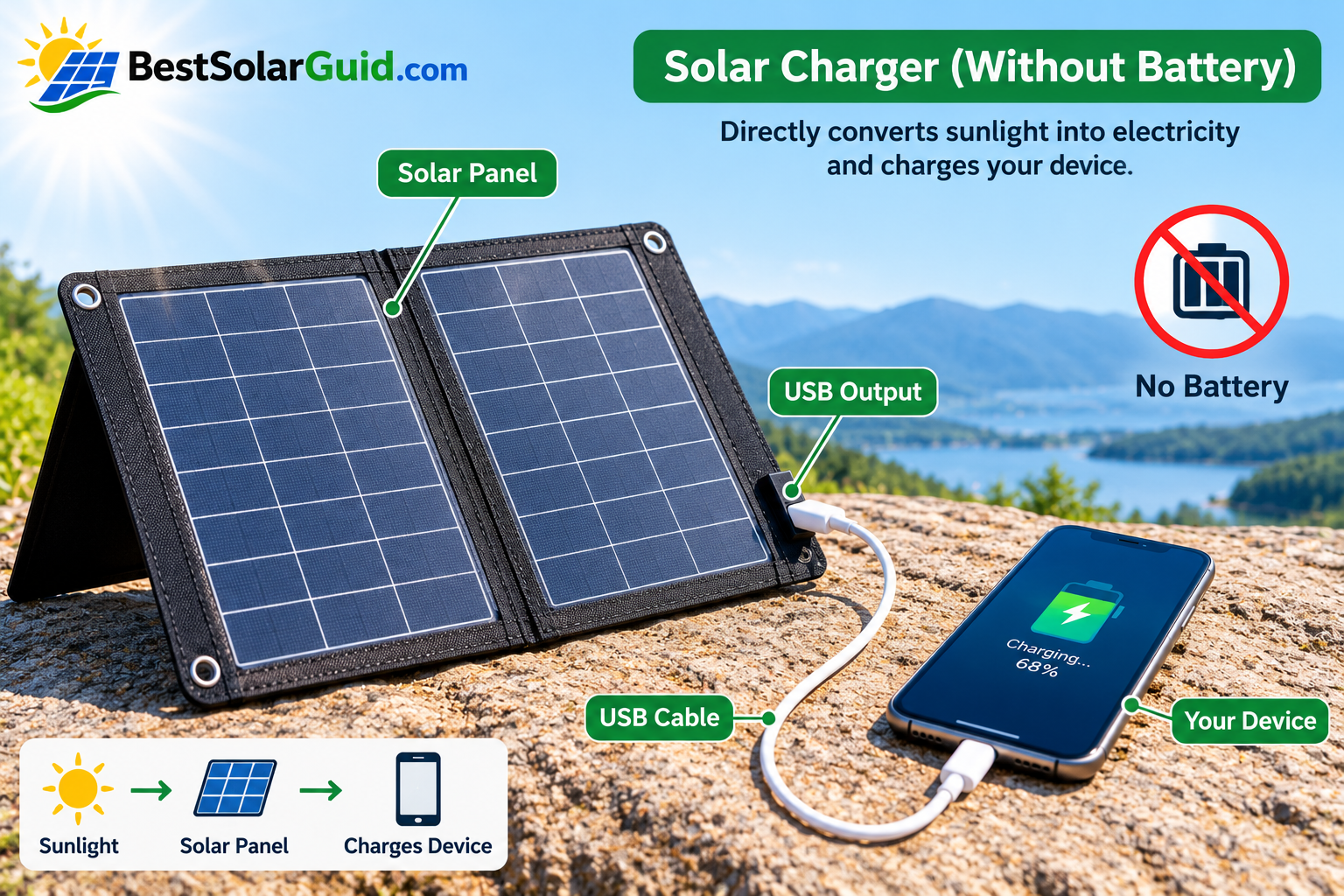
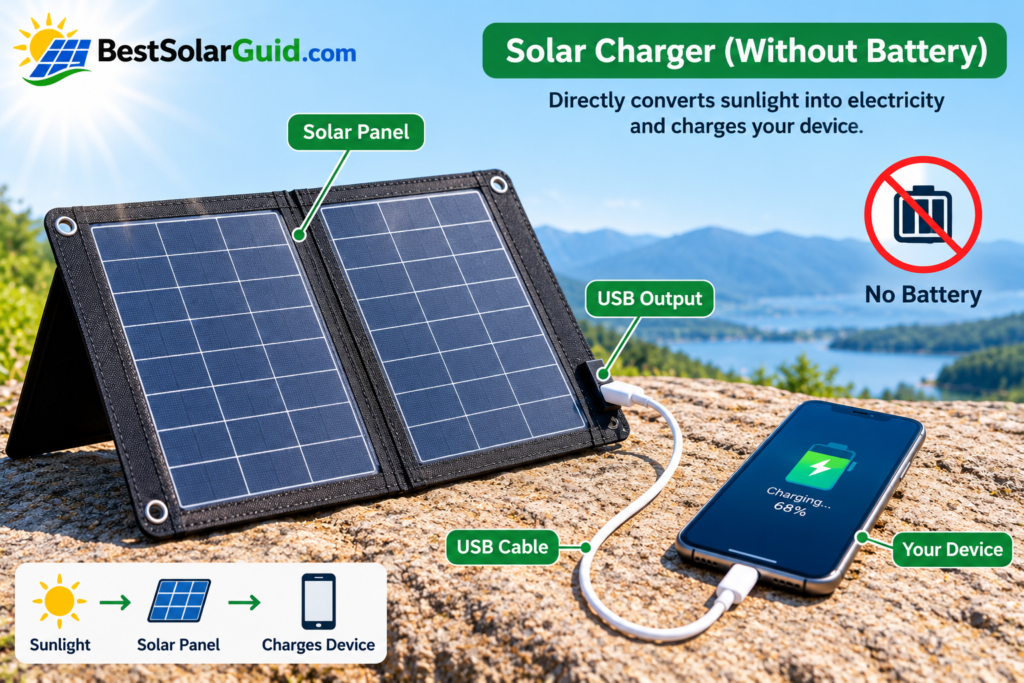
Strip away the marketing language and it’s simple: a solar charger without battery is a photovoltaic (PV) panel wired to a voltage regulator and an output port — USB-A, USB-C, or a DC barrel jack — with nothing in between to store the energy. Sunlight hits the cells, the regulator cleans up the current, and power flows straight to whatever you’ve plugged in. The instant the sun disappears, so does the power.
Manufacturers use several names for the same basic idea:
- Direct solar charger
- Pass-through solar panel
- Solar power supply (common in industrial/DIY contexts)
- Battery-free solar panel
They’re not the same thing as a “solar power bank,” which is a battery pack with a small panel glued onto it. That distinction trips up a lot of buyers, and it’s the first thing worth getting right before you spend money.
If you want to learn how solar power can work without energy storage, check out our complete guide to Solar System Without Battery.
How Does a Solar Charger Without Battery Work?
The working principle is easier than it may sound.
1. Solar Panel Captures Sunlight
The solar panel contains photovoltaic cells that convert sunlight into DC electricity.
The amount of electricity produced depends on several factors, including:
- Sunlight intensity
- Panel size
- Panel efficiency
- Panel angle
- Temperature
- Shade
- Weather conditions
- Quality of the panel
A panel usually produces its best output when it receives strong, direct sunlight without shading.
2. Solar Electricity Goes to a Regulator
Raw solar-panel electricity is not always suitable for directly connecting to a phone or other sensitive electronics.
The voltage and current produced by a solar panel can change as sunlight changes.
A regulator or dedicated solar USB charging circuit can help convert the variable panel output into a more suitable output.
For example, a USB charging module may provide a regulated output for a USB device.
3. The Device Uses the Available Solar Power
After regulation, electricity goes directly to the connected device.
There is no battery storing extra electricity between the panel and the device.
This means the device is using the energy being produced right now.
4. Output Changes With Sunlight
This is the most important thing to understand about a solar charger without battery.
If sunlight is strong, the panel can produce more power.
If a cloud covers the panel, output may fall.
If the panel is shaded, output can fall significantly.
At night, the solar panel cannot generate useful solar electricity.
This is why battery-free solar charging is best for devices and applications that can tolerate changing power availability.
Can You Charge a Phone With a Solar Charger Without a Battery?
Yes, it is possible, but the setup needs to be designed correctly.
A simple solar panel should not normally be connected directly to a phone just because the panel has a USB cable. Solar-panel output can fluctuate, while phones expect a controlled charging input.
A better arrangement is:
Solar panel → voltage regulator/USB solar charging module → phone
Some portable solar panels are specifically designed with regulated USB outputs for direct device charging. Other setups require a separate regulator.
However, direct phone charging can still be less stable than charging through a power bank because sunlight changes throughout the day.
If a cloud suddenly blocks the sun, the available power can drop. The phone may slow charging, stop charging, or repeatedly connect and disconnect depending on the quality of the charging circuit.
This is one reason larger foldable solar panels are often used with a separate power bank for more consistent charging.
Main Components of a Battery-Free Solar Charger
A basic solar charger without battery may contain the following components:
1. Solar Panel
This is the main energy source.
Choose the panel according to the power requirement of your device.
2. Solar Regulator or Charge Module
This component helps convert variable solar electricity into a more usable output.
For USB devices, a suitable USB regulator or solar charging module is important.
3. USB Port or DC Output
Depending on the system, the output may be:
Another regulated DC voltage
- USB-A
- USB-C
- 5V DC
- 12V DC
4. Cables and Connectors
Good-quality cables reduce unnecessary voltage loss and improve reliability.
5. Optional Protection Components
Depending on the design, protection may include:
- Overvoltage protection
- Overcurrent protection
- Short-circuit protection
- Reverse-polarity protection
- Thermal protection
For sensitive electronics, these protections are particularly important.
Solar Charger vs. Solar Power Bank: The Comparison Nobody Explains Properly
Most articles either avoid this comparison or handle it in one throwaway line. Here’s the honest breakdown, based on how these two categories actually perform in daily use rather than on a spec sheet.
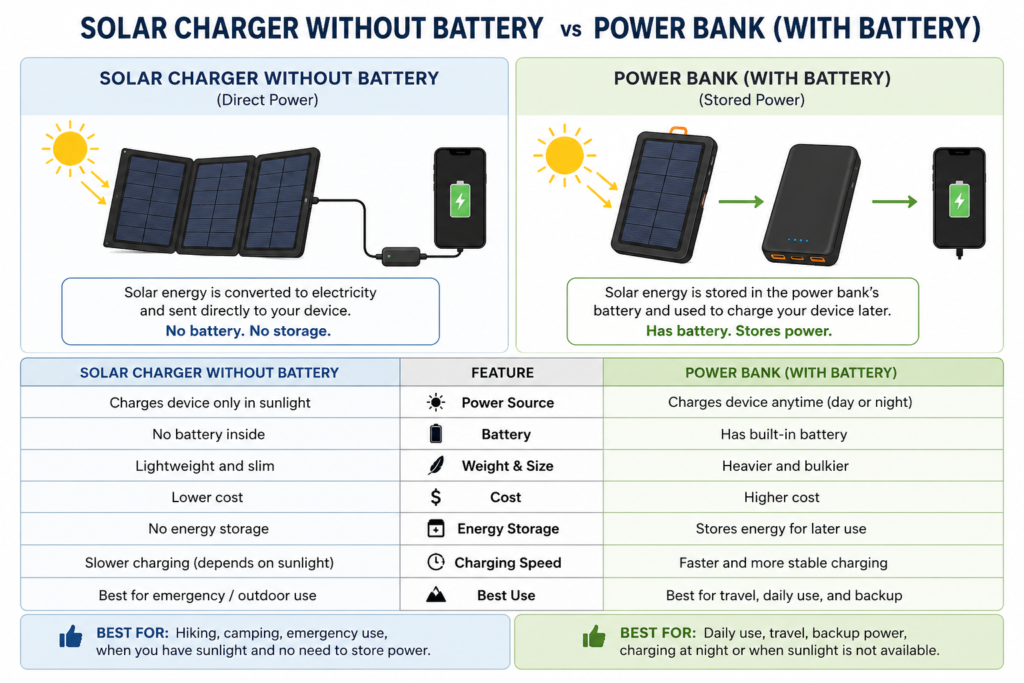
Battery-free solar panel
- Delivers whatever the panel is generating, right now, in real time
- No internal battery to degrade, swell, or eventually stop holding charge
- Lighter per watt, since there’s no cell taking up weight and space
- Cheaper for the same panel wattage
- Output disappears the moment a cloud passes or the sun sets
- Best paired with a phone, a power bank you already own, or a small DC device
Solar power bank (built-in battery)
- Stores whatever the panel collects, so you can use it after dark
- Usually has a small panel (5–10W) relative to the battery size, so the panel alone recharges the battery painfully slowly — often a full day or more of direct sun for a full charge
- Heavier, bulkier, and the battery is a wear part — expect capacity loss after 300–500 cycles
- More expensive for equivalent panel wattage, since you’re paying for cells, protection circuitry, and casing
The trade-off in one sentence: a battery-free charger gives you more real power when the sun is out; a solar power bank gives you less power, but on your own schedule. Neither is “better” — they solve different problems, and a lot of buyer’s remorse in this category comes from people expecting a small solar power bank to behave like a battery-free panel’s bigger, faster cousin.
Can a Solar Panel Run a Device Directly Without a Battery?
Yes, some devices can operate directly from solar power, but it depends on the device and the solar system.
Simple DC loads can be easier to operate directly.
Examples include:
- Small DC fans
- LED lights
- Outdoor sensors
- Small pumps
- Monitoring equipment
- Some USB electronics
However, devices that require stable and continuous power may not work reliably without energy storage.
For example, a device that suddenly needs more power than the panel can produce may shut down.
A battery can solve this problem by acting as an energy buffer.
“For a larger home installation, read our guide to a solar system without a battery to understand how battery-free solar systems work.”
What Happens When Clouds Cover the Solar Panel?
This is one of the biggest disadvantages of a solar charger without battery.
When clouds reduce sunlight, the panel normally produces less electricity.
The exact reduction depends on:
- Type of cloud
- Panel technology
- Panel size
- Sun angle
- Cloud thickness
- Shading
- Quality of the regulator
Your device may continue working at reduced power, charge more slowly, or stop charging completely.
Without a battery, there is no stored energy to compensate for this reduction.
That means a battery-free solar charger works best when the connected device can tolerate variable power.
What Happens at Night?
Nothing is stored because there is no battery.
At night:
Solar panel → no useful sunlight → little or no solar generation → no charging
This is the main difference between a battery-free solar charger and a solar system with energy storage.
If you need charging after sunset, you will need another energy source, such as:
- A power bank
- Solar battery
- Portable power station
- Grid electricity
Advantages of a Solar Charger Without Battery
A battery-free solar charger can be a smart option in the right situation.
1. Lower Cost
Removing the battery can reduce the overall cost of the system.
You do not have to purchase a separate storage battery or pay for battery replacement.
2. No Battery Degradation
Batteries have a limited lifespan.
Over time, their capacity decreases.
A battery-free solar charger avoids this particular problem because there is no storage battery to age.
3. Lightweight Design
A system without a battery can be easier to carry, especially for:
- Hiking
- Camping
- Travel
- Outdoor photography
- Field work
- Emergency use
4. Simple System
There are fewer components compared with a complete solar-plus-battery setup.
A simple system may only require a panel, regulator, cable, and device.
5. Useful During Daytime
If you only need power while the sun is available, storing electricity may not be necessary.
For example, a daytime outdoor sensor may not need a battery at all.
6. Less Battery Maintenance
There is no battery to inspect, replace, or maintain.
This can be useful for applications where simplicity is more important than continuous power.
7. No fire or swelling risk.
Lithium-ion cells carried in hot glove boxes, direct sun, or checked luggage are a known safety concern. A battery-free charger has none of that risk, and some airlines are stricter about power banks than about plain panels for exactly this reason.
Disadvantages of a Solar Charger Without Battery
Battery-free charging is not perfect.
1. No Power at Night
The most obvious limitation is the lack of stored energy.
Once solar production stops, charging stops.
2. Variable Output
Solar power changes with weather, shade, temperature, and time of day.
Your device may therefore receive different amounts of power throughout the day.
3. Direct Phone Charging Can Be Unstable
A phone may not always charge consistently if the solar input keeps changing.
A good regulator can improve this situation, but it cannot create energy that the panel is not producing.
4. Not Ideal for Every Device
Some electronics need stable, uninterrupted power.
For these devices, a battery or power bank may be a better option.
5. Cloudy Weather Can Reduce Performance
In areas with frequent clouds or poor sunlight, battery-free charging may not provide enough reliable power.
Is a Solar Charger Without Battery Good for Pakistan?
Yes, it can be useful in Pakistan, particularly for daytime outdoor applications.
Pakistan receives strong sunlight in many regions for a significant part of the year, making solar power attractive for homes, businesses, agriculture, travel, and backup applications.
A battery-free charger can be useful for:
- Mobile phone charging
- Camping
- Outdoor work
- Emergency daytime charging
- Small DC devices
- Remote monitoring equipment
- Small solar projects
- Daytime lighting applications
- Agricultural equipment
However, Pakistan also experiences dust, heat, clouds, and seasonal weather changes.
Dust can reduce the amount of sunlight reaching the solar cells, while very high temperatures can affect panel performance.
Therefore, keeping the panel clean and correctly positioned can make a noticeable difference.
For Pakistani buyers, another important issue is product quality. Very cheap solar controllers advertised with impressive specifications may not always deliver the performance buyers expect, so checking the actual electrical ratings and protection features is more important than choosing a product only because it has a high amp number.
“If your goal is to power household appliances rather than just charge small devices, see our guide to a home solar system without a battery for installation costs, benefits, and limitations.”
Solar Charger Without Battery for Camping
Camping is one of the best applications for a battery-free solar charger.
Imagine spending the day outdoors with a foldable solar panel.
You can place the panel in direct sunlight and connect a compatible device through a regulated USB output.
This can reduce your dependence on wall electricity.
However, if you need your phone to remain available at night, carrying a separate power bank is usually a better solution.
A practical camping setup can therefore be:
Solar panel → regulated USB output → power bank → phone
The solar panel charges the power bank during the day, and the power bank provides stable charging whenever needed.
“If you need a portable panel for outdoor trips, explore our guide to the best portable solar panels for camping to compare suitable options.”
Solar Charger Without Battery for Emergency Use
A battery-free solar charger can also be useful during power outages.
For example, if the electricity goes out during the daytime, you may still be able to charge a phone using sunlight.
This can be particularly useful during:
- Load shedding
- Natural disasters
- Outdoor emergencies
- Travel
- Remote work
- Camping
- Long power outages
However, if an emergency continues overnight or during several cloudy days, a battery becomes much more valuable.
This is why a battery-free solar charger is best considered a direct daytime power solution, rather than a complete backup-power system.
MPPT vs PWM for a Solar Charger Without Battery
You may have heard the terms MPPT and PWM when researching solar charging systems.
They are different types of solar charge-control technology.
PWM
PWM stands for Pulse Width Modulation.
It is a simpler control method and is commonly used in smaller solar systems.
MPPT
MPPT stands for Maximum Power Point Tracking.
An MPPT controller tracks the panel’s operating point and uses DC-to-DC conversion to extract available power more effectively when panel and load voltages differ.
For larger or more demanding solar systems, MPPT can offer advantages, particularly when the panel voltage is significantly different from the required output voltage.
But do not assume that every product labelled “MPPT” is automatically better.
The actual specifications, voltage range, current rating, efficiency, protections, and build quality matter.
How to Get Better Performance From a Battery-Free Solar Charger
You can improve performance with a few simple steps.
Keep the Panel in Direct Sunlight
Avoid trees, buildings, walls, and other objects that create shade.
Even partial shading can reduce solar output.
Position the Panel Properly
Keep the panel facing the strongest available sunlight.
For portable panels, you may need to adjust the angle during the day.
Keep the Panel Clean
Dust and dirt can reduce the amount of sunlight reaching the solar cells.
This is especially important in dusty environments.
Avoid Unnecessary Loads
If the panel is producing limited power, connecting several devices at the same time may cause unstable charging.
Use a Proper Regulator
Do not rely on a simple wire connection between a solar panel and a sensitive electronic device.
The regulator is an important part of a safe and practical battery-free charging system.
How Much Power Can You Really Expect?
This is the part most buying guides gloss over, and it’s the part that actually determines whether you’ll be happy with the purchase.
A “20W” or “28W” rating on the box is the panel’s output under lab-perfect conditions: full sun, ideal panel angle, cool temperature. In everyday use, expect 50–70% of the rated wattage as realistic output — so a 20W panel typically delivers 10–14W in good midday sun, and noticeably less in early morning, late afternoon, or a hazy sky.
Rough real-world benchmarks worth knowing before you buy:
| Panel rating | Realistic output in direct sun | Time to add ~30% to an average phone battery |
|---|---|---|
| 5–7W | 3–5W | 45–70 minutes |
| 10W | 6–8W | 30–45 minutes |
| 20–28W | 12–18W | 15–25 minutes |
| 60W+ | 35–45W | Fast enough for tablets and small laptops |
Two conditions matter more than the wattage number itself: direct sun vs. shade, and panel angle to the sun. A panel angled correctly toward the sun can outperform a larger panel lying flat on the ground. If you only take one practical tip from this article, take this one — angle beats wattage more often than people expect.
Buying Guide: What Actually Matters (In Priority Order)
- Real-world wattage, not the marketing number. Look for independent test data or reviews that mention measured mAh output, not just the panel’s rated watts.
- Number and type of ports. USB-C PD support matters if you’re charging newer phones or tablets fast; USB-A is fine for basic devices.
- Foldability and cell type. Monocrystalline cells (often 21–25% efficient) outperform polycrystalline in the same physical size — worth the small price difference.
- Weather resistance. IPX4 (splash-resistant) is the realistic minimum for outdoor use; it is not the same as waterproof.
- Built-in ammeter or output display. A small but genuinely useful feature — it lets you angle the panel for maximum output instead of guessing.
- Weight per watt, if you’re carrying it — hiking and cycling users should prioritize this over raw wattage.
How Much Does a Solar Charger Without Battery Cost Worldwide?
Pricing for battery-free solar chargers varies mainly by wattage tier, cell quality, and where you’re buying from — but the pattern holds fairly consistently across markets once you adjust for local import costs and currency.
At the entry level, small USB folding panels in the 5–10W range — enough to trickle-charge a single phone — generally sell for around $15 to $35 worldwide, with the lower end of that range typically using cheaper polycrystalline cells and a bare-bones single USB-A port. Stepping up to the 20–28W tier, which is the most popular size for phones, small tablets, and topping up a power bank on the move, pricing usually lands between $40 and $90, with well-known monocrystalline models featuring USB-C and an ammeter sitting at the top of that band. For 60W and larger panels aimed at power stations, multiple devices, or small laptops, expect $150 to $350, scaling up further for 100W+ arrays with proper MC4 connectors and rugged casing.
Buying a bare panel with no casing, ports, or electronics — common for DIY and off-grid setups — is usually the cheapest route per watt, often landing close to $1 per watt for larger cells, though small panels can run several dollars per watt due to fixed manufacturing costs that don’t scale down proportionally.
Regionally, the US and Western Europe tend to reflect brand MSRP fairly closely, with VAT or import duty added in EU and UK markets. In Pakistan, India, and much of South Asia, local reseller markups and import costs typically push prices higher than the US-dollar equivalent of brand pricing — a small folding panel that costs $50–$70 at source often retails locally for the equivalent of $70–$100 once shipping, customs, and reseller margin are factored in. That’s worth keeping in mind before assuming a locally listed price reflects the panel’s true international value — comparing the wattage against the global USD benchmarks above is a quick way to check whether a local listing is fairly priced or inflated.
Solar Charger Without a Battery in Pakistan: A Different Use Case Entirely
Most English-language guides on this topic are written for American or European hikers and campers. That’s a narrow lens. In Pakistan, the single biggest reason people search for “solar charger without battery” isn’t a camping trip — it’s daily load shedding, unreliable grid supply in smaller cities and rural areas, and the cost of electricity itself. That changes what actually matters in a buying decision.
What’s different about the Pakistani context:
- Sunlight availability works in your favor. Most of Pakistan gets 7–9 hours of strong, direct sun for the majority of the year, particularly across Punjab, Sindh, and Balochistan — genuinely better conditions for direct solar charging than most of the US or Europe, where these guides are usually written.
- Reliability during outages matters more than portability. A hiker cares about grams; a household dealing with load shedding cares about whether the phone, the router, or a small fan keeps running during a 2–4 hour outage. That shifts the ideal setup from an ultralight folding panel toward a slightly larger panel (20–60W) paired with a basic charge controller feeding a power strip or a small existing battery/UPS.
- Local pricing reality. Small folding USB panels (10–28W) generally run somewhere in the Rs. 6,000–25,000 range depending on brand and import source, while larger 60W+ panels with a proper charge controller sit higher. Solar power banks with a small integrated panel are usually cheaper upfront (roughly Rs. 8,000–15,000 for larger capacities) but, as covered above, the panel on these is too small to be your main charging source — treat it as a battery that happens to have a trickle-charge panel, not as a solar charger in its own right.
- Combine, don’t choose blindly. For most homes dealing with load shedding, a battery-free panel paired with a separate battery or small UPS you already own is usually more cost-effective than buying an all-in-one solar power bank, because you’re not paying twice for battery capacity you may already have.
- Import and warranty matter. A large share of solar chargers sold in Pakistan are imported through resellers rather than sold directly by the brand. Check for a local warranty or return policy before buying — panels are simple and durable, but connectors and regulators do fail, and cross-border returns are a genuine hassle.
If you’re buying specifically for outages rather than travel, prioritize a panel in the 20–60W range with an MC4 or DC output and a basic PWM/MPPT controller, over a small USB-only folding panel meant for backpacking. The backpacking-style panels are excellent for phones on the move, but they’re undersized for keeping a household connected through a multi-hour outage.
Common Mistakes to Avoid
Mistake 1: Connecting a Phone Directly to a Raw Solar Panel
Solar-panel output can vary significantly.
Use an appropriate regulated charging solution.
Mistake 2: Expecting Charging at Night
Without a battery, there is no stored solar energy.
Mistake 3: Buying the Smallest Panel
A tiny panel may not produce enough power for your device.
Mistake 4: Ignoring Cloudy Weather
Always consider your local sunlight conditions.
Mistake 5: Choosing Only by Wattage
A higher watt rating does not automatically mean a better charging system.
The regulator, output voltage, current, connectors, and protections also matter.
Mistake 6: Ignoring Heat and Dust
Outdoor solar equipment needs proper placement and maintenance, especially in hot and dusty environments.
Conclusion
A solar charger without a battery isn’t a stripped-down or lesser version of a solar power bank — it’s a different tool built around a different trade-off: more real power right now, in exchange for having no power once the sun is gone. For hikers, cyclists, and anyone charging a power bank they already carry, that trade-off usually works in their favor. For households facing load shedding, the same logic applies at a larger scale: pair a properly sized panel with whatever storage you already have, rather than buying storage and generation bundled together at a worse price and a smaller wattage.
Buy based on real-world output and your actual use case — not the biggest number printed on the box.
Can I charge my phone directly from a solar panel without a battery?
Yes, if the solar panel is connected to a suitable regulated charging circuit or has an appropriate regulated USB output. Direct charging can become unstable when sunlight changes, so a power bank is often more convenient for consistent charging.
Does a solar charger without battery work at night?
No. Without a battery or another energy-storage system, there is no stored solar energy available at night.
Can I use a solar charger without battery on cloudy days?
Yes, but performance may be significantly lower. If the panel cannot produce enough power, charging may slow down or stop.
Is a battery-free solar charger cheaper?
Usually, yes. Removing the storage battery reduces the number of components and eliminates battery replacement costs.
Is MPPT necessary for a small solar charger?
Not always. The correct controller depends on the panel, voltage, load, and system design. MPPT becomes particularly useful when efficient power extraction and voltage conversion are important.
Can I run a fan directly from solar power without a battery?
Yes, a compatible DC fan can potentially operate directly from solar power. However, its speed may change when sunlight changes.
Can a solar charger without battery charge a power bank?
Yes, if the solar panel and regulated output provide the power required by the power bank. This is actually a practical way to use solar energy during the day while keeping stored energy available for later.
Which is better: a solar charger without battery or a solar power bank?
Neither is universally better. A battery-free charger is simpler and lighter for direct daytime use, while a solar power bank is more useful when you need stored energy and charging after sunlight disappears.