Lightweight Solar Panels in 2026: Complete Guide for Pakistan and Worldwide
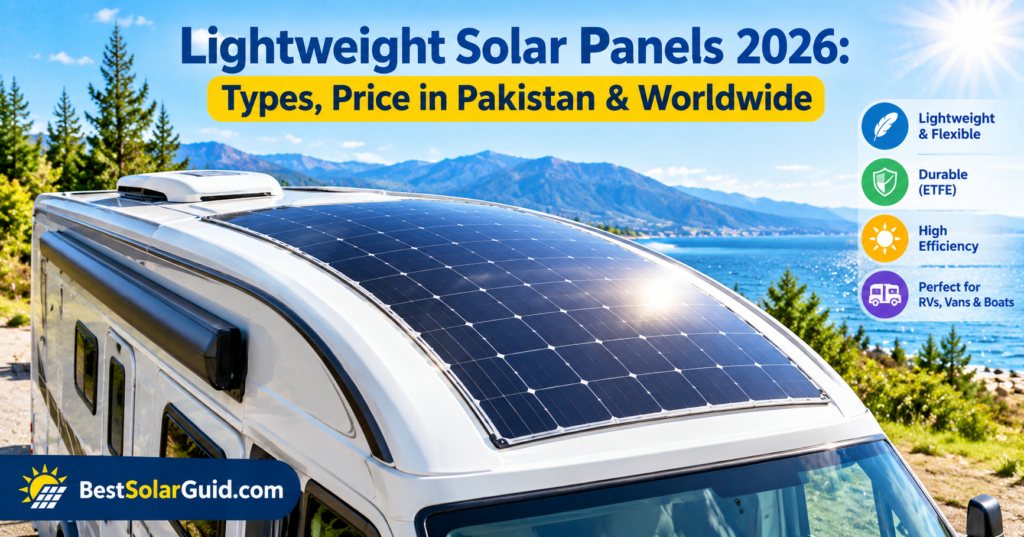
Lightweight solar panels are becoming popular for RVs, boats, vans, weak roofs and portable power setups. A normal rigid panel is heavy because of its glass and aluminium frame. A lightweight panel removes most of that weight, so you can mount it almost anywhere.
Flexible lightweight panels weigh about one-third of a rigid panel. In this 2026 guide you will learn what they are, how they work, the types, worldwide options, prices in Pakistan and worldwide, and how to buy the right one.
Table of Contents
- What Are Lightweight Solar Panels?
- How Much Lighter Are They?
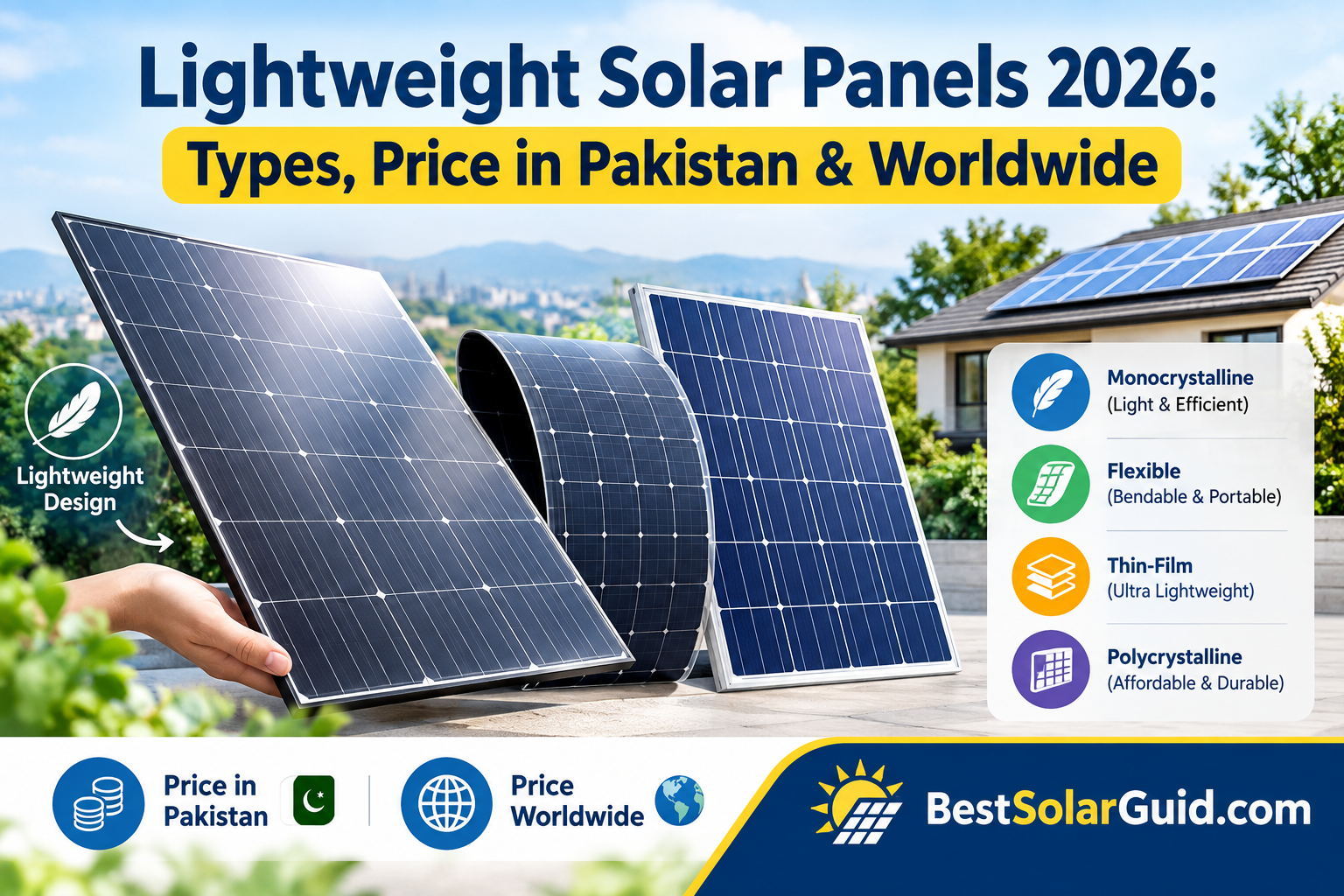
- Types of Lightweight Solar Panels
- Advantages and Disadvantages
- ETFE vs PET: Which Coating Is Better?
- Lightweight Solar Panels Worldwide
- Lightweight Solar Panel Price Worldwide (USD)
- Lightweight Solar Panels in Pakistan
- Price of Lightweight Solar Panels in Pakistan (2026)
- How to Choose the Best Lightweight Solar Panel
- Installation and Maintenance Tips
- FAQs
- Conclusion
What Are Lightweight Solar Panels?
Lightweight solar panels are thin PV modules built without heavy glass and thick aluminium frames. They use a polymer front sheet instead. They are also called flexible, semi-flexible or portable solar panels.
They produce electricity the same way as normal panels, through the photovoltaic effect. The cells are protected by layers of plastic and ETFE against UV and moisture.
How Much Lighter Are They?
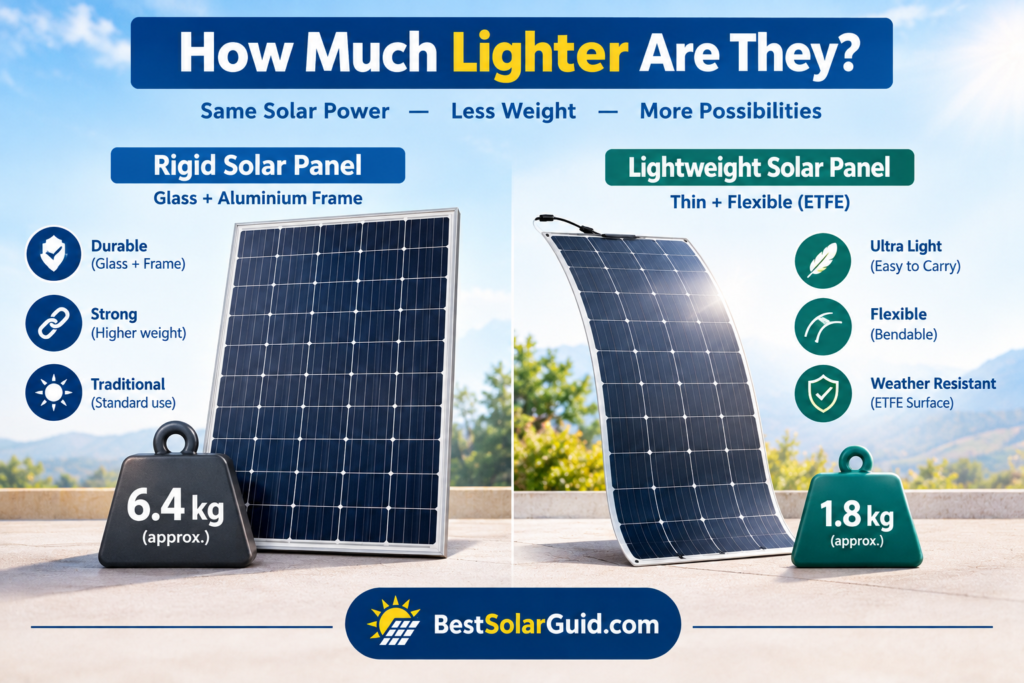
One manufacturer’s own product line shows flexible panels are 63–67% lighter per watt than rigid ones. A 100W rigid panel may weigh about 6.4 kg, while a flexible 100W version is often about 1.8 kg.
| Feature | Rigid Panel | Lightweight Panel |
|---|---|---|
| Weight (100W) | ~6 kg | ~1.8–2.5 kg |
| Thickness | 30–35 mm | 2–3 mm |
| Bendable | No | Yes (semi to full) |
| Typical lifespan | 25+ years | 5–10 years (ETFE longer) |
| Price per watt | Lower | Higher |
Types of Lightweight Solar Panels
Flexible Monocrystalline Panels
The most popular type. Good models reach 21–22% efficiency. Best for RVs, boats and curved roofs.
Semi-Flexible Panels
Thin but with limited bending (around 30°). More durable and good for flat roofs.
Thin-Film Panels
Very light and bendable but low efficiency, often in single digits. They are cheaper but need more space.
If you want to compare different flexible panel options, materials, efficiency, installation methods, and prices, see our guide to the best flexible solar panels in 2026.
Foldable and Portable Panels
Fold into a bag for camping, trekking and phone or power-station charging.
For a closer look at portable options for outdoor use, check our guide to the best portable solar panels for camping in 2026.
Bifacial Lightweight Panels
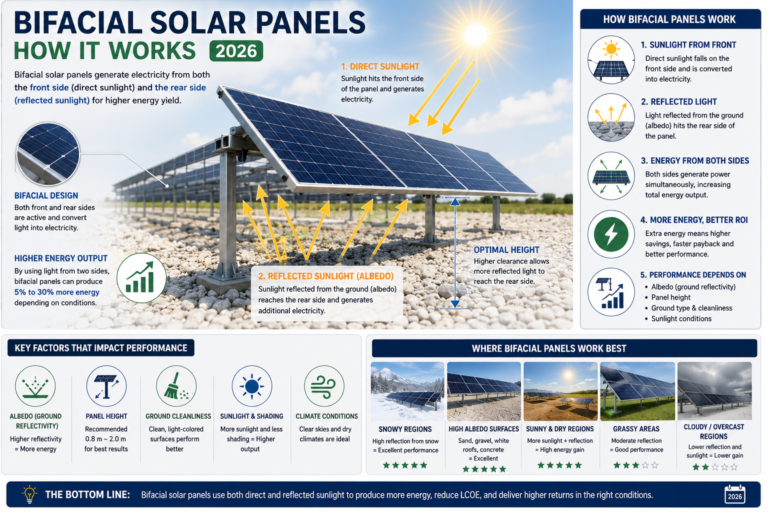
Newer 2026 models collect light from both sides. One 200W bifacial model claims about 15% extra rear-side output.
Advantages and Disadvantages
Advantages
- Very light, so weak roofs, tin sheds and vans can carry them
- Easy transport and quick installation, with no heavy frame or rails
- Fit curved surfaces such as boat decks and caravan roofs
- Lower shipping cost
Disadvantages
- Higher price per watt than rigid panels
- Shorter lifespan, especially with cheap PET coating
- Heat builds up if glued flat with no air gap
- Can crack if bent too sharply
ETFE vs PET: Which Coating Is Better?
ETFE is more expensive than PET but gives better durability and efficiency. ETFE-coated panels last about 5–8 years, against 2–3 years for PET. Always choose ETFE if your budget allows, especially in hot, sunny Pakistan.
Lightweight Solar Panels Worldwide
Worldwide, lightweight panels are used mainly for RVs, marine, camping, drones and portable power.
- Efficiency: The best flexible panels now reach about 23%, matching budget rigid panels. Some N-type models claim up to 25%.
- Popular brands: Renogy, DOKIO, ALLPOWERS, EcoFlow, Newpowa, Topsolar and Eco-Worthy.
- Typical sizes: 50W to 200W for consumers, with larger custom modules for OEM and marine use.
- Latest trend: Back-contact (HPBC) cells with ETFE. HPBC flexible modules reach about 20–22% efficiency.
- Warranty: Usually 1–5 years worldwide.
Lightweight Solar Panel Price Worldwide (USD)
Worldwide, and especially in the US, lightweight panels are priced in US dollars, usually per panel or per watt.
Flexible solar panels typically cost between $0.80 and $2.50 per watt, and most high-quality monocrystalline ETFE panels fall between $1.20 and $2.00 per watt. That makes a good 100W panel roughly $120 to $200. Budget options exist too. A well-known budget 100W flexible panel sells for under $150, and some marketplace listings go lower, though very cheap panels often degrade faster.
Premium brands cost more. Renogy’s 200W flexible panel starts from about $311.99, and portable 200W models from other brands sell for around $189 on large retail sites.
| Panel Size | Typical Worldwide Price (USD) |
|---|---|
| 100W flexible | $90–$200 |
| 200W flexible | $190–$310+ |
| Per watt | $0.80–$2.50 (best ETFE: $1.20–$2.00) |
| Foldable/portable (100–200W) | $140–$300 |
Why prices differ:
- Coating: ETFE costs more than PET but lasts longer
- Efficiency: 22–25% N-type or back-contact cells cost more than basic monocrystalline
- Brand and warranty: Trusted brands with 5-year warranties charge a premium
- Extras: Kits with charge controllers, cables and mounting cost more than the panel alone
Panel price vs system price: These are panel prices only. US residential rooftop systems cost about $2.50 to $3.50 per watt before incentives, because that includes the inverter, mounting, wiring, labor and permits. Lightweight panels are mostly bought as small DIY kits for RVs, boats and portable use, so the per-panel price is what matters here.
Prices are approximate for 2026 and vary by brand and seller.
Lightweight Solar Panels in Pakistan
Pakistan is one of the world’s biggest solar markets. In 2024 it imported more solar panels than any other country. Most of the market is rigid panels from Longi, Jinko, Trina and Canadian Solar, but flexible panels are also available.
Where to buy:
- Online: Daraz, Ubuy (imported brands like DOKIO) and dedicated solar websites
- Physical: Karachi, Lahore, Islamabad and Rawalpindi have wide availability. Solar markets such as Hall Road (Lahore) and Shershah (Karachi) are also options.
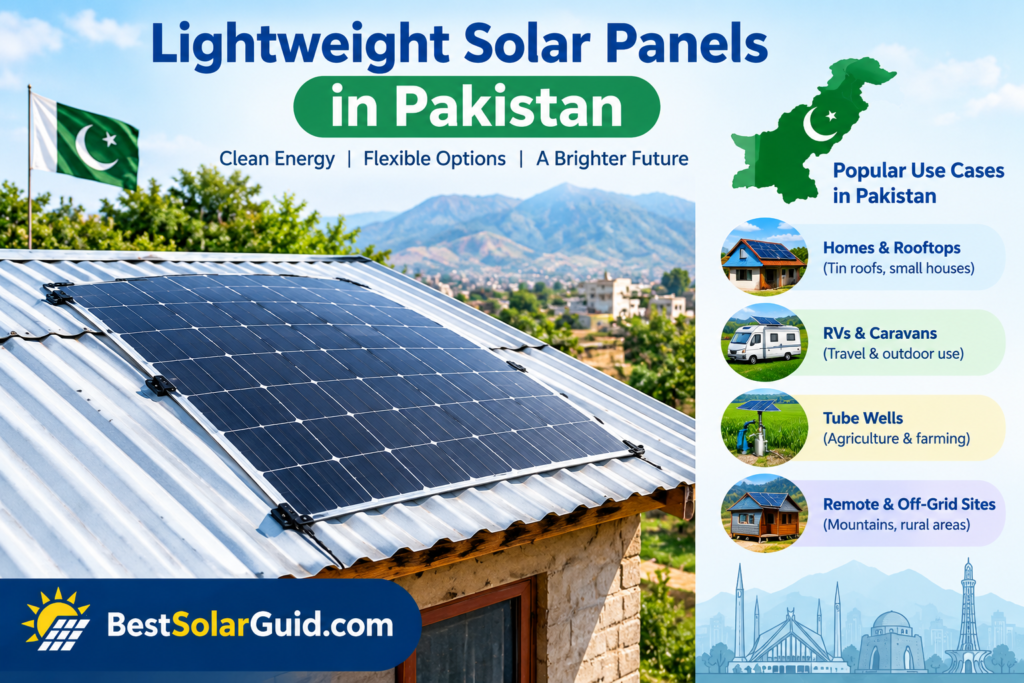
Best uses in Pakistan: Caravans and vans, boats, tin or weak roofs, tube-well covers, camping, and small 12V battery charging.
Price of Lightweight Solar Panels in Pakistan (2026)
Prices vary a lot between sellers. One 2026 guide lists 100W at PKR 18,000–22,000, 150W at PKR 25,000–30,000 and 200W at PKR 35,000–40,000. Other sellers list 100W flexible panels from about PKR 15,800. Very cheap Daraz listings are often low-grade PET panels.
For comparison, standard rigid A-grade panels cost about PKR 27–45 per watt in 2026. Flexible panels are usually more per watt, with one guide saying 30–35% more.
| Wattage | Approx. Price (PKR) |
|---|---|
| 100W | 15,000–22,000 |
| 150W | 25,000–30,000 |
| 200W | 35,000–40,000 |
Once converted, Pakistani prices are in a similar range to global prices. Local duties, shipping and warranty support make the difference.
Check today’s rates before buying. Exchange rates and duties change prices often.
How to Choose the Best Lightweight Solar Panel
- Coating: Choose ETFE over PET
- Efficiency: Aim for 20%+ monocrystalline
- Bendability: Check the maximum bend angle for your surface
- Waterproofing: IP65 or higher
- Warranty: 5 years is ideal, with real local support
- Bypass diodes: They reduce loss during shade
- Connectors: MC4 for easy system wiring
- Seller: Buy from a trusted seller and ask for a datasheet
Installation and Maintenance Tips
- Leave a small air gap if possible, because heat reduces output
- Use proper adhesive or grommet mounting, and never bend sharply
- Clean with a soft cloth and clean water. Regular cleaning of the ETFE surface maintains output.
- Avoid walking on the panel
- Match the panel voltage with your charge controller
FAQS
Are lightweight solar panels worth it?
Yes, when weight, curved surfaces or portability matter. For a normal home rooftop with a strong roof, rigid panels give better value.
Are they available in Pakistan?
Yes, in major cities and on online marketplaces.
How much do lightweight solar panels cost worldwide?
Roughly $0.80 to $2.50 per watt, with a good 100W panel costing about $120 to $200.
How long do they last?
Usually 5–10 years, with ETFE models lasting longer than PET.
Are they less efficient?
Monocrystalline flexible panels are now close to rigid ones. Thin-film versions are much lower.
Can I run a home on them?
Only for small loads or as an addition. For full-home systems, rigid N-type panels are the better choice.
What is the best type for RVs and boats?
ETFE-coated flexible monocrystalline panels.
Conclusion
Lightweight solar panels are the best answer where weight and flexibility matter. In 2026 they are more efficient and durable than before, especially ETFE models. In Pakistan, choose ETFE, a real warranty and a trusted seller, and compare current prices before you order.