Best Portable Solar Panels for Camping in 2026: Top Picks & Buying Guide
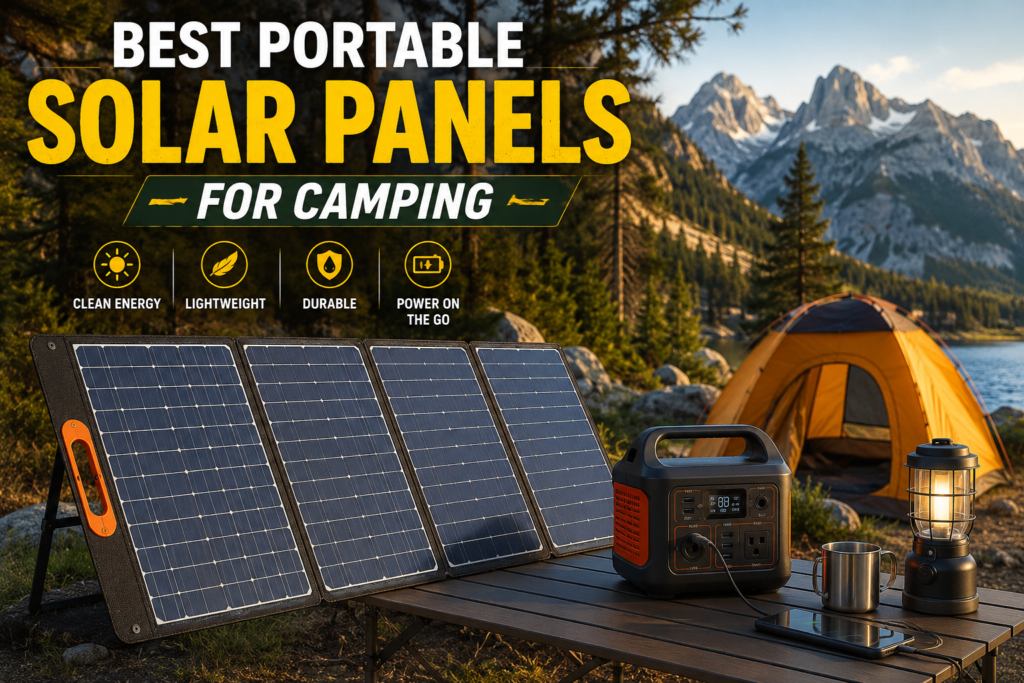
The best portable solar panels for camping depend on how much power you need, how far you need to carry your equipment, and whether you use a portable power station. For most car campers, a foldable 100W–220W panel offers a practical balance between portability and charging capacity. Backpackers may prefer smaller, lightweight solar chargers, while RV campers may need higher-wattage options.
Camping gives you a chance to disconnect from the grid, but that does not always mean you want to disconnect from your phone, camera, GPS, lights, laptop, or other essential devices.
That is where portable solar panels for camping can make a big difference. Unlike traditional rooftop solar panels, portable models are designed to be folded, carried, positioned in the sun, and connected to a portable power station or compatible battery system.
But choosing the right panel is not simply about buying the one with the highest wattage. A 400W panel may produce more electricity, but it can also be heavier, larger, and less convenient than a 100W or 200W model.
In this guide, we compare portable solar panel options for different camping styles, explain how to choose the right wattage, and cover important features such as weight, weather resistance, efficiency, and power station compatibility.
Table of Content
- What Is a Portable Solar Panel for Camping?
- Portable Solar Panel Prices in Pakistan for Camping (2026)
- How Do Portable Solar Panels Work While Camping?
- Best Portable Solar Panels for Camping in 2026
- Portable Solar Panel Wattage: How Many Watts Do You Need?
- 20W–40W Solar Panels: Are They Enough for Camping?
- 100W Solar Panels: The Camping Sweet Spot
- 200W Solar Panels: Better for Power Stations
- Best Portable Solar Panels for a Week-Long Off-Grid Camping Trip
- Why a 200W Solar Panel May Produce Less Than 200W
- Monocrystalline vs. Other Solar Cells for Camping
- Are Bifacial Portable Solar Panels Better for Camping?
- Portable Solar Panel vs. Solar Charger: What’s the Difference?
- What Should You Look for in the Best Portable Solar Panel for Camping?
- How to Choose the Best Portable Solar Panels for Efficiency, Weight, and Value
- Best Portable Solar Chargers for Camping and Backpacking
- How to Position a Portable Solar Panel While Camping
- Should You Put a Solar Panel Directly on the Ground?
- Can Portable Solar Panels Charge a Power Station While Camping?
- How Long Does It Take to Charge a Portable Power Station?
- Portable Solar Panels for Camping in Cloudy Weather
- Portable Solar Panels for Hot Weather
- Portable Solar Panels for Winter Camping
- Portable Solar Panels for Backpacking vs. Car Camping
- Portable Solar Panels for Camping vs. Rigid Solar Panels
- Common Mistakes When Buying a Camping Solar Panel
- How to Choose the Best Portable Solar Panel for Your Camping Trip
- Are Portable Solar Panels Worth It for Camping?
- Best Portable Solar Panel for Camping: Final Verdict
- Frequently Asked Questions
What Is a Portable Solar Panel for Camping?
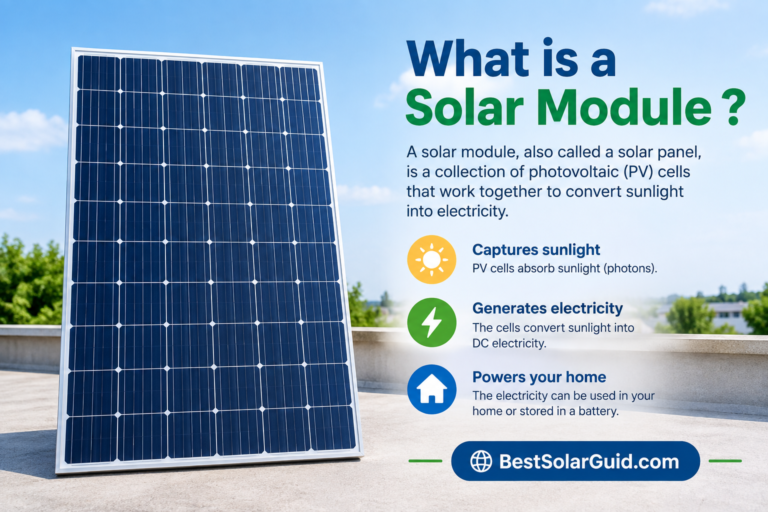
A portable solar panel is a photovoltaic panel designed to generate electricity without permanent rooftop installation.
Most camping models are:
- Foldable
- Lightweight compared with traditional rigid panels
- Equipped with a carrying handle or protective case
- Designed for temporary outdoor use
- Compatible with portable power stations or battery systems
- Available in different wattages, commonly from around 20W to 400W or more
The panel itself does not store electricity. It converts sunlight into electrical energy, which must either be used immediately or sent to a battery or portable power station for storage.
This distinction is important because many beginners assume that a solar panel works like a power bank. It does not.
Portable Solar Panel Prices in Pakistan for Camping (2026)
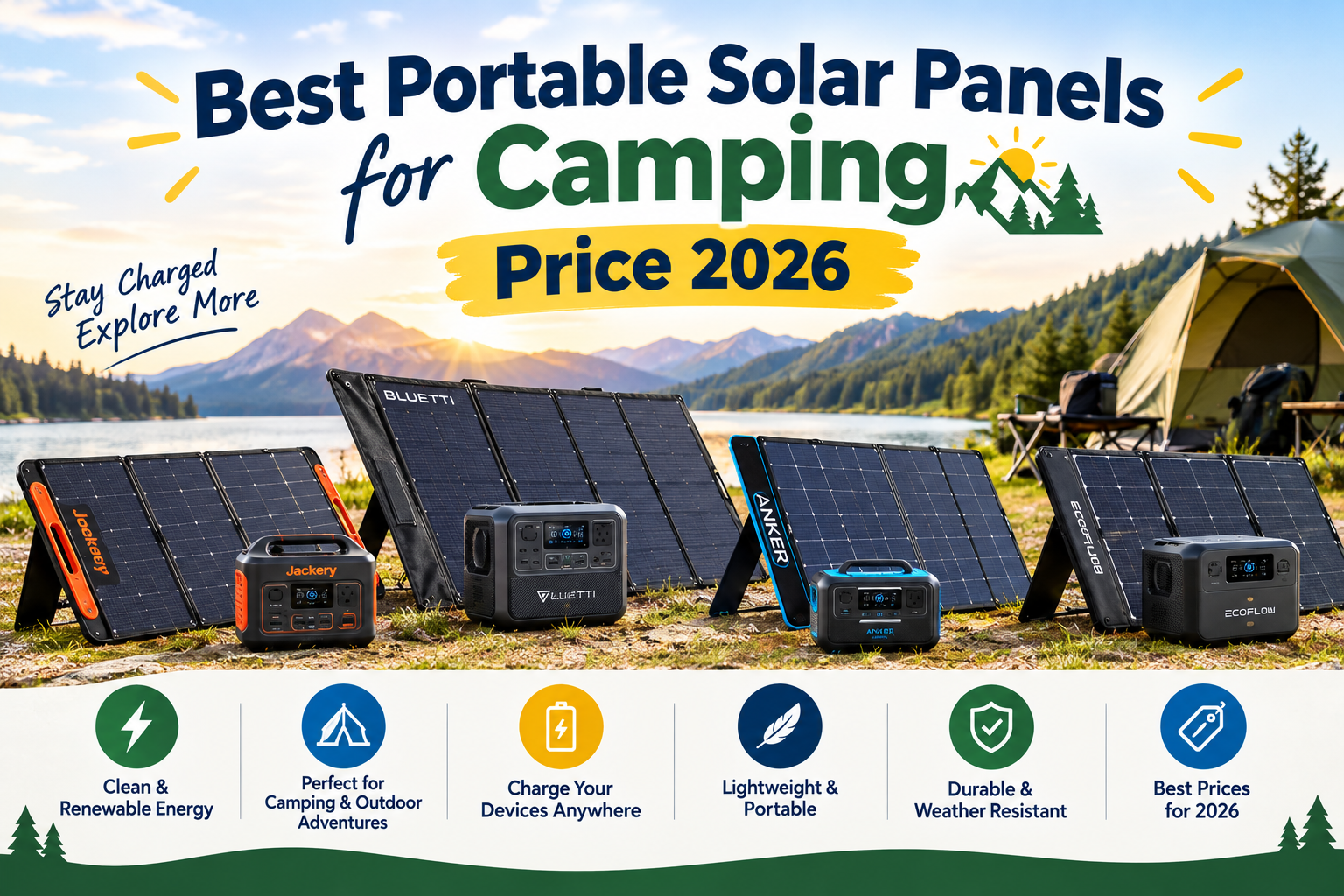
Portable solar panel prices in Pakistan vary widely depending on whether you go for a locally assembled foldable panel or an imported branded unit (Jackery, Anker, EcoFlow, Bluetti). Import duties, currency exchange rates, and dealer markups mean branded panels usually cost significantly more than generic Chinese foldable panels sold through local electronics markets and online stores like Daraz. Below is an approximate price breakdown by wattage and brand tier to help you budget for your camping setup.
| Panel Type / Brand | Wattage | Approx. Price (PKR) |
|---|---|---|
| Generic/local foldable (Daraz, Hall Road, etc.) | 60W–100W | Rs. 12,000 – 20,000 |
| Generic/local foldable | 150W–200W | Rs. 25,000 – 40,000 |
| Generic/local foldable | 300W | Rs. 45,000 – 60,000 |
| Anker (imported) | 100W | Rs. 65,000 – 90,000 |
| Anker (imported) | 200W | Rs. 100,000 – 140,000 |
| Jackery SolarSaga (imported) | 100W | Rs. 75,000 – 100,000 |
| Jackery SolarSaga (imported) | 200W | Rs. 150,000 – 190,000 |
| EcoFlow (imported) | 100W–160W | Rs. 70,000 – 110,000 |
| Bluetti PV (imported) | 200W | Rs. 100,000 – 150,000 |
| Bluetti PV (imported) | 350W | Rs. 160,000 – 210,000 |
How Do Portable Solar Panels Work While Camping?
The basic process is simple:
Sunlight → Solar Panel → Solar Input/Charge Controller → Battery or Power Station → Your Devices
During the day, sunlight hits the solar cells and produces DC electricity. Depending on the system, the electricity is sent directly to a compatible device or, more commonly for camping, into a portable power station.
The power station then stores that energy in its battery.
At night, when the solar panel is no longer producing useful electricity, you can use the stored energy to operate lights, phones, laptops, cameras, fans, small appliances, or other compatible equipment.
This makes a portable solar panel particularly useful for multi-day camping trips where access to an electrical outlet is limited.
Best Portable Solar Panels for Camping in 2026
For most campers, a 100W to 220W foldable monocrystalline solar panel offers the best balance between portability and useful power output.
If you want a simple recommendation:
- Best overall: EcoFlow NextGen 220W Bifacial Portable Solar Panel
- Best for Jackery users: Jackery SolarSaga 200W
- Best for lightweight camping: A compact 60W–100W foldable panel
- Best for larger power stations: 200W–400W portable solar panels
- Best for backpacking: Lightweight USB solar chargers rather than large power-station panels
- Best for RV and van camping: 200W–400W portable or flexible solar systems
There is no single solar panel that is perfect for every camper. A backpacker has very different requirements from someone camping beside an RV.
The ideal choice depends on what you want to power, how far you need to carry the panel, and which portable power station you already own.
Here are the main options worth considering.
1. EcoFlow NextGen 220W Bifacial Portable Solar Panel — Best Overall
The EcoFlow NextGen 220W Bifacial Portable Solar Panel is one of the most interesting choices for campers who want substantial solar generation without moving to a large rigid panel.
It uses N-type TOPCon monocrystalline solar cells and has a stated conversion efficiency of 25%. Its front side is rated at 220W, while the rear side is designed to capture additional ambient and reflected light. EcoFlow lists a weight of approximately 7 kg and an IP68 waterproof and dustproof rating.
Its integrated adjustable stand also makes positioning easier at camp.
Best for:
Campers who use a medium or large portable power station and want high solar input.
Why it stands out:
- 220W rated front-side output
- Bifacial design
- N-type TOPCon technology
- Up to 25% stated conversion efficiency
- Integrated adjustable stand
- Foldable design
- IP68 protection
- Suitable for larger outdoor power systems
The important limitation is weight. At about 7 kg, it is portable for car camping and RV use, but it is not something most backpackers will want to carry over long distances.
2. Jackery SolarSaga 200W — Best for Jackery Power Stations
The Jackery SolarSaga 200W is a strong choice for campers who already use a Jackery power station and want a straightforward solar setup.
Jackery lists the panel at approximately 6.5 kg, with a 200W rated output under standard test conditions. The current SolarSaga 200W also includes USB-A and USB-C outputs and has an IP68 waterproof rating.
Its specifications also show that the panel can benefit from reflected light through its bifacial design.
Best for:
Jackery users, car campers, and people who want a relatively simple 200W setup.
Advantages:
- 200W rated output
- Foldable design
- About 6.5 kg
- IP68 protection
- USB-A and USB-C outputs
- Bifacial characteristics
- Designed to work within the Jackery ecosystem
Potential drawback:
A 200W folding panel is still fairly large when unfolded, so it is better suited to car camping, RV camping, and base camps than backpacking.
3. 100W Foldable Solar Panel — Best Balance for Smaller Camping Trips
For many campers, 100W is the sweet spot.
A quality 100W monocrystalline folding panel can provide useful solar charging without the weight and bulk associated with 200W or larger panels.
It is suitable for:
- Phones
- Tablets
- Cameras
- LED lights
- Small power banks
- GPS devices
- Small portable power stations
- Camping accessories
A 100W panel will not continuously run high-power appliances such as air conditioners or electric heaters, but that is not what it is designed for.
Best for:
Weekend camping and campers carrying equipment in a vehicle.
When choosing a 100W model, prioritize:
- Monocrystalline cells
- Good weather protection
- Strong folding hinges
- Reliable connectors
- A stable stand
- Compatibility with your battery or power station
4. 200W Portable Solar Panel — Best for Extended Camping
If you regularly spend several days off-grid, a 200W portable solar panel can be much more useful than a small 20W or 50W charger.
A 200W panel gives you more solar input during good sunlight and can replenish a larger portable power station more quickly.
This makes 200W particularly useful for:
- Multi-day camping
- RV trips
- Van life
- Overlanding
- Family camping
- Larger power stations
- Cameras and laptops
- Small refrigerators and other moderate loads
The trade-off is straightforward: more power usually means more size and weight.
5. 400W Portable Solar Panel — Best for High-Power Camping
A 400W portable solar setup is aimed at campers who need considerably more energy.
It can make sense when you are using a large-capacity portable power station and want to recharge it during the day.
However, 400W is usually overkill for someone who only wants to charge a phone and a few LED lights.
Before buying a 400W panel, check:
- Your power station’s maximum solar input.
- The panel’s voltage.
- The panel’s current.
- Connector compatibility.
- Panel weight.
- Available space at your campsite.
A panel can have a high wattage rating but still be unsuitable if its electrical specifications do not match your power station.
For a deeper look at output, efficiency, sizing, and practical applications, see our guide to 400 watt solar panels.
Best Portable Solar Panels for Camping in 2026: Top Picks Compared
Choosing the best portable solar panel for camping depends on your camping style, power requirements, and the size of your portable power station. Some campers only need enough power for phones and small devices, while others need a higher-wattage panel for a power station, RV, or multi-day off-grid camping.
The following portable solar panels cover different camping needs and power requirements.
| Solar Panel | Wattage | Best For | Our Rating |
|---|---|---|---|
| EcoFlow NextGen 220W Bifacial | 220W | Best overall | 9.5/10 |
| Jackery SolarSaga 200W | 200W | Jackery users & car camping | 9.1/10 |
| Renogy E.Flex 200W | 200W | RV & weekend camping | 8.8/10 |
| BLUETTI PV200 | 200W | Portable power-station users | 8.7/10 |
| Goal Zero Nomad 200 | 200W | Portable off-grid camping | 8.5/10 |
| Anker SOLIX PS400 | 400W | Larger power stations | 9.0/10 |
Renogy E.Flex 200W Portable Solar Panel
Best for: RV camping, car camping, and campers who want a balance between power output and portability.
The Renogy E.Flex 200W is a practical option for campers who need more solar power than a small 60W or 100W panel can provide. A 200W-class portable panel can provide useful solar input for compatible power stations during weekend trips, RV camping, and longer outdoor stays.
Its portable format also makes it easier to transport and set up compared with a conventional rigid solar panel.
Pros:
- 200W-class solar output
- Foldable portable design
- Useful for RV and car camping
- Suitable for compatible portable power stations
Cons:
- Heavier and bulkier than smaller panels
- Not ideal for lightweight backpacking
- Actual output varies with weather, sunlight, and panel positioning
BLUETTI PV200
Best for: Portable power-station users who need a 200W-class solar panel.
The BLUETTI PV200 is designed for portable solar charging and can be useful for camping, RV trips, and other outdoor applications. Its foldable format makes it easier to transport and position than a traditional rigid solar panel.
It is a good option for campers who already use a compatible BLUETTI power station or need a portable panel for higher solar input.
Pros:
- 200W-class output
- Foldable and portable
- Suitable for compatible power stations
- Useful for camping and outdoor charging
Cons:
- Too large for most backpacking trips
- Requires adequate sunlight for good charging performance
- Compatibility should be checked before purchase
Goal Zero Nomad 200
Best for: Goal Zero users and campers looking for portable off-grid charging.
The Goal Zero Nomad 200 is a portable solar panel option for outdoor users who want to recharge compatible portable power equipment away from the electrical grid. It can be useful for camping, road trips, and other situations where portability and solar charging are important.
It is especially worth considering for campers who already use compatible Goal Zero equipment and want to stay within the same ecosystem.
Pros:
- Designed for portable outdoor use
- Useful for compatible power stations
- Suitable for off-grid camping
- More transport-friendly than a conventional rigid panel
Cons:
- Bulkier than small camping panels
- Not the best choice for lightweight backpacking
- Best suited to users with compatible equipment
Anker SOLIX PS400
Best for: Larger portable power stations and campers with higher energy requirements.
The Anker SOLIX PS400 is aimed at users who need substantially more solar input than a typical 100W or 200W camping panel can provide. A 400W-class portable panel can be useful for larger power stations, RV camping, and multi-day off-grid trips where higher solar input can help reduce charging time under suitable sunlight conditions.
Because of its higher capacity, it is generally better suited to car camping, RV use, and larger portable power setups than lightweight backpacking.
Pros:
- 400W-class solar output
- Designed for higher-power portable setups
- Useful for larger compatible power stations
- Suitable for extended camping and RV use
Cons:
Unnecessary for campers who only need basic device charging
Larger and heavier than lower-wattage panels
Requires more space for setup
EcoFlow NextGen 220W Bifacial Portable Solar Panel and Jackery SolarSaga 200W have been discussed.
Portable Solar Panel Wattage: How Many Watts Do You Need?
This is one of the most important questions to answer before buying.
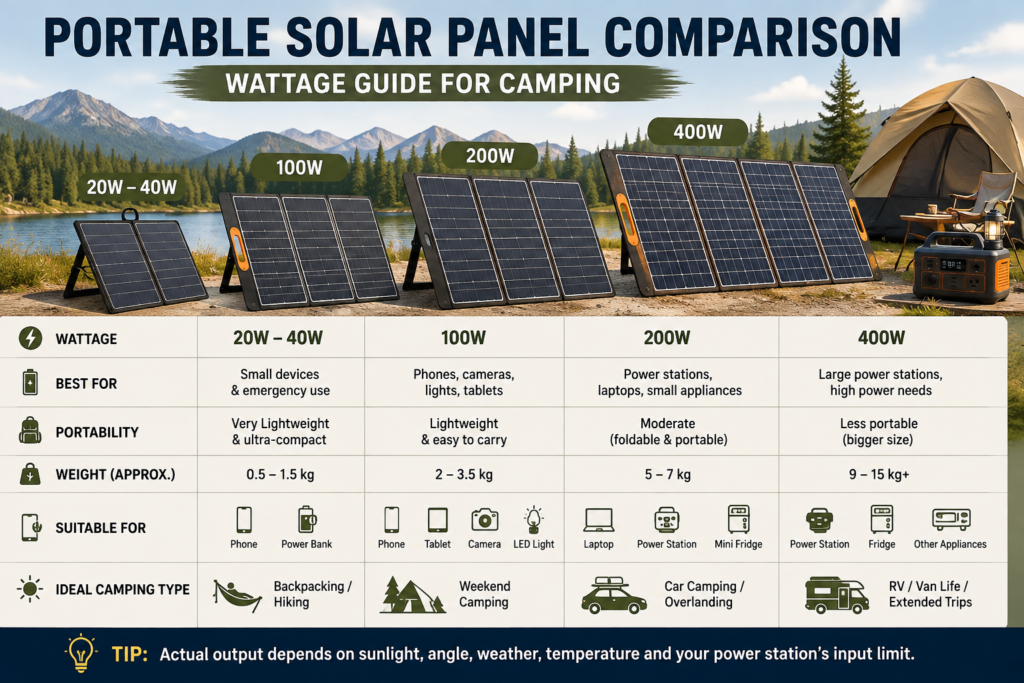
| Camping Need | Recommended Panel Size |
|---|---|
| Phone and small USB devices | 20W–40W |
| Phone + camera + lights | 40W–80W |
| Weekend camping | 80W–120W |
| Small portable power station | 100W–200W |
| Multi-day off-grid camping | 200W–300W |
| RV/van with larger power station | 200W–400W+ |
| Heavy electrical loads | 400W+ system |
These are starting points rather than guarantees because actual solar production changes with sunlight, temperature, orientation, shading, and the equipment connected to the panel.
20W–40W Solar Panels: Are They Enough for Camping?
Small panels are ideal when portability matters more than power.
They can be useful for:
- Smartphones
- GPS devices
- Small power banks
- Emergency charging
- Small USB electronics
Their biggest advantage is that they are easy to carry.
For backpacking, a small panel can be a better choice than carrying a heavy 200W folding panel.
The downside is slow charging, particularly during cloudy weather or when the panel cannot remain pointed toward the sun.
100W Solar Panels: The Camping Sweet Spot
A 100W panel offers a much better balance.
It is powerful enough for many common camping electronics while still being manageable to transport.
If you are unsure what size to buy and your camping style involves a vehicle, 100W is often a sensible starting point.
200W Solar Panels: Better for Power Stations
A 200W panel is a better choice when your camping setup revolves around a portable power station.
It provides substantially more potential solar input than a small USB panel and can help replenish a larger battery during daylight hours.
However, don’t assume that a 200W-rated panel will always produce 200W.
Best Portable Solar Panels for a Week-Long Off-Grid Camping Trip
For a week-long off-grid camping trip, choose a portable solar panel based on your daily electricity needs, available sunlight, and battery capacity. A 100W panel may be sufficient for charging phones, GPS devices, and LED lights, while a 200W–300W portable solar setup is a more practical starting point for campers using a power station to run several devices. If you plan to power a portable refrigerator, laptop, or other energy-consuming equipment, you may need a larger system.
Pair your solar panel with a compatible portable power station so you can store electricity during the day and use it at night. Before your trip, estimate the daily watt-hours required by your equipment and check the power station’s maximum solar input. Leave some extra capacity for cloudy weather, shade, and charging losses. For a seven-day trip, a suitable combination of solar panels, battery storage, and energy-efficient devices will help you stay powered without access to the electrical grid.
Why a 200W Solar Panel May Produce Less Than 200W
The wattage printed on a solar panel is normally its rated output under standardized test conditions.
Real camping conditions are different.
Output can fall because of:
- Clouds
- Morning or evening sunlight
- Incorrect panel angle
- Partial shade
- Dust
- High temperatures
- Trees or nearby structures
- Cable losses
- Power-station input limits
For this reason, rated wattage should be treated as maximum or test-condition performance, not a guaranteed real-world output.
Monocrystalline vs. Other Solar Cells for Camping
For portable camping panels, monocrystalline solar cells are generally the most practical choice when you want good power from a relatively compact panel.
Modern products are also moving toward technologies such as N-type TOPCon.
For example, EcoFlow’s current NextGen 220W model uses N-type TOPCon monocrystalline cells and lists 25% conversion efficiency.
The important point is not simply to buy a panel because it says “high efficiency.”
You should consider efficiency together with:
- Weight
- Folded size
- Durability
- Output
- Price
- Warranty
- Compatibility
Are Bifacial Portable Solar Panels Better for Camping?
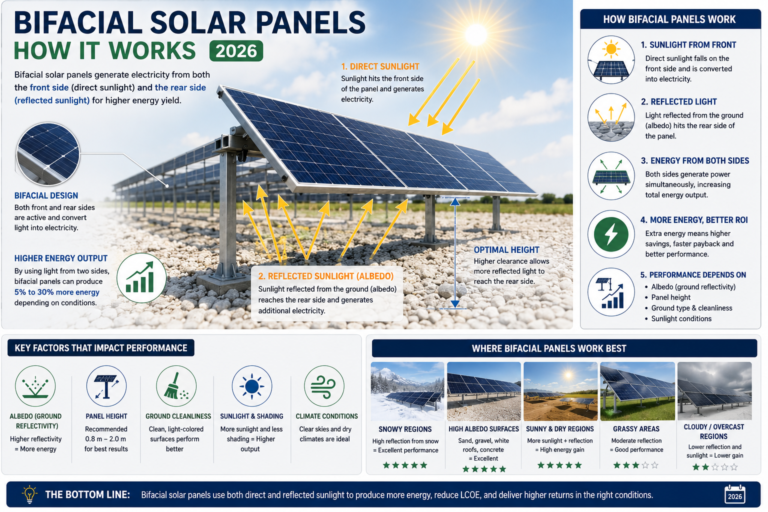
Bifacial solar panels can capture light from both sides of the panel.
This can be useful outdoors because sunlight can reflect from surfaces such as:
- Light-colored ground
- Sand
- Rocks
- Concrete
- Snow
- Other reflective surfaces
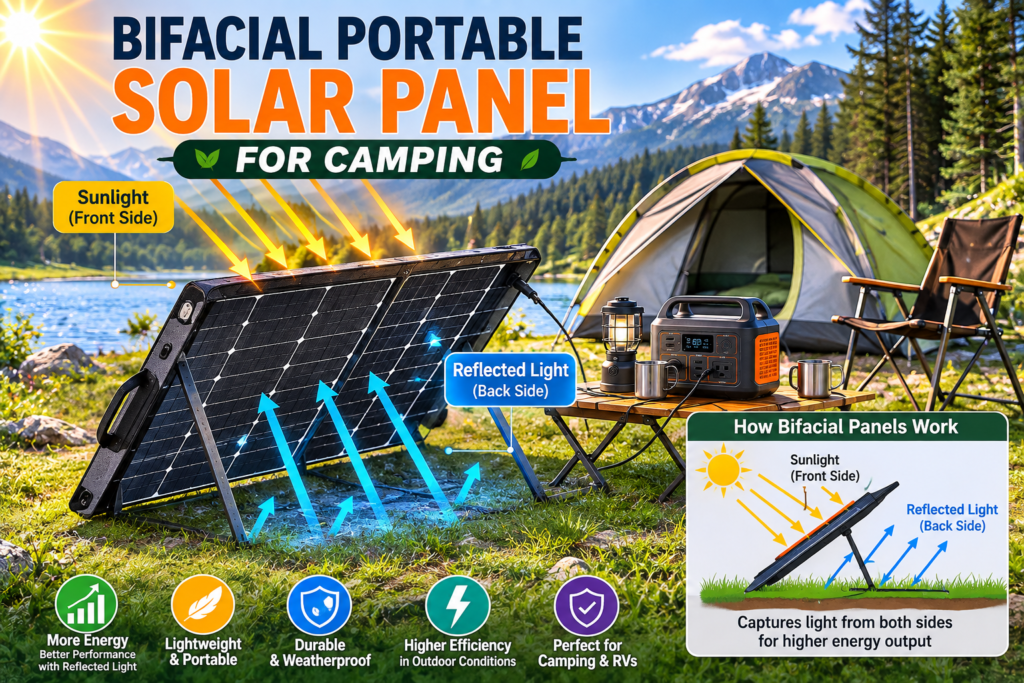
However, the rear side does not automatically produce its rated front-side output.
The amount of additional energy depends heavily on how much useful light reaches the back of the panel.
For example, EcoFlow states that its NextGen 220W panel has a 220W front rating and a 175W rear rating, while Jackery’s SolarSaga 200W also specifies bifacial characteristics.
If you want to learn more about how bifacial technology works and where these panels perform best, see our complete guide to bifacial solar panels.
When Bifacial Panels Make Sense
Bifacial portable panels can be particularly interesting for:
- Open campsites
- Bright ground surfaces
- Sandy environments
- Snowy locations
- RV camping
- Long-duration outdoor use
If the rear of the panel is blocked by dark grass or placed directly against the ground, the bifacial advantage may be much smaller.
Portable Solar Panel vs. Solar Charger: What’s the Difference?
The terms are sometimes used interchangeably, but they can describe different products.
A small solar charger is generally designed to charge USB devices directly.
A larger portable solar panel is usually designed to feed a portable power station or battery system.
Solar Charger
Best for:
- Phones
- GPS
- Small electronics
- Backpacking
Portable Solar Panel
Best for:
- Power stations
- Larger batteries
- Laptops
- Camping appliances
- RV systems
- Multi-day off-grid use
Choosing between them depends on what you actually need to power.
What Should You Look for in the Best Portable Solar Panel for Camping?
Don’t buy a panel based on wattage alone.
These are the specifications that matter most.
1. Wattage
Higher wattage means greater potential power generation, but usually also increases weight and size.
Choose the smallest panel that comfortably meets your energy needs.
2. Weight
Weight becomes extremely important if you are hiking.
For car camping, a 6–8 kg panel may be perfectly manageable.
For backpacking, even a few kilograms can become inconvenient.
3. Folded Size
A panel may look compact in photographs but become very large when unfolded.
Check both:
- Folded dimensions
- Unfolded dimensions
before purchasing.
4. Solar Cell Efficiency
Higher efficiency can allow a panel to generate more power from a smaller surface area.
However, efficiency should not be considered independently from price and weight.
5. Weather Resistance
Camping exposes equipment to:
- Rain
- Dust
- Humidity
- Mud
- Heat
- Accidental splashes
An IP rating can provide useful information about protection against water and dust.
For example, current EcoFlow and Jackery 200W-class products list IP68 protection.
But remember: water-resistant does not mean you should ignore the manufacturer’s operating instructions.
6. Connectors
Compatibility is critical.
A solar panel may physically connect to a power station but still be electrically unsuitable.
Check:
- Connector type
- Voltage range
- Current
- Maximum solar input
- Polarity
- Required adapters
7. Built-In Stand
A good stand can make camping much easier.
You want to be able to position the panel toward the sun without constantly supporting it with rocks, bags, or other camping equipment.
8. Durability
Look for:
- Strong hinges
- Durable protective material
- Reinforced connectors
- Scratch-resistant surfaces
- Reliable carrying handles
- Good weather protection
A camping panel will normally experience more handling than a permanently mounted rooftop panel.
How to Choose the Best Portable Solar Panels for Efficiency, Weight, and Value
The best portable solar panel is not necessarily the one with the highest wattage or the lowest price. To find the right option for camping, compare conversion efficiency, total carrying weight, and the amount of power you receive for your money. These three factors help you choose a panel that fits your camping setup without paying for features you do not need.
1. Compare Solar Panel Efficiency
Solar panel efficiency indicates how effectively a panel converts sunlight into electricity. Higher-efficiency panels can produce more power from a smaller surface area, which is useful when vehicle storage space or campsite space is limited. However, efficiency alone does not guarantee better real-world performance because sunlight intensity, panel angle, temperature, and shading also affect output.
When comparing portable panels, check the manufacturer’s stated efficiency and rated wattage. Consider premium high-efficiency panels when compact size matters, but compare their prices with standard monocrystalline panels before paying extra.
2. Compare Weight and Portability
Weight matters most when you need to carry your solar panel over long distances. Backpackers should prioritize lightweight, compact solar chargers, while car campers can usually manage larger folding panels that generate more power for a portable power station.
Do not compare weight alone. Check the packed dimensions, carrying case, handles, kickstand, and ease of setup. A panel that is slightly heavier may be more practical if it offers substantially more power and is easier to position toward the sun.
3. Compare Value for Money
A good-value solar panel provides suitable power, reliable construction, and compatible connections at a reasonable price. Instead of choosing the cheapest model, compare its cost per rated watt and check whether you need to purchase additional cables or adapters.
You can calculate the cost per watt by dividing the panel’s purchase price by its rated wattage. For example, a hypothetical $150, 100W panel costs $1.50 per watt, while a $240, 200W panel costs $1.20 per watt. The second option offers a lower cost per rated watt, although it may be heavier and less convenient for backpacking.
Which Portable Solar Panel Offers the Best Overall Balance?
For car camping and portable power stations, a 100W–220W foldable panel can offer a useful balance of output and portability. A lightweight 60W–100W panel may be more suitable when carrying weight and storage space are priorities. For extended off-grid trips or higher electricity consumption, consider a larger panel that matches your battery or power station’s solar input limits.
Before choosing a model, compare its published efficiency, total weight, purchase price, warranty, weather protection, and connector compatibility. The best option is the one that meets your energy needs while remaining practical to transport and affordable to own.
Best Portable Solar Chargers for Camping and Backpacking
The best portable solar charger depends on whether you need to charge small electronic devices or power larger camping equipment. Compact solar chargers are ideal for campers who want to keep their phones, GPS devices, cameras, and USB power banks charged without carrying a heavy solar setup.
Best Portable Solar Charger for Phones
A compact 10W–28W solar charger can be suitable for charging phones and small USB devices during sunny camping days. Look for USB-A or USB-C outputs that support your device’s charging requirements. For more reliable charging, pair the solar charger with a power bank so you can store energy during the day and charge your phone later.
Best Portable Solar Charger for Backpacking
For backpacking, choose a lightweight, foldable solar charger that fits easily into your backpack. Weight, folded dimensions, durability, and ease of positioning in direct sunlight matter more than maximum wattage alone. A smaller charger is convenient for essential devices, but charging may be slow when sunlight is weak or inconsistent.
How to Position a Portable Solar Panel While Camping
Panel positioning can make a major difference.
The basic rule is simple:
Keep the panel facing the strongest available sunlight and avoid shadows.
Even partial shading can reduce the output of a panel because solar cells are electrically connected in groups.
During the day, you may need to reposition the panel as the sun moves.
A panel that was perfectly positioned at 10 a.m. may not be optimally positioned at 2 p.m.
Should You Put a Solar Panel Directly on the Ground?
You can, but it is not always ideal.
Putting a panel directly on the ground can:
- Increase dirt accumulation
- Reduce rear-side light for bifacial panels
- Increase the chance of scratches
- Make it easier for water or mud to reach the equipment
A built-in stand is therefore a valuable feature.
For bifacial panels, leaving some space behind the panel can also allow more reflected light to reach the rear side.
Can Portable Solar Panels Charge a Power Station While Camping?
Yes, provided the panel’s electrical specifications are compatible with the power station.
This is one of the most common camping applications.
The setup usually looks like:
Portable Solar Panel → Solar Input → Power Station → Camping Devices
Before connecting the two, check the power station manufacturer’s maximum solar input voltage, current, and wattage.
Do not assume that a 400W panel can automatically be connected to every 400W-capable power station.
How Long Does It Take to Charge a Portable Power Station?
There is no universal charging time.
A simple theoretical estimate is:
Charging Time ≈ Battery Capacity (Wh) ÷ Actual Solar Input (W)
For example, a 1,000Wh battery receiving a steady 200W of solar input would theoretically require about 5 hours.
But real charging normally takes longer because solar input is not constant throughout the day and there are conversion and charging losses.
A more realistic calculation must consider:
- Actual solar production
- Weather
- Panel angle
- Temperature
- Battery charging efficiency
- Power-station solar input limits
- Shading
So don’t buy a panel based only on a theoretical charging-time calculation.
Portable Solar Panels for Camping in Cloudy Weather
Solar panels still produce electricity in cloudy weather, but output can be significantly lower than under strong direct sunlight.
This is why campers should not plan their entire energy supply around ideal weather.
If you’re camping for several days, a larger battery can provide an important backup.
A practical setup is:
Solar Panel + Portable Power Station + Energy-Efficient Devices
This combination gives you solar generation during the day and stored energy when sunlight is weak or unavailable.
Portable Solar Panels for Hot Weather
More sunlight does not necessarily mean unlimited solar output.
Solar modules experience temperature-related performance changes, and manufacturers publish temperature coefficients for their products.
For example, EcoFlow publishes a temperature coefficient for the rated power of its NextGen 220W panel.
In very hot camping environments:
- Keep airflow around the panel where appropriate.
- Follow the manufacturer’s operating-temperature guidance.
- Avoid placing the panel where heat can become trapped.
- Keep connectors protected and clean.
Portable Solar Panels for Winter Camping
Cold weather itself is not necessarily a reason to avoid solar.
In some conditions, cooler temperatures can actually be favorable for photovoltaic performance, while snow and cloud cover can reduce available sunlight.
If using a bifacial panel, reflective snow can potentially provide useful light to the rear side, but the panel must be used according to the manufacturer’s instructions.
For winter camping, durability and weather protection become especially important.
Portable Solar Panels for Backpacking vs. Car Camping
This is where many buyers make the wrong decision.
Best for Backpacking
Choose:
- 20W–40W
- Lightweight construction
- USB charging
- Compact folded size
- Minimal accessories
Your priority should be weight.
Best for Car Camping
Choose:
- 100W–200W
- Folding design
- Built-in stand
- Good weather protection
- Power-station compatibility
You can carry more weight because your vehicle does most of the transportation.
Best for RV or Van Camping
Consider:
- 200W–400W+
- Larger power stations
- Multiple panels
- Flexible or portable configurations
- Higher solar input capacity
Your priority is usually daily energy production rather than minimum weight.
Portable Solar Panels for Camping vs. Rigid Solar Panels
Both types have advantages.
| Feature | Portable/Foldable | Rigid |
| Portability | Excellent | Poor |
| Installation | Easy | More involved |
| Storage | Easy when folded | Requires more space |
| Camping use | Excellent | Better for permanent setups |
| Weight | Often manageable | Can be heavier/bulkier |
| Setup time | Low | Higher |
| Long-term mounting | Limited | Excellent |
For temporary camping, a folding portable panel is usually much more convenient.
For a permanent RV or rooftop installation, rigid panels may make more sense.
Common Mistakes When Buying a Camping Solar Panel
Mistake 1: Buying the Highest Wattage
More watts are not always better.
A 400W panel is useless if it is too heavy for your camping style or incompatible with your power station.
Mistake 2: Ignoring Compatibility
Always check voltage, current, connectors, and the power station’s solar input limits.
Mistake 3: Expecting Rated Wattage in Every Situation
A 200W panel does not mean you will see 200W continuously.
Weather, angle, shade, heat, and equipment limitations all matter.
Mistake 4: Choosing a Panel Without Checking Its Weight
A panel that is easy to move from a car to a campsite can be very different from one you need to carry several kilometers.
Mistake 5: Ignoring Shading
A small tree shadow can have a surprisingly large effect on solar production.
Mistake 6: Buying Only for Price
The cheapest panel may save money initially but can become a poor investment if its connectors, hinges, stand, or protective construction are not suitable for outdoor use.
Mistake 7: Assuming a Solar Panel Stores Electricity
It doesn’t.
You need a battery, power station, or another compatible storage solution if you want to use solar energy after sunset.
How to Choose the Best Portable Solar Panel for Your Camping Trip
Use this simple decision process.
Step 1: List Your Devices
Write down everything you want to power:
- Phone
- Camera
- Laptop
- Lights
- Fan
- Refrigerator
- CPAP or other essential equipment
- Cooking appliances
Step 2: Estimate Your Daily Energy Use
Think in watt-hours rather than only watts.
For example, a 20W device running for 3 hours consumes approximately:
20W × 3 hours = 60Wh
Repeat this calculation for your main devices.
Step 3: Choose Your Battery Size
Your battery should have enough capacity to cover your expected use, especially during periods of poor sunlight.
Step 4: Choose Your Solar Input
Then select a panel or panel combination capable of supplying useful energy to the battery.
Step 5: Check Compatibility
This step should never be skipped.
Step 6: Consider Portability
Finally, ask yourself:
Will I actually want to carry this panel every time I go camping?
If the answer is no, the panel may be too large for your needs.
What Is the Best Wattage for Camping?
For most people, there are three useful categories:
20W–40W: Best for lightweight backpacking and basic USB charging.
100W–200W: Best all-around range for car camping and portable power stations.
200W–400W+: Best for extended off-grid camping, RVs, vans, and larger power stations.
The best portable solar panel is therefore not necessarily the most powerful one.
It is the one that gives you enough energy without becoming unnecessarily heavy or difficult to use.
Are Portable Solar Panels Worth It for Camping?
Yes, especially if you regularly camp away from electrical outlets.
They can provide renewable electricity without fuel, engine noise, or a traditional generator.
The biggest benefits are:
- Free energy from sunlight
- Quiet operation
- No fuel required
- Reusable for many trips
- Useful for emergency backup
- Suitable for off-grid camping
- Can extend the usable time of a portable power station
The biggest limitations are:
- Dependent on sunlight
- Output changes with weather
- Larger models can be heavy
- Initial cost can be significant
- Compatibility must be checked carefully
Portable solar panels are particularly useful when you need electricity away from the utility grid. If you want to understand the key differences between grid-connected and independent solar setups, read our guide to on-grid vs off-grid solar systems.
Best Portable Solar Panel for Camping: Final Verdict
For most car campers and outdoor enthusiasts, a 100W–220W foldable monocrystalline solar panel is the best balance between useful power, portability, and practicality.
If you want a higher-output option with modern cell technology and bifacial capability, the EcoFlow NextGen 220W is an especially strong choice on paper, with 25% stated efficiency, N-type TOPCon cells, an integrated adjustable stand, and IP68 protection.
The Jackery SolarSaga 200W is another strong option, particularly for people already using Jackery equipment. Its current specifications include a 200W rated output, approximately 6.5 kg weight, USB outputs, bifacial characteristics, and IP68 protection.
For backpacking, however, neither of these large panels is necessarily the best choice. A lightweight 20W–40W solar charger can be more practical when every kilogram matters.
Ultimately, the right panel depends on your camping style, daily energy needs, available sunlight, and portable power station compatibility.
Don’t buy the biggest panel. Buy the panel that fits your actual camping setup.
What is the best portable solar panel for camping?
For many car campers, a 100W–220W folding monocrystalline panel provides a good combination of portability and useful power. Higher-output panels are better for larger power stations and extended off-grid camping.
Is 100W enough for camping?
A 100W panel can be enough for phones, cameras, lights, tablets, and small power stations. It may not be sufficient for continuously running high-power appliances.
Is 200W solar enough for camping?
A 200W portable solar panel is a strong choice for multi-day camping and portable power stations. Actual output depends on sunlight, shading, temperature, panel angle, and the power station’s solar input limits.
Can a portable solar panel charge a phone directly?
Some smaller solar chargers provide USB outputs and can charge phones directly. Larger camping panels are commonly designed to connect to a compatible portable power station.
Do portable solar panels work at night?
No. Solar panels require available light to generate electricity. If you need power at night, store energy in a compatible battery or portable power station during the day.
How long do portable solar panels last?
Lifespan varies by product, construction quality, usage, and environmental exposure. Check the manufacturer’s warranty and degradation information before buying.
Are portable solar panels waterproof?
Some models have substantial water and dust protection. For example, current EcoFlow NextGen 220W and Jackery SolarSaga 200W specifications list IP68 protection. However, always follow the manufacturer’s specific operating and storage instructions.
What size solar panel is best for RV camping?
For RV and van camping, 200W–400W or more can be useful, particularly when paired with a larger battery or portable power station. The correct size depends on your daily electricity consumption and available solar input capacity
What size portable solar panel do I need for a week-long off-grid camping trip?
A 200W–300W portable solar setup can be a useful starting point for a week-long camping trip involving several electronic devices and a compatible power station. However, the ideal size depends on daily electricity consumption, sunlight, battery capacity, and the equipment you want to run. Campers using only phones and LED lights may need less power, while those running a refrigerator or laptop may need a larger system.