Solar System Without Battery: How It Works, Benefits, Cost, Limitations & Best Uses in 2026
As electricity prices continue to rise, more homeowners and businesses are switching to solar energy. One of the most affordable options is a solar system without battery, also known as a grid-tied solar system.
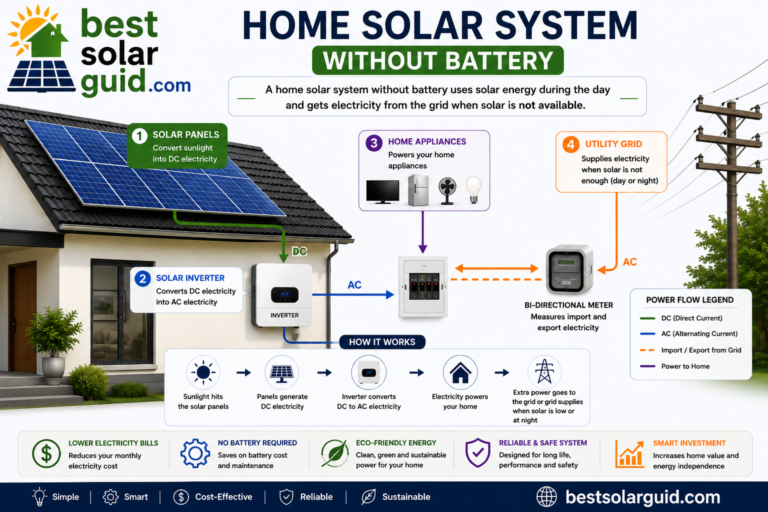
If you are specifically planning a battery-free system for your home, read our complete guide to a home solar system without battery.
Unlike battery-based systems, these setups send excess electricity to the utility grid instead of storing it in batteries. This significantly reduces installation costs while providing reliable power during sunny hours.
In this guide, you’ll learn how battery-free solar systems work, their advantages, disadvantages, installation process, costs, and whether they are the right investment.
Table of content
- What Is a Solar System Without Battery?
- Can a Solar System Work Without a Battery?
- Two Main Types of Solar Systems Without Battery
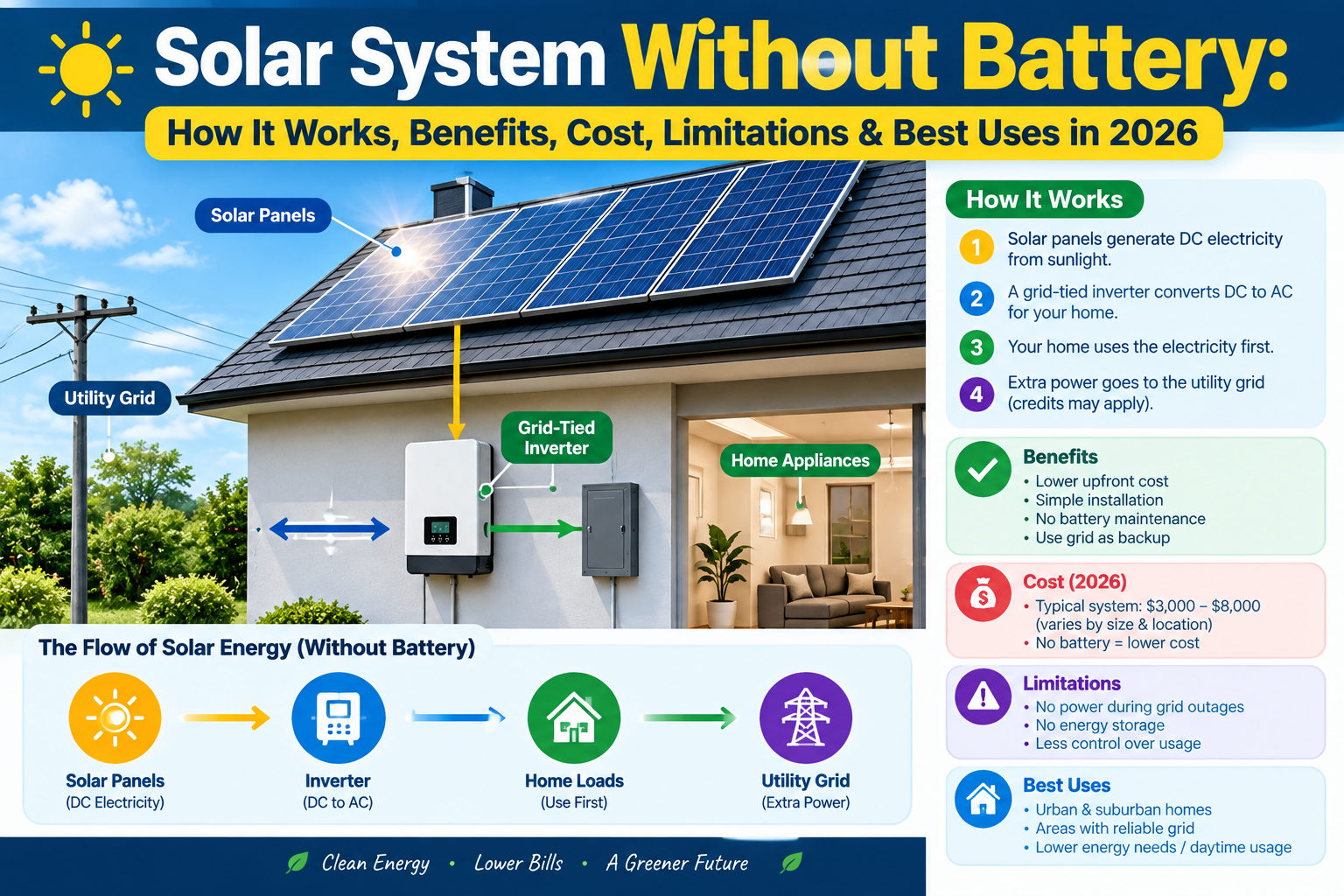
- How Does a Solar System Without Battery Work?
- Main Components
- What Happens When Clouds Cover the Sun?
- What Happens at Night?
- Can You Run a House on Solar Without a Battery?
- Can You Run an AC on Solar Without a Battery?
- Can You Run a Refrigerator Without a Battery?
- Can You Run Fans Without a Battery?
- Solar System Without Battery for Water Pumping
- Advantages and disadvantages of a Solar System Without Battery
- Who Should Choose a Solar System Without Battery?
- Who Should Avoid It?
- Solar System Without Battery vs Battery System
- Cost of a Solar System Without Battery
- Installation Process
- Solar System Without Battery in Pakistan
- Is Solar Without Battery Good for Load Shedding?
- How Much Solar Power Do You Need Without a Battery?
- What Is the Best Time to Use a Solar System Without Battery?
- How to Improve the Performance of a Battery-Free Solar System
- Common Mistakes When Installing Solar Without Battery
- Is a Solar System Without Battery Worth It?
- Frequently Asked Questions
- conclusion
What Is a Solar System Without Battery?
A solar system without battery is a solar power system that generates electricity directly from sunlight without storing energy.
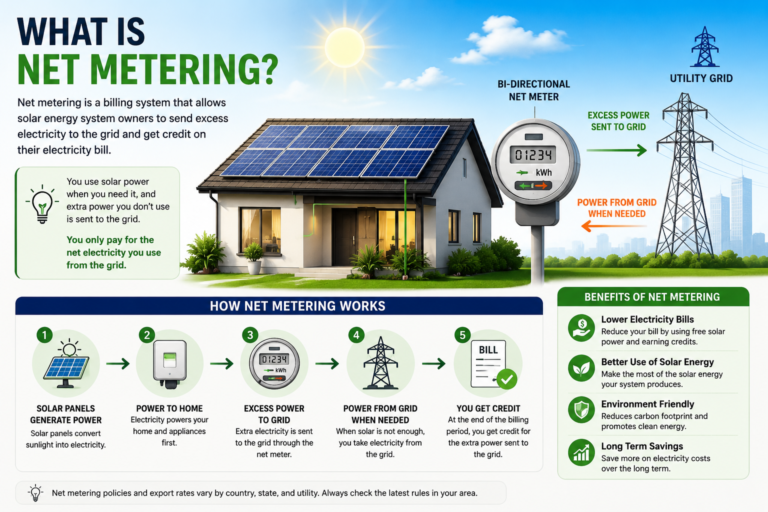
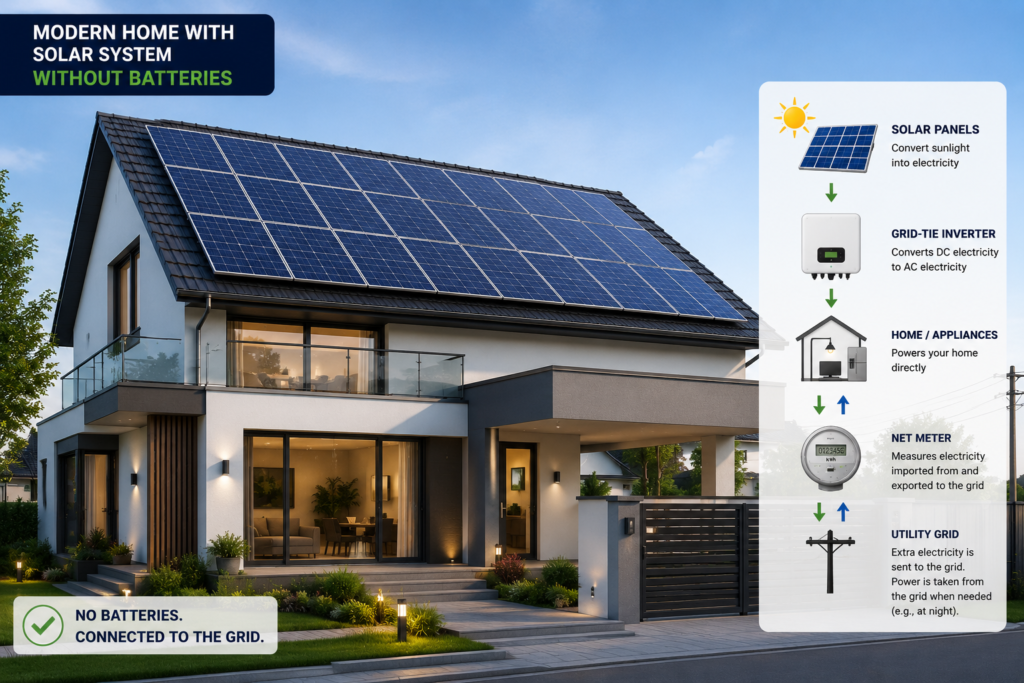
Instead of charging batteries, any unused electricity is exported to the utility grid through a net metering system (where available).
During daylight hours, your home uses electricity produced by the solar panels. If solar production is insufficient, electricity is automatically imported from the power grid.
Can a Solar System Work Without a Battery?
Yes, a solar system can work without a battery, but the system must be designed specifically for battery-free operation.
This is one of the most important points for beginners.
You cannot simply remove the battery from any solar installation and assume everything will continue working normally.
Some solar inverters are designed to operate without batteries, while others require battery support or another power source.
A direct-coupled PV system can supply a load directly from solar energy, but the load will generally operate only when sufficient sunlight is available. Direct-coupled systems are commonly suitable for applications such as water pumps and ventilation systems.
For a home, the inverter and the type of connection are especially important.
Two Main Types of Solar Systems Without Battery
When people search for solar system without battery, they may actually be talking about two different setups.
1. On-Grid Solar System Without Battery
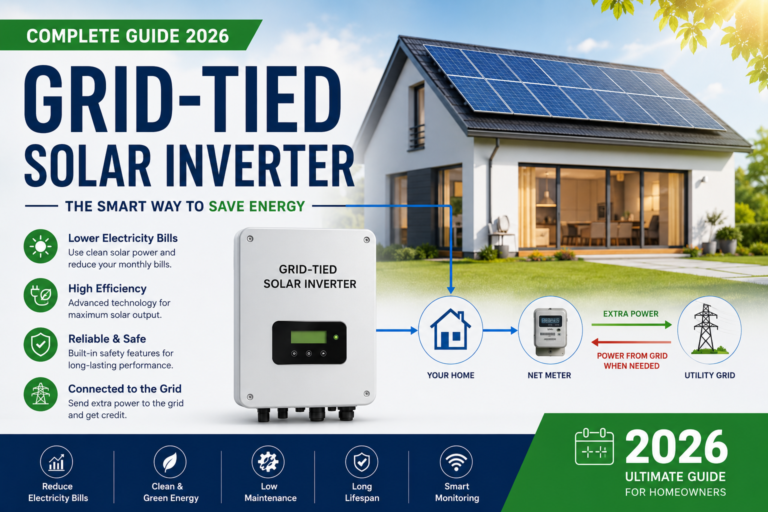
An on-grid or grid-tied solar system is connected to the electricity grid.
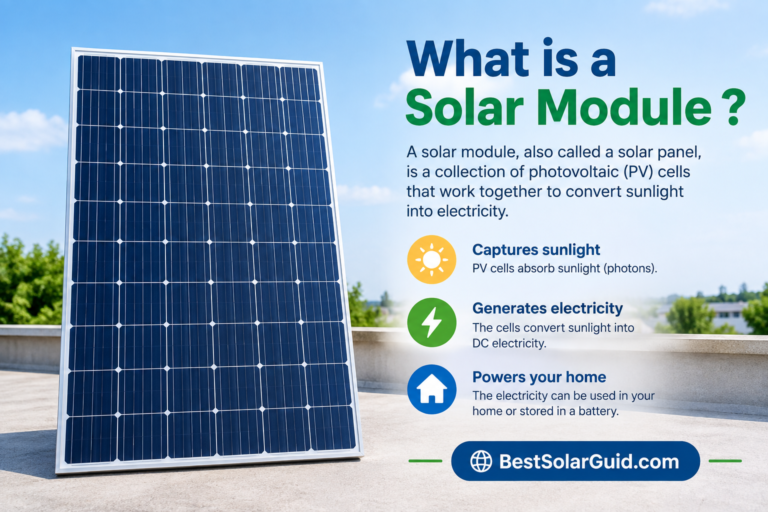
During the day, solar panels generate electricity. The inverter converts the solar DC electricity into AC electricity that can be used by household appliances.
If solar production is not enough for the home’s demand, electricity can come from the grid.
If the solar system produces more electricity than the home is using, the excess may be exported to the grid depending on the applicable utility arrangement and regulations.
The grid effectively provides the balancing function that a battery would otherwise provide in many batteryless grid-connected systems.
Important point
A normal grid-tied solar system does not automatically provide backup power during a grid outage.
This is because many grid-tied inverters shut down when the utility grid goes down, a safety requirement known as anti-islanding.
So if someone says:
“I have solar without a battery, so my house will keep running during load shedding.”
That is not necessarily true.
The type of inverter and system architecture determine whether backup operation is possible.
2. Stand-Alone Solar System Without Battery
A stand-alone batteryless solar system is different.
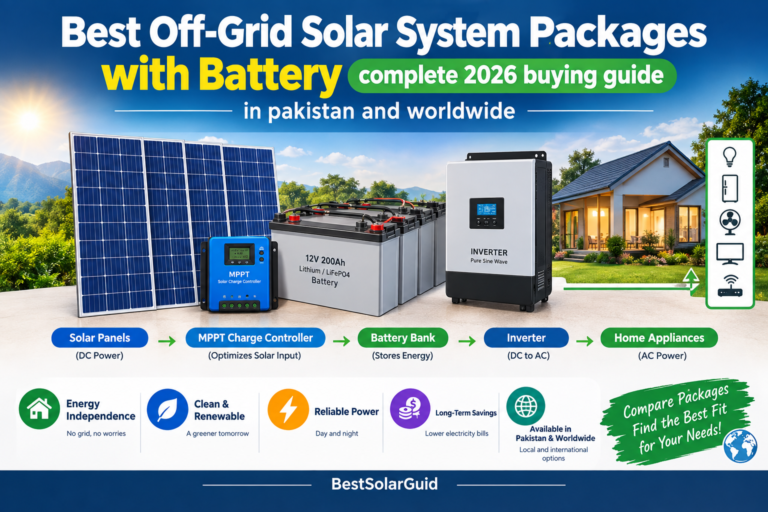
It is designed to operate without a utility grid and without battery storage.
The solar panels supply power directly to a suitable load, usually through the required power electronics.
The major limitation is simple:
No sunlight + no battery = no stored solar electricity.
This type of system can work well for loads that only need to operate during daylight hours.
Examples include:
- Solar water pumps
- Ventilation fans
- Some DC fans
- Small pumps
- Certain agricultural equipment
- Solar-powered sensors
- Daytime equipment
- Specially designed DC loads
Direct-coupled PV systems are a recognized type of batteryless photovoltaic system, particularly for loads such as pumps and fans.
How Does a Solar System Without Battery Work?
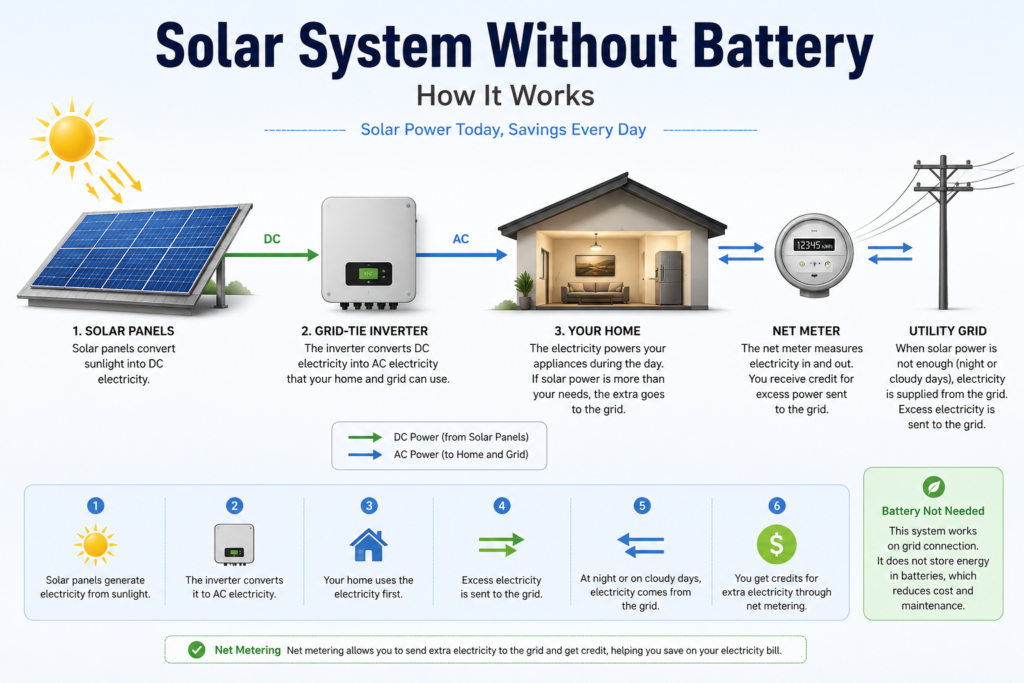
- Sunlight hits the solar panels.
- Panels generate DC electricity.
- The inverter converts DC into AC electricity.
- Your appliances use the electricity immediately.
- Extra electricity flows to the power grid.
- At night or during cloudy weather, electricity comes from the grid.
Main Components
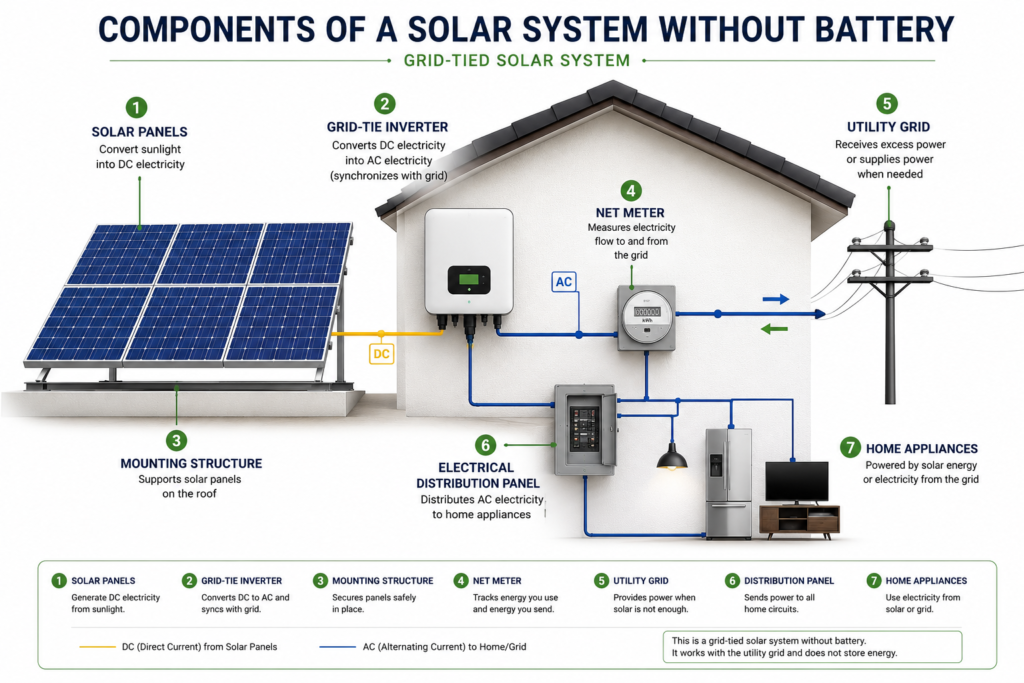
- Solar Panels
- Grid-Tie Inverter
- Mounting Structure
- DC & AC Wiring
- Net Meter
- Safety Disconnect Switch
Most battery-free grid-connected solar systems use a grid-tied solar inverter to convert solar electricity into usable AC power and connect the system to the utility grid.
What Happens When Clouds Cover the Sun?
This is one of the biggest differences between a battery system and a battery-free system.
When a cloud passes over the solar panels, solar production can decrease.
If the available solar power becomes lower than the power required by the appliances, a batteryless system may:
- Reduce output
- Switch to another power source
- Stop supplying certain loads
- Cause the inverter to shut down
- Stop charging a connected device
The exact result depends on the inverter and system design.
A battery can act as an energy buffer, but a batteryless system does not have that stored-energy reserve.
Research on batteryless PV systems also highlights the challenge of maintaining stable output because PV voltage and power vary with solar irradiation and temperature.
What Happens at Night?
At night, solar panels do not produce useful solar power.
If there is no battery and no grid or other backup source:
Solar power = unavailable
This means a battery-free solar system cannot provide stored solar electricity after sunset.
If you need electricity at night, you need another source, such as:
- Grid electricity
- Battery storage
- Generator
- Another backup system
This is the biggest limitation of a solar system without battery.
Can You Run a House on Solar Without a Battery?
Sometimes, yes — but it depends on the system.
A properly designed grid-connected system can supply daytime household loads without a battery because the grid can supplement the solar power when needed.
However, a true off-grid house without battery storage is much more difficult.
Household appliances do not all consume electricity in the same way.
Some appliances have high starting or surge requirements.
Examples include:
- Water pumps
- Refrigerators
- Air conditioners
- Washing machines
- Compressors
A system that appears large enough based only on the appliance’s running wattage may still struggle with startup demand.
For example, a recent Pakistan-based discussion about a batteryless off-grid home reported problems when heavier loads such as an AC and water motor were used with a low-cost inverter. This illustrates why inverter capability, surge handling, and system design matter — not simply the total panel wattage.
Can You Run an AC on Solar Without a Battery?
Yes, under the right conditions.
An inverter AC can potentially operate from solar power during the daytime when enough solar energy is available.
However, this does not mean that every AC can be operated directly from any batteryless solar system.
You need to consider:
- AC capacity
- Solar array size
- Inverter capacity
- Inverter surge capability
- Minimum solar input
- Weather
- Other appliances running at the same time
An AC can also change its power consumption depending on its operating conditions.
Therefore, a professional should size the complete system rather than simply calculating the AC’s nameplate wattage.
Can You Run a Refrigerator Without a Battery?
It can be possible with a suitable system, but refrigerators can be challenging because their compressors have startup requirements.
A batteryless system must have enough available power and an inverter capable of handling the refrigerator’s starting demand.
If the system cannot handle the startup event, the refrigerator may fail to start or the inverter may trip.
For important appliances, it is better to use a properly designed inverter and, where necessary, a battery or grid backup.
Can You Run Fans Without a Battery?
Yes.
Fans are among the easier loads for direct solar operation, particularly when using an appropriate DC solar setup.
A fan may operate faster during strong sunlight and slower when solar power falls if the system is designed for direct solar operation.
If you want constant speed and reliable operation regardless of weather, battery storage or another regulated power source may be preferable.
Solar System Without Battery for Water Pumping
Water pumping is one of the most practical applications for a batteryless solar system.
A solar water pump does not necessarily need to operate at night.
You can pump water during daylight hours and store the water rather than storing electricity in a battery.
For example:
Solar panels → solar pump controller → water pump → water tank
This can be a very practical design for:
- Agriculture
- Irrigation
- Livestock
- Farms
- Water storage tanks
- Remote areas
Direct-coupled PV systems have long been used for water pumping because the load can operate when solar energy is available.
Advantages of a Solar System Without Battery
Lower Installation Cost
Batteries are one of the most expensive parts of a solar system. Eliminating them can reduce the total project cost significantly.
Less Maintenance
Battery systems require regular maintenance and eventual replacement. A battery-free system has fewer components to maintain.
Longer System Life
Modern solar panels typically last 25–30 years, while inverters often last 10–15 years. Without batteries, there are fewer components that need replacement.
Higher Efficiency
Because energy is used immediately instead of being stored and discharged, there are fewer energy losses.
Eco-Friendly
Battery-free systems avoid battery manufacturing and disposal, reducing environmental impact.
Disadvantages
No Backup During Power Outages
Most grid-connected systems automatically shut down during a utility outage to protect line workers.
Grid Dependency
You still rely on the utility grid during nighttime or periods of low solar production.
Net Metering Availability
The financial benefits are greater where net metering policies are available.
Who Should Choose a Solar System Without Battery?
A battery-free system is ideal for:
- Homes with reliable grid electricity
- Businesses operating during daylight hours
- Homeowners looking for lower installation costs
- Users who want faster return on investment
- Areas with net metering
Who Should Avoid It?
It may not be suitable for:
- Remote locations
- Off-grid homes
- Areas with frequent power outages
- Users who require backup power
Solar System Without Battery vs Battery System
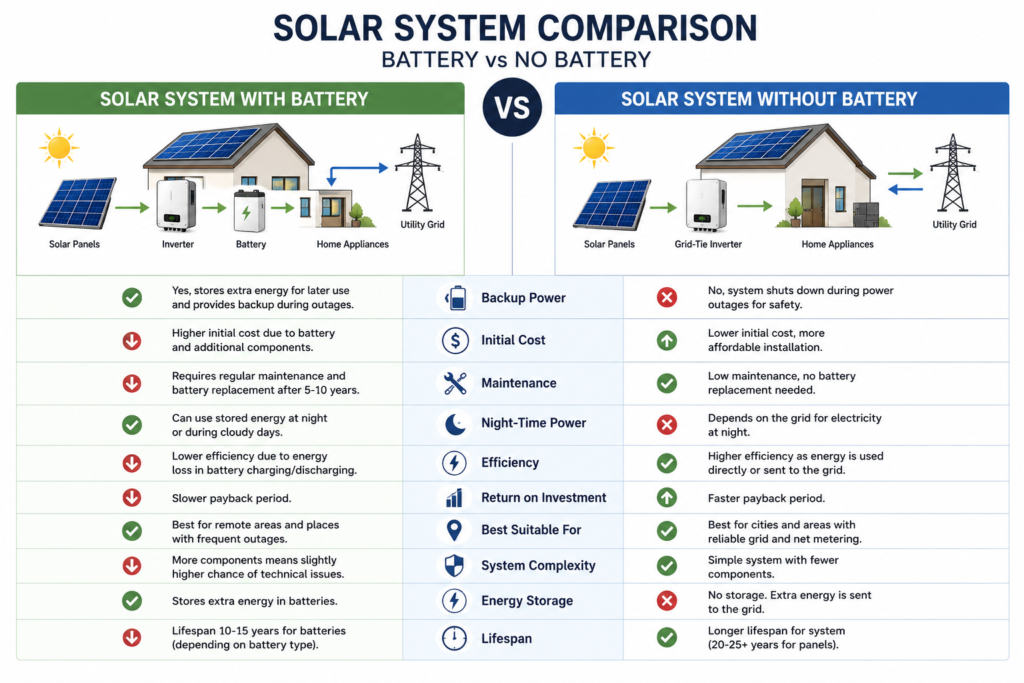
| Feature | Without Battery | With Battery |
| Initial Cost | Lower | Higher |
| Maintenance | Low | Moderate |
| Backup Power | No | Yes |
| ROI | Faster | Slower |
| Night-Time Power | Grid | Battery |
| Best For | Cities | Remote Areas |
Cost of a Solar System Without Battery
The total cost depends on system size, panel quality, inverter brand, installation, and local labor costs.
Typical factors included
- Solar panels
- Grid-tie inverter
- Mounting hardware
- Electrical wiring
- Installation labor
- Permits (where required)
Because no battery bank is required, battery-free systems are generally much more affordable than hybrid or off-grid systems.
Installation Process
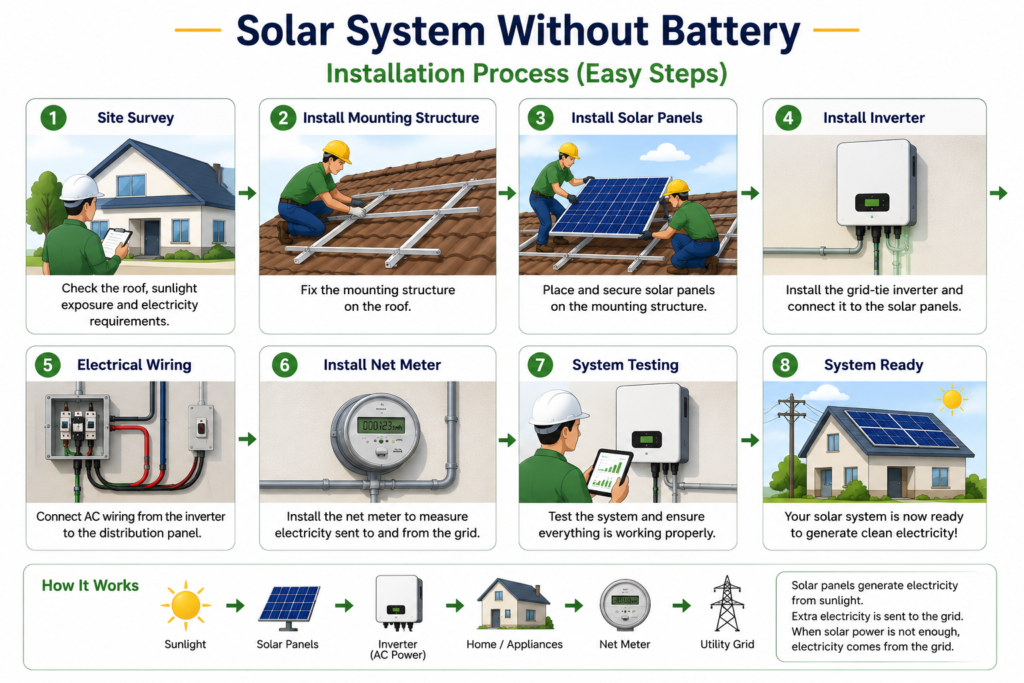
Solar System Without Battery in Pakistan
A batteryless solar system can be attractive in Pakistan because many households and businesses use a large amount of electricity during daylight hours.
It may be suitable for:
- Homes with daytime loads
- Shops
- Offices
- Schools
- Clinics
- Farms
- Agricultural pumps
- Workshops
- Small businesses
However, Pakistani users should pay particular attention to load shedding and backup requirements.
If your main reason for installing solar is to keep fans, lights, refrigerators, or other appliances running during a grid outage, simply installing a battery-free grid-tied system may not solve that problem.
You need to know whether the system provides backup functionality.
A recent Pakistan-focused inverter guide similarly emphasizes that battery-free systems are mainly useful for selected daytime loads and that users must check appliance wattage and startup requirements before choosing an inverter.
Is Solar Without Battery Good for Load Shedding?
This depends on what type of solar system you install.
During normal grid operation
An on-grid solar system can reduce the amount of electricity you need from the grid during sunny hours.
During a grid outage
A standard grid-tied inverter may shut down.
Therefore:
On-grid solar without battery ≠ automatic load-shedding backup.
If backup during outages is important, you should consider a suitable hybrid or backup-capable system with the required energy storage or other backup architecture.
This distinction should be clearly explained to Pakistani readers because it prevents a very common misunderstanding.
How Much Solar Power Do You Need Without a Battery?
There is no single answer because the required solar capacity depends on your loads.
Start by making a list of the appliances you want to operate.
For example:
| Appliance | Approximate Power | Hours of Use |
| LED light | 10–15 W | 5 hours |
| Fan | 50–100 W | 6 hours |
| Laptop | 45–100 W | 5 hours |
| Refrigerator | Variable | 24 hours |
| Water pump | Variable | 1–3 hours |
| AC | Highly variable | Depends on use |
These numbers are only examples. Always check the actual rating of your appliances.
You also need to consider the difference between:
Running power
and
Starting/surge power
A water pump or compressor can require much more power when starting than when already running.
That is why solar system sizing should consider both the energy requirement and the maximum instantaneous load.
What Is the Best Time to Use a Solar System Without Battery?
The best time is generally when solar production is strong.
For many systems, this means using major daytime loads around the period of strongest sunlight rather than relying heavily on early morning or late evening solar generation.
For example, you could schedule:
- Water pumping
- Washing
- Daytime cooling
- Workshop equipment
- Agricultural equipment
during periods when the solar system is producing sufficient power.
This approach helps you use solar electricity directly instead of installing storage solely to shift daytime solar energy into the evening.
How to Improve the Performance of a Battery-Free Solar System
Keep Solar Panels Clean
Dust and dirt can reduce the sunlight reaching the panel.
This is particularly important in dusty areas.
Avoid Shading
Even partial shade can significantly affect solar output.
Keep panels away from unnecessary shadows from trees, walls, poles, and nearby buildings.
Use the Correct Inverter
The inverter must be compatible with the solar array and intended batteryless operation.
Match the Load to Solar Production
Try to run high-power daytime appliances when the sun is strong.
Avoid Overloading the System
Do not connect more appliances than the inverter and solar array can safely support.
Use Proper Protection
Solar installations involve potentially dangerous DC and AC voltages.
Protection equipment and professional installation are important.
Common Mistakes When Installing Solar Without Battery
Mistake 1: Assuming Every Inverter Works Without a Battery
This is false.
Always check the inverter’s specifications.
Mistake 2: Thinking Solar Works Like a Generator
A generator can provide a relatively controllable output while running.
Solar production changes with sunlight.
Mistake 3: Ignoring Starting Loads
Motors and compressors may require more power when starting.
Mistake 4: Expecting Night-Time Backup
Without storage or another power source, there is no stored solar electricity at night.
Mistake 5: Confusing On-Grid With Off-Grid
An on-grid batteryless system can rely on the grid.
A stand-alone batteryless system cannot use the grid unless the system is specifically designed as a hybrid arrangement.
Mistake 6: Choosing an Inverter Only by Wattage
Look at the complete specifications, including:
- PV voltage range
- Maximum PV input
- AC output
- Surge capability
- Batteryless operating mode
- Protection features
- Grid compatibility
Is a Solar System Without Battery Worth It?
For the right user, yes.
A battery-free solar system can make sense when:
- Most electricity use happens during daylight.
- You already have reliable grid electricity for nighttime use.
- You want to reduce upfront solar costs.
- You mainly need daytime solar power.
- You are running a water pump or another suitable daytime load.
- You do not need backup power after sunset.
It may not be the right choice when:
You are completely off-grid and cannot tolerate interruptions.
You need electricity at night.
You experience frequent power outages.
You need uninterrupted power.
You operate heavy loads with high starting requirements.
Conclusion
A solar system without battery is one of the most cost-effective ways to switch to renewable energy. It offers lower installation costs, minimal maintenance, and reliable daytime electricity generation. While it does not provide backup power during outages, it is an excellent choice for homes and businesses with a dependable utility grid.
By selecting quality solar panels, a reliable grid-tie inverter, and professional installation, you can maximize energy savings and enjoy clean electricity for decades.
1. Can a solar system work without a battery?
Yes. A grid-tied solar system can power your home directly during the day without using batteries.
2. What happens at night?
The system draws electricity from the utility grid because the solar panels are not generating power.
3. Does it work during a power outage?
Most standard grid-tied systems automatically shut down during outages for safety reasons.
4. Is it cheaper than a battery system?
Yes. Removing the battery significantly reduces installation costs.
5. How long do solar panels last?
Most high-quality solar panels have a lifespan of 25–30 years.
6. Can I add a battery later?
Yes. Many homeowners start with a grid-tied system and upgrade to a hybrid system later, depending on the inverter and system design.
7. Is net metering required?
No, but it can improve the financial return by allowing you to receive credit for excess electricity sent to the grid.
8. Is this system suitable for businesses?
Yes. Businesses that consume most of their electricity during daylight hours often benefit greatly from battery-free solar systems.
9. Do solar panels require batteries?
No, solar panels do not always require batteries. A grid-tied solar system can use solar electricity directly during the day without battery storage. Batteries are mainly needed when you want backup power or want to store solar energy for use when the panels are not producing electricity.
10. Can we use solar panels without a battery?
Yes, solar panels can be used without a battery when the system is designed for battery-free operation. A grid-tied system can supply electricity to your home during the day, while the utility grid can provide electricity when solar production is insufficient.
11. How do you store solar energy without batteries?
You generally cannot store solar electricity for later use without some form of energy storage. Instead, you can use the electricity directly when the panels are producing power or export excess electricity to the grid if your system and local regulations allow it.
12. I have solar panels but no battery. What happens when the sun goes down?
When the sun goes down, the solar panels stop producing electricity. If your system is connected to the utility grid, your home can normally use grid electricity at night. Without a grid connection or another backup source, a battery-free system cannot provide stored solar electricity after sunset.
13. How can I use solar power without a battery during the day?
You can use solar electricity directly by running appliances while the panels are generating enough power. This works particularly well for daytime loads such as fans, water pumps, washing machines, and other appliances that operate during sunny hours.