Commercial Solar Panels in Pakistan 2026: Cost, Best Options & Maintenance Guide
Electricity is one of the biggest monthly expenses for shops, factories, offices, schools and warehouses in Pakistan. Commercial solar panels can cut that expense sharply. In 2026, however, the rules for selling extra power have changed, so choosing the cheapest panel is no longer enough.
In this guide, you will learn what commercial solar panels are, how much they cost in Pakistan, which options are the best, and how to maintain them so they keep producing for 25 years or more.
Table of Contents
- What Are Commercial Solar Panels?
- Commercial vs Residential Solar Panels
- Types of Commercial Solar Panels
- Commercial Solar Panel Cost in Pakistan (2026)
- Best Commercial Solar Panels and Brands
- Net Billing in Pakistan: What Changed for Businesses
- How to Choose the Right Commercial Solar Panels
- Inverters and Batteries for Commercial Systems
- ROI and Payback Period
- Commercial Solar Panel Maintenance
- FAQs
- Conclusion
What Are Commercial Solar Panels?
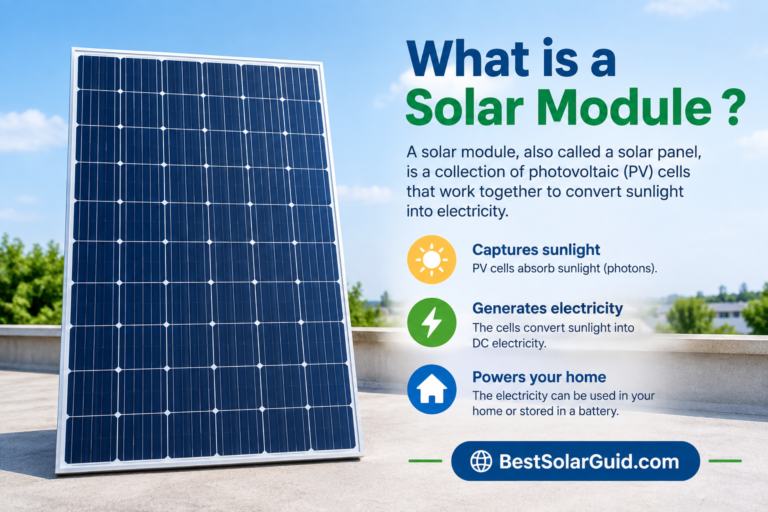
Commercial solar panels are photovoltaic (PV) modules used in larger systems that power a business instead of a home. They convert sunlight into electricity, which runs your machines, lights, air conditioners and pumps during the day.
Rooftop systems on commercial buildings often range from 100 kilowatts to 1 megawatt. In Pakistan, many small businesses start with 10 kW to 50 kW systems.
Commercial vs Residential Solar Panels
Commercial solar panels are designed for businesses with higher energy demands, while residential solar panels are generally used for homes with lower electricity consumption. If you want to understand the key differences in system size, cost, and performance, read our detailed guide on Commercial vs Residential Solar Panels.
System Size
Homes usually need 3 to 10 kW. Businesses often need 15 kW or more, frequently with a three-phase connection.
Panel Wattage
Commercial projects mostly use high-wattage panels (550W to 720W). Fewer panels mean lower mounting and wiring costs.
Electricity Usage Pattern
Most businesses use the majority of their power in daylight hours. This matches solar production well and often gives a faster payback than home systems.
Engineering Requirements
Large systems need roof strength checks, proper string design, earthing, surge protection and monitoring. A factory roof should never be treated like a house roof.
Types of Commercial Solar Panels
Monocrystalline PERC
The most common type. It offers good efficiency, wide availability and a lower price.
N-Type TOPCon
The current mainstream upgrade. It offers higher efficiency, better performance in heat and slower output loss over time, which suits Pakistan’s hot climate.
HJT (Heterojunction)
A premium technology with high efficiency. It costs slightly more because of that efficiency.
Bifacial Panels
These collect light from both sides and work best on flat roofs with light-colored surfaces or ground mounts.
Polycrystalline
This is now older technology. Avoid it for new commercial projects.
Commercial Solar Panel Cost in Pakistan (2026)
Panel Price per Watt
In 2026, solar panels in Pakistan range from PKR 24 to PKR 35 per watt depending on the brand and technology. Individual panels between 545W and 720W typically sell for about PKR 24,000 to PKR 35,000.
Full System Cost (Installed)
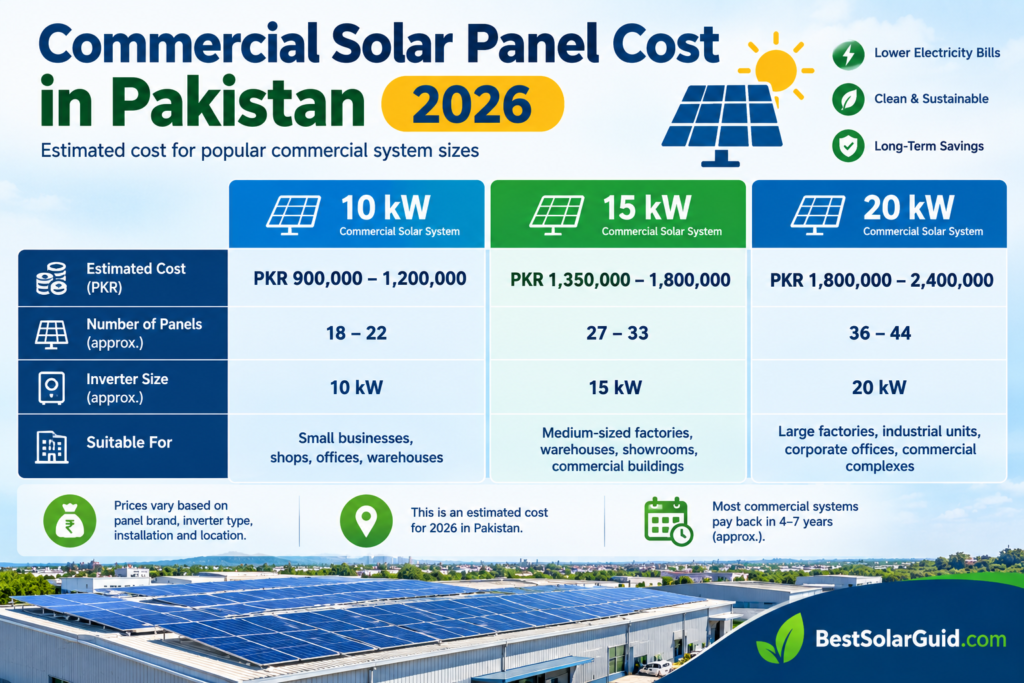
| System Size | Approx. Installed Cost (PKR) | Best For |
|---|---|---|
| 10 kW | 1.0M – 2.2M | Small office, shop, clinic |
| 15 kW | 1.2M – 2.5M | Large shop, school, workshop |
| 20 kW | 1.9M – 3.5M | Factory unit, warehouse, plaza |
Market quotes vary widely. A 10 kW system is reported anywhere from about PKR 950,000 to PKR 2.2 million, a 15 kW system between PKR 1.22 million and PKR 2.5 million, and a 20 kW system between PKR 1.9 million and PKR 3.5 million fully installed.
The gap comes from panel brand, inverter quality, warranty and whether a battery is included.
What Affects the Price
- Panel brand and technology
- Inverter brand (Huawei, Growatt, Solis)
- Battery storage, which adds a large amount
- Roof type and mounting structure
- Cable length, earthing and protection
- Your city and installer
Hidden Costs to Ask About
Ask whether the quote includes the grid application, meter, surge protection, transport, structure and warranty paperwork. Remember that a “panel price” covers modules only, not installation.
Best Commercial Solar Panels and Brands
Choose Tier-1 brands with strong warranties and local support. Popular options in Pakistan include:
- Jinko Solar: The 585W panel is priced at roughly PKR 30–35 per watt.
- LONGi (HiMO series): HiMO 6 ranges around PKR 28–33 per watt.
- JA Solar: High-efficiency bifacial 700W panels cost about PKR 42–45 per watt.
- Canadian Solar: Known for bankability and long warranty history.
- Trina Solar: A solid Tier-1 option for larger projects.
Prices change often, so always request a dated written quote.
Net Billing in Pakistan: What Changed for Businesses
This is the biggest 2026 update. On February 9, 2026, NEPRA notified the Prosumer Regulations 2026, which replaced net metering with net billing.
Under the new net billing system, surplus power is bought back at roughly Rs 10–11 per unit (linked to the National Average Energy Purchase Price), compared with about Rs 26 earlier. Electricity you import from the grid is billed separately at the regular tariff. Always confirm the current rate with your DISCO before signing.
Here is what else changed:
- New prosumer agreements now run for five years instead of seven.
- New rules also limit the system size to your original sanctioned load, so check your sanctioned load before choosing a system size.
- Customers with a valid, signed net-metering agreement before 9 February 2026 continue on their old terms until the agreement expires.
What this means for your business:
- Selling extra power to the grid now earns much less.
- Using your own solar power during the day is now more valuable.
- Size your system for your daytime load, not just your roof space.
- A battery can help if your business also runs in the evening.
Because this policy has been widely debated, the rules can still change. Check NEPRA’s official notifications before you apply.
How to Choose the Right Commercial Solar Panels
1. Check Your Daytime Load
Review 6 to 12 months of bills and look at your real usage between 9 am and 5 pm.
2. Compare Efficiency and Temperature Coefficient
Higher efficiency saves roof space. A lower temperature coefficient means less power loss in hot weather.
3. Read the Warranties
Look for a product warranty of 12 years or more and a performance warranty of 25 to 30 years.
4. Confirm Certifications
Ask for IEC and TUV certificates and check the datasheet.
5. Inspect the Roof
Roof age, load capacity and shade decide how many panels you can safely install.
6. Choose a Reliable Installer
Pick a NEPRA-registered installer with past commercial projects and proper after-sales support.
Inverters and Batteries for Commercial Systems
Commonly recommended inverters include Huawei SUN2000, Growatt SPH, Solis and Itel, with Huawei and Growatt often chosen for durability and smart monitoring. The inverter strongly affects how long your system runs smoothly, so do not choose on price alone.
For backup, lithium (LiFePO4) batteries are now the standard choice because of longer life and better usable capacity than lead-acid.
ROI and Payback Period
Payback depends on your tariff, system cost and daytime usage. Installers often claim that with electricity rates above PKR 60 per unit, a solar system can pay for itself in 3-4 years, and some suggest a large commercial system can recover its cost even faster. Treat these as best-case estimates and ask for a calculation based on your own bills.
Simple formula: Monthly units generated × your per-unit tariff = monthly savings. Divide total system cost by monthly savings to estimate payback.
Under net billing, savings come mainly from the power you use yourself, so a system sized to your daytime load usually pays back faster than one built mainly to export.
Commercial Solar Panel Maintenance
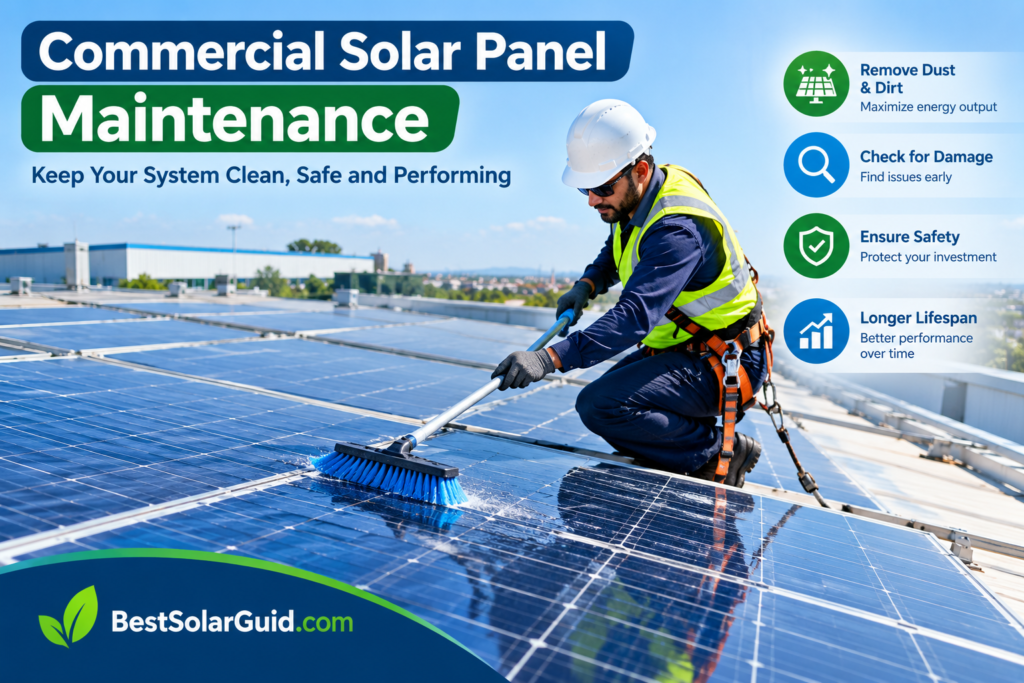
Regular maintenance protects your output and extends the life of your system.
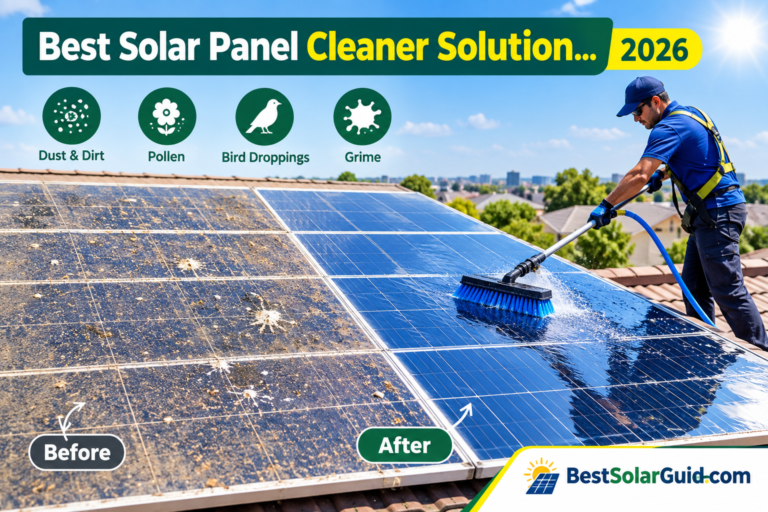
Cleaning
- In dusty areas, clean panels weekly to monthly.
- Always clean after dust storms.
- Use clean water and a soft cloth or brush, and avoid harsh chemicals.
- Do not wash hot panels at midday. Early morning or evening is better.
Monitoring
- Check your inverter app weekly.
- Investigate any sudden drop in output right away.
Electrical Checks
- Inspect cables, connectors and earthing regularly.
- Check surge protectors before the monsoon season.
Shade and Structure
- Look for new shade from trees or buildings.
- Inspect the mounting structure for rust or loose bolts.
Yearly Inspection
Have a professional inspect the system once a year and keep the service record for warranty claims.
Frequently Asked Questions
What is the best commercial solar panel in 2026?
There is no single winner. N-type TOPCon panels from Tier-1 brands like Jinko, LONGi, JA Solar and Canadian Solar are safe choices for most businesses.
How much do commercial solar panels cost in Pakistan?
Installed systems from 10 kW to 20 kW typically cost about PKR 1 million to PKR 3.5 million, depending on the brand, inverter and battery.
Is net metering still available in Pakistan?
New applicants now fall under net billing with a much lower buyback rate. Older agreements continue until they expire.
Are commercial solar panels worth it in Pakistan?
For most businesses with heavy daytime use and high tariffs, yes. In 2026 the biggest savings come from using your own solar power.
How long do commercial solar panels last?
Most last 25 to 30 years, with a small drop in output each year.
Do I need a battery for a commercial system?
Only if you need backup power or work after sunset. Otherwise an on-grid system costs less.
How often should commercial solar panels be maintained?
Clean them weekly to monthly depending on dust, check monitoring weekly, and book a professional inspection once a year.
Conclusion
The best commercial solar panels are the ones that fit your load, roof, budget and warranty needs. In 2026, choose Tier-1 TOPCon or HJT panels, a reliable inverter, and size the system for daytime self-consumption because of net billing. Get at least three written quotes and compare warranty and scope, not just price.