Best Flexible Solar Panels in 2026: Complete Buying, Installation and Comparison Guide
Flexible solar panels have become a popular choice for people who need solar power without the weight, bulk, and mounting requirements of traditional glass solar panels. They can be useful on RVs, camper vans, boats, curved roofs, tents, and other surfaces where a conventional rigid panel may be difficult to install.
But choosing the best flexible solar panels is not as simple as buying the panel with the highest wattage.
The material, surface coating, flexibility, heat management, waterproof rating, cell technology, and installation method can all affect how well a panel performs and how long it lasts.
In this guide, we will look at the best types of flexible solar panels available in 2026, what features matter most, how they compare with rigid panels, how much power they can produce, and what buyers in Pakistan and other countries should consider before purchasing one.
Table of Content
- Quick Answer: What are the Best Flexible Solar Panels?
- Best Flexible Solar Panels in 2026
- Flexible Solar Panel Types
- Flexible Solar Panels vs. Rigid Solar Panels
- How Much Power Does a Flexible Solar Panel Produce?
- How Many Watts Do You Need?
- Flexible Solar Panels for RVs
- Flexible Solar Panels for Boats
- Are Flexible Solar Panels Good for Pakistan?
- Estimated Flexible Solar Panel Prices in Pakistan
- How to Choose the Best Flexible Solar Panel
- Do You Need an MPPT or PWM Charge Controller?
- How to Install Flexible Solar Panels
- Common Problems With Flexible Solar Panels
- How Long Do Flexible Solar Panels Last?
- Flexible Solar Panel Maintenance
- Frequently Asked Questions
- Final Verdict: Which Flexible Solar Panel Should You Buy?
Quick Answer: What are the Best Flexible Solar Panels?
For most buyers, a high-quality ETFE-coated monocrystalline flexible solar panel offers the best balance of efficiency, weight, durability, and price.
However, the best choice depends on where you plan to install it:
| Best For | Recommended Type |
|---|---|
| Overall performance | ETFE monocrystalline flexible panel |
| RV or camper van | 100W–200W high-efficiency flexible panel |
| Curved roof | Highly bendable ETFE or CIGS panel |
| Boat or marine use | Waterproof, corrosion-resistant flexible panel |
| Hot climate | ETFE panel with good ventilation |
| Cloudy or partially shaded conditions | CIGS flexible solar panel |
| Budget buyers | PET or entry-level flexible panel, with realistic lifespan expectations |
| Backpacking or ultra-lightweight use | Lightweight thin-film flexible panel |
Recent flexible-panel designs increasingly use improved ETFE surfaces, higher-efficiency monocrystalline cells, and CIGS thin-film technology. CIGS panels can offer particular advantages in difficult lighting conditions and on highly curved surfaces, although they are not always the most efficient option under standard laboratory conditions.
What Are Flexible Solar Panels?
A flexible solar panel is a lightweight solar panel designed to bend to a certain degree rather than remaining completely flat and rigid.
Unlike conventional solar panels, which normally use a heavy aluminum frame and tempered glass, flexible panels are built with lightweight layers and flexible materials.
They are often used where weight or surface shape is a major concern.
Common applications include:
- RV roofs
- Camper vans
- Boats and yachts
- Curved vehicle roofs
- Portable solar systems
- Camping setups
- Remote cabins
- Lightweight off-grid systems
- Tents and temporary installations
However, there is an important point that many buyers misunderstand:
Flexible does not mean you can fold a solar panel like a blanket.
Most flexible monocrystalline panels can bend only up to a specified curvature. Repeatedly folding or sharply bending them beyond the manufacturer’s limit can damage the solar cells or internal connections.
Always check the manufacturer’s specified bending limit before installation.
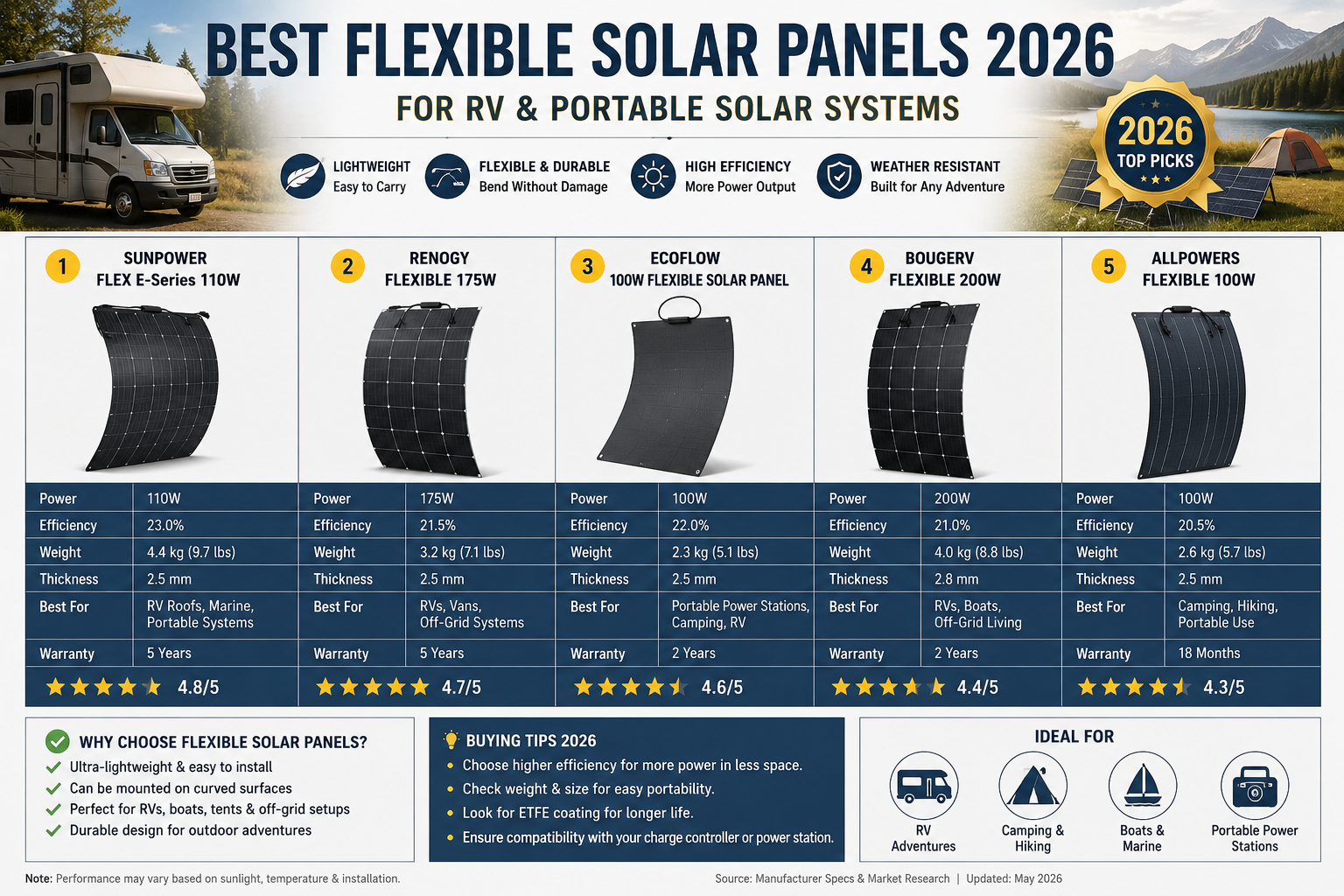
Best Flexible Solar Panels in 2026
Instead of choosing one panel for everyone, it is better to select a panel based on your installation and power requirements.
1. Renogy Flexible Solar Panels – Best for Overall Balance
Renogy remains one of the most recognizable brands in the consumer off-grid solar market. Its flexible panel range is designed for applications where traditional framed panels may be too heavy or difficult to mount.
A good-quality Renogy flexible panel can be a strong choice for:
- RVs
- Vans
- Boats
- Small off-grid systems
- Curved surfaces
Modern flexible solar technology from established brands increasingly focuses on better coatings and improved cell performance. Renogy has also expanded its flexible solar technology to include comparisons between conventional crystalline-silicon flexible panels and CIGS technology for different use cases.
Pros
- Established solar brand
- Good compatibility with common solar components
- Lightweight design
- Suitable for mobile applications
- Available in different wattages
Cons
- Usually more expensive than no-name alternatives
- Flexible panels still require careful heat management
- Not always the best choice for a large permanent rooftop system
Best for: Buyers who want a balance between brand reputation, performance, and off-grid compatibility.
2. BougeRV Flexible Solar Panels – Best for RVs and Camper Vans
BougeRV has become increasingly popular in the RV and van-life market.
Higher-wattage flexible panels can be especially useful when roof space is limited. Instead of installing several smaller panels, a buyer may be able to install a larger flexible panel while keeping the total roof weight relatively low.
BougeRV also offers flexible-panel options aimed at different needs, including high-efficiency crystalline panels and CIGS-based designs for more demanding curved or variable-light conditions. Recent testing and reviews have highlighted flexible BougeRV panels as useful for vehicle mounting, while also emphasizing that connector and voltage compatibility should always be checked before connecting a panel to a power station or charge controller.
Pros
- Good options for RV and van installations
- High wattage available in lightweight designs
- Suitable for curved surfaces
- ETFE options available
- CIGS options for difficult conditions
Cons
- Some models may require careful controller selection
- Large flexible panels can still be difficult to install
- Heat buildup can reduce performance if mounted directly against a hot roof
Best for: RV owners, camper vans, and buyers with limited roof space.
3. CIGS Flexible Solar Panels – Best for Difficult Conditions
CIGS stands for Copper Indium Gallium Selenide.
CIGS panels use thin-film solar technology rather than the traditional crystalline silicon design found in most rigid panels.
Their advantages can include:
- Excellent flexibility
- Better performance characteristics in some low-light conditions
- Good performance at higher operating temperatures
- Lightweight construction
- Reduced sensitivity to some shading situations
This does not mean that every CIGS panel will automatically produce more energy than a high-efficiency monocrystalline panel.
The correct choice depends on the installation.
For example, if you have a small area with perfect direct sunlight, a high-efficiency monocrystalline flexible panel may be the better option.
However, if your installation experiences variable light, high temperatures, partial shading, or requires significant flexibility, CIGS can be worth considering.
Best for: Boats, curved roofs, variable weather, and specialized lightweight installations.
Flexible Solar Panel Types
There are several types of flexible solar panels available today.
1. Monocrystalline Flexible Solar Panels
These are among the most common flexible panels.
They generally offer:
- Higher efficiency
- Good performance in limited installation space
- Lightweight construction
- Strong direct-sun performance
They are often a good choice when you want to generate the maximum possible power from a limited roof area.
2. CIGS Flexible Solar Panels
CIGS panels are based on thin-film technology.
They can be extremely flexible and may perform well in challenging environmental conditions.
They are particularly interesting for:
- Curved surfaces
- Boats
- Portable applications
- Variable weather
- Installations where weight is critical
3. ETFE-Coated Flexible Panels
ETFE is not the solar cell itself.
It is a protective surface material.
ETFE-coated flexible solar panels are generally considered more durable than cheaper PET-coated designs.
Benefits may include:
- Better UV resistance
- Improved surface durability
- Better resistance to yellowing
- Improved outdoor performance
For a long-term outdoor installation, ETFE is usually the better choice.
4. PET Flexible Solar Panels
PET-coated panels are often cheaper.
They can be suitable for:
- Short-term projects
- Budget installations
- Occasional portable use
However, PET may age faster under intense UV exposure and heat.
For permanent installation in very hot climates, a high-quality ETFE panel is usually the safer choice.
Flexible Solar Panels vs. Rigid Solar Panels
Before buying a flexible panel, ask yourself one important question:
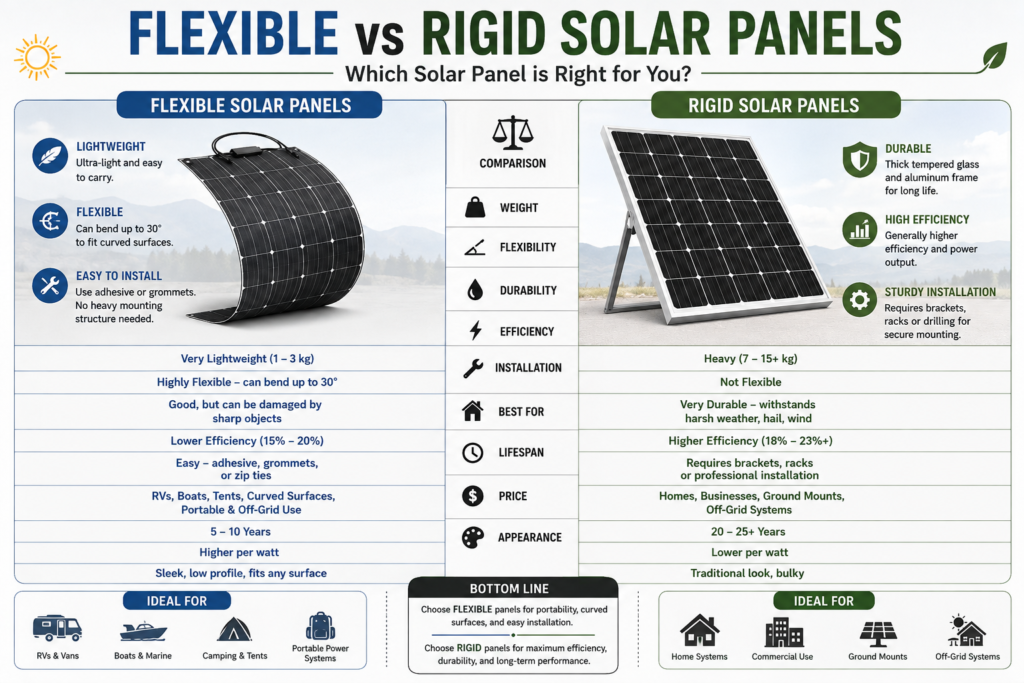
Do I actually need flexibility?
Flexible panels solve a specific problem. They are not automatically better than rigid solar panels.
| Feature | Flexible Solar Panels | Rigid Solar Panels |
| Weight | Very light | Heavier |
| Curved surfaces | Excellent | Poor |
| Installation | Often easier | Requires mounting hardware |
| Heat management | Can be challenging | Usually better airflow |
| Efficiency | Good to high | Often higher |
| Lifespan | Usually shorter | Usually longer |
| Cost per watt | Often higher | Often lower |
| Durability | Depends heavily on quality | Generally excellent |
For a permanent home rooftop with plenty of space, traditional rigid solar panels are often the better investment.
But for an RV, boat, van, curved roof, or weight-sensitive application, flexible solar panels can make much more sense.
They solve a different problem.
How Much Power Does a Flexible Solar Panel Produce?
The wattage printed on a solar panel represents its rated output under standard test conditions.
Real-world output will vary.
For example, a 100W flexible solar panel will not necessarily produce exactly 100 watts throughout the day.
Actual production depends on:
- Sunlight intensity
- Panel angle
- Temperature
- Shade
- Dust and dirt
- Cable losses
- Charge controller efficiency
- Battery condition
A simple estimate is:
Daily Energy = Panel Wattage × Peak Sun Hours × System Efficiency
For example:
200W × 5 peak sun hours × 0.80 system efficiency = approximately 800Wh per day
This is only an estimate.
In Pakistan, solar production can be excellent because many areas receive strong sunlight, but high summer temperatures, dust, and poor installation can significantly reduce real-world performance.
How Many Watts Do You Need?
50W Flexible Solar Panel
Suitable for:
- Small lights
- Phone charging
- Small USB devices
- Basic battery maintenance
100W Flexible Solar Panel
Suitable for:
- Camping
- Small battery systems
- Lights
- Phone and laptop charging
- Small RV systems
200W Flexible Solar Panel
Suitable for:
- RVs
- Camper vans
- Larger battery systems
- Small appliances
- Extended off-grid use
300W or More
Suitable for:
- Larger off-grid systems
- Multiple appliances
- Larger battery banks
- Mobile workstations
Always calculate your daily energy consumption before choosing panel wattage.
Flexible Solar Panels for RVs
Flexible panels are particularly popular on RV roofs because they:
- Add less weight
- Can fit curved surfaces
- Have a lower profile
- May reduce wind resistance
- Can be easier to install than framed panels
However, heat management is extremely important.
If a flexible panel is installed directly against a hot roof with no airflow, its temperature can rise significantly.
Higher temperatures can reduce solar output and may affect long-term durability.
When possible, follow the manufacturer’s installation recommendations and avoid installation methods that trap excessive heat.
Flexible Solar Panels for Boats
Flexible solar panels can also be useful for boats because of their lightweight design and ability to follow curved surfaces.
For marine installations, look for:
- Strong waterproof protection
- ETFE surface
- Corrosion-resistant components
- High-quality cables
- Properly sealed connections
- Suitable charge controllers
Saltwater environments can be harsh on electrical equipment, so cheap connectors and poor-quality wiring can become a major problem.
Are Flexible Solar Panels Good for Pakistan?
Yes, but buyers in Pakistan should consider several local conditions.
Pakistan has strong solar potential, but flexible solar panels are not ideal for every installation.
They can be particularly useful for:
- Camper vans
- Small mobile setups
- Boats
- Lightweight roofs
- Remote locations
- Portable power
- Small battery systems
For a normal residential rooftop solar system, however, standard rigid Tier-1 panels may provide better long-term value.
Pakistan’s mainstream solar market in 2026 is heavily focused on high-efficiency rigid modules, with N-type TOPCon panels widely available. That means flexible panels remain more of a specialized solution than a replacement for standard residential modules.
Estimated Flexible Solar Panel Prices in Pakistan
Prices vary significantly depending on brand, wattage, cell technology, import costs, and availability.
A rough market range may look like this:
| Panel Size | Approximate Price Range |
| 50W | PKR 10,000–15,000 |
| 100W | PKR 15,000–30,000 |
| 150W | PKR 22,000–40,000 |
| 200W | PKR 30,000–60,000+ |
| 300W | PKR 45,000–85,000+ |
These are broad estimates only. Prices can change because of exchange rates, import costs, taxes, brand availability, and local seller margins.
Before purchasing, compare the price per watt, warranty, coating material, and specifications instead of choosing only the cheapest panel.
How to Choose the Best Flexible Solar Panel
Here are the most important factors.
1. Choose ETFE Over PET When Possible
If your budget allows, choose a high-quality ETFE-coated panel.
It is generally better suited to long-term outdoor exposure.
2. Check the Efficiency
Higher efficiency can help when roof space is limited.
However, do not choose a panel based only on one efficiency number.
Build quality and long-term reliability also matter.
3. Check the Bending Limit
Different panels have different flexibility limits.
Never assume that every flexible panel can bend around any surface.
Check the manufacturer’s specifications.
4. Check the Waterproof Rating
For RVs, boats, and outdoor installations, look carefully at the protection rating of the panel and its junction box.
Remember that a waterproof panel does not automatically make every cable connection waterproof.
5. Consider Heat
Flexible panels installed directly on a roof may become hotter than raised rigid panels.
If heat is a major concern, consider installation methods that improve ventilation where appropriate and permitted by the manufacturer.
6. Check the Warranty
Flexible panels may have different warranty terms from rigid panels.
Read:
- Product warranty
- Power output warranty
- Installation requirements
- Exclusions
A very cheap panel with no meaningful warranty may become more expensive in the long run.
Do You Need an MPPT or PWM Charge Controller?
For serious solar systems, an MPPT charge controller is generally the better option.
MPPT controllers can optimize the relationship between solar panel voltage and battery charging requirements.
PWM controllers are simpler and cheaper, but they may not use the panel’s available power as efficiently in many configurations.
Your choice depends on:
- Panel voltage
- Battery voltage
- System size
- Budget
- Wiring configuration
Always make sure the controller’s voltage and current ratings are compatible with your solar panel.
Do not connect a panel to a controller or power station without checking its maximum input voltage and current specifications.
How to Install Flexible Solar Panels
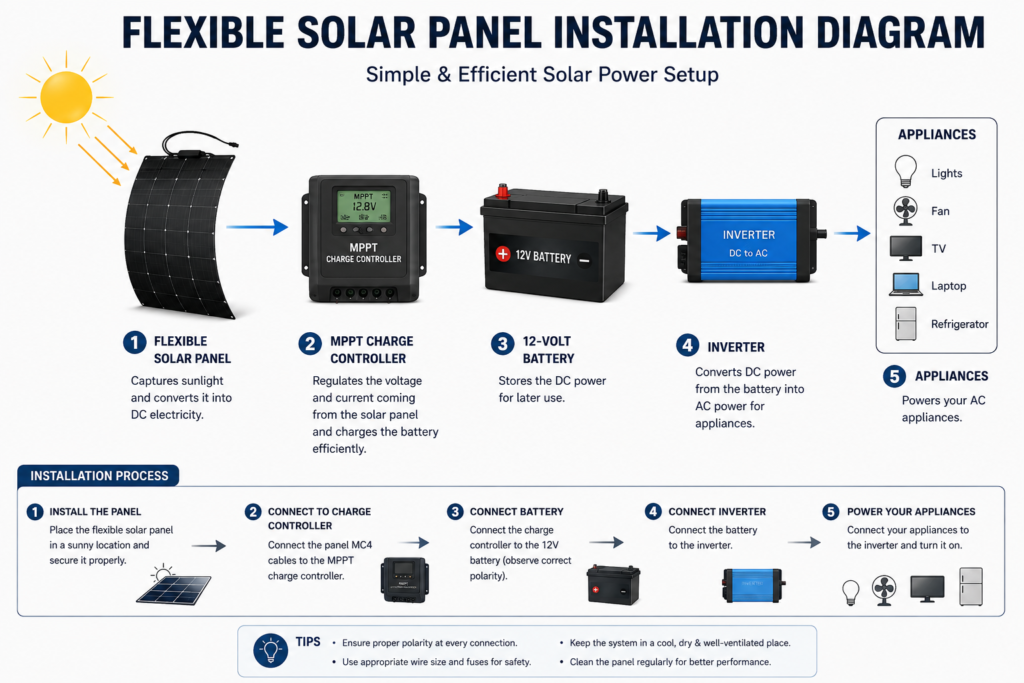
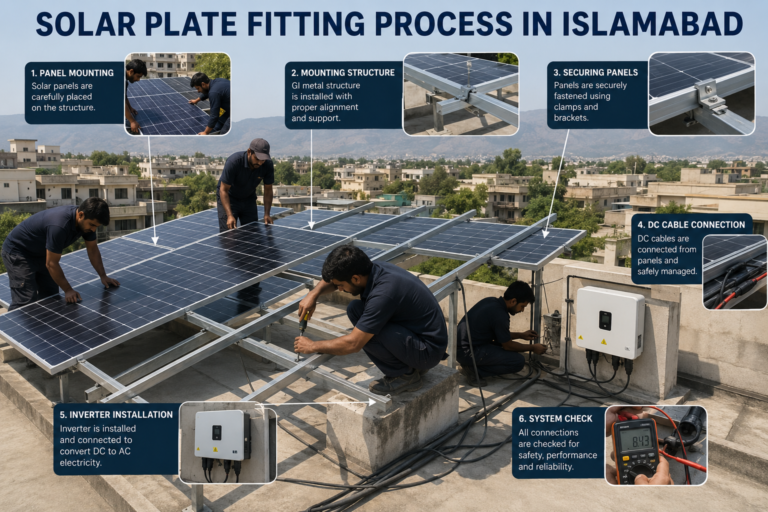
Installing flexible solar panels involves connecting the panel to an MPPT charge controller, which regulates the voltage and current for efficient battery charging. The 12V battery stores the generated DC electricity for later use, while an inverter converts the stored DC power into AC electricity. Finally, the AC power is supplied to household appliances for everyday use.
Installation methods may include:
- Adhesive
- Screws
- Bolts
- Grommets
- Specialized mounting systems
A basic installation process usually involves:
Step 1: Plan the Location
Choose an area with maximum sunlight and minimum shade.
Step 2: Check the Surface
The surface should be clean, strong, and suitable for the selected mounting method.
Step 3: Test the Panel Position
Place the panel temporarily before permanently attaching it.
Step 4: Follow the Bending Limit
Do not force the panel beyond its rated curvature.
Step 5: Connect the Wiring
Use suitable solar cable and weather-resistant connectors.
Step 6: Connect the Charge Controller
Make sure the controller matches the panel and battery specifications.
Step 7: Test the System
Check:
- Voltage
- Current
- Charging performance
- Connector temperature
- Battery charging behavior
For permanent installations, following the manufacturer’s instructions and applicable electrical safety rules is essential.
Choose Location → Measure & Test Position → Clean Surface → Mount Flexible Solar Panel → Connect Solar Cables → Connect Charge Controller → Connect Battery → Test the System
Once your flexible solar panel is properly connected to the battery and charge controller, you can learn more about how to charge a 12V solar battery safely and efficiently.
Common Problems With Flexible Solar Panels
Overheating
This can happen when a panel has poor airflow and is installed directly on a very hot surface.
Delamination
Low-quality panels may begin separating between layers after long exposure to heat and UV radiation.
Yellowing
This can be more common with cheaper protective materials.
Cracked Cells
Excessive bending or pressure can damage internal solar cells.
Water Damage
Poorly sealed junction boxes or connectors can allow moisture into the system.
Lower Output
Possible causes include:
- Shade
- Dirt
- High temperatures
- Poor panel angle
- Cable losses
- Damaged cells
- Incorrect controller configuration
How Long Do Flexible Solar Panels Last?
The lifespan depends heavily on:
- Panel quality
- Coating material
- Climate
- Heat exposure
- Installation
- Maintenance
High-quality flexible panels can last for many years, but they generally should not be expected to match the lifespan of a premium glass-and-frame rigid panel in every installation.
A well-built ETFE panel installed correctly will usually offer better long-term durability than a cheap flexible panel exposed to intense heat and UV radiation.
Flexible Solar Panel Maintenance
Maintenance is relatively simple.
- Remove dust and dirt gently.
- Avoid abrasive cleaning materials.
- Check cables regularly.
- Inspect the surface for cracks or bubbles.
- Check connectors for corrosion.
- Monitor power output.
- Inspect adhesive or mounting points.
In dusty environments, including many areas of Pakistan, regular cleaning can help maintain performance.
Do not use harsh chemicals unless the manufacturer specifically recommends them.
After installation, proper battery care is important for maintaining reliable solar power and extending battery life. Check our guide to solar battery maintenance for useful tips.
Final Verdict: Which Flexible Solar Panel Should You Buy?
The best flexible solar panels in 2026 are not necessarily the ones with the biggest wattage number or the lowest price.
The right choice depends on your installation.
Choose a high-quality ETFE monocrystalline flexible panel if you want a good combination of efficiency, durability, and lightweight performance.
Consider CIGS flexible solar technology if flexibility, high-temperature behavior, or variable-light performance is especially important.
Choose a rigid solar panel instead if you are installing a permanent residential rooftop system and do not actually need a flexible design.
For buyers in Pakistan, flexible panels are best suited to specialized installations such as RVs, mobile systems, boats, lightweight structures, and portable power setups. For standard homes, comparing them against the widely available high-efficiency rigid N-type panels is usually the smarter approach.
The most important rule is simple:
Do not buy a flexible solar panel only because it is lightweight. Compare the coating, cell technology, bending limit, waterproof protection, warranty, voltage, heat management, and price per watt before making your final decision.
With the right panel and proper installation, flexible solar technology can provide an efficient and practical source of power where traditional rigid panels simply do not fit.
Are flexible solar panels worth buying?
Yes, if you need lightweight solar power for a curved, mobile, or weight-sensitive surface.
For a permanent home rooftop, rigid panels are often the better long-term investment.
Are flexible solar panels waterproof?
Many are designed for outdoor use, but the protection level varies. Check the IP rating and remember that connectors and other system components also need proper protection.
Can flexible solar panels be walked on?
Generally, you should not assume that a flexible panel is safe to walk on unless the manufacturer specifically states that it is designed for that use.
Flexibility does not mean the panel is pressure-proof.
Are flexible solar panels as efficient as rigid panels?
Some modern flexible monocrystalline panels can offer strong efficiency, but rigid panels often provide better long-term performance, cooling, and durability.
Do flexible solar panels work on cloudy days?
Yes. Solar output will be lower, but the panel can still generate electricity.
CIGS technology may be particularly attractive in variable lighting conditions.
Can I connect a flexible solar panel directly to a battery?
Usually, a charge controller should be used between the panel and battery unless you are using a specially designed system with its own integrated regulation.
What is the best flexible solar panel for an RV?
A high-quality ETFE-coated 100W–200W monocrystalline flexible panel is often a practical choice. If your roof has significant curves or your conditions include variable light, a CIGS option may also be worth considering.