Commercial vs Residential Solar Panels: Complete Comparison Guide 2026
Solar panels are becoming an important source of electricity for homes, businesses, factories, offices, warehouses, and other properties. However, not every solar panel or solar system is designed for the same purpose.
When comparing commercial vs residential solar panels, you may notice differences in panel size, power output, system capacity, installation requirements, inverter selection, cost, and overall system design.
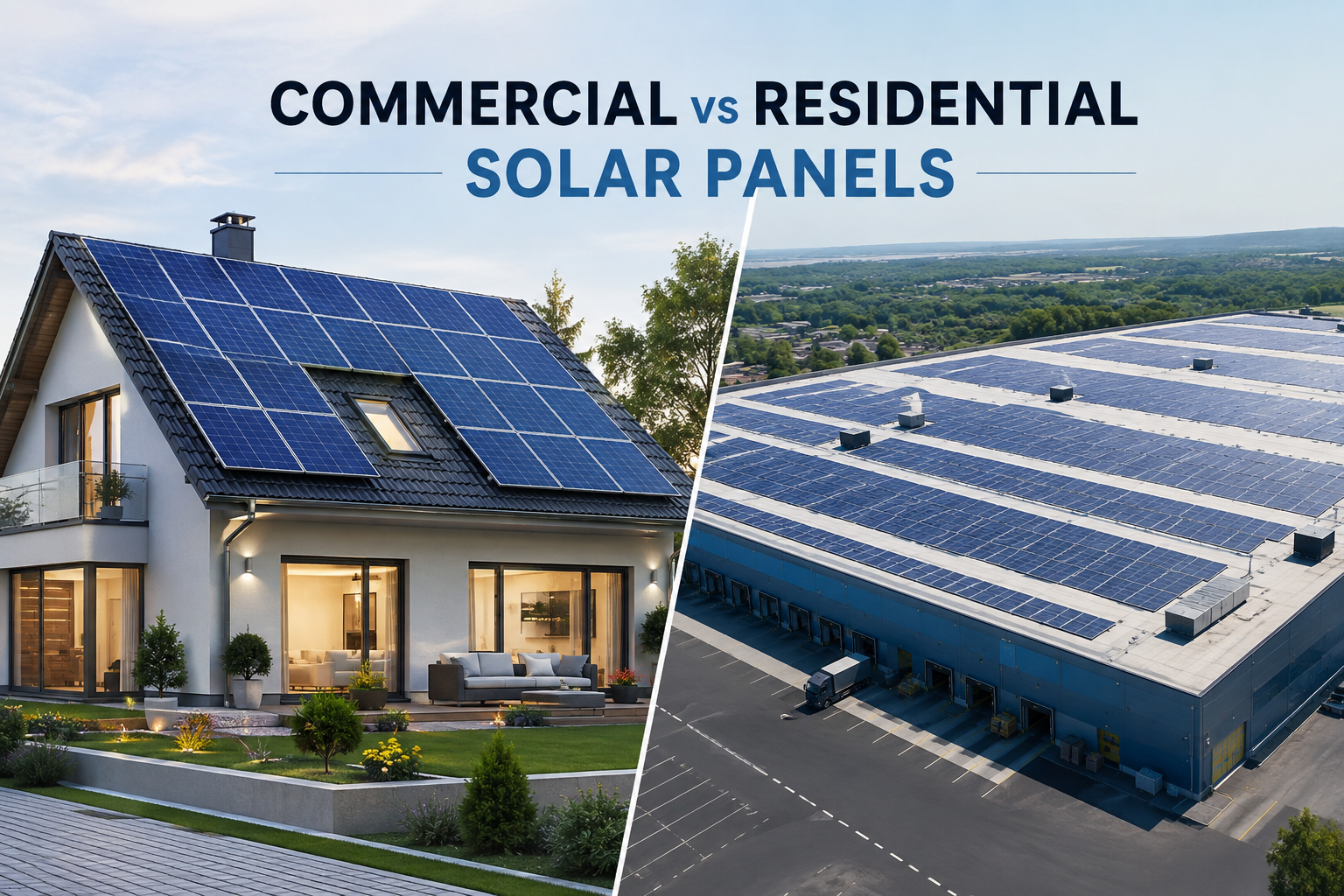
Residential solar panels are generally designed for homes and smaller electricity loads, while commercial solar panels and systems are commonly used for businesses and larger properties with higher electricity consumption.
But are commercial solar panels actually better than residential panels? Can residential solar panels be used on a commercial building? Which brands are popular in Pakistan and worldwide? And which type should you choose for your property?
This complete guide explains the difference between commercial and residential solar panels, including their size, efficiency, cost, installation, inverters, system capacity, maintenance, popular brands, and important factors to consider before buying.
Table of Contents
- What Are Residential Solar Panels?
- What Are Commercial Solar Panels?
- Commercial vs Residential Solar Panels: Quick Comparison
- Major Differences Between Commercial and Residential Solar Panels
- Panel Size
- Power Output
- System Size
- Solar Inverters
- Installation Method
- Cost
- Electricity Consumption
- Maintenance and Monitoring
- Are Commercial Solar Panels More Efficient?
- Can You Use Residential Solar Panels for a Commercial Building?
- How Many Solar Panels Does a Commercial Building Need?
- Commercial vs Residential Solar Panels: Pros and Cons
- Residential Solar Panels
- Commercial Solar Panels
- Best Residential and Commercial Solar Panel Brands
- Jinko Solar
- LONGi Solar
- JA Solar
- Canadian Solar
- Trina Solar
- How to Choose the Right Solar Panels
- Commercial Solar Panels for Businesses
- Residential Solar Panels for Homes
- Commercial vs Residential Solar Panels in Pakistan
- How to Avoid Fake Solar Panels in Pakistan
- Frequently Asked Questions
- Final Verdict
What Are Residential Solar Panels?
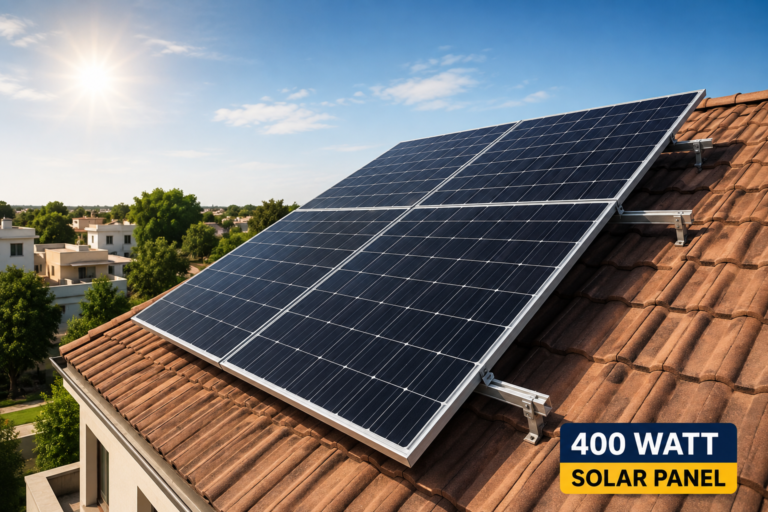
Residential solar panels are photovoltaic (PV) modules primarily designed for homes and other small residential properties.
They are commonly installed on house rooftops, although they can also be used with ground-mounted systems, solar carports, and other residential applications.
A residential solar system may include:
- Solar panels
- Solar inverter
- Mounting structure
- DC and AC wiring
- Electrical protection equipment
- Monitoring system
- Solar battery, if required
- Grid connection equipment
Most modern residential solar systems use monocrystalline solar panels because they can provide high power output while using relatively limited roof space.
Why Are Residential Solar Panels Usually Smaller?
Residential properties usually have less electricity demand and less usable installation space than factories or large commercial buildings.
For this reason, residential solar panels are often designed to provide a good balance between:
- Power output
- Efficiency
- Physical size
- Weight
- Roof-space requirements
- Appearance
Homeowners may also need to work around chimneys, water tanks, vents, skylights, and other rooftop obstacles.
What Are Commercial Solar Panels?
Commercial solar panels are photovoltaic modules used for businesses, offices, factories, warehouses, schools, hospitals, hotels, farms, and other larger properties.
Commercial solar systems are usually larger because businesses often consume considerably more electricity than individual homes.
A commercial solar installation may be placed on:
- Large commercial rooftops
- Factory roofs
- Warehouses
- Office buildings
- Parking structures
- Solar carports
- Ground-mounted areas
- Agricultural or industrial properties
Commercial solar systems can range from relatively small business installations to systems with hundreds of kilowatts or even megawatts of capacity.
The exact system size depends on electricity consumption, available space, budget, electrical infrastructure, and the project’s goals.
Commercial vs Residential Solar Panels: Quick Comparison
| Feature | Residential Solar Panels | Commercial Solar Panels |
|---|---|---|
| Main use | Homes and residential properties | Businesses and larger properties |
| Typical system size | Smaller | Larger |
| Electricity demand | Lower | Usually higher |
| Panel size | Generally smaller | Often larger |
| Power per panel | Varies by model | Often available in higher-wattage formats |
| Installation | Mostly residential rooftops | Large rooftops, ground mounts, carports, industrial sites |
| Inverter | String, microinverter, hybrid | Larger string or centralized configurations |
| Electrical system | Single-phase or three-phase | Frequently three-phase |
| Installation complexity | Usually lower | Usually higher |
| Total project cost | Lower | Higher |
| Cost per watt | Can be higher at small scale | Can benefit from economies of scale |
| Main priority | Household energy needs | Energy demand, space, ROI, and system performance |
| Best suited for | Houses | Businesses, factories, warehouses, offices |
Important: Commercial panels are not automatically better than residential panels. The best panel depends on the exact model, efficiency, power output, dimensions, warranty, degradation rate, price, and system requirements.
Major Differences Between Commercial and Residential Solar Panels
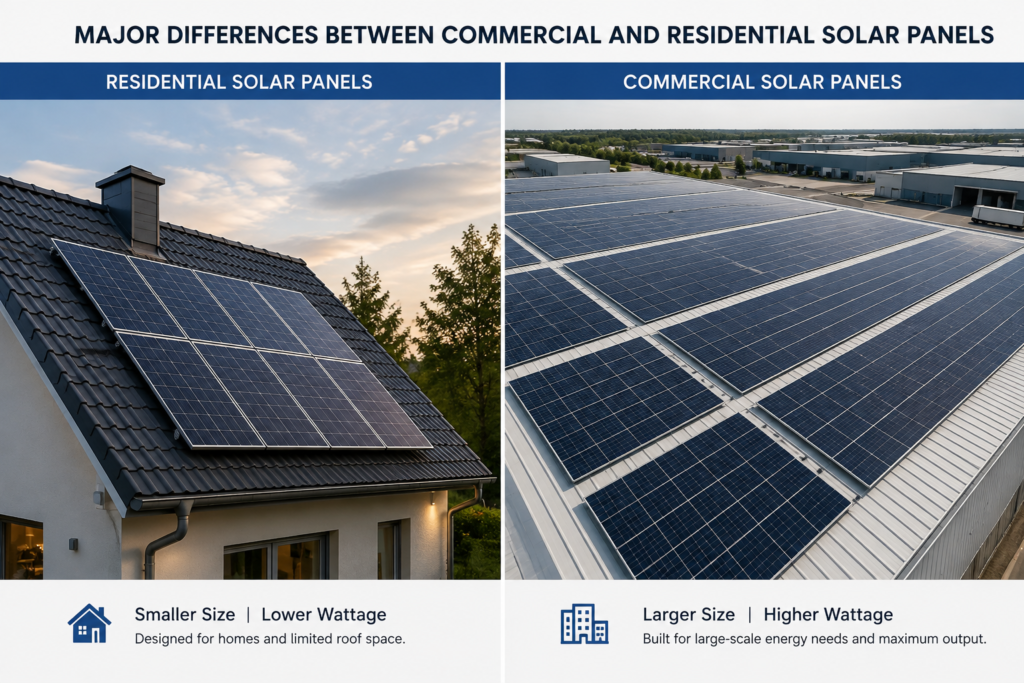
Panel Size
One of the most noticeable differences between commercial and residential solar panels is their physical size.
Commercial projects often use larger solar modules because large buildings usually have more installation space and higher electricity requirements.
Residential panels are generally easier to handle and install on smaller rooftops.
However, a larger panel is not automatically a better panel.
If your roof has limited usable space, a high-efficiency panel may provide more power from the same area.
When comparing panel size, check:
- Length and width
- Weight
- Power rating
- Efficiency
- Watts per square meter
- Mounting requirements
- Roof loading limitations
Power Output
Commercial solar panels are often available with higher wattage ratings than traditional residential modules.
For example, large commercial projects may use high-wattage panels to reduce the total number of modules required to reach a specific system capacity.
However, panel wattage should not be confused with actual daily energy production.
A 550-watt panel does not continuously produce 550 watts throughout the day.
Actual production depends on:
- Sunlight intensity
- Panel orientation
- Tilt angle
- Temperature
- Shading
- Dust
- System losses
- Inverter efficiency
- Local weather conditions
Therefore, always consider expected energy production rather than looking only at the wattage printed on the panel.
System Size
System size is another major difference.
A residential solar system is normally designed around household electricity consumption and available roof space.
A commercial system can be much larger because businesses may have significant electricity loads from:
- Air conditioning
- Refrigeration
- Industrial machinery
- Pumps
- Motors
- Lighting
- Computers
- HVAC equipment
- Production equipment
A commercial project may therefore require dozens, hundreds, or even thousands of solar panels.
Commercial systems often use higher-wattage modules, such as 610W solar panels, because they can provide more power per module and may reduce the total number of panels required.
Solar Inverters
The solar inverter converts DC electricity generated by the solar panels into AC electricity that can be used by electrical appliances and equipment.
Residential systems commonly use:
- String inverters
- Microinverters
- Hybrid inverters
Commercial systems can use:
- Larger string inverters
- Central inverters
- Multiple inverter configurations
The inverter must be selected according to the system’s size and electrical requirements.
Commercial properties often use three-phase electrical systems, making electrical design more complex than a typical small residential installation.
When choosing an inverter, consider:
- DC input capacity
- AC output
- Voltage
- Phase
- Efficiency
- MPPT configuration
- Monitoring
- Battery compatibility
- Grid requirements
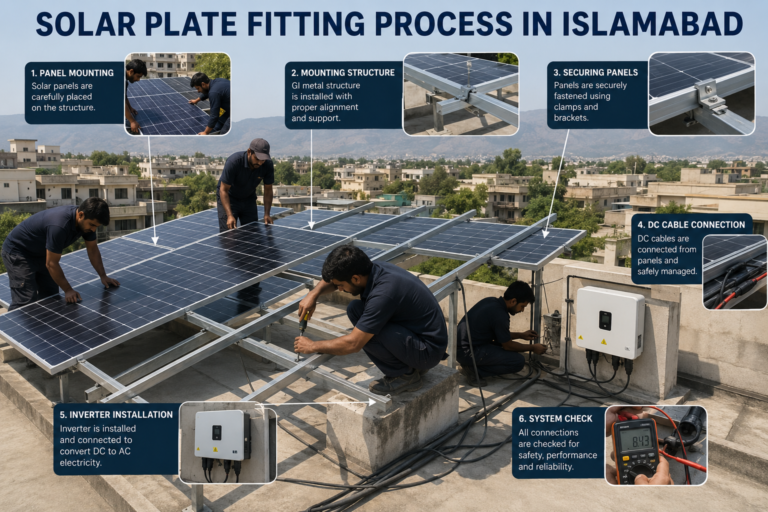
Installation Method
Residential solar panels are most commonly installed on house rooftops.
Commercial solar systems can be installed on:
- Flat roofs
- Metal roofs
- Large industrial rooftops
- Parking structures
- Ground-mounted structures
- Commercial buildings
Large commercial installations require more detailed planning.
Engineers may need to consider:
- Structural loading
- Wind loads
- Roof condition
- Drainage
- Shading
- Maintenance access
- Cable routing
- Fire and safety requirements
Cost
The total cost of a solar system includes much more than the price of solar panels.
You may also need to pay for:
- Solar inverter
- Mounting structure
- Wiring
- Protection equipment
- Installation labor
- Engineering
- Transportation
- Monitoring
- Permits and approvals
- Battery storage, if required
- Grid connection work
A residential solar system normally costs less overall because it is smaller.
A commercial system requires a larger initial investment, but larger projects can sometimes benefit from economies of scale.
Instead of comparing only the price of individual panels, compare:
Total installed cost ÷ total system capacity
This gives you a more useful cost-per-watt comparison.
Electricity Consumption
Electricity consumption patterns can be very different between homes and businesses.
A residential property may have higher electricity use during the morning and evening when family members are at home.
A business may consume most of its electricity during working hours.
This can be particularly useful for solar because solar panels generate electricity during daylight hours.
For example, an office using air conditioning, computers, lighting, and other equipment during the day may be able to directly use a significant portion of its solar generation.
Maintenance and Monitoring
Both residential and commercial solar systems require maintenance.
Commercial systems, however, contain more panels and equipment, so monitoring and maintenance can become more important.
Maintenance may include:
- Cleaning solar panels
- Inspecting cables
- Checking mounting structures
- Inspecting inverters
- Monitoring system performance
- Checking electrical connections
- Removing excessive dust or debris
- Managing vegetation around ground-mounted systems
A monitoring system can help identify production problems quickly.
If one part of a large commercial solar array stops working, monitoring can help locate the issue before it causes significant energy losses.
Are Commercial Solar Panels More Efficient?
Not necessarily.
This is one of the most important points to understand.
Solar panel efficiency depends on the specific technology and model rather than simply whether the panel is classified as residential or commercial.
A high-efficiency residential solar panel can have a higher efficiency rating than a particular commercial panel.
At the same time, a commercial solar project may generate much more total electricity because it uses:
- More panels
- Larger panels
- More roof space
- Greater total system capacity
Therefore:
Panel efficiency is not the same as total system production.
When comparing solar panels, look at the complete specifications instead of choosing based only on the residential or commercial label.
Can You Use Residential Solar Panels for a Commercial Building?
Yes, in some situations.
Residential and commercial solar panels use the same basic photovoltaic technology. The main differences are often their physical dimensions, power ratings, electrical characteristics, and intended applications.
A commercial building can potentially use residential-sized solar panels if those panels meet the project’s technical requirements.
However, the decision depends on:
- Roof area
- Required system capacity
- Panel dimensions
- Structural limitations
- Electrical design
- Inverter compatibility
- Budget
- Local regulations
- Installation requirements
The opposite can also be possible: some larger commercial panels may technically work in certain residential applications, but their size and weight may make them impractical for a home.
So instead of asking:
“Are commercial solar panels better?”
Ask:
“Which solar panel is best for my property’s electricity needs, available space, and system design?”
How Many Solar Panels Does a Commercial Building Need?
There is no fixed number of panels required for every commercial building.
A basic calculation is:
Number of panels = Required solar capacity ÷ Panel wattage
For example, if a business wants to install a 100 kW solar array using 500-watt panels:
100,000 watts ÷ 500 watts = 200 panels
This is only a basic calculation.
A professional solar design should also consider:
- Annual electricity consumption
- Daytime electricity demand
- Roof area
- Panel orientation
- Shading
- Temperature
- System losses
- Inverter capacity
- Electrical infrastructure
- Local solar conditions
- Desired energy production
Commercial vs Residential Solar Panels: Pros and Cons
Residential Solar Panels
Pros
- Suitable for home rooftops
- Easier to fit around rooftop obstacles
- Available in many high-efficiency models
- Suitable for smaller systems
- Wide range of residential inverters
- Can be combined with batteries for backup
Cons
- Smaller modules may require more panels for large systems
- Residential rooftops can have limited usable space
- Cost per watt can sometimes be higher for small installations
Commercial Solar Panels
Pros
- Suitable for large solar installations
- High-wattage modules are widely available
- Can make good use of large rooftops
- Suitable for businesses and industrial properties
- Large projects can benefit from economies of scale
- Can significantly reduce business electricity costs
Cons
- Higher total project investment
- Larger modules can be heavier
- Installation is usually more complex
- May require detailed structural and electrical engineering
- Maintenance can involve larger and more equipment
Best Solar Panel Brands for Residential and Commercial Solar Systems
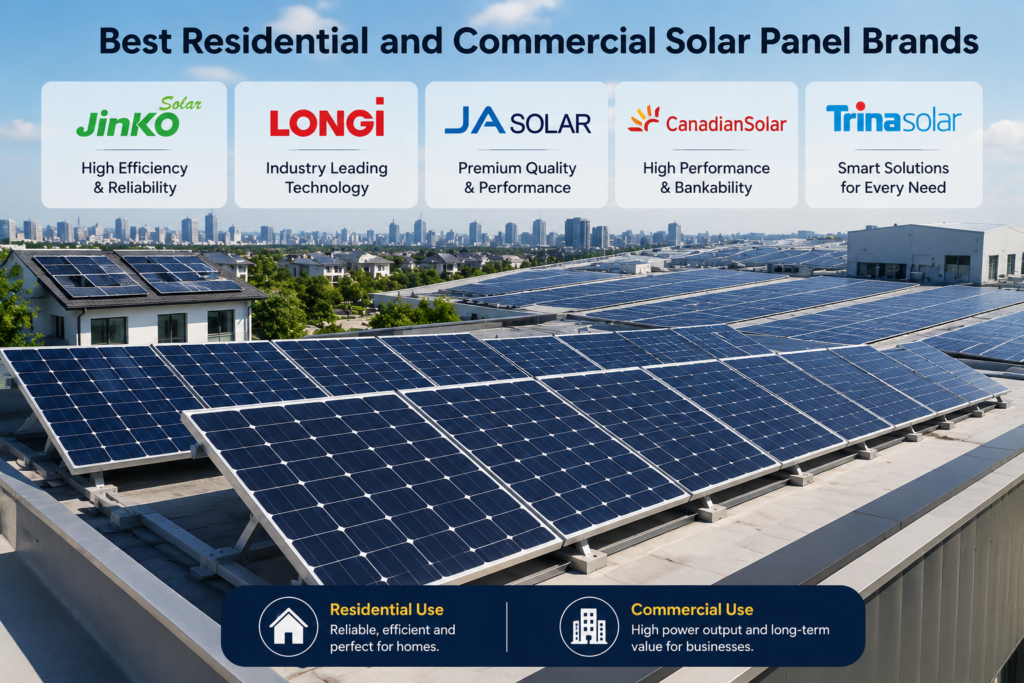
Choosing the right solar panel brand is almost as important as choosing the right system size. A good solar panel should offer reliable performance, suitable efficiency, a strong warranty, low degradation, and dependable manufacturer support.
Some brands are especially popular for residential installations, while others have a strong presence in large commercial and utility-scale projects. However, most leading manufacturers offer panels for both residential and commercial applications.
For buyers in Pakistan, five names worth comparing are Jinko Solar, LONGi Solar, JA Solar, Canadian Solar, and Trina Solar. These manufacturers also have a significant global presence and offer modern high-efficiency module technologies.
Top Solar Panel Brands at a Glance
| Brand | Best Known For | Residential | Commercial | Global Market |
|---|---|---|---|---|
| Jinko Solar | N-type technology and strong availability | ✅ | ✅ | ✅ |
| LONGi Solar | High efficiency and advanced module technology | ✅ | ✅ | ✅ |
| JA Solar | Value and broad product range | ✅ | ✅ | ✅ |
| Canadian Solar | Commercial projects and broad global presence | ✅ | ✅ | ✅ |
| Trina Solar | Large commercial and utility-scale projects | ✅ | ✅ | ✅ |
Important: The best choice can change depending on the exact panel model. Always compare the current datasheet, efficiency, power rating, temperature coefficient, degradation rate, warranty, authenticity, and price before purchasing.
1. Jinko Solar
Jinko Solar is one of the most recognized solar panel manufacturers in Pakistan and worldwide. Its Tiger Neo family is particularly well known for modern N-type TOPCon technology.
Jinko panels are available for both residential rooftops and larger commercial installations. Current Pakistan market comparisons frequently list Jinko among the leading brands available to buyers.
Why choose Jinko Solar?
- Strong N-type/TOPCon product range
- High-efficiency modules
- Available in residential and commercial formats
- Widely recognized internationally
- Popular among Pakistani solar installers
- Suitable for large rooftop and commercial projects
Best for:
Residential: Homeowners looking for a high-efficiency modern panel.
Commercial: Businesses that need high-wattage modules for larger rooftop or industrial systems.
Popular series:
Tiger Neo
Always check the exact model because specifications vary between generations.
2. LONGi Solar
LONGi Solar is another major global solar manufacturer and one of the most commonly compared brands in Pakistan.
The company’s Hi-MO family includes advanced solar modules designed for different applications, including residential, commercial, and utility-scale projects.
LONGi is particularly attractive when roof space is limited, because higher-efficiency modules can help increase installed capacity within a restricted area.
Current Pakistan comparisons frequently place LONGi among the leading choices for both residential and commercial installations.
Why choose LONGi?
- High-efficiency module options
- Strong global presence
- Wide product range
- Suitable for residential rooftops
- Suitable for commercial installations
- Advanced cell technologies
Best for:
Residential: Homes with limited usable roof space where maximizing watts per square meter is important.
Commercial: Commercial rooftops where high power density and long-term performance are priorities.
Popular series:
Hi-MO series
Because LONGi has multiple generations and technologies, buyers should compare the exact model rather than choosing only by the LONGi name.
3. JA Solar
JA Solar is another globally recognized solar manufacturer that is widely available in Pakistan.
Its panels are used in residential, commercial, and utility-scale applications. Current Pakistan market guides commonly include JA Solar among the major brands buyers compare with Jinko and LONGi.
Why choose JA Solar?
- Established global manufacturer
- Modern N-type module options
- Broad range of panel sizes and power ratings
- Suitable for residential installations
- Suitable for commercial solar projects
- Competitive value in many markets
Best for:
Residential: Homeowners looking for a balance between panel performance and overall system cost.
Commercial: Businesses looking for established modules for larger solar installations.
Popular family:
DeepBlue series
As with other manufacturers, the specifications depend on the exact model and generation.
4. Canadian Solar
Despite its name, Canadian Solar operates as a global solar technology and manufacturing company with products used in many international markets.
Canadian Solar offers modules for residential, commercial, and utility-scale applications.
It is particularly worth considering for larger projects where bankability, product range, and long-term manufacturer presence are important.
Current Pakistan comparisons regularly include Canadian Solar alongside Jinko, LONGi, JA Solar, and Trina.
Why choose Canadian Solar?
- Strong international presence
- Wide range of solar modules
- Residential and commercial options
- High-efficiency module choices
- Strong presence in larger solar projects
- Established manufacturer
Best for:
Residential: Homeowners who want an established international manufacturer.
Commercial: Businesses and larger projects where long-term manufacturer reputation and project-scale product options are important.
Popular product families:
Canadian Solar offers several module families, including TOPHiKu and other high-efficiency product lines.
5. Trina Solar
Trina Solar is another major international solar manufacturer with a strong presence across residential, commercial, and utility-scale markets.
Its Vertex family is particularly associated with high-power modules and larger installations.
Current Pakistan comparisons commonly list Trina alongside Jinko, LONGi, JA Solar, and Canadian Solar.
Why choose Trina Solar?
- Strong global presence
- High-power module options
- Suitable for large rooftop installations
- Commercial and utility-scale experience
- Modern N-type module options
Best for:
Residential: Homeowners who want a globally established manufacturer and a suitable high-efficiency module.
Commercial: Larger businesses, warehouses, factories, and other projects where high-power modules can help reduce the number of modules required.
Are Tier-1 Solar Panels Better?
You will often see sellers in Pakistan use the term “Tier 1” when advertising solar panels.
Be careful with this term.
Tier 1 is not a simple quality rating for an individual solar panel. It is primarily related to manufacturer bankability and financing criteria. A buyer should still examine the actual module’s technical specifications, warranty, authenticity, and installation quality.
So don’t choose a panel simply because a seller says:
“This is Tier 1.”
Instead, ask for the exact model number and official datasheet.
How to Avoid Fake Solar Panels in Pakistan
Brand popularity also creates a problem: well-known panels can be attractive targets for counterfeit or improperly sourced products.
Before buying expensive solar panels:
Check the panel model
Make sure the model on the quotation matches the model on the physical panel and datasheet.
Verify the serial number
Where the manufacturer provides an official verification system, use it.
Check the documentation
Ask the supplier for proper product documentation and warranty information.
Compare the price
If a supposedly premium panel is dramatically cheaper than comparable market offers, investigate why.
Buy from a reputable supplier
A genuine panel from a reliable supplier is generally a better investment than a cheaper panel with uncertain origin.
Commercial vs Residential Solar Panels: Which Brands Can Be Used for Both?
One important point is that you do not necessarily need a separate “commercial brand” and “residential brand.”
Many major manufacturers produce modules for both markets.
For example:
Jinko → Residential + Commercial + Utility
LONGi → Residential + Commercial + Utility
JA Solar → Residential + Commercial + Utility
Canadian Solar → Residential + Commercial + Utility
Trina Solar → Residential + Commercial + Utility
The difference is usually more about the specific module design, power rating, dimensions, system requirements, and project scale than the brand name itself.
How to Choose the Right Solar Panels
Whether you are buying residential or commercial solar panels, the brand should not be your only consideration.
Check the Panel Efficiency
Higher efficiency can be useful when available roof space is limited.
However, do not choose a panel based on efficiency alone.
Compare Power Output
A higher-wattage panel can reduce the number of panels required for a particular system capacity.
But always check the physical dimensions as well.
Check the Warranty
Look for both:
- Product warranty
- Performance warranty
Also check the terms and conditions rather than looking only at the number of years.
Check the Degradation Rate
Solar panels gradually lose some power output over time.
A lower degradation rate can help maintain better long-term energy production.
Consider the Temperature Coefficient
Solar panel output can decrease as panel temperature rises.
A better temperature coefficient can be beneficial in hot climates such as Pakistan.
Check Panel Dimensions and Weight
This is particularly important for rooftops.
A panel may have excellent specifications but still be unsuitable if its size or weight creates installation or structural problems.
Verify the Product Is Genuine
Always check the exact model number, documentation, serial number, and manufacturer’s verification system where available.
Compare Price Per Watt
Instead of comparing only the price of one panel, calculate:
Panel price ÷ panel wattage = price per watt
For a complete project, it is even better to compare the total installed cost per watt.
Commercial Solar Panels for Businesses
Commercial solar can be particularly valuable for businesses with significant daytime electricity consumption.
Examples include:
- Offices
- Factories
- Warehouses
- Hotels
- Schools
- Hospitals
- Shopping centers
- Restaurants
- Farms
- Cold storage facilities
Before installing a commercial solar system, a business should review its electricity consumption and load profile.
Why Daytime Electricity Use Matters
Solar panels produce electricity primarily during daylight hours.
If a business consumes substantial electricity during the day, it may be able to directly use a large portion of its solar generation.
This can help reduce the amount of electricity purchased from the grid.
Commercial Solar and Return on Investment
A commercial solar system should be evaluated as a long-term investment.
Important factors include:
- System cost
- Annual electricity generation
- Electricity tariff
- Self-consumption
- Export arrangements
- Maintenance cost
- Inverter replacement
- System degradation
- Financing cost
- Expected payback period
A professional solar assessment can provide a more accurate estimate than using a generic payback formula.
Residential Solar Panels for Homes
Residential solar systems are designed around household electricity consumption and the available roof area.
Before buying a residential system, identify the appliances you want the system to operate.
These may include:
- Fans
- Lights
- Refrigerator
- Television
- Washing machine
- Water pump
- Air conditioner
- Computers
- Other household appliances
You should also decide whether you need:
- On-grid solar
- Off-grid solar
- Hybrid solar
- Battery backup
The correct configuration depends on your electricity needs, grid reliability, budget, and backup requirements.
Commercial vs Residential Solar Panels in Pakistan
Solar power is increasingly important for both homeowners and businesses in Pakistan.
Residential properties commonly use solar power for household appliances, while commercial and industrial properties may have much larger electricity loads.
Commercial electricity consumption can include:
- Industrial machinery
- Motors
- Pumps
- HVAC systems
- Refrigeration
- Commercial lighting
- Office equipment
- Production equipment
For larger commercial installations, electrical infrastructure and three-phase systems may also be important considerations.
Final Verdict: Commercial vs Residential Solar Panels
The difference between commercial vs residential solar panels is mainly related to the property’s electricity requirements, installation scale, available space, and system design.
Residential solar panels are generally designed for homes where roof space, household electricity consumption, appearance, and smaller system sizes are important.
Commercial solar panels and systems are generally designed for businesses, factories, warehouses, offices, and other larger properties where electricity consumption and system capacity are much higher.
When choosing solar panels, do not simply ask whether a panel is residential or commercial.
Instead, compare:
- Efficiency
- Power output
- Panel size
- Temperature coefficient
- Degradation rate
- Warranty
- Manufacturer reputation
- Authenticity
- Price per watt
- Inverter compatibility
- Installation requirements
- Expected energy production
For buyers in Pakistan, Jinko Solar, LONGi, JA Solar, Canadian Solar, and Trina Solar are good brands to include in your comparison.
Ultimately, the best solar panel is not necessarily the panel with the highest wattage or the most famous brand. It is the panel that provides the right combination of performance, reliability, available space, price, warranty, and long-term value for your specific solar system.
Are commercial and residential solar panels the same?
Are commercial and residential solar panels the same?
They use the same basic photovoltaic technology, but their size, power rating, electrical characteristics, and intended applications can differ.
Are commercial solar panels more powerful?
Commercial modules are often available in higher-wattage formats, but power output depends on the specific panel model rather than whether it is labeled commercial.
Are commercial solar panels more efficient?
Not necessarily. Efficiency depends on the individual panel’s technology and design. A high-efficiency residential panel can be more efficient than a particular commercial module.
Are commercial solar panels cheaper?
The total cost of a commercial solar project is normally higher because the system is larger. However, large projects can sometimes achieve a lower cost per watt because of economies of scale.
Can I use commercial solar panels for my house?
Some commercial-sized panels can technically be used in residential systems, but their size, weight, electrical specifications, and installation requirements may make them unsuitable for a particular home.
Which solar panel brand is best for commercial use?
Jinko Solar, LONGi, Canadian Solar, Trina Solar, and JA Solar are major brands worth considering for commercial applications. The final choice should be based on the complete project requirements rather than brand name alone.
Do commercial solar systems need batteries?
No. A commercial solar system can operate without batteries. Batteries may be added when backup power, energy storage, or greater control over electricity usage is required.
How many solar panels does a business need?
It depends on the required system capacity and panel wattage. For example, a 100 kW system using 500W panels would require approximately 200 panels before considering design factors and system losses.
Do commercial solar panels last longer than residential panels?
Not necessarily. Lifespan depends on the specific panel, manufacturer, environmental conditions, installation quality, degradation rate, and warranty terms.
Do solar panels work differently on homes and businesses?
The basic photovoltaic process is the same. The major differences are usually the scale of the installation, electrical design, panel configuration, energy consumption, and installation environment.
Can residential solar panels be used for a commercial building?
Yes, in some cases. If the panels meet the required technical, structural, electrical, and installation requirements, residential-sized modules can potentially be used in a commercial project.
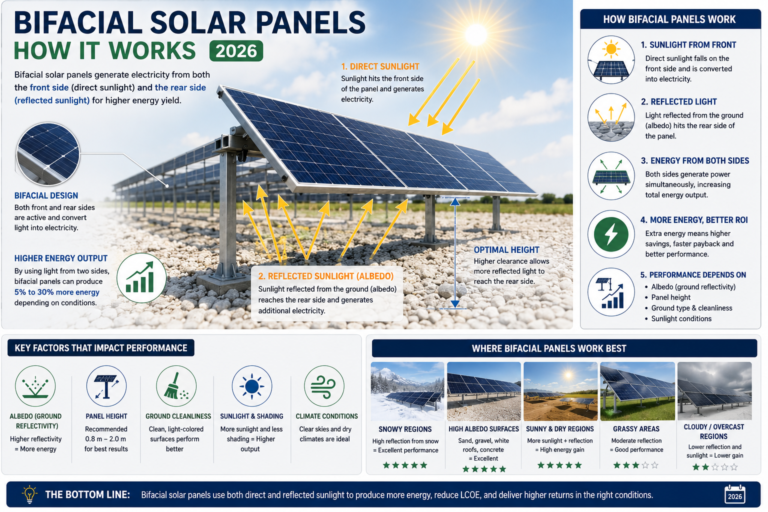
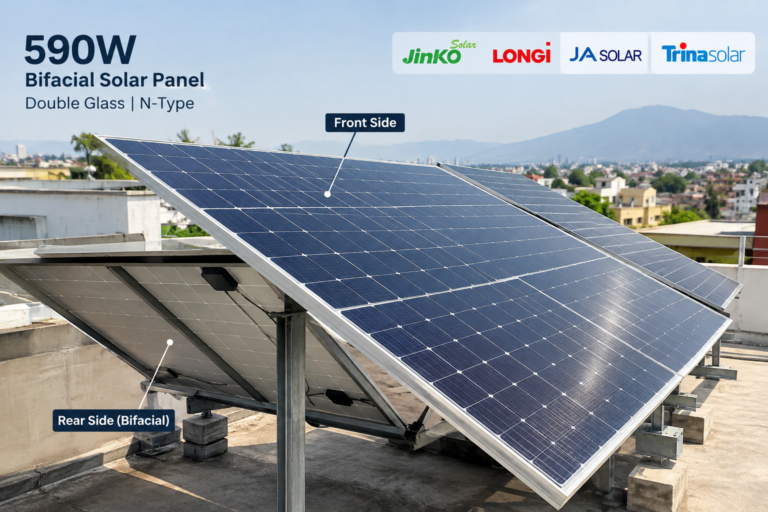
High-power modules such as 590W bifacial solar panels can be considered for both large residential rooftops and commercial solar installations, depending on roof space and system design.
Which solar panel brand is best for residential use?
LONGi, Jinko Solar, JA Solar, Canadian Solar, and Trina Solar are all brands worth comparing. The best choice depends on the exact model, price, efficiency, warranty, roof space, and installation requirements.