
Deep Cycle Battery for Solar: The Complete Buying Guide
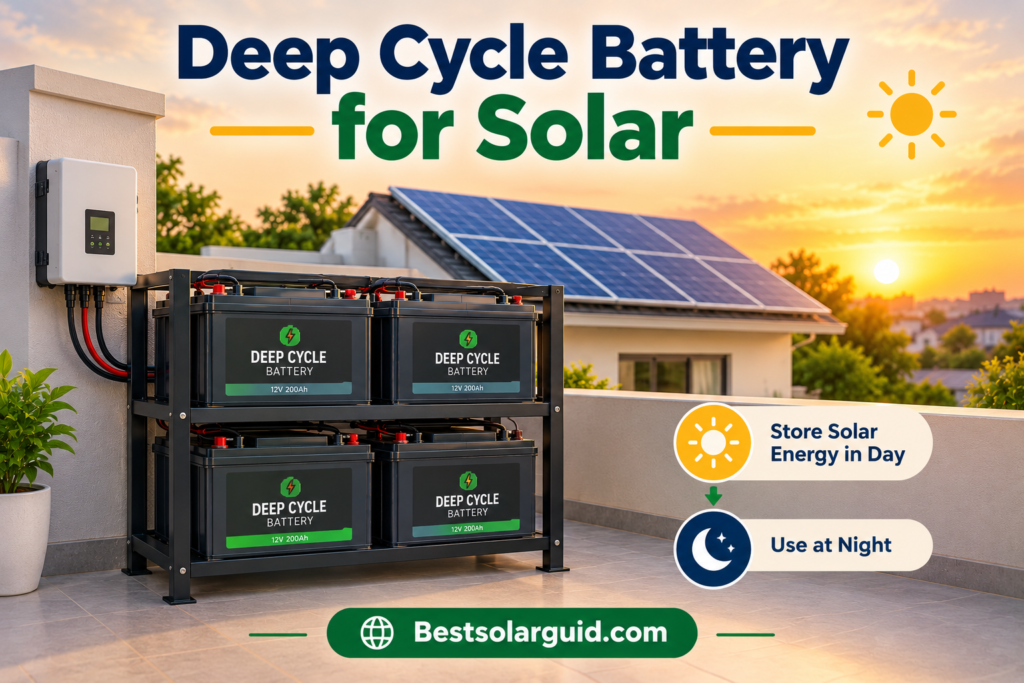
A solar panel only makes power while the sun is up. Your home needs it at night, during cloudy spells and in outages. A deep cycle battery bridges that gap by storing surplus energy and releasing it steadily when you need it. Pick the wrong one and you’ll replace it in two years. Pick the right one and it can run for a decade or more.
This guide explains what a deep cycle battery is, how the main types compare, and how to choose the right size for your system.
Table of Contents
- What Is a Deep Cycle Battery?
- Why Solar Systems Need Deep Cycle Batteries
- Types of Deep Cycle Solar Batteries
- Comparison Table
- How to Size Your Battery Bank
- Key Specs to Check Before Buying
- Battery Care Tips
- Common Mistakes to Avoid
- FAQs
What Is a Deep Cycle Battery?
A deep cycle battery is built to discharge a large share of its stored energy, again and again, without damage. A car battery does the opposite: it delivers a huge burst of power for a few seconds to start the engine, then gets topped up straight away.
Deep cycle batteries use thicker internal plates (in lead-acid models) or specialized cell chemistry (in lithium models) so they can handle repeated heavy discharge and recharge cycles.
Why Solar Systems Need Deep Cycle Batteries
Solar generation and household demand rarely line up. Panels peak around midday, while demand often peaks in the evening. A deep cycle battery:
- Stores extra daytime energy instead of wasting it
- Powers your home at night and during outages
- Smooths out voltage for sensitive appliances
- Lowers your dependence on the grid or a generator
Using a starter battery for this job would wear it out within months.
Types of Deep Cycle Solar Batteries
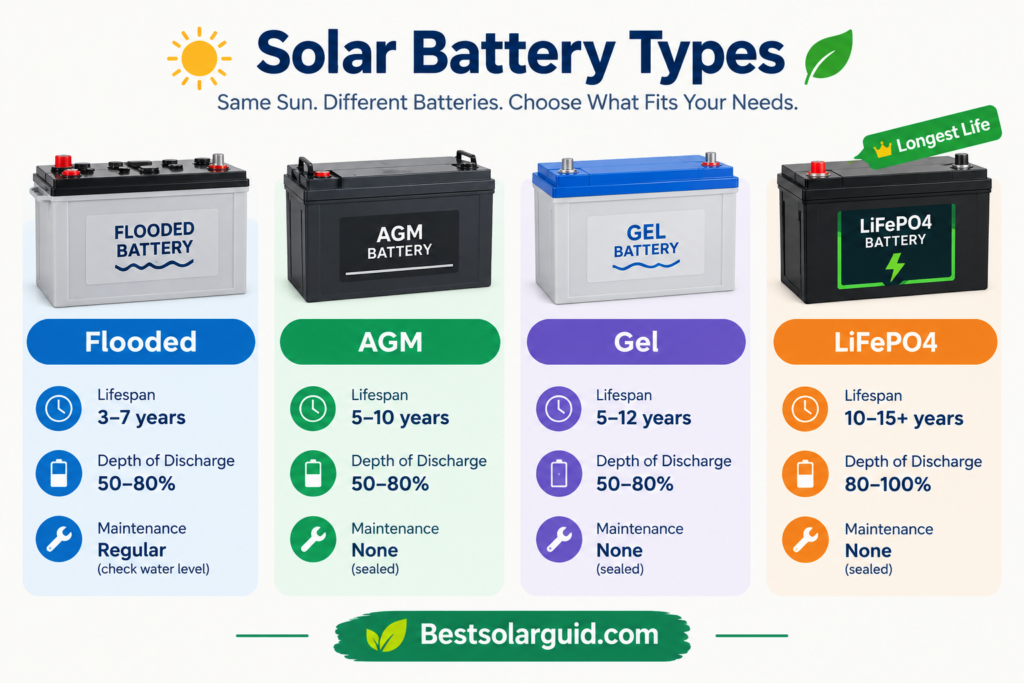
Flooded lead-acid (FLA). The traditional, budget-friendly choice. It offers solid cycle life when maintained, but you must top up distilled water and keep it well ventilated. Best for people who don’t mind regular upkeep.
AGM (Absorbent Glass Mat). Sealed and maintenance-free, with acid held in glass mats. It tolerates vibration and can be mounted in different positions. It costs more than flooded but is easier to live with.
Gel. Also sealed, with the electrolyte in gel form. It handles slow, deep discharges and heat quite well, but it is sensitive to overcharging, so the charge settings must be correct.
Lithium iron phosphate (LiFePO4). The premium option. It allows deeper usable discharge, lasts far more cycles, is much lighter and needs no maintenance. The upfront price is higher, but the cost per cycle is often lower over the battery’s life.
Comparison Table
| Feature | Flooded | AGM | Gel | LiFePO4 |
|---|---|---|---|---|
| Upfront cost | Lowest | Medium | Medium–High | Highest |
| Typical usable depth of discharge | ~50% | ~50% | ~50–60% | ~80–90% |
| Typical cycle life | 500–1,200 | 500–1,000 | 600–1,200 | 3,000–6,000+ |
| Maintenance | Regular | None | None | None |
| Weight | Heavy | Heavy | Heavy | Light |
| Best for | Tight budgets | Easy, sealed setups | Hot or slow-discharge use | Long-term daily cycling |
Figures are typical ranges and vary by brand and model, so always check the manufacturer’s datasheet.
How to Size Your Battery Bank
Sizing takes four steps:
- Add up your nightly or backup load. List the appliances you want to run and their wattage and hours. For example, 600 W for 5 hours = 3,000 Wh.
- Add days of autonomy. Decide how many cloudy days you want covered. One day is common; two or more is safer for off-grid homes.
- Account for depth of discharge. Divide your energy need by the usable percentage. For a 3,000 Wh load on a lead-acid battery at 50%: 3,000 ÷ 0.5 = 6,000 Wh of total capacity.
- Convert to amp-hours. Divide watt-hours by system voltage. 6,000 Wh ÷ 24 V = 250 Ah.
Add a small margin (about 10–20%) for inverter losses and battery aging.
If you’re comparing battery capacities for home backup, our 5kWh battery guide explains how much energy this size can store and which household needs it may suit.
Key Specs to Check Before Buying
- Capacity (Ah or kWh): how much energy it stores
- Voltage (12 V, 24 V, 48 V): must match your inverter and system design
- Depth of discharge (DoD): how much you can safely use each cycle
- Cycle life: the number of cycles at a stated DoD, since a cycle figure with no DoD means little
- Efficiency: lithium typically wastes less energy than lead-acid
- Warranty: check years, throughput limits and what counts as misuse
- Operating temperature range: crucial in very hot or cold climates
Battery lifespan depends on chemistry, depth of discharge, temperature, and charging habits. For a closer look at expected service life and the factors that affect it, see our guide to the lifespan of solar panel batteries.
Battery Care Tips
- Keep batteries in a cool, dry, ventilated place, away from direct sun
- Avoid regularly draining lead-acid batteries below 50%
- Use a charge controller and inverter with settings that match your battery type
- Tighten terminals and keep them clean to prevent resistance and heat
- For flooded batteries, check water levels monthly and use only distilled water
- Don’t mix old and new batteries or different brands in one bank
Proper maintenance can help extend battery life and prevent avoidable performance problems. Read our complete guide to solar battery maintenance for practical tips on keeping your battery in good condition.
Common Mistakes to Avoid
- Buying on price alone. A cheap battery that dies in two years costs more than a pricier one that lasts ten.
- Undersizing the bank. Constant deep discharging shortens life dramatically.
- Ignoring compatibility. Not every lithium battery works with every inverter. Confirm communication and voltage support.
- Using car batteries. They are not built for deep discharge.
- Skipping proper wiring and protection. Fuses, correct cable sizes and breakers are not optional.
FAQs
What is the best deep cycle battery for solar?
For daily use and long life, LiFePO4 is generally the strongest choice. For tight budgets, AGM or flooded batteries still work well if sized and maintained properly.
How long does a deep cycle solar battery last?
Lead-acid typically lasts 3–7 years, depending on depth of discharge and care. Quality lithium can last 10 years or more.
Can I use a regular car battery with solar panels?
It’s not recommended. Car batteries are designed for short bursts of power, and deep discharging ruins them quickly.
How many batteries do I need for a solar system?
It depends on your daily energy use, desired backup time and system voltage. Use the sizing steps above to calculate it.
Is lithium worth the extra cost?
For most people who cycle their battery daily, yes. Its longer life, higher usable capacity and zero maintenance usually bring the cost per cycle below lead-acid.
Do deep cycle batteries need maintenance?
Flooded batteries do. AGM, gel and lithium are essentially maintenance-free.
Final Thoughts
The best deep cycle battery for solar is the one that fits your load, budget and climate. Size it honestly, match it to your inverter, and look at cost per cycle rather than sticker price. Do that, and your battery bank will quietly do its job for years.
Agar chahein to main is article ko Pakistan ke prices aur local market angle ke saath update kar sakti hoon, ya competitors ki SERP check karke headings aur bhi tight kar sakti hoon. Batayein?