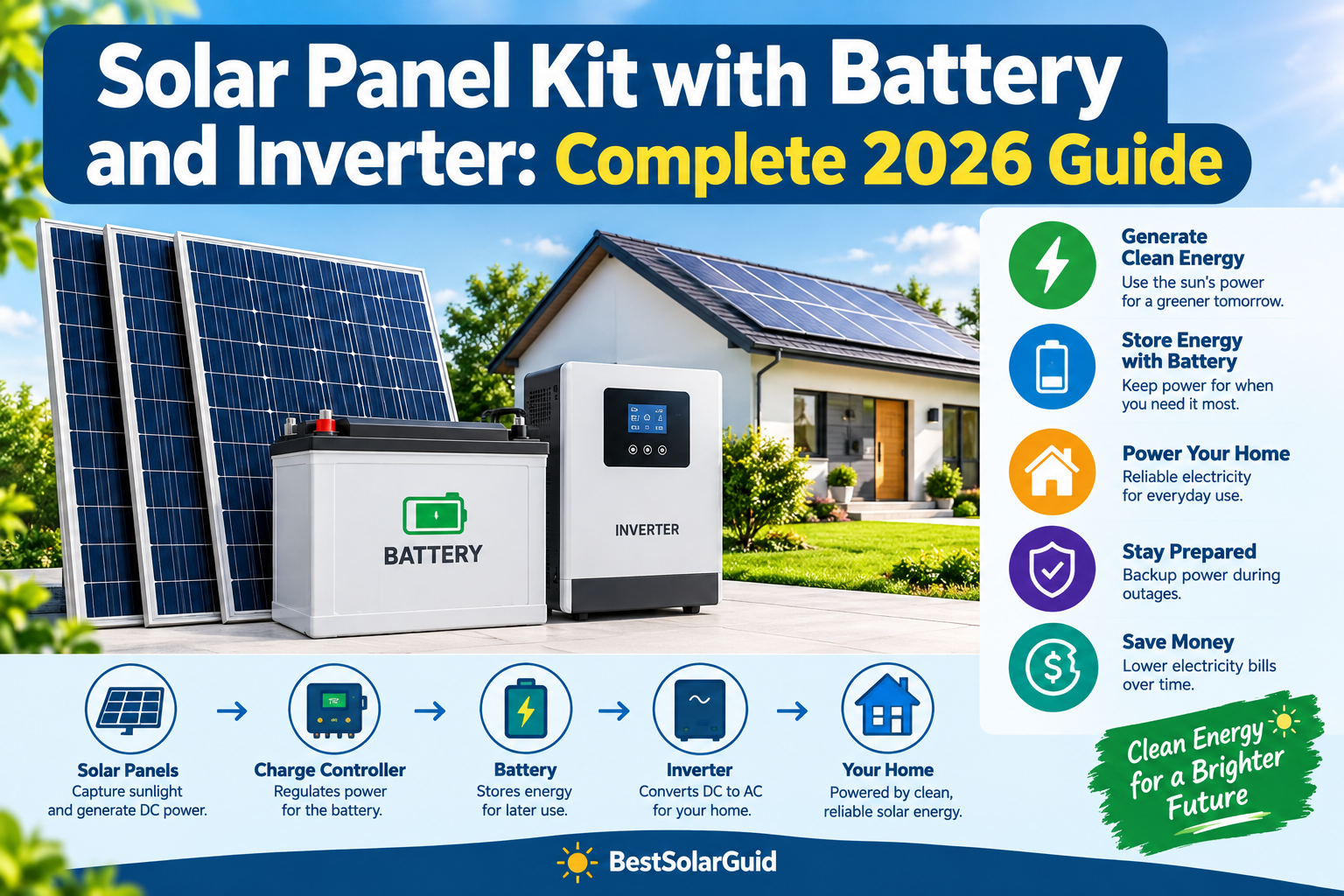
Solar Panel Kit with Battery and Inverter: Complete 2026 Guide for Homeowners
A solar panel kit with a battery and inverter can give your home a reliable way to generate, store, and use solar electricity. Instead of buying every major component separately, a complete kit brings the main parts of a solar power system together and can make the buying and installation process easier.
But choosing a solar kit is not as simple as looking at the number of solar panels or picking the biggest inverter. The panels, battery, inverter, charge controller, wiring, protection devices, and mounting system all need to work together.
This guide explains what a complete solar panel kit with battery and inverter includes, how it works, how to choose the right size, what to check before buying, and the common mistakes you should avoid.
Table of Content
- What Is a Solar Panel Kit with Battery and Inverter?
- How Does a Solar Panel Kit with Battery and Inverter Work?
- What Is Included in a Complete Solar Panel Kit?
- Why Choose a Complete Solar Kit?
- How to Choose the Right Solar Kit Size
- 1kW, 3kW, 5kW, or Larger: Which Kit Do You Need?
- Solar Panel Kit with Battery and Inverter for Pakistan
- How Much Does a Solar Panel Kit with Battery and Inverter Cost?
- What Should You Check Before Buying a Solar Kit?
- Common Mistakes to Avoid
- Advantages of a Solar Panel Kit with Battery and Inverter
- Limitations of a Solar Panel Kit
- Solar Kit vs Buying Components Separately
- Is a Battery Always Necessary?
- Can a Solar Kit Run an Entire House?
- How Long Can the Battery Provide Backup?
- Maintenance Tips for a Solar Kit
- Frequently Asked Questions
- Final Verdict: Is a Solar Panel Kit with Battery and Inverter Worth It?
What Is a Solar Panel Kit with Battery and Inverter?
A solar panel kit with battery and inverter is a complete or pre-configured solar power system designed to generate electricity from sunlight, store excess energy in a battery, and convert solar or stored DC electricity into AC power for household appliances.
The three main components have different jobs:
- Solar panels generate electricity from sunlight.
- The battery stores electrical energy for later use.
- The inverter converts DC electricity into AC electricity that most household appliances use.
A complete kit may also include a charge controller, mounting structure, solar cables, connectors, breakers, fuses, monitoring equipment, and other balance-of-system components.
Not every product advertised as a “complete kit” contains all of these items, so always check the included components before purchasing.
How Does a Solar Panel Kit with Battery and Inverter Work?
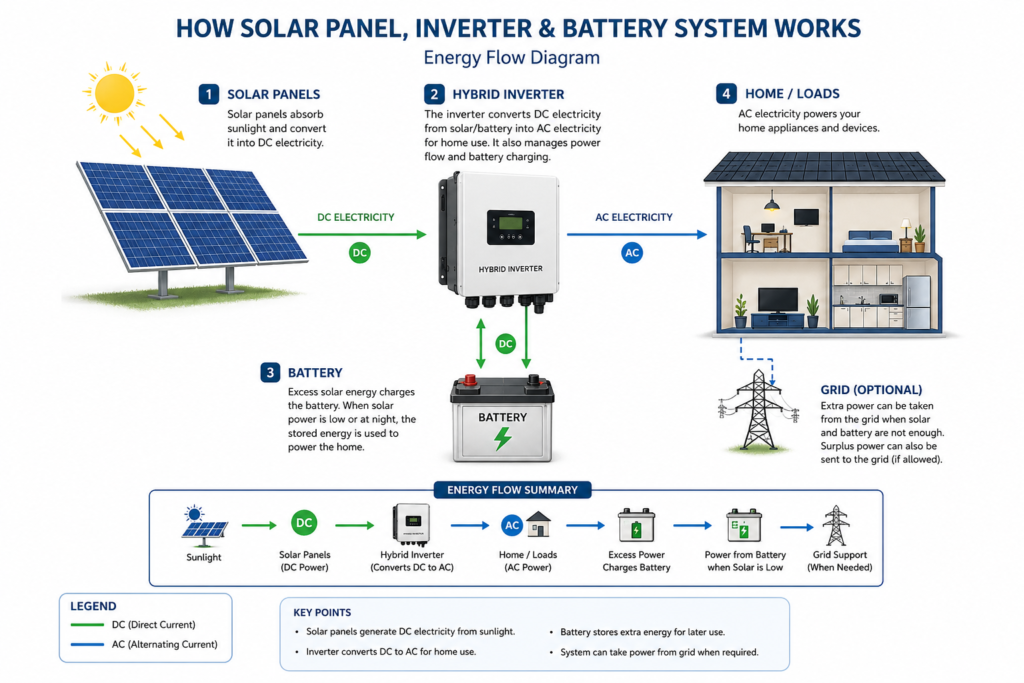
The basic energy flow is straightforward:
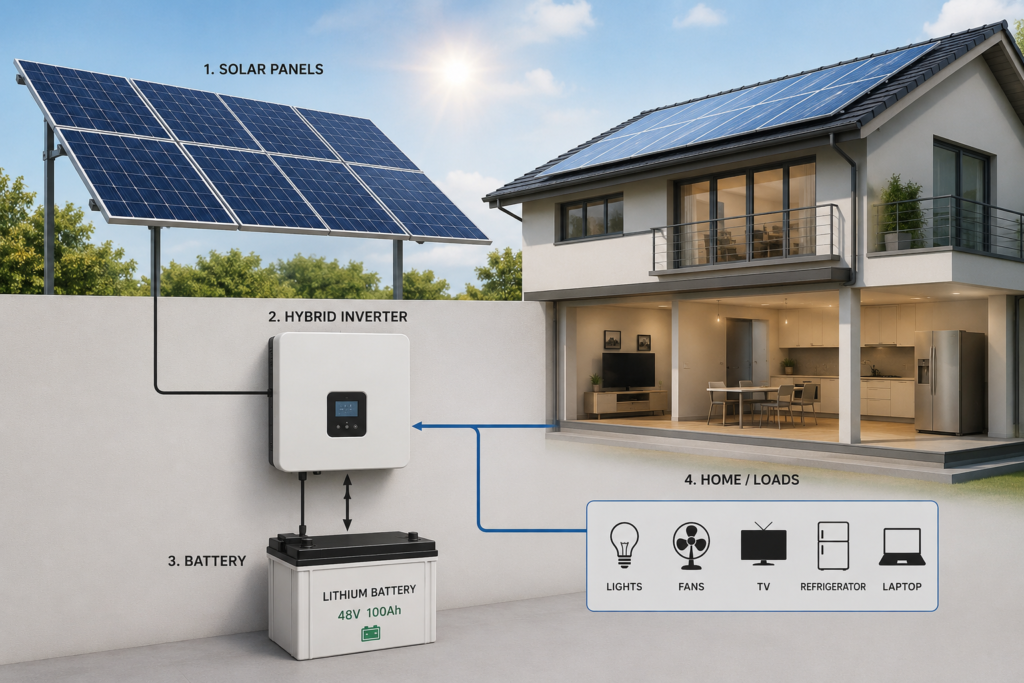
Sunlight → Solar Panels → Inverter/Charge Controller → Home Appliances + Battery
During the day, solar panels produce DC electricity. Depending on the system design and inverter settings, that electricity can power your appliances directly while excess energy charges the battery.
When solar production falls, such as in the evening or during a power outage, the battery can supply stored electricity through the inverter.
In a hybrid system, the inverter can also coordinate electricity from the solar panels, battery, and utility grid.
This makes a battery-based solar system different from a basic grid-tied system, which normally does not provide backup power during a grid outage.
What Is Included in a Complete Solar Panel Kit?
A properly designed kit can contain several components.
1. Solar Panels
Solar panels are the electricity-generating part of the system.
The total panel capacity is normally expressed in watts or kilowatts, such as:
- 1,000W (1kW)
- 3,000W (3kW)
- 5,000W (5kW)
- 10,000W (10kW)
The required capacity depends on your electricity consumption, available sunlight, roof space, and the type of appliances you want to run.
2. Solar Inverter
The inverter is one of the most important components because it manages and converts electrical power.
For a battery-based home system, you may encounter:
- Hybrid inverters
- Off-grid inverters
- Battery inverters
- All-in-one inverter systems
A pure sine wave inverter is generally preferred for residential applications because it provides AC power suitable for a wide range of modern appliances.
Do not choose an inverter only by its headline wattage. Check its continuous output, surge capacity, battery voltage, PV input limits, MPPT range, and compatibility with your battery.
3. Solar Battery
The battery stores energy generated by the solar panels.
Common battery options include:
- Lithium-ion batteries
- LiFePO4 batteries
- Gel batteries
- AGM batteries
- Lead-acid batteries
Lithium-based batteries, especially LiFePO4, are widely used in modern energy-storage systems because of their usable capacity, cycle life, and compact design. However, the best battery depends on your budget, expected usage, system voltage, and inverter compatibility.
4. Charge Controller
Some systems use a separate charge controller, while many modern hybrid inverters have MPPT charge controllers built in.
MPPT technology helps the system extract useful power from the solar array under changing operating conditions.
If your selected kit already has an integrated MPPT controller, you normally do not need to purchase another standalone controller unless the system design specifically requires one.
5. Mounting Structure
Solar panels need a secure mounting structure appropriate for the installation location.
For a roof installation, the structure should be suitable for the roof type and local weather conditions.
6. Solar Cables and Connectors
Properly rated PV cables, connectors, and wiring are essential for safe and efficient operation.
Never assume that ordinary electrical cable is suitable for every solar application.
7. Protection Equipment
A professional installation may require components such as:
- DC isolators
- AC breakers
- DC breakers or fuses
- Surge protection devices
- Earthing/grounding equipment
- Battery protection
- Appropriate disconnects
The exact protection requirements depend on the system design and local electrical standards.
Why Choose a Complete Solar Kit?
A pre-configured solar kit can simplify the process of building a solar system.
Better Component Compatibility
Buying components as a matched package can reduce the risk of selecting an inverter that is incompatible with the battery or solar array.
However, you should still verify the technical specifications instead of assuming every package is automatically compatible.
Easier System Planning
A complete kit gives you a starting point for understanding the overall system size.
Instead of calculating every component from scratch, you can compare complete configurations based on your energy requirements.
Simplified Installation
A properly designed package can make installation easier because the main components are already selected for the intended system.
Professional installation is still recommended for fixed home solar systems.
Backup During Power Outages
A solar system with battery storage can continue supplying selected loads when the grid goes down, provided the inverter and system are designed for backup operation.
This is especially useful in areas where power interruptions are common.
How to Choose the Right Solar Kit Size
This is one of the most important parts of buying a solar kit.
Do not choose a system simply because a seller says a certain size is “best for a home.”
Your system should be based on your actual electricity consumption and the appliances you want to operate.
Step 1: Calculate Your Daily Energy Use
Make a list of the appliances you want to run.
For example:
| Appliance | Power | Daily Use | Approx. Energy |
|---|---|---|---|
| Fan | 80W | 8 hours | 640Wh |
| LED lights | 10W each | 6 hours | 60Wh each |
| Refrigerator | Varies | Varies | Depends on usage |
| TV | 100W | 4 hours | 400Wh |
The basic formula is:
Energy (Wh) = Power (W) × Operating Time (hours)
Add the energy consumption of the appliances to estimate your daily requirement.
Remember that real-world consumption is affected by appliance efficiency, starting loads, inverter losses, weather, and usage patterns.
Step 2: Decide Which Appliances Need Backup
You may not need to run your entire house from the battery.
For example, you might want backup power for:
- Fans
- Lights
- Refrigerator
- Wi-Fi router
- Television
- Computers
- Small appliances
Large loads such as air conditioners, electric heaters, water heaters, and pumps can require much more power.
Separating essential and non-essential loads can significantly change the size and cost of the battery system.
Step 3: Choose the Inverter Size
The inverter must be able to handle the appliances you want to operate at the same time.
For example, if your simultaneous load can reach 3kW, choosing a 1.5kW inverter would not be appropriate.
Also consider starting or surge power.
Some appliances, particularly motors and compressors, can temporarily require considerably more power when they start.
Choosing the right inverter is just as important as selecting the solar panels and battery. If you’re comparing different inverter types and brands, see our complete guide to the [best solar inverters in 2026].
Step 4: Choose the Battery Capacity
Battery capacity is usually expressed in kWh or Ah.
For example, a battery rated at 5kWh has a nominal energy capacity of 5 kilowatt-hours.
But you should not assume that the entire nominal capacity is always available for everyday use.
Usable capacity depends on factors such as:
- Battery chemistry
- Depth of discharge
- Temperature
- Battery age
- Manufacturer specifications
- System losses
This is why comparing batteries only by their Ah rating can be misleading.
Step 5: Size the Solar Panels
The solar array needs to produce enough energy to run daytime loads and recharge the battery according to your system’s operating goals.
Solar production depends on:
- Panel wattage
- Number of panels
- Peak sun hours
- Roof direction
- Tilt angle
- Shading
- Temperature
- Dust and dirt
- System losses
A system that looks large on paper may produce less energy than expected if the panels are heavily shaded or poorly positioned.
1kW, 3kW, 5kW, or Larger: Which Kit Do You Need?
There is no single solar system size that is right for every home.
1kW Solar Kit
A small system may be suitable for basic loads such as lights, fans, networking equipment, and other low-power appliances, depending on the battery and inverter configuration.
3kW Solar Kit
A 3kW system can support a larger combination of household loads, but the actual appliances you can operate depend on the inverter, battery capacity, and solar production.
5kW Solar Kit
A 5kW system can be suitable for homes with higher electricity consumption, but it should still be sized according to actual load requirements rather than simply choosing a larger number.
10kW and Larger Systems
Larger systems may be appropriate for high-consumption homes, businesses, farms, or properties with substantial backup requirements.
For these systems, professional system design becomes even more important.
Solar Panel Kit with Battery and Inverter for Pakistan
For homeowners in Pakistan, the system should be designed around local electricity usage, sunlight conditions, load-shedding patterns, available roof space, and the type of backup required.
A hybrid system can be particularly useful when you want solar generation, battery backup, and grid electricity to work together.
However, system requirements and grid-interconnection rules can change, so check the latest applicable requirements before purchasing or installing a system.
Do not choose a battery size only because it is advertised as suitable for “a Pakistani home.” Every household has a different load profile.
How Much Does a Solar Panel Kit with Battery and Inverter Cost?
There is no single price for a complete solar kit.
The total cost depends on:
- Solar panel capacity
- Panel brand and efficiency
- Inverter capacity and type
- Battery chemistry
- Battery capacity
- Mounting structure
- Protection equipment
- Wiring and installation
- Monitoring equipment
- System size
- Local market prices
Battery storage can make a solar system considerably more expensive than a basic grid-connected system because you are paying for energy storage as well as generation.
For this reason, compare complete system specifications rather than comparing prices alone.
A cheaper kit may contain a smaller battery, lower-quality components, fewer protection devices, or exclude installation and mounting hardware.
What Should You Check Before Buying a Solar Kit?
Before paying for a complete solar panel kit, ask the seller for a detailed specification sheet.
Check these points:
Solar Panels
- Total PV capacity
- Individual panel wattage
- Efficiency
- Warranty
- Manufacturer specifications
Inverter
- Continuous output power
- Surge capacity
- Battery voltage
- PV input range
- MPPT voltage range
- Maximum PV input
- Backup capability
- Warranty
Battery
- Nominal capacity
- Usable capacity
- Battery chemistry
- Maximum charge/discharge current
- Cycle life
- BMS
- Warranty
- Inverter compatibility
Installation
- Mounting structure included?
- Cables included?
- Protection devices included?
- Earthing included?
- Installation included?
- Monitoring included?
These questions can prevent unpleasant surprises after purchase.
Common Mistakes to Avoid
Choosing the Largest System
Bigger is not always better.
An oversized system can increase your upfront cost without providing proportional benefits.
Ignoring Battery Capacity
A large solar array does not automatically mean you will have long backup at night.
Nighttime backup depends heavily on battery capacity and your actual load.
Buying an Incompatible Battery
Not every battery works with every inverter.
Check the supported battery voltage, communication protocol, charge/discharge limits, and manufacturer’s compatibility list where applicable.
Looking Only at Price
The cheapest package may not be the best value.
Always compare what is actually included.
Forgetting Surge Loads
A refrigerator, pump, or motor may have a higher starting requirement than its normal running wattage.
Your inverter should be capable of handling these loads.
Ignoring Shading
Even partial shading can affect solar production.
Check the roof carefully before deciding how many panels you need.
Assuming “Complete Kit” Means Everything Is Included
Always request a written list of included components.
A package may include panels, battery, and inverter but exclude mounting hardware, protection equipment, cables, or installation.
Advantages of a Solar Panel Kit with Battery and Inverter
A well-designed system can provide several benefits:
- Generates electricity from sunlight
- Stores excess solar energy
- Provides backup during grid outages
- Can reduce dependence on grid electricity
- Simplifies system planning
- Can combine solar, battery, and grid power
- May improve energy independence
- Can be expanded in some system designs
Limitations of a Solar Panel Kit
Solar kits also have limitations.
Higher Upfront Cost
Adding battery storage significantly increases the initial investment.
Battery Replacement
Batteries have a finite service life and may eventually need replacement.
Space Requirements
You need enough suitable roof area for the solar panels and an appropriate location for the inverter and battery.
Weather Dependence
Solar generation changes with sunlight, weather, shading, and seasonal conditions.
Installation Requirements
A safe permanent installation requires appropriate electrical protection and professional planning.
Solar Kit vs Buying Components Separately
| Feature | Complete Solar Kit | Separate Components |
| Component selection | Easier | More flexible |
| Compatibility | Usually easier to manage | Must be checked carefully |
| Customization | Moderate | High |
| Installation planning | Simpler | More involved |
| Price comparison | Easy at package level | More detailed |
| Risk of mismatched components | Lower if properly designed | Higher |
| Best for beginners | Often yes | Better for experienced buyers |
A complete kit is not automatically better than buying components separately. The right choice depends on your technical knowledge, budget, and need for customization.
Is a Battery Always Necessary?
No.
A battery is not required for every solar system.
For example, a basic grid-tied solar system can use solar power during the day without storing electricity in a battery.
A battery becomes important when your goal includes:
- Backup power
- Nighttime solar usage
- Greater energy independence
- Storing excess solar generation
If backup is not important to you, a battery-free system may be worth considering.
Can a Solar Kit Run an Entire House?
It can, but only if the system is properly sized for the home’s actual load.
A small kit cannot realistically power every appliance in a large house at the same time.
Before claiming that a system can run an entire home, calculate:
- Maximum simultaneous load
- Daily energy consumption
- Battery capacity
- Solar generation
- Inverter output
- Backup duration required
This is much more reliable than choosing a system based only on the number of rooms in a house.
How Long Can the Battery Provide Backup?
Backup time depends on battery capacity and the load.
A simplified calculation is:
Backup Time ≈ Usable Battery Energy ÷ Load
For example, if you have approximately 5kWh of usable battery energy and your appliances are consuming 1kW, the theoretical runtime would be around 5 hours.
Real-world runtime will be lower or different depending on inverter efficiency, battery limits, temperature, and changing appliance loads.
Maintenance Tips for a Solar Kit
A solar system does not require constant attention, but regular checks can help maintain performance.
Keep Solar Panels Clean
Dust and dirt can reduce the amount of sunlight reaching the cells.
Check for Shading
Trees and new construction can create shading that was not present when the system was installed.
Monitor Battery Health
Use the battery monitoring system where available and pay attention to unusual temperature, alarms, or performance changes.
Inspect Connections
A qualified technician should periodically inspect electrical connections, protection devices, and cables.
Monitor Solar Production
Comparing current production with historical performance can help identify problems early.
Final Verdict: Is a Solar Panel Kit with Battery and Inverter Worth It?
A solar panel kit with battery and inverter can be a practical choice if you want solar generation, energy storage, and backup power in one system.
The key is not to choose a kit simply because it has a high wattage or an attractive price. The best system is the one that matches your actual electricity consumption, backup requirements, available roof space, battery needs, and budget.
Before buying, compare the solar array, inverter, battery, usable storage, compatibility, protection equipment, installation, warranty, and total cost as one complete package.
If you are a beginner, understanding these details first can help you avoid buying an oversized, undersized, or poorly matched solar system.
The right solar kit is not necessarily the biggest one or the cheapest one—it is the one correctly sized for the way your home actually uses electricity.
What is a solar panel kit with battery and inverter?
It is a solar power package that combines solar panels for electricity generation, a battery for energy storage, and an inverter for converting DC electricity into usable AC power.
Is a solar kit with a battery better than a solar system without a battery?
It depends on your needs. A battery is useful when you need backup power or want to use stored solar electricity later. If you mainly want to reduce daytime electricity consumption, a battery may not always be necessary.
What size solar panel kit do I need for my home?
The correct size depends on your daily energy consumption, peak load, battery requirements, sunlight availability, and the appliances you want to operate.
Can I add more batteries later?
Some systems are designed to be expanded, while others have strict limits. Check the inverter and battery manufacturer’s specifications before planning future expansion.
Can I use lithium batteries with a solar inverter?
Yes, but the inverter must support the battery’s voltage, charging requirements, communication method where applicable, and other technical specifications.
What is the most important thing to check before buying a solar kit?
Do not look at price alone. Check the complete specifications, compatibility between components, usable battery capacity, inverter output, included equipment, warranties, and installation requirements.
Can a solar panel kit work during a power outage?
A system can provide backup during an outage if it is designed with an appropriate battery and backup-capable inverter. A standard grid-tied system may shut down when the grid goes off for safety reasons.