Black Solar Panels: Cost, Efficiency, Pros & Cons (2026 Guide)
If you’ve been comparing solar quotes, you’ve probably noticed that not all panels look the same. Some have a bluish, speckled surface with visible silver lines. Others are sleek, uniformly dark, and almost disappear into a dark roof. That second option is what most homeowners now mean when they ask for “black solar panels” — and in 2026, they’ve become the default choice for most residential installations, not just a premium upgrade.
But are they actually worth the extra cost, or is it just a style preference? In this guide, we’ll break down exactly what black solar panels are, how they compare to older blue panels, what they cost, and whether they make sense for your roof.
Table of Contents
- What Are Black Solar Panels?
- How Are Black Solar Panels Made?
- Black vs. Blue Solar Panels: What’s the Difference?
- How Efficient Are Black Solar Panels?
- Pros of Black Solar Panels
- Cons of Black Solar Panels
- How Much Do Black Solar Panels Cost?
- Best Black Solar Panel Brands in Pakistan (2026)
- Are Black Solar Panels Worth It?
- Black Solar Panels and Home Value
- Tips Before You Buy
- Frequently Asked Questions
- Final Verdict
What Are Black Solar Panels?
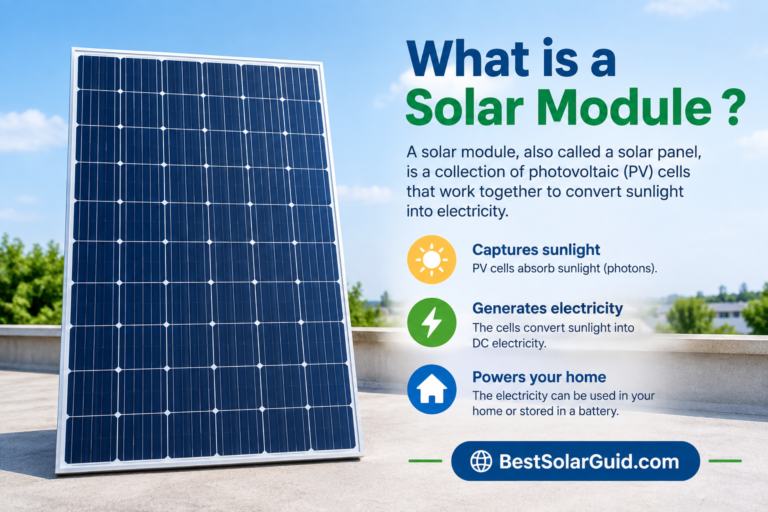
Black solar panels — sometimes called “all-black” or “black-on-black” panels — are solar modules built entirely from dark components: black monocrystalline solar cells, a black backsheet, and a black anodized aluminum frame instead of the traditional silver one. The result is a panel that looks like a single uniform dark surface, without the visible grid lines or white gaps you’d see on older-style panels.
This is different from just a “black frame” panel, where only the border is dark but the cells underneath still show a bluish tint. True all-black panels are dark from every angle, which is why they’ve become popular on homes where the roof is visible from the street.
If you’re also comparing panel technologies, it’s worth looking at bifacial solar panels, which use a similar advanced cell design to capture sunlight from both sides.
How Are Black Solar Panels Made?
The dark color comes from the type of silicon used and how the cells are finished. Black panels use monocrystalline silicon, which is cut from a single, pure crystal structure. This naturally gives the cells a darker, more uniform appearance compared to polycrystalline cells, which are made from melted silicon fragments and produce that familiar mottled blue look.
Manufacturers also apply an anti-reflective coating during production. This coating does double duty — it removes the grey and blue undertones from the cells for a deeper black finish, and it helps the panel absorb more usable sunlight instead of reflecting it away.
Black vs. Blue Solar Panels: What’s the Difference?
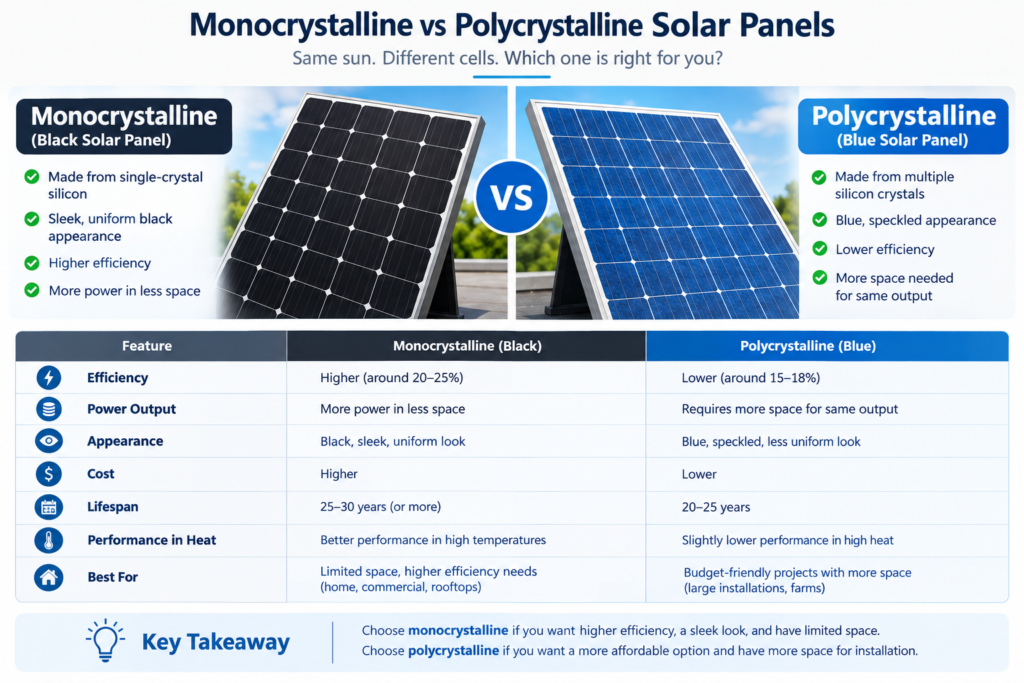
| Feature | Black (Monocrystalline) Panels | Blue (Polycrystalline) Panels |
|---|---|---|
| Silicon type | Single-crystal (pure) | Multiple silicon fragments |
| Typical efficiency | 20–25% | 15–17% |
| Appearance | Uniform dark/black | Mottled blue with visible grid lids |
| Lifespan | Slightly longer on average | Slightly shorter on average |
| Manufacturing cost | Higher | Lower |
| Availability in 2026 | Industry standard | Largely discontinued by major manufacturers |
It’s worth noting that most manufacturers have shifted almost entirely to monocrystalline (black) production. Blue polycrystalline panels are becoming harder to find at all, so for most homeowners shopping today, the real decision isn’t “black vs. blue” — it’s choosing between a standard all-black panel and a premium high-efficiency black panel.
How Efficient Are Black Solar Panels?
Modern black monocrystalline panels typically fall in the 20–25% efficiency range, with newer premium technologies — like N-type cells and heterojunction (HJT) designs — pushing past 24–26% in top-tier models. That’s a meaningful jump over older polycrystalline panels, which usually maxed out around 15–17%.
There is one small technical trade-off: a black backsheet absorbs slightly more heat and reflects slightly less light back into the cells than a white backsheet would. Manufacturers offset this using half-cut cell designs, which split each cell in two to reduce resistance losses — bringing black-panel efficiency essentially in line with, or better than, standard panels.
Pros of Black Solar Panels
- Higher efficiency — more power generated per square foot, which matters if your roof space is limited.
- Better low-light performance — monocrystalline cells generally perform better on cloudy days and in early morning/evening light.
- Cleaner, more uniform look — no visible grid lines or color patches, which blends more naturally with dark shingles or slate roofs.
- Faster snow shedding — the darker surface absorbs more heat, which can help snow slide off faster in winter climates.
- Longer typical lifespan — monocrystalline cells generally hold up well over 25+ years with a slower efficiency decline.
Cons of Black Solar Panels
- Higher upfront cost — expect to pay more per panel than older polycrystalline options.
- Slightly more heat sensitivity — panels lose a small amount of efficiency as they heat up, and black surfaces run a bit hotter.
- Limited color choice — if you want a “stealth” all-black look, you’ll also want black mounting hardware and frames to match, which can add a small additional cost.
How Much Do Black Solar Panels Cost?
Pricing varies a lot depending on your region, system size, and installer, but as a general benchmark, installed black solar panel systems typically run in the range of $3–4 per watt in markets like the US and UK. For a typical residential system, that usually works out to a modest premium over standard panels — often in the range of a few hundred to a couple thousand dollars more for a full system, depending on size.
If you’re in Pakistan or another region where solar is priced per panel or per kW rather than per watt-installed, expect black/monocrystalline panels to sit noticeably above older polycrystalline pricing, but the gap has been shrinking each year as manufacturing has scaled up and blue panels have become harder to source at all.
Best Black Solar Panel Brands in Pakistan (2026)
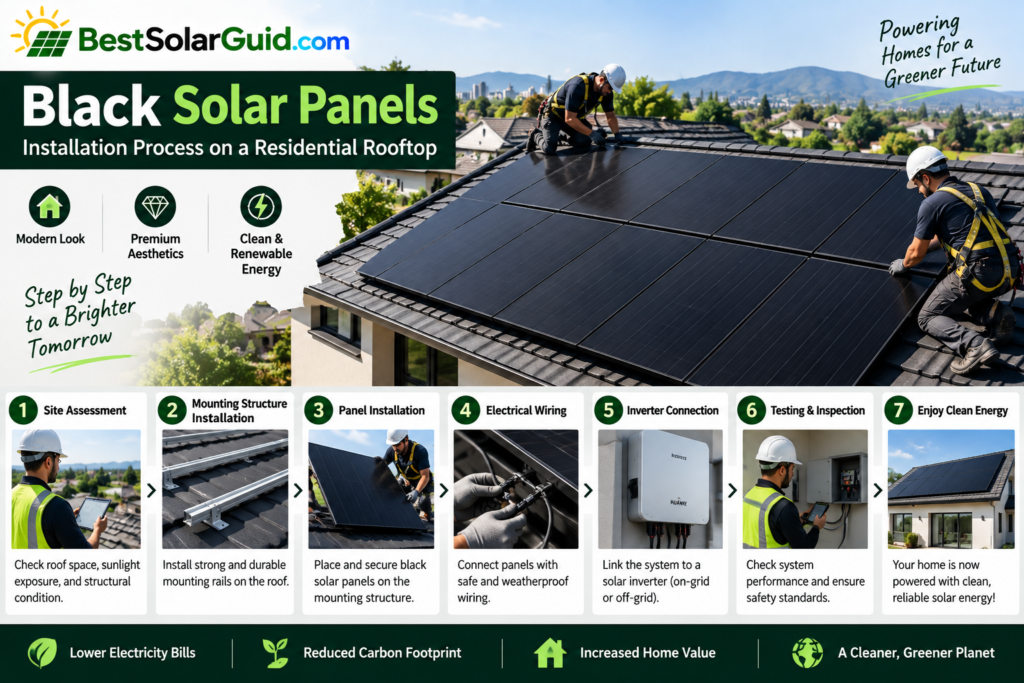
If you’re shopping for all-black panels in Pakistan, you don’t need to look far — most of the world’s leading monocrystalline manufacturers already have strong distribution networks here. Here are the names worth knowing:
| Brand | Popular Black/Mono Series | Known For | Approx. Price Range (PKR/watt) |
|---|---|---|---|
| LONGi Solar | Hi-MO 6, Hi-MO 7 | World’s largest monocrystalline producer; excellent heat performance for cities like Multan and Jacobabad | ~PKR 30–40 |
| Jinko Solar | Tiger Neo (N-Type) | Strongest distribution network in Pakistan, so availability is rarely an issue | ~PKR 40–43 |
| Canadian Solar | HiKu / TOPHiKu series | Durable build quality with stable long-term output | ~PKR 32–40 |
| JA Solar | DeepBlue series | Reliable performance during Pakistan’s high summer temperatures | ~PKR 30–38 |
| Trina Solar | Vertex series | Popular for high-wattage panels on larger residential and commercial roofs | ~PKR 33–40 |
| Astronergy | N-Type TOPCon | Newer entrant gaining traction for its higher-efficiency TOPCon technology | ~PKR 33–37 |
A few buying notes worth passing on to readers:
Buy from an authorized distributor. Counterfeit or mislabeled panels are a known issue in the local market; verify with the manufacturer’s official distributor list before purchasing.
Stick to Tier 1 brands. This is a real classification (from Bloomberg New Energy Finance) based on manufacturing scale and financial stability — not just a marketing term. Panels from unlisted or unknown brands carry a higher risk of underperformance or early failure.
Prices shift with the dollar rate. Since these panels are imported, PKR pricing can move week to week — always confirm current rates with your installer rather than relying on fixed figures.
For a closer look at how these brands perform in high-wattage systems, check out our guide to 610W solar panels in Pakistan, which covers N-Type bifacial pricing and top brands in detail.
Are Black Solar Panels Worth It?
For most homeowners installing solar in 2026, the answer is yes — but not purely for the color. Because monocrystalline production now dominates the market, you’re often paying for genuinely higher efficiency and durability, not just aesthetics. The exceptions are:
- If your roof has plenty of unused space and cost is your main priority, a smaller efficiency gain may not be worth chasing.
- If you can still find older polycrystalline stock at a steep discount and don’t mind the visible blue tint, it can still be a reasonable budget option in some markets.
For homes with limited roof space, strict HOA or aesthetic rules, or simply a preference for a clean look, black panels are close to a no-brainer.
Black Solar Panels and Home Value
Beyond energy savings, solar installations — particularly ones that look intentional rather than bolted-on — tend to have a positive effect on resale value. Buyers increasingly view a clean, all-black solar array as a modern upgrade rather than an eyesore, which is one reason installers report growing demand for the all-black look even when it costs more upfront.
Tips Before You Buy
- Ask for the cell type, not just the color. Some panels have black frames but standard blue cells underneath — confirm you’re getting true monocrystalline cells if that’s what you want.
- Match your mounting hardware. Black-anodized racking and clamps preserve the uniform look; silver hardware against black panels creates visible contrast.
- Compare efficiency ratings, not just price per panel. A slightly more expensive, higher-efficiency panel can generate more power over its lifetime, especially on a smaller roof.
- Get at least two or three quotes. Installed pricing varies significantly between installers even for identical panel models.
- Don’t overlook your inverter. Even the best panels won’t perform at their full potential without the right solar inverter to match them — check both together before finalizing your system.
Frequently Asked Questions
Are black solar panels less efficient than blue ones?
No — it’s the opposite in most cases. Black monocrystalline panels are generally more efficient (20–25%) than older blue polycrystalline panels (15–17%), thanks to the purer silicon structure used to make them.
Do black solar panels get hotter than blue ones?
Slightly, yes. The darker surface absorbs a bit more heat, which can cause a small dip in efficiency on very hot days. Most modern panels are designed with this in mind and still outperform older polycrystalline options overall.
Why are black solar panels more expensive?
The monocrystalline manufacturing process used for black panels is more resource- and energy-intensive than the process used for polycrystalline cells, which drives up production costs.
Can I still buy blue solar panels in 2026?
It’s becoming difficult. Most major manufacturers have shifted almost entirely to monocrystalline production, so blue polycrystalline panels are increasingly rare and typically limited to leftover stock or budget suppliers.
Do black solar panels increase home value?
They can. A clean, uniform solar installation is generally viewed more favorably by buyers than an older, visibly patterned system, and solar installations overall tend to have a positive effect on resale value.
Final Verdict
Black solar panels aren’t just a style choice anymore — they represent where solar panel manufacturing has actually gone. Higher efficiency, better low-light performance, and a cleaner appearance make them the practical default for most new installations in 2026, even with a modest cost premium. If you’re planning a solar installation this year, the real question isn’t whether to go black — it’s which black panel, and which installer, gives you the best value for your specific roof.