What Is a Solar Module? A Complete Guide to How Solar Modules Work (2026 Update)
If you’ve ever looked at a rooftop covered in flat, glass-faced rectangles or searched for a way to cut your electricity bill, you’ve likely come across the term “solar module.” But what is a solar module exactly, how is it different from a solar panel or a solar cell, and how do you choose the right one? This guide breaks it all down in plain language, using the latest 2026 industry data, so you can make an informed decision — whether you’re a homeowner, a student, or someone researching solar for a business project.
Table of Content
- What Is a Solar Module? (Definition)
- Solar Cell vs Solar Module vs Solar Panel vs Solar Array — What’s the Difference?
- How Does a Solar Module Work?
- Key Components of a Solar Module
- Types of Solar Modules
- Solar Module Efficiency in 2026: What’s Changed
- How Solar Modules Are Rated
- Benefits of Using Solar Modules
- Factors to Consider When Choosing a Solar Module
- How Long Do Solar Modules Last?
- Basic Installation and Maintenance Tips
- Conclusion
- Frequently Asked Questions (FAQs)
What Is a Solar Module? (Definition)
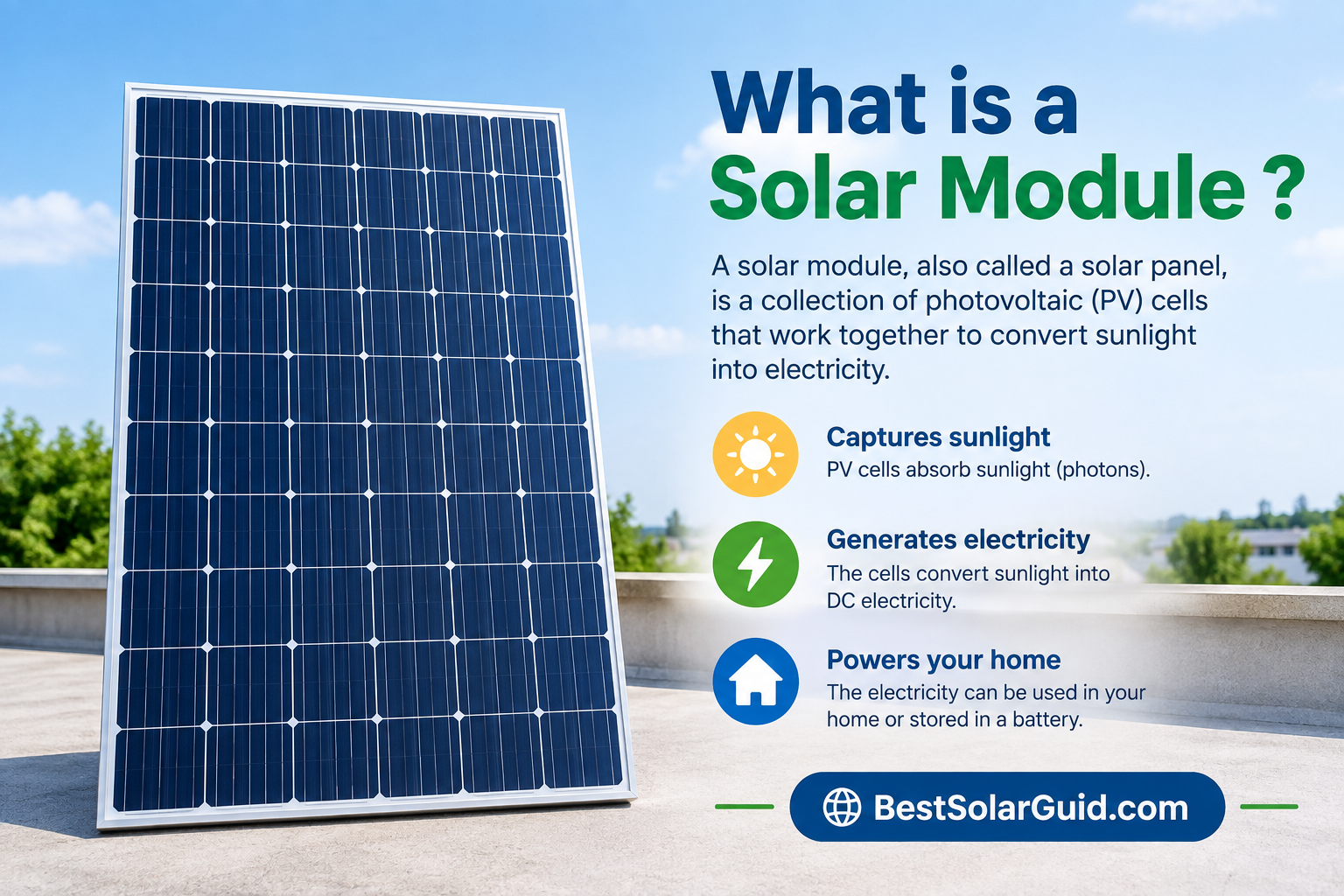
A solar module is a single, factory-assembled unit made up of multiple interconnected solar cells, sealed between protective layers of glass, encapsulant, and a backsheet, and framed for structural support. Its job is simple: convert sunlight into usable electricity through a process called the photovoltaic (PV) effect.
In everyday conversation, people often use “solar module” and “solar panel” interchangeably — and that’s technically fine, since a panel is simply a module in its finished, ready-to-install form. But in engineering and manufacturing contexts, “module” refers specifically to the assembled product that comes off the production line, while “panel” is the more casual, consumer-facing term for the same thing.
Solar Cell vs Solar Module vs Solar Panel vs Solar Array — What’s the Difference?
This is one of the most searched-for clarifications on this topic, so let’s settle it clearly:
- Solar cell – The smallest functional unit. A thin wafer of semiconductor material (usually silicon) that generates a small amount of electricity when exposed to light.
- Solar module – A group of solar cells (typically 60, 72, 96, or 120+ cells) wired together and packaged into one sealed, weatherproof unit.
- Solar panel – The common name for a solar module once it’s ready for installation. In practice, “panel” and “module” mean the same product.
- Solar array – Multiple solar modules/panels connected and mounted together to form a larger power-generating system, such as a full rooftop installation or a solar farm.
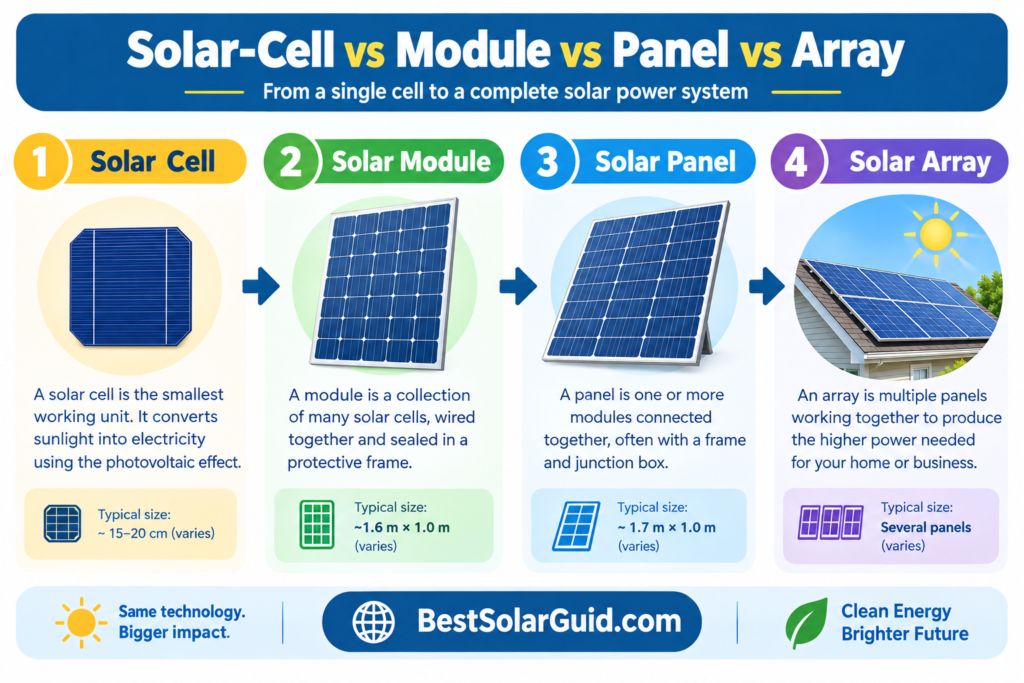
Think of it like a hierarchy: cell → module (panel) → array.
How Does a Solar Module Work?
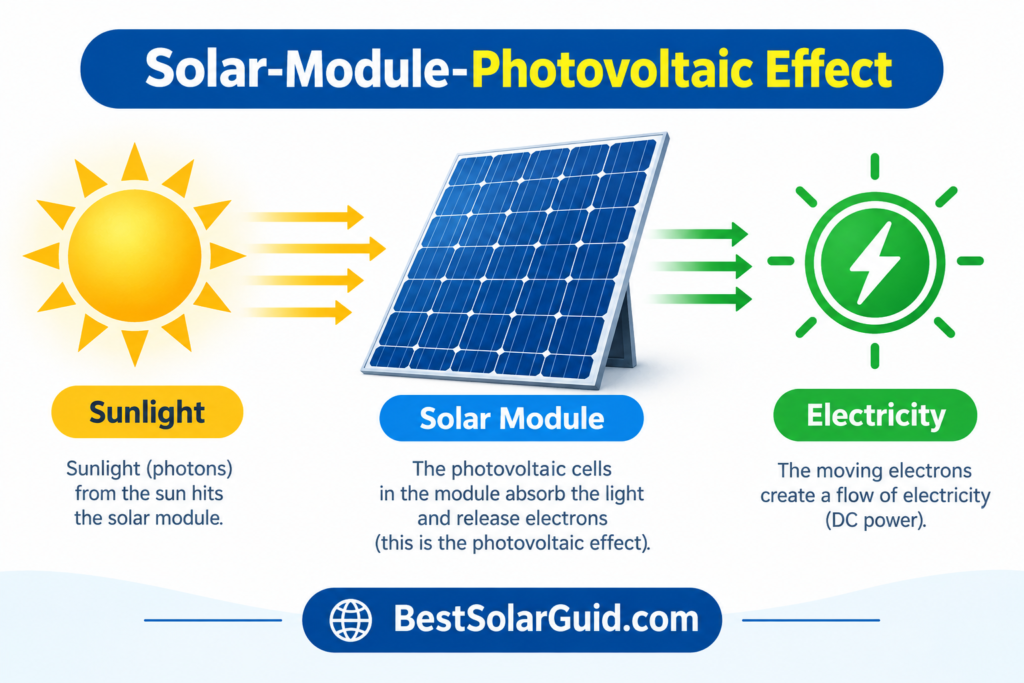
A solar module generates electricity through the photovoltaic effect, which happens in four basic steps:
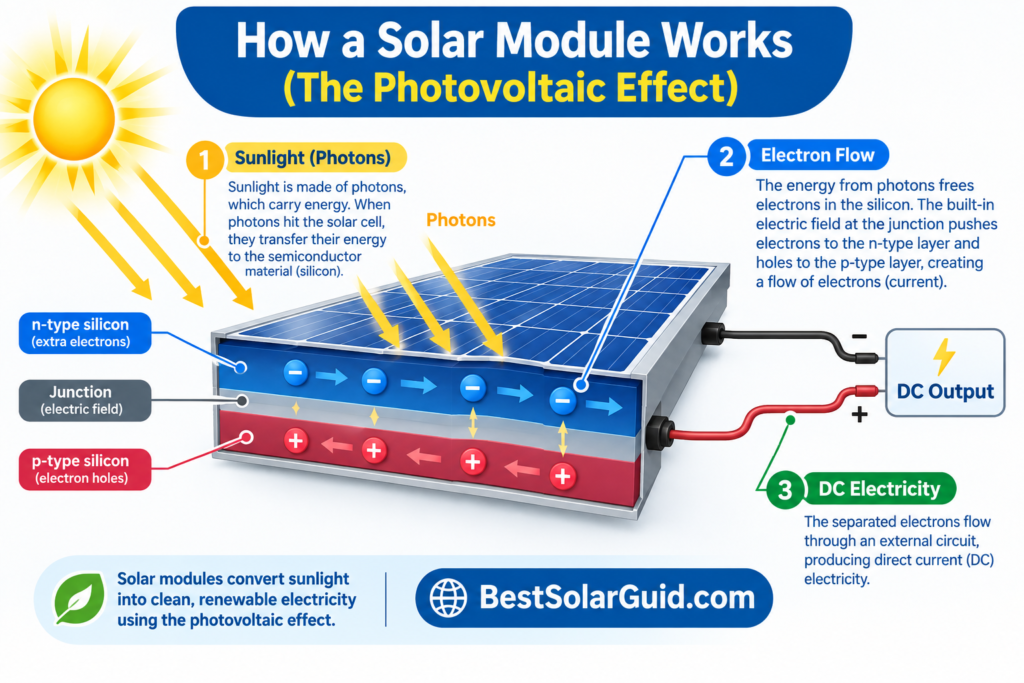
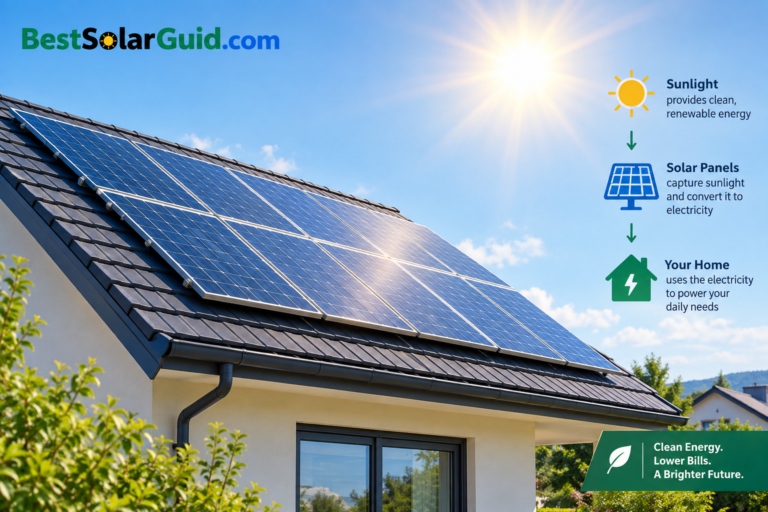
- Sunlight hits the cells. Photons (particles of light) strike the semiconductor material inside each solar cell.
- Electrons are knocked loose. This energy excites electrons in the silicon, freeing them from their atoms.
- An electric field directs the flow. The cell’s internal structure (a p-n junction) forces these freed electrons to flow in one direction, creating direct current (DC) electricity.
- The module collects and outputs power. Wiring inside the module gathers the current from every cell and sends it out through the module’s junction box, ready to be converted to usable alternating current (AC) by an inverter.
The more sunlight a module receives, and the more efficient its cells are, the more electricity it produces.
To learn how sunlight, panel wattage, peak sun hours, and system losses affect actual electricity production, read our guide on how much energy a solar panel can produce.
Key Components of a Solar Module
Every solar module is built from several layers working together:
- Solar cells – The core power-generating units, arranged in a grid.
- Tempered glass – A protective front layer that lets light through while shielding cells from weather and impact.
- Encapsulant (EVA film) – A transparent layer that seals and cushions the cells, protecting them from moisture.
- Backsheet – A weatherproof layer on the rear that provides insulation and protection from the elements.
- Aluminum frame – Provides structural rigidity and a mounting point for installation.
- Junction box – Houses the electrical connections and bypass diodes, and is where the output cables exit the module.
Types of Solar Modules
Not all solar modules are built the same. Here are the main types you’ll encounter:
Monocrystalline modules – Made from a single, pure silicon crystal. Recognizable by their uniform black color and rounded cell edges. They offer high efficiency and a sleek appearance, making them popular for residential rooftops.
Polycrystalline modules – Made from multiple silicon fragments melted together. They have a distinctive blue, speckled look, slightly lower efficiency than monocrystalline, and a lower price point.
Thin-film modules – Made by depositing a thin layer of photovoltaic material (such as cadmium telluride or amorphous silicon) onto a substrate. Lightweight and flexible, but generally less efficient and less space-efficient than crystalline modules.
Bifacial modules – Capture sunlight on both the front and rear sides of the module, using reflected light from the ground or roof surface. This can boost total energy output by roughly 5–20% depending on the installation setup.
PERC, TOPCon, and HJT modules – These refer to advances in cell architecture rather than a different base material. PERC (Passivated Emitter and Rear Cell) improves how light is captured within the cell. TOPCon (Tunnel Oxide Passivated Contact) and HJT (Heterojunction Technology) go further, reducing energy loss and improving performance in high heat — and as of 2026, these have become the mainstream commercial standard, gradually replacing older PERC technology.
Perovskite and tandem modules – An emerging category that layers perovskite material over traditional silicon cells to capture a broader spectrum of sunlight. Still mostly in pilot and early commercial stages, but a technology to watch.
Solar Module Efficiency in 2026: What’s Changed
Solar module efficiency has climbed noticeably in the past couple of years, and it’s worth understanding where the market stands today if you’re comparing products.
At major industry trade shows in 2026, 25%-efficient modules have become common flagship products, with 24% efficiency now considered the mainstream standard and 23% modules occupying the more budget-friendly tier. On the higher end, some manufacturers have already unveiled modules exceeding 25.6% efficiency, with further gains expected. pv-magazine
Newer cell technologies are driving this shift. TOPCon modules typically deliver efficiencies in the low-to-mid 20% range and have become the new commercial standard, with major manufacturers shipping it at prices close to older PERC technology while gaining one to two percentage points of efficiency. Meanwhile, back-contact (BC) modules recently became the first commercially available modules to reach 25% efficiency, and TOPCon modules broke past the 24% mark for the first time in 2026. portlandiaelectric
Perovskite-silicon tandem technology remains the most promising long-term development, with commercial tandem modules now shipping at roughly 24–26% efficiency, even as lab-scale cells push well beyond 30%.
What this means for you: if you’re buying a solar module today, anything in the 21–24% efficiency range is a solid, modern choice, while 25%+ modules represent the current premium tier.
How Solar Modules Are Rated
When comparing solar modules, three specifications matter most:
- Wattage (W) – The amount of power a module produces under standard test conditions. Residential modules commonly range from 350W to 500W+.
- Efficiency (%) – The percentage of sunlight the module converts into usable electricity. Higher efficiency means more power generated per square foot.
- Temperature coefficient – Measures how much a module’s output drops as temperatures rise. A lower (more negative) number is worse; modern HJT and TOPCon modules tend to perform better in heat than older technologies.
If you want to understand how a panel’s wattage affects its output, size, efficiency, and daily energy production, see our complete guide to 400 watt solar panels.
Benefits of Using Solar Modules
- Lower electricity bills by generating your own power on-site.
- Reduced carbon footprint, since solar generates electricity without burning fossil fuels.
- Energy independence, especially when paired with battery storage.
- Long operational lifespan, typically 25–30 years with a manufacturer’s performance warranty.
- Minimal maintenance, since modules have no moving parts.
- Increased property value in many housing markets.
Factors to Consider When Choosing a Solar Module
- Available roof or ground space – Higher-efficiency modules make sense if space is limited.
- Local climate – Hot climates benefit from modules with a better temperature coefficient, like HJT or TOPCon.
- Budget – Polycrystalline and standard PERC modules are more affordable; premium monocrystalline, bifacial, or high-efficiency modules cost more upfront but generate more power per panel.
- Warranty length – Look for a 25-year (or longer) performance warranty from a reputable manufacturer.
- Aesthetics – Monocrystalline’s uniform black look is often preferred for residential installs.
- Degradation rate – Newer modules tend to lose less output per year (commonly around 0.4–0.5% annually) compared to older panel generations.
How Long Do Solar Modules Last?
Most solar modules are designed to operate for 25 to 30+ years, with manufacturers typically guaranteeing that a module will still produce at least 80–87% of its original output after 25 years. In practice, well-maintained modules often continue generating usable power well beyond their warranty period, just at a gradually reduced capacity.
Basic Installation and Maintenance Tips
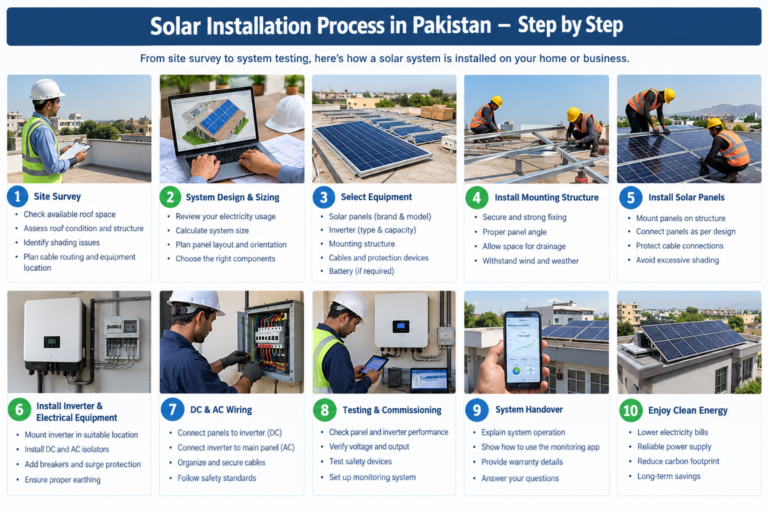
- Solar modules should be installed by a licensed solar professional to ensure proper wiring, structural mounting, and code compliance.
- Cleaning is minimal — rain typically washes away most dust and debris, though occasional manual cleaning helps in dusty or low-rainfall climates.
- Periodic inspection of connections, mounting hardware, and inverter performance helps catch issues early.
- Avoid shading from trees, chimneys, or nearby structures, since even partial shading can significantly reduce a module’s output.
Conclusion
A solar module is the fundamental building block of any solar power system — a sealed, weatherproof unit of interconnected solar cells that converts sunlight into electricity. Whether you call it a “module” or a “panel,” understanding its components, types, and efficiency ratings puts you in a much stronger position to choose the right solar solution for your home or business. With 2026’s rapid efficiency gains — from mainstream 24% modules to premium 25%+ options — there’s never been a better time to compare your options.
Frequently Asked Questions (FAQs)
1. Is a solar module the same as a solar panel?
Yes, in everyday use they mean the same thing. “Module” is the more technical/manufacturing term, while “panel” is the common consumer term for the same finished product.
2. How many solar cells are in one solar module?
Most residential modules contain 60, 66, or 72 cells, while some newer high-power modules use 96, 108, or even 120+ smaller “half-cut” or “shingled” cells for improved performance.
3. What is the average efficiency of a solar module in 2026?
Mainstream commercial modules now typically range from 21–24% efficiency, with premium products reaching 25% or higher, based on the latest industry benchmarks from 2026 trade events.
4. How long does a solar module last?
Most solar modules are built to last 25–30 years, backed by manufacturer performance warranties guaranteeing a minimum output level even after decades of use.
5. What’s the difference between monocrystalline and polycrystalline modules?
Monocrystalline modules are made from a single silicon crystal, offering higher efficiency and a uniform black appearance. Polycrystalline modules use multiple silicon fragments, are slightly less efficient, and typically cost less.
6. Do solar modules work on cloudy days?
Yes. Solar modules still generate electricity in cloudy or overcast conditions, though output is reduced compared to direct sunlight — typically producing 10–25% of their rated capacity depending on cloud density.
7. What size solar module do I need for my home?
This depends on your household’s energy consumption, roof space, and local sunlight hours. A solar installer can calculate the right module wattage and quantity based on your utility bills and roof measurements.
8. Are higher-wattage solar modules always better?
Not necessarily. A higher wattage means more power per module, but the best choice depends on your available space, budget, and energy needs — a mix of wattage, efficiency, and price usually determines the best fit.